Tattooing Without Machines
A Thread Connecting Austronesian Peoples
Tina Xie / photos by Lin Min-hsuan / tr. by Phil Newell
December 2022

00:00

As Nannu Kabua (left) of the Marshall Islands has learned hand-tapping tattooing from Cudjuy Patjidres (right), she has also gotten to know the culture of her own homeland and of the Austronesian-speaking peoples on a much deeper level.
The peoples who speak Austronesian languages are mainly spread out across the islands of the South Pacific Ocean. Numbering roughly 250 million people, the Austronesian-speaking peoples not only share similarities in their languages and appearance, but many also have a tradition of tattooing. Comparing the tattoo patterns used in various regions, one can discover that they are connected, providing clues that can guide the island peoples of the Pacific to discover their shared heritage and the origins of their identity.
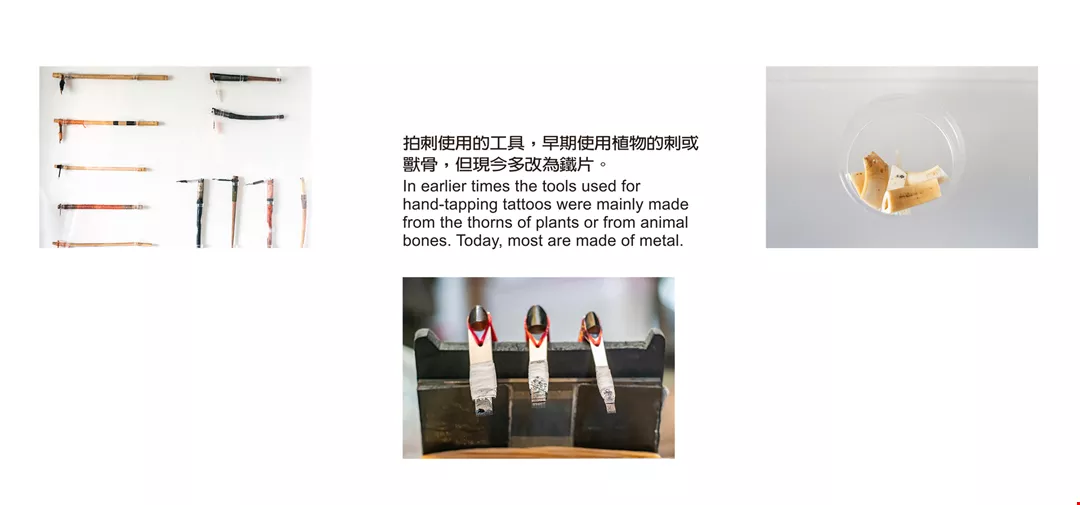
The Republic of the Marshall Islands, a diplomatic ally of Taiwan’s located in the Pacific Ocean, once had a traditional tattooing culture. In the past they used the wingbone of the frigate-bird to make tattooing needles. Tapping the skin with the needle breaks the through epidermis (the outer layer of the skin), enabling pigment to penetrate into the underlying dermis to leave permanent markings. In English this traditional method is known as “hand-tapping.” However, as a result of colonization and the impact of Western religions, this skill disappeared from the Marshall Islands. It was only in 2021 that a young Marshallese woman, Nannu Kabua, who was studying at university in Taiwan, happened to make the acquaintance of the Paiwan tattoo artist Cudjuy Patjidres, and began to study this tradition. She decided that she wanted to revive tattooing culture in her homeland.
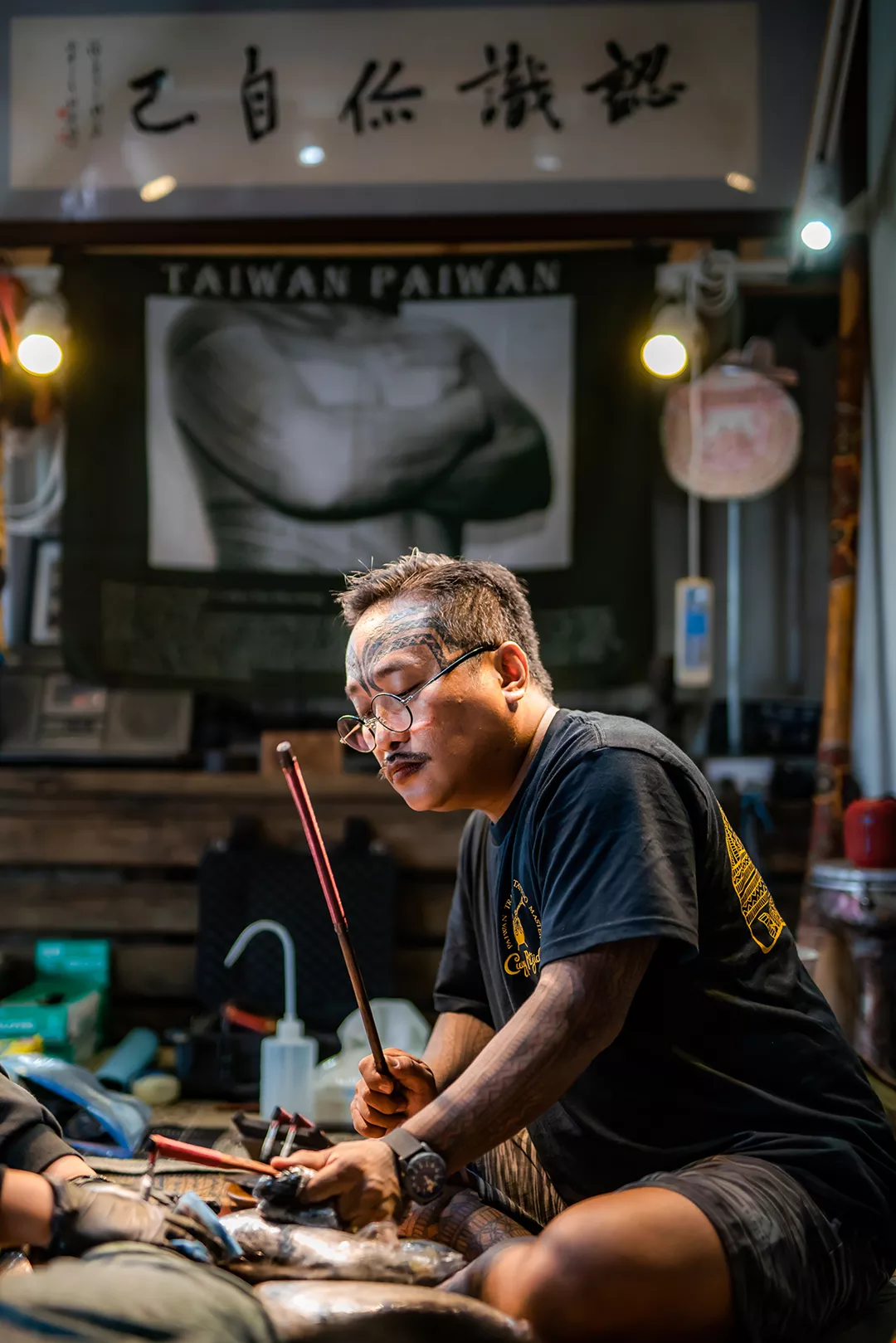
The traditional “hand-tapping” tattooing technique known to the Austronesian-speaking peoples had long disappeared from Taiwan, but Cudjuy Patjidres of the Paiwan indigenous people has in recent years dedicated himself to its revival. He has also been teaching students from the Marshall Islands and Tahiti.
Keeping Pacific tattooing alive
Like many young people from the Marshall Islands, Kabua wanted to get a tattoo, so she got one done on her right arm by machine, and later she got one on her right leg by hand-tapping. The lines on these tattoos appear rather rough and the motifs have simple geometric forms. Pointing to the tattoo on her leg, she says: “This stepped shape is a basic pattern in Marshallese tattooing. For me it represents hope for continual forward progress.”
It all began when through a friend, Kabua met Taiwan’s only traditional tattoo artist, Cudjuy Patjidres. At the time she knew little about Austronesian culture, but the first time she met Cudjuy his dark skin and deep-set facial features reminded her of her friends and family at home. In particular, the tattoo art on his belly happened to be a motif that she herself often practiced drawing. “Although the Marshall Islands are part of Micronesia, I knew that the pattern on his body was from Samoa.”
On asking Cudjuy about his tattoos, Kabua found out that he had made it his mission to revive the traditional hand-tapping tattoo culture of the Paiwan people. Several years ago, at an international tattoo convention, Cudjuy was inspired by the Hawaiian tattoo master Keone Nunes and began to study under him. Thereafter, Cudjuy was invited to many Pacific nations, including Samoa, the Philippines, and Indonesia. Virtually every time he arrived in a new country he would ask a local tattoo master to give him a tattoo, and his body became a record of interactions between Taiwan and other Austronesian nations.
Cudjuy’s familiar facial features and tattoo patterns caused Kabua to think about the tattoo culture of her own homeland. She discovered that the younger generation had lost all knowledge of traditional tattooing, and only a few elders still had some notion of it. Following a suggestion from an elder, she found the book Tattooing in the Marshall Islands, and she began to seek out information about the history of tattooing in her homeland, the meanings of the motifs used, and their relationship with social status. She decided to begin studying traditional tattooing with Cudjuy in hopes that after returning home she would be able to revive this craft.
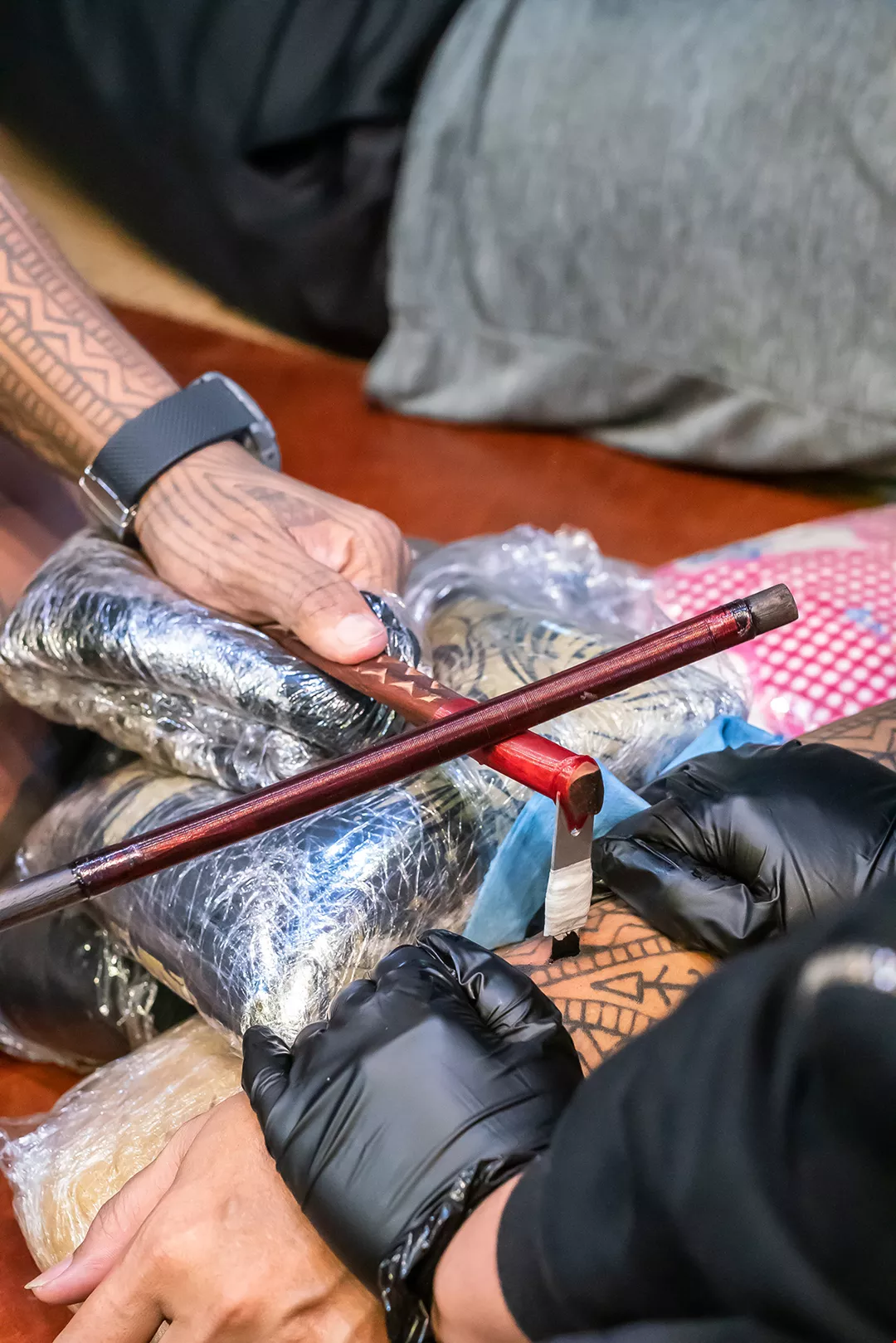
Through tattoos one can better understand the culture of Austronesian nations. For the Austronesian-speaking peoples, they are also a way to rediscover their own identity.
A journey of learning
While the process of hand-tapping might look easy, in fact it requires good observational skills and lots of practice. Take for example skin stretching, which refers to the use of both hands to stabilize the skin and pull it taut in the area where the tattoo is to be made, enabling the tattoo artist to accurately puncture the skin to make the lines. As a tattooing assistant, not only does Kabua have to know the next step the tattoo artist will take and rapidly adjust the position of her hands, but she must also wipe away excess ink and blood that flows from the wounds. Each tattoo takes at least two to three hours, so how does she stay focused over such a long period of time? Kabua says with a laugh: “Cudjuy once asked me whether I get bored. But for me it’s an honor to assist each and every tattoo client, and getting a tattoo means a great deal to the clients themselves. I also enjoy hearing the stories they share while they are being worked on.”
Although there is a language barrier between the artist and his student, they have built up a tacit mutual understanding. Kabua is always able to follow Cudjuy’s rhythm and change the position of her hands when stretching the client’s skin. Besides hands-on practice on the weekends, she routinely watches Cudjuy’s videos on YouTube and buys artificial skin to practice on.
Kabua has noticed some similarities between the patterns used in the tattoos of the Marshall Islanders and those of the Paiwan people in Taiwan. For example, both use triangle and zigzag shapes. However, these motifs have different meanings for the two groups: for the Marshallese they represent turtles, while for the Paiwan they are snake designs.
At the Lunar New Year in January 2023, Cudjuy will hold a formal ceremony for taking on apprentices, to announce that Kabua and two Taiwanese indigenous women (one Paiwan, one Rukai) are his students. When the time comes, he will give Kabua a tattoo on her shoulder that matches her status. “My grand-uncle will choose which pattern of the bwilak design is best suited to me. The bwilak is a shoulder tattoo that is worn exclusively by women of the Marshall Islands and is placed on the shoulder because the popularity of a woman is placed on her shoulders.” Kabua says with a smile that she looks forward to returning home with her new status to share tattooing culture.
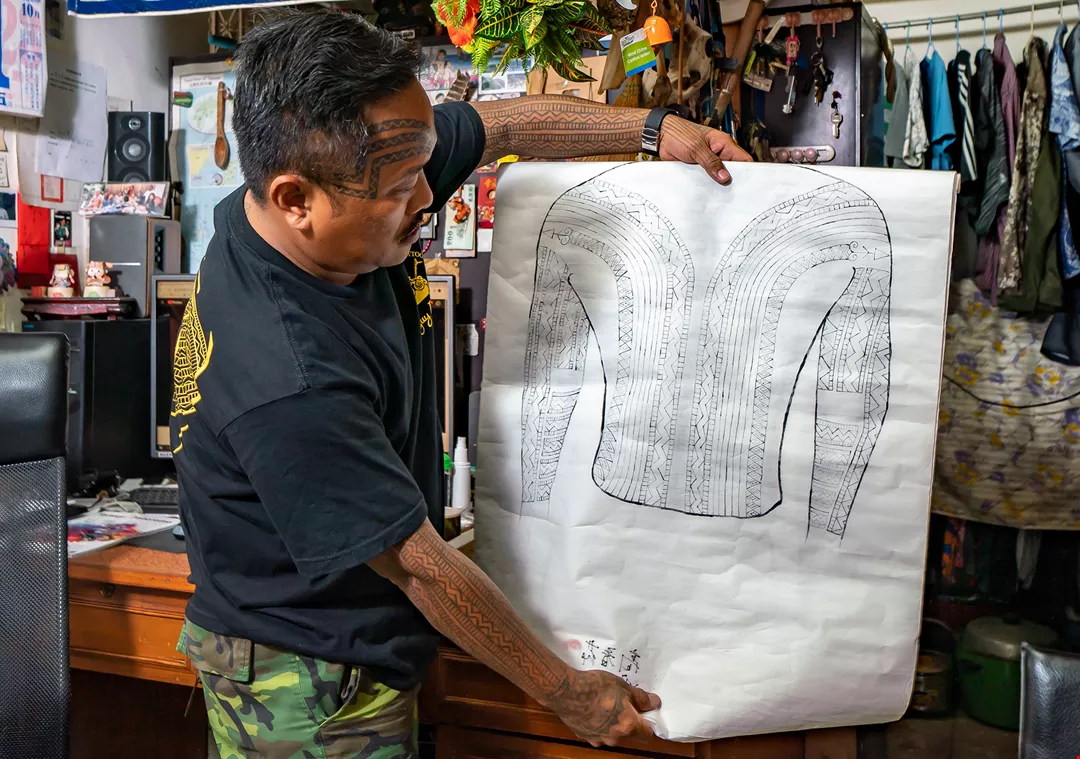
Paiwan men traditionally wear tattoos mainly on the arms and torso, while Paiwan women wear them on the hands.
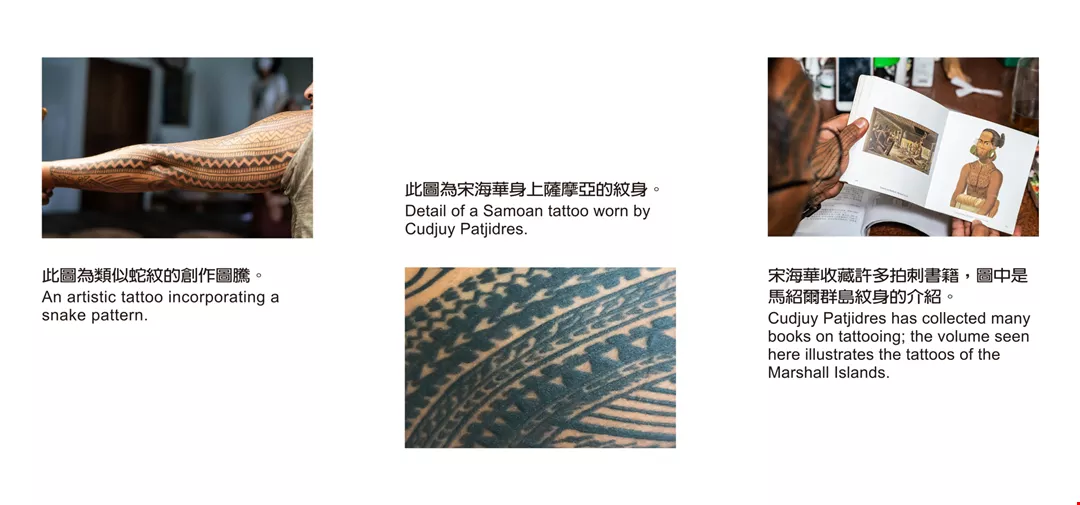
The status value of tattoos
On the day of our visit to Cudjuy’s studio, a younger Paiwan man from the same village is getting tattooed with an artistic design based on a snake pattern, and the client’s son is there as well. As Cudjuy works, the two men talk about farming and friends and family in their community and also discuss Cudjuy’s improvements to the tools of his trade. Another client that day is a young Amis artist who has dedicated himself to pursuing an indigenous cultural renaissance. He wants a traditional triangular pattern, representing mountains and sea, tattooed on his arm. Before Cudjuy begins tattooing him, the young man, accompanied by his wife and son, holds an Amis ritual of prayer for good fortune, laying out offerings of betelnuts, cigarette papers, and millet wine to inform his ancestors that he is about to experience a major event in his life. In Kabua’s eyes, this scene of piety and warmth is something of great value uniquely associated with traditional tattooing.
When we visit Cudjuy in his staff office at National Tsing Hua University (NTHU), the walls are covered with tattoo patterns and posters. One of them is of Dremedreman Azangiljan, a female Paiwan chief who returned home to rebuild her family’s house. When she decided to accept her new status, after getting permission from the main tribal chief Cudjuy gave her tattoos on her hands. By contrast, the traditional tattoos worn by Paiwan men are mostly snake patterns on the arms and shoulders, so that when they raise both arms they look like an eagle spreading its wings; the tattoos also symbolize protection by their ancestors.

Cudjuy Patjidres (right) hopes to pass along the art of hand-tapping tattoos to young people. Besides teaching Nannu Kabua (center) of the Marshall Islands, he also often has his niece (left) act as his assistant to take care of skin stretching.
Linking together Austronesian tattoo culture
The Austronesian-speaking peoples are spread out over a vast area, but when they see each others’ tattoos they immediately feel a sense of friendship. Cudjuy’s good friend Lin Hao-li, an assistant professor of anthropology at NTHU, says that he previously ran a class on Taiwan’s indigenous peoples at National Taiwan University in collaboration with a university in New Zealand. When several Maori students who came on an exchange visit heard Lin introduce Paiwan tattoo culture in class, they got the notion to meet with Cudjuy. When this group of students walked into Cudjuy’s office, it was like a gathering of old friends: They hugged one another and talked about their tattoos, not at all like strangers meeting for the first time.
Lin speculates that the origin of tattooing may be related to the tradition of pottery making among Austronesian-speaking peoples. Both processes involve making marks by tapping with sticks, and some of the designs on pottery found in excavations are similar to the patterns frequently used in hand-tapping tattoos. He concludes, “You could say that the action of tapping is a distinct part of the memories of Austronesian-speaking peoples.”
Thanks to the information shared with them by Nannu Kabua, her family back home has been able to better understand this lost craft. Her elder sister Kitlang Kabua, the Marshall Islands’ minister of foreign affairs and trade, says that the family was very happy to see Nannu, who has a natural gift for drawing, have the opportunity to study with the Paiwan tattoo master Cudjuy Patjidres, because traditional tattooing is an important part of the Marshallese cultural heritage. Through Nannu, her family has become better informed about tattoos, such as what motifs can be used by specific family members and what parts of the body can be tattooed. Even more importantly, tattooing is a key to understanding the past and has enabled them to know their ancestors better.
At the 2019 Taiwan Tattoo Convention, held in Kaohsiung, Cudjuy acted as an assistant to Keone Nunes, whereas in 2022 it was Nannu Kabua’s turn to assist Cudjuy. Their good friend Lin Hao-li also attended the convention, and got a rare and valuable opportunity to see in practice things that for him had been a matter of academic research. He says that it is not difficult to learn about Austronesian culture, and that it is possible to start a conversation based on the designs tattooed on someone’s body and thereby begin exploring the culture of the Pacific islands.

The tattoo on the right arm of Lin Hao-li, an assistant professor in the Institute of Anthropology at National Tsing Hua University, was done by Cudjuy Patjidres. It is a traditional motif from Fiji.
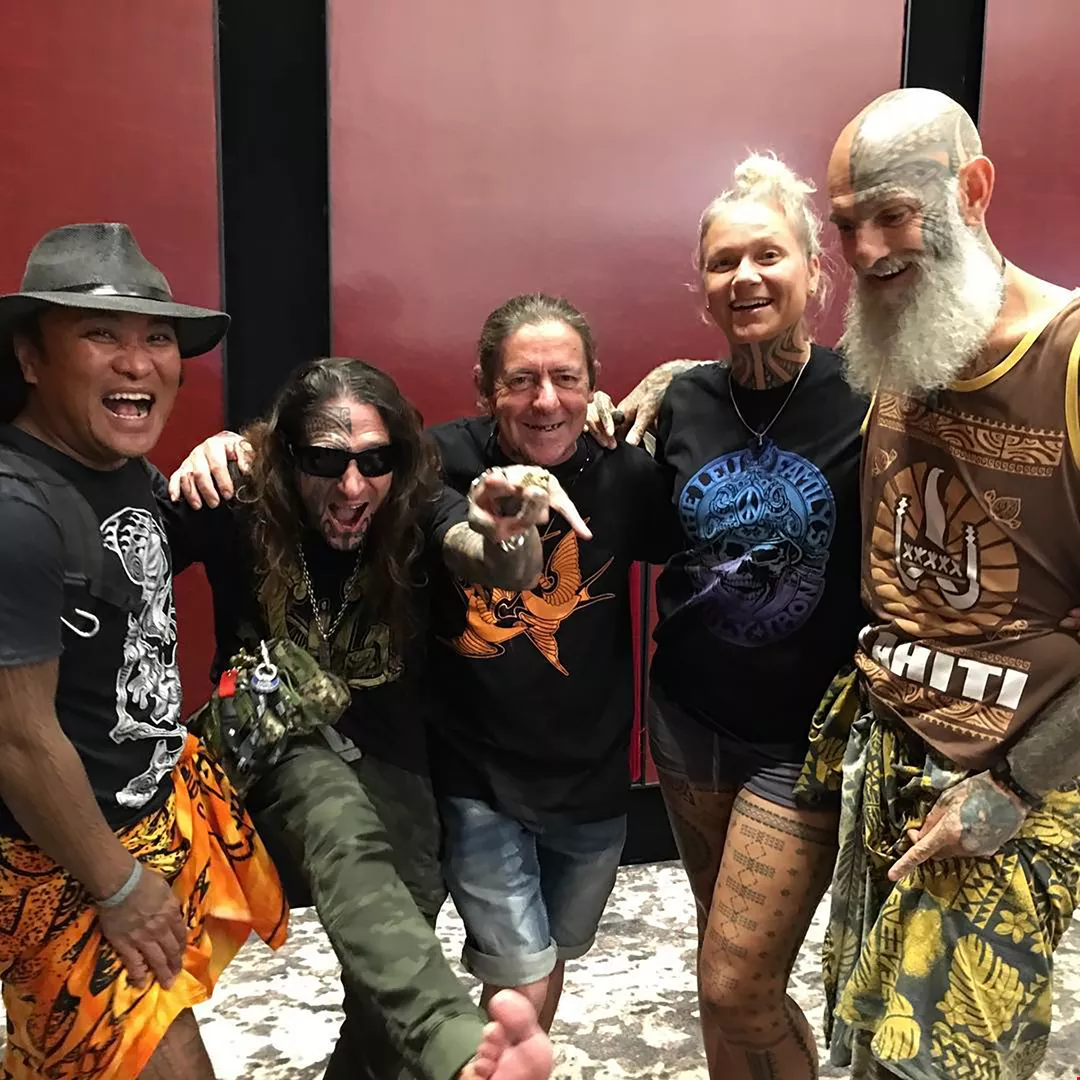
Cudjuy Patjidres has visited many Pacific nations to exchange ideas and tattooing techniques. (courtesy of Cudjuy Patjidres)


@List.jpg?w=522&h=410&mode=crop&format=webp&quality=80)
