

Many questions about the medical uses of hypnosis prick people's curiosity: How is hypnosis carried out as therapy? How does hypnosis cure nervous diseases? What is it like when people relive past lives? Let us go to the clinic of psychiatrist Wang Wu-shih and--with the consent of his patient "Little Lin"--observe the drama of a past life unfold.
At four in the afternoon, Little Lin, an English teacher, is lying in an examination room in Dr. Wang's clinic. In subdued lighting, the carpet, wallpaper and mattress impart a warm mood. With the air conditioning set at a comfort able temperature, the environment encourages feelings of peace and calm.
Little Lin's eyes are firmly shut, and her limbs and torso are relaxed. Her whole person appears much like someone who is asleep. This is the eighth month she has been receiving hypnosis therapy. She has had neuroses for ten years. Early on, she often felt anxious and nervous, and every day she would have diarrhea and need to urinate often. She would even frequently violently vomit and break into a cold sweat when she was eating. The stomach and intestinal medicine she was taking wasn't any help at all, and so she went to a psychiatrist.
After psychoanalysis, she discovered that past difficulties in her love life, an overly strict family upbringing, problems with academic advancement, and difficulties at work caused constant pressure and led to her depression. Yet even with the cause identified, treatment with traditional psychiatric therapy and drugs was making no progress. After changing doctors several times, her current doctor, Wang Wu-shih, suggested using hypnosis to delve into her subconscious and discover the experiences that had created the pain. Then she could go back and deal with the emotions as she first experienced them.
After three months of hypnosis therapy, her anxiety and nervousness had greatly abated, and her health had improved. But a new wave of strange feelings of depression, terror, hopelessness and sadness was gradually rising. The two had gone back in time over 20 years, and had yet to discover a particular experience that was causing the pain.
Psychiatrists believe that emotional problems are caused by past painful experiences. Since he couldn't find any cause for the illness in the patient's current life, the doctor, after obtaining his patient's consent, started to embark on "past life therapy."
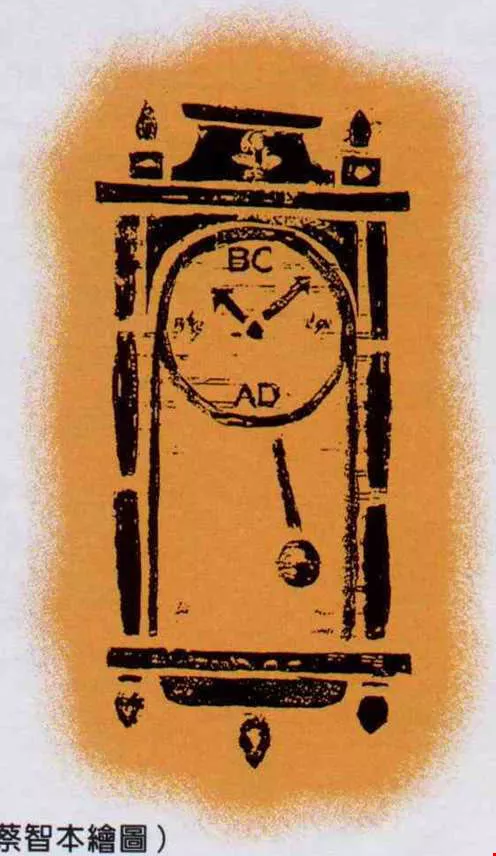
(drawing by Tsai Chih-pen)
A hot spring from the heart of the universe
The doctor arrives, comes to her side and suggests in low tones to return to when she was 25, 20, 18, 15, ten, three, two, one; to go back to when she was in the womb, and go through a time tunnel. She pushes down into her subconscious to probe her "past life."
Little Lin's eyeballs roll fiercely under their lids. She has entered a deep hypnotic state. She says there is fire, fire on the roof, that she is trapped in a room and can't get out. The door is locked, and the thick smoke nearly suffocates her. A burning piece of wood hits her in the face. It's hot and painful, and she is scared. She crawls along the floor. There's a small hole in the corner of the wall. She tries hard to get out through it. Outside people are waiting. "Beat it! Give me some space!" Little Lin's entire body is shaking and she is sobbing. "The idea of fairness is bull shit! This society is all about officials letting each other get away with the bad things they do, and the big bullying the little," she says, starting to shout.
For the following 40 minutes, she is in her "former life," crying, shouting, feeling numb, jerking and feeling hungry. Dr. Wang observes compassionately, and leads her to talk about her accumulated feelings of depression. This is the most important part of the treatment. Little Lin says that she is angry, so angry that her entire body is going numb, that she is without hope, hopeless and racked by pain.
"Imagine that you are lying in a hot spring. This hot spring comes from the center of the universe. It is full of power, love and caring. It gradually dissolves your numbness," suggests Wang, pointing an infra-red light at her. This suggestive light shines from the center of the universe, bringing heat to her body so that she can feel completely comfortable and at peace.
The Little Lin who wakes up is peaceful and quiet, and she discusses the progress of her treatment with the doctor. This tragic former life has already come back to her several times during therapy. It took place during the early Ching dynasty. She was a he, a talented boy from Taiwan's Lukang, who went with a good friend from his home village to take the provincial exams in the capital. Unfortunately, his friend became very ill and couldn't sit the exam. But he himself performed splendidly. Bitter and resentful, his friend assumed his identity and took his position as a mandarin. The friend tried to murder him, forcing him to take poison that burned his throat and then pushing him off a cliff. His house was burned, and his entire family was killed. Crippled and nearly blind, his face disfigured, he begged for ten years as a tragic and despairing figure, before his good friend grabbed him once again and tortured him to death while he was still in his thirties.
Spiritual techniques
Stirring up these "memories" was not a happy experience for Little Lin. When she goes home from the clinic, pain unleashed by the hypnosis will often leap out to sting her, making her physical and psychological difficulties just so much worse.
Nevertheless, Little Lin feels positive about her hypnosis treatment for the long run. Take, for instance, the pain in this life. "When I look back now [after three months of returning through hypnosis], there isn't any more pain. I feel calm and happy. It's like something that happened to someone else." As for the psychological and physical torment endured in her "past life," the treatment will probably take a year or two, but she has only been undergoing it for five months. Hence, many painful experiences are just being boldly uncovered, and her strident emotions have yet to subside. Nevertheless, her emotional response grows less fervent every time she goes back over the same territory.
Wang says that when someone has an unreasonable emotional response to something, to the point where it affects his ability to function in everyday life, he may need psychiatric help. A patient might be especially scared of the dark or being alone, or have oversensitive reactions to small matters, and all could be related to past painful experiences. "We use hypnosis to return to the roots of the pain and eliminate the patient's symptoms."
Clinically, "past lives" are for him just a stage for the patient to release emotions. In this drama of "past lives," he wants his patients to imagine that they are in a beam of light, hot spring, or spring shower that bathes them in caring and love. Or he has patients imagine that they are unloading a big lead block of depression and smashing it to bits with an ax. He uses such physical aids as heat, light and magnetism to help spur people's imaginations. He believes that by thus releasing spiritual and parapsychological powers, one can increase the effectiveness of therapy.
Are there past lives?
The many examples of "past life phenomena" make psychiatrists who work with hypnosis therapy face the possibility of past lives, and look toward Buddhist ideas about reincarnation for an explanation.
Christians, who don't believe in reincarnation, have another way of looking at it. Some of them believe that in hypnosis one's own consciousness is left empty, and it is easy for other spirits in the universe to enter one's body. This leads the subconscious to create all sorts of strange "former lives" in a process that is similar to a jitong or a medium being possessed. Hence, Christians believe that such experiences don't prove that "past lives" are real.
From hypnosis, to "former lives," to a religious dialectic--the debate has gone far past the suitability of hypnosis being used as a supplement to psychoanalysis. It just goes to show that there are limits to what modern science knows and that the realm of the human spirit is vast.
[Picture Caption]
p.34
While administering hypnosis therapy, the psychiatrist Wang Wu-shih uses heat, light and other physical aids to assist his patients' imaginations . (photo by Vincent Chang)
p.35
(drawing by Tsai Chih-pen)


@List.jpg?w=522&h=410&mode=crop&format=webp&quality=80)


