

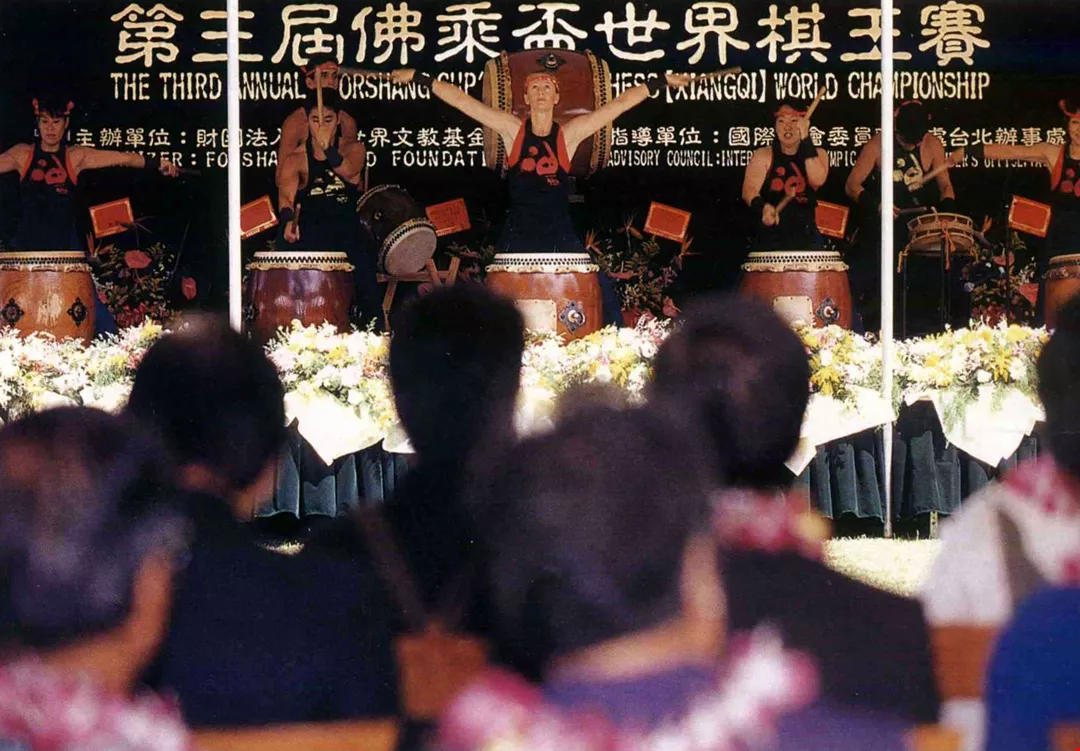
Drummers put on a heart-thumping performance at the opening ceremony for the third annual Forshang Cup Chinese Chess World Champion ship. San-Don Lee.
For the past three years, the Forshang Cup Chinese Chess World Championship has been a major landmark in the lives of competitive Chinese chess players throughout the world. This tournament, which is sponsored by the Forshang World Foundation, gives the players a chance to test their mettle once a year against the world's top competition.
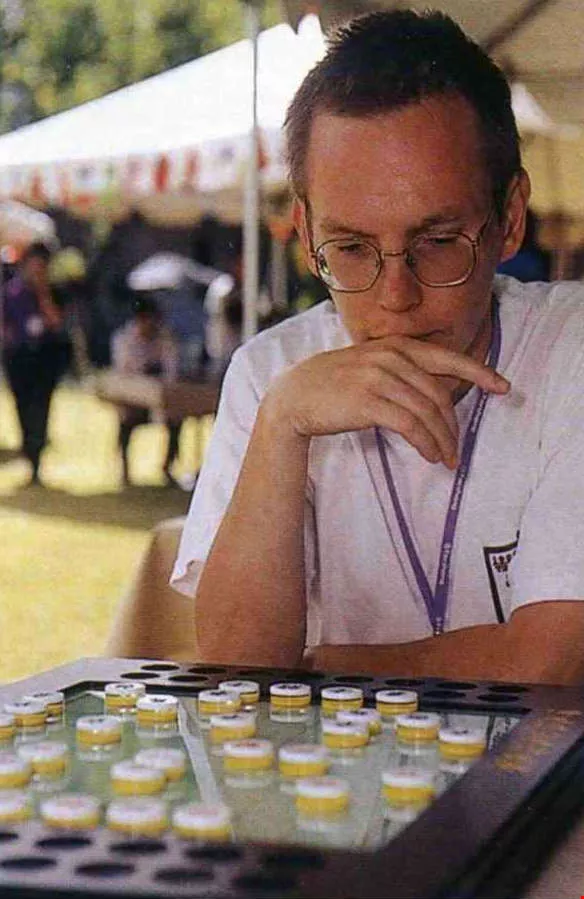
Ari Luiro (upper left), who plays for the Finnish team, can neither speak nor write Chinese. So how does he comply with the rule that requires the players to write down every move they make?
On a sunny day in late August, a breeze carries the soothing strains of a gentle melody across the tree-shaded lawn of Forshang Garden on the outskirts of Honolulu. Just as the afternoon round of Chinese chess matches gets under way, a gusty breeze kicks up, bringing with it a driving drizzle. Trees sway and tablecloths flutter, but no matter-no one is paying attention to anything but the little chess tables placed here and there on the lawn and under the shelters. Tournament of champions
A speaker crackles to life: "Important announcement-play shall commence in one minute!"
The contestants scurry to their places and the atmosphere immediately starts to grow intense. A lot of spectators are already sitting in front of two large-screen televisions in one corner of the garden. Once the competition begins, the spectators keep a steady vigil on the progress of the matches. Some people have brought their own chess sets, which they use to recreate the moves of the competitors. The crowd comments on each move.
This year's competition, a ten-day affair, marks the third annual Forshang Cup. Forty contestants from over 20 different countries have entered the tournament. At stake is prize money totaling US$200,000. A player racks up three points for each win, and players with the 16 top point totals advance to the championship round and a chance at a share of the prize money. The players can't afford to slough off even a single match. The champion takes home US$40,000 and plays the champion from the previous year for an additional US$15,000 prize.
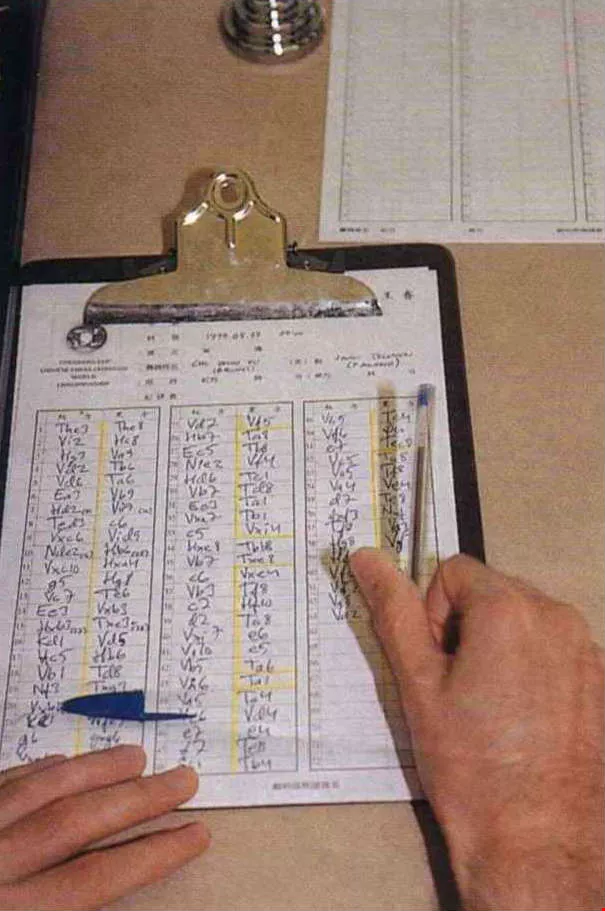
Where there's a will, there's a way--he uses symbols and the Western alphabet (lower left) to get the idea across.
Compared with tennis, basketball, and other sports that have developed into professional events on an international scale, the money at stake in the Forshang Cup is only a pittance, yet it is by far the biggest plum in world of Chinese chess. That is quite an accomplishment for an event that totally lacks commercial sponsorship. Although this big prize money comes from a Taiwan-based organization, the fact is, Chinese chess in Taiwan is deplorably disorganized. Starving chess players
Although Chinese chess is very popular in Taiwan, one gets the impression that it is only played in parks, markets, temples, and other public spaces by people who are just looking for a fun way to kill time. The abilities of the players can vary considerably, and private Chinese chess clubs are sometimes just fronts for gambling operations. The United Daily News once organized a tournament that ended up being canceled because the contestants had conspired to fix the matches. The ROC Chinese Chess Association would like to organize large tournaments and promote the development of better players, but in comparison with other competitive events, very few corporate sponsors regard Chinese chess as something worth sponsorship money. In the 1980s, the Council for Cultural Affairs started up an annual international Chinese chess tournament called the Chungshan Cup, but the event folded after nine years due to a lack of support from influential people and difficulty in obtaining sponsorship.
Local tournaments go on all the time in Taiwan, but as last year's Forshang Cup champion Lin Chien-chih will attest, there is very little money involved. At tournaments organized by local organizations, Liu has won enough soap and towels to last for years, but even if he were to win every tournament in Taiwan, the cash prizes would not add up to the value of the sponsorship that he receives from the Forshang World Foundation.
Chinese chess is far less organized than Western chess and Go. Now that athletic sports have developed to the point of maturity and beyond, the International Olympic Committee (IOC) is very interested in promoting "mental sports." Thanks to the active support of many Western nations, the incomes of chess players have been slowly catching up with the salaries commanded by professional athletes, and chess has even been selected by the IOC for eventual inclusion as an Olympic event.
Japan has reacted to this international trend by vigorously promoting Go, shogi, and other Japanese board games. Anyone who rises to the top of the Go or shogi world becomes instantly wealthy. There is a comic book series in Japan entitled Shogi Master in the Moonlight, which is centered on the adventures of a shogi master. The title refers to the idea that a shogi player, fighting away in solitude in the fiercely competitive world of shogi, is like a lone person walking a moonlit pathway at night In order to defeat the opponent or execute the perfect stratagem, there is no length to which the shogi master will not go; he is willing to exhaust himself emotionally and physically, and will push himself to take part in every match even when ill to the point of collapse. He is even willing to die! That sort of attitude is a goal to which many players aspire.
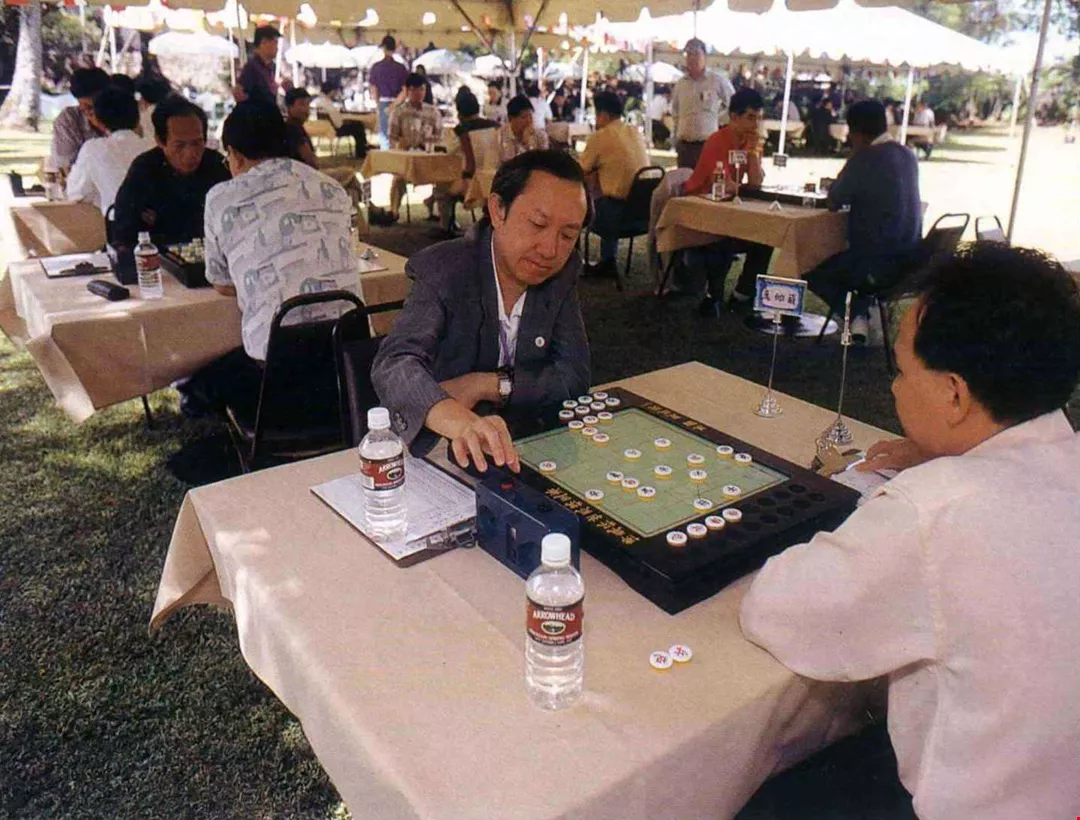
Top players from around the world (right) come together at the Forshang Cup.
In Japan, these "lone wolf" players can look forward at the end of their struggles to immense prestige, a fabulous income, and lofty social status. In Taiwan, Go also enjoys high status and the support of influential people. There are professional Go players, and parents are very happy to see their children opt for Go as a career. As a result, the level of expertise in Go is very high in Taiwan. The situation with Chinese chess, however, presents a stark contrast. No one would ever dream of making a living from the latter no matter how they might love the game, how talented they might be, or how hard they might work at it. Top Taiwanese talent
Lin Cheng-ming was totally dedicated as a child to becoming a Chinese chess champion, and he is now one of the game's better known competitors. As a young man he would roam the chess clubs of Taiwan looking for masters to play against. Whenever he found one, he would immediately ask for a match. It was unfortunate that Taiwan didn't have an island-wide Chinese chess event at that time. After he had beaten all the local masters, he had to forget about his Chinese chess and get ready for the university entrance exams.
Last year's Forshang Cup champion, Lin Chien-chih, has had to quit job after job in such fields as construction, plumbing, and a furniture store, and so on-all because his bosses have not been willing to let him take enough time off for his chess.
The only person in Taiwan currently making a full-time career of Chinese chess is the island's No.1 player, Wu Kui-lin. Wu began studying the game in his hometown in southern Taiwan, switching teachers and towns as he progressed. He eventually ended up in Taipei. Finally, the day came when he found himself without equal in Taiwan, so he went off to the mainland to continue studying under another master.
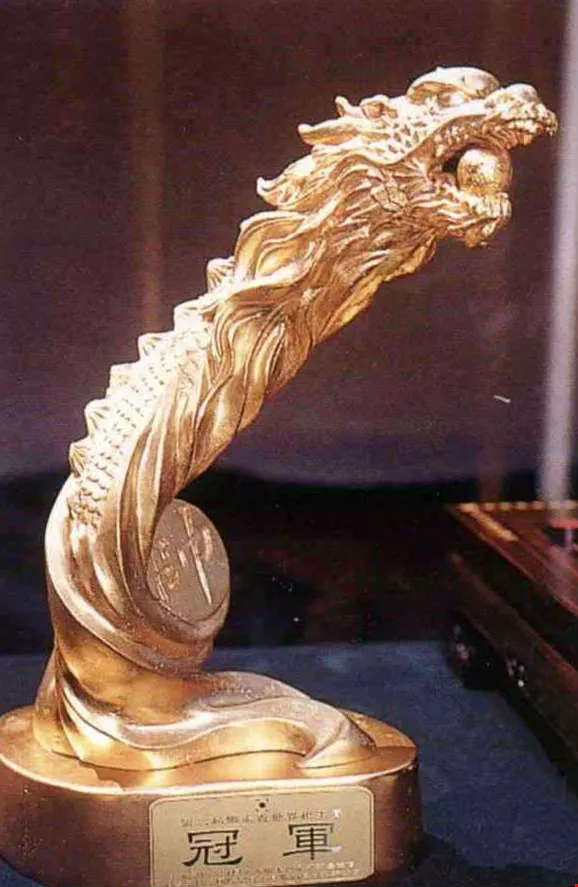
Taiwan's Wu Kui-lin captured the champion ship and a big cash prize this year, staggering away with a 20-kilo trophy.
According to Ding Yat-sen, who serves as the head referee at the Forshang Cup competitions, a player cannot rely on talent alone. One must work hard to deepen one's mastery of the game. Says Ding, "Even though Wu Kui-lin is already the champion, he never goes a day without studying the game, and as soon as he finishes a game he immediately begins to examine and analyze it. Every day he studies records of games played in the past, thinking about how he would play against different opponents. He always works to keep himself in top condition, both mentally and physically." A professional player must be independently wealthy to maintain this kind of training regimen. Chinese chess goes international
San-Don Lee, chairman of the Forshang World Foundation, has been an ardent fan of Chinese chess since childhood. His concern at the lack of professionalism in the Chinese chess world prompted him to organize the Forshang Cup in hopes that the tournament would familiarize more people with the sport, bolster the morale of players, and introduce a bit of Chinese culture to the rest of the world.
In his remarks during the opening ceremony at this year's tournament, which the Forshang World Foundation decided to hold in Hawaii, Lee declared his intention to open a Chinese chess museum in Hawaii within three years and to offer a total of US$1 million in prize money by the time of the tenth Forshang Cup in 2006. He also stated his hope that Chinese chess would follow in the path of Western chess and become an Olympic sport within ten years.
Lee has his work cut out for him. The contrast between Chinese chess and Go, for example, is striking. At an international Go tournament held recently in San Francisco, Western players were to be seen everywhere. It is generally agreed that Chinese chess has a long way to go before it can be considered a truly international sport. Although the three Forshang Cups held to date have featured teams from all over the world, all the players for the other countries (except for Finland, Vietnam, and Germany) have been Chinese expatriates. The most commonly spoken languages at the tournaments are Chaozhou dialect, Cantonese, and Mandarin. At the other two major international Chinese chess tournaments (the World Cup and the Asia Cup), the crowd looks like it might just as well have shown up for a general session of the World Association of Overseas Chinese.
Looking at the bright side, it is good that the Chinese diaspora has spread Chinese chess throughout the world, thus planting the seeds for expansion of the game's popularity, but Jackson Teoh, captain of the West Malaysia team, considers it unlikely that the sport will be widely played internationally within the next 30 years. Getting there before Go
Wu Ching-kuo, an IOC member from Taipei who traveled to Hawaii to attend the Forshang Cup, is more optimistic. In his opinion, getting the IOC interested in Chinese chess is the best way to pique the interest of the Chinese people and raise the game to the level of an international sport. With a major international competition like the Forshang Cup being held once a year, the IOC can hardly overlook Chinese chess any longer.
What are the chances of getting a purely Asian game selected as an official Olympic event? It would not be unprecedented. Japan successfully promoted judo at the time of the 1964 Tokyo Olympics, and Korea's taekwondo will soon become an official Olympic event as well. Says Wu, "There is no reason why Chinese chess can't become an Olympic event."
To become an Olympic event, a sport must first be recognized by the IOC. To obtain this recognition, the sport must have an international association, and there must be at least 75 national teams in the men's division and 50 national teams in the women's division. Furthermore, there must be a national association in each of these countries, and regular competitions must be held every year.
The World Chinese Chess League now has more than 40 member nations. In addition to Southeast Asia, there are also associations in such countries as Australia, New Zealand, and even such European nations as Germany, France, Italy, Portugal, and Finland. This total easily tops the number of nations with Go associations, which is why Wu feels that Chinese chess has a better chance than Go to become an Olympic event. The foreign contingent
According to Kim Laurent, chairman of the Chinese chess association in France, textbooks on Chinese chess have long been available in French and German, and non-Chinese faces can be seen everywhere at Chinese chess competitions in Europe. Westerners have not been playing the sport for very long, though, so they cannot beat the Chinese players.
Jouni Tolonen, vice-chairman of The Friends of Chinese Chess in Finland, reveals that his interest in the game stemmed from a fondness for Chinese characters. He says that all Chinese chess players in Finland are locally born, and that they generally take up the game because they already have an avid interest in Western chess. The Chinese characters on the pieces, however, pose a stumbling block for beginners, and it is difficult to buy a Chinese chess set in Finland, so Western chess sets are often used instead.
In Asia, thanks to the deep cultural ties between China and its neighbors, Chinese chess is already beginning to be played widely even outside the Chinese community. In Singapore and Malaysia, where ethnic Chinese enjoy high social and economic status, Chinese chess tournaments are held throughout the year. Jackson Teoh, captain of the West Malaysia team, reports, "They've been holding Chinese chess tournaments for non-Chinese now for the past five years on national day."
Even in Indonesia, where the use of Chinese characters is prohibited, they can't keep the local Chinese community from playing Chinese chess. To avoid being fined for the Chinese characters normally printed on the chess pieces, the local Chinese have taken to using upright pieces that can be distinguished by shape rather than by the written characters. The piece that normally has the character for "cannon" printed on it, for example, might be crafted in the shape of a missile, while the "horse" is made in the shape of a horse's head, the "chariot" takes the form of a chariot wheel, etc.
As for Vietnam, the captain of the Vietnamese national team swears he is not exaggerating when he states, "Every single day, 20 million people play Chinese chess in Vietnam." In fact, the Vietnamese are even more enamored of the game than the Chinese themselves are. Chinese culture has had a deep impact upon Vietnam, and Chinese chess has long been played there. It would not be an exaggeration to call it a national pastime. Because of Vietnam's long contact with China, there are many Chinese books and written records in the country, and depending on your job, you may just have to read them. This is especially the case for historians. As a result, the Vietnamese have no trouble reading the Chinese characters on the Chinese chess pieces.
In addition to mainland China, Vietnam is a key supporter of efforts to internationalize Chinese chess. In spite of the country's difficult economic situation, the government still provides the members of the national Chinese chess team with a stipend that is sufficient to live on. The situation is far different in Taiwan, where the government takes a laissez-faire approach that some might prefer to describe as a policy of "live and let die." Players here can only heave an envious sigh when told about the conditions enjoyed by their counterparts in Vietnam. Just for the fun of it
Fortunately, though, the Forshang Cup has already improved the situation. It was announced at the most recent Forshang Cup that the IOC will invite the current and previous Forshang Cup champions to participate next year in an exhibition tournament in Lausanne, Switzerland. The Forshang World Foundation has also agreed to sponsor three Taiwanese players in hopes that the financial stipend will enable them to concentrate on their game without worrying so much about job pressures. This development constitutes the first step toward the establishment of a professional Chinese chess system.
There are many who dream of participating in the Olympics, but the players who congregate at the Forshang Cup do not give the impression that they are hell-bent on winning. The players are on friendly terms, and seem more like "cultural ambassadors" than Olympic gladiators.
Although the main character of Shogi Master in the Moonlight goes to extreme lengths for the sake of a win, you don't see that kind of display at the Forshang Cup. While everyone is all business during the matches, as soon as a match finishes the players immediately retrace the moves they have just made and talk about how the match went. Some players take advantage of every opportunity to seek advice from stronger players.
Some emphasize that no one can win at this game all the time, and that the player who understands this truth will be able to lose with grace, secure in the knowledge that a larger world looms beyond the boundaries of the chess board. Mou Haiqin, who has represented America in all three Forshang Cups to date, says that he plays Chinese chess in order to make friends and travel to interesting places. Will the Chungshan Cup return?
While the team members are squaring off in the official competition, an even more exciting battle takes place away from the spotlight. Laughingly referring to themselves as sworn enemies for life, the captains of the Singapore and West Malaysia teams are playing against each other practically non-stop. The two took part in last year's Forshang Cup, but as team captains they've had to stay on the sidelines this year, where they have played 100 games over a period of three days and two nights. Don't these guys ever get tired? Says Jackson Teoh, "It's so rare to run into a true rival. It would be a shame if we didn't take advantage of the chance to play."
Adds Teoh, "We players don't get lonely." Teoh relates that while he was in Taiwan to take part in the Chungshan Cup, he took a chess set with him to places like Hualien and Taitung, playing with people wherever he went. Conversation really gets rolling when talk turns to the Chungshan Cup. Another player who has also participated in the Chungshan Cup states: "I'll have you know that we bought the airplane tickets ourselves!"
Lin Yi-shih, secretary-general of the ROC Chinese Chess Association, hopes to see the Council for Cultural Affairs revive the Chungshan Cup. Says Lin, "Every time I travel abroad, people ask me when there'll be another Chungshan Cup." In Lin's opinion, it would be much easier for Chinese chess to become an Olympic event if both the government and private sector each organized a major international tournament.
The players miss the Chungshan Cup for various reasons. Apart from the fun of competition, San-Don Lee points out that Chinese chess brings together people of different linguistic backgrounds and nationalities and enables them to transcend the boundaries of space and time. This ancient Chinese game creates a living link between all sorts of people.


@List.jpg?w=522&h=410&mode=crop&format=webp&quality=80)
