

What's so great about birth? What's so cruel about death? Philosophers may say what they will, but most ordinary people will count themselves fortunate to have a "good birth and good death."
A "good birth" isn't all that hard; a lot of things are taught in books. But a "good death"? Is it a bustling, noisy funeral? Burning a paper house for the deceased to live in? A table full of funerary offerings?
It was evident from the densely hung funerary couplets, whose signatures include ministers and elected officials from all levels, that the funeral of Mr. Chang, who followed the national government to Taiwan in 1949, was an honorable one.
Yet, extremely few people actually attended the funeral. They were for outnumbered by the commemorative displays, and the ceremony broke up after less than ten minutes.
In comparison, the funeral of Mr. Li--who had been very active in election activities--was more "lively."
The funeral, otherwise similar with its commemorative complets and ceremony, came at election time. Thus, besides friends and family, everyone from incumbents to candidates to future hopefuls, acquaintances and strangers also participated enthusiastically, observing every rite. Amidst the murmurs from lowered heads, you could still hear analyses of the election situation and of the direction of the stock market.
Whether the scene be quiet and sparse or busy and crowded, the photo of the deceased hung in the center of the funeral hall seemed incredibly isolated; they both seemed to be "supporting actors."

It is popularly believed that though people can freely come and go when alive, after death they require the guidance of a Taoist priest to get out the door and return to "extreme joy.".
Who is the leading man?
A funeral is a major event in the human drama, and it seems that it should go without saying that the deceased would play the leading role. Yet the deceased has no way to insist upon what form the funeral should take. Although one could make arrangements beforehand, the children and grandchildren vary in virtue and foolishness, and if they decide not to follow the directions of the deceased, there is no way to protest. With the complexity of human relationships in modern society, plus commercialization, it seems that many people are not even accorded the status of guests at their own funerals.
After coldly watching the memorial service, some offspring want to have a bit of excitement, so they invite various people to participate in the procession. The line of cars can extend to tens of kilometers. People along the way who lose their patience because the traffic gets backed up can't help but displace some of their anger onto the deceased. And when you see the "filial daughters mourning the parent" whose cries make you wish you were deaf or the girl on the "flower vehicle" whose voice sings sad dirges but whose scantily clad body is very cool and comfortable. . . it would make a person roll over in their grave.
When some of the ridiculous aspects of contemporary funerals are mentioned, Hsu Fu-chuan, a professor at the Taiwan Institute of Technology who has studied quite a bit about traditional funeral rites, can't help but sigh. Birth and death are major events in the lives of any individual, yet are also important for socialization. The only thing is, in today's changing society, who will pass these ceremonies along?
In the rural society of the past, under the clan system, funerals were mostly led by the head of the family. Such individuals experienced no less than 100 funerals in their lives, and were quite familiar with the rites. Moreover, traditional clan funeral ceremonies fit in with the Chinese idea of expressing filial piety through care in funeral preparations for one's parents; this was a kind of education in life.
In the modern nuclear family, there are few heads of households who can run a funeral. People in industrial society are busy making a living, and no longer have the time or the knowledge to undertake a funeral. Death has thus also been integrated into the division of labor, with funerary societies replacing the clan chief in directing the funeral. Under the sweep of commercialization, the relationship between form and substance becomes even more obscured.

Paper high-rises and mourning music are all part of the sentiments of the relatives.
Originally a form of socialization:
Professor Hsu Fu-chuan points out that the basic sentiments in funerals included mourning, gratitude, reserve, and filial piety.
The Analects of Confucius note that the fundamental significance of funerals lies in mourning. In ancient times, when there was a funeral in the family, the whole household was swept up in grief. Relatives ate without regard for taste, with children and grandchildren not allowed to consume fine foods, to express their sense of mourning. Their clothing also had to be different from that of ordinary folk, putting on robes of hemp and black mourning bands. In terms of living arrangements, the way of ancient ritual was that when one's father or mother died one would have to remain at home for three years. In terms of deportment, a person could not act carelessly; thus people in mourning could not just go visiting friends whenever they felt like it.
Looking, on the other hand, at modern funeral habits, often the family and guests lay out an elaborate dinner to thank the living for their efforts; the cost of these dinners is no less than for weddings. It is virtually impossible today to find funerals based on the Taiwan folk custom wherein people could only eat "triangular meat" (bits of meat carved off without regard for appearance).
In traditional rites, the activity that most completely expressed the idea of "gratitude" was the "offering of food." When someone in the family passed on, family members would change into their mourning dress and, starting the next day, sons and daughters would, as usual, undertake the daily routine in front of the memorial tablet for the deceased. They would first bring water to the front of the tablet for the late parent to wash with. Later they would offer food for the parent to eat. In the evening they would first bring food, and then carry over water for the parent to bathe in. This "offering of the food" truly puts into practice the filial spirit of Confucius' idea, "in death as in life."
However, in modern life, though the "offering of food" is still around, its transformation is nearly unbearable to observe. Because the corpses are now mostly placed in funeral homes, it is hard for relatives to go every morning and evening to perform the offering. Therefore, the funeral home usually has tens of memorial tablets outside where the coffins are kept, with the rice provided by the funeral home at a fixed price of NT$20 per bowl. At morning and evening mealtimes, the staff set out the rice bowls one by one, looking a bit like a cafeteria.

To carry the "soul palanquin" where the soul of the deceased temporarily resides is to accompany the dead as they walk the last road in life.
Reserved behavior:
When a parent dies, inevitably the family members are saddened. Many of the rites in a funeral are aimed precisely at supporting the living in getting over this difficult period. It is said, "There are proper limits for birth and for death." This advises people that the ceremonies should not overdo it--even in mourning.
In the design of the ceremony, the ancient rites say the following about the proper timing of encoffinment and burial: "For the Son of Heaven [emperor], there should be encoffinment after seven days and burial after seven months. For the nobility, there should be encoffinment after five days, and burial after five months. For the gentry, there should be encoffinment after three days, and burial after three months." Keeping the coffin in the home was in hopes that people could adjust themselves, so that the living would have sufficient strength to rely on when commemorating the dead, only burying the body after emotions had stabilized. The tradition of seven seven-day periods also has this function.
As for the idea of "socialization in filial piety" in funerals, taking the "offering of food" for example, not only children, but sometimes even grandchildren will take part. In the process they learn what it means to thoroughly manage a funeral for one's parents and pay sufficient respect to the dead. Also, during the funeral process, Taoist priests chant sacred texts, definitely including the "24 filials." These both obviously have the meaning of teaching children filial piety.
Funerary customs change with the times, and of course many are no longer suitable for modern society. For example, the rules requiring people to withdraw from life for three years of mourning, or to leave coffins in their homes for months, clearly cannot survive in Taiwan's hot and hectic society. What's sad is that the spiritual meaning these rites included easily gives way to the material side in a wealthy society.

The custom of the "offering of food" expresses the filial idea of "in death as in life." But the uniform offerings in the funeral homes, which retain merely the form, give one the feeling of a chow line.
Face for the living, apologies to the dead:
Kan Wen-ruo, director of the Taipei City Funerary Association, says that when modern people arrange funerals for their parents, they most fear that others will criticize them as unfilial. Thus they want to make as much of a display as they can, making everything "solemn but impressive."
Thus we saw several years ago how a certain big shot living in a lane along Jen-ai Road in Taipei put up a fifty or sixty meter long tent in the lane for his mother's funeral, taking up most of the road and even having police on hand to stand guard. When the coffin was sent out to be buried, they mobilized 36 large black imported sedans to lead the procession, making quite an extravagant setup.
Two or three weeks later, a mother of a certain underworld figure living in Sungshan also passed away. Because of the previous example, the son felt inclined to follow suit. Though owing to disparities in influence, he could only get 24 black large-size taxis, a bit less imposing. The license plates on the cars came from Keelung and even as far away as Kaohsiung, quite sufficient to show the scope of the man's connections.
It's not hard to figure out the logic behind the vulgarization of funeral rites. "Everyone else does it this way, I guess I should, too. If I don't know what to do, the best thing is to go along with what others have done and hire a funeral society to run the affair." Behind this logic are none other than the twin mindsets of glory and regret. Glory comes from the competition among the living for "face" and status, while regret includes the apologies owed to relatives for slights produced by social change.
"In an industrial society everyone is busy making money, so they have no time to be fully filial. Thus, to some extent, people use an elaborate funeral as a kind of compensation," concludes Lai Hsiang-hsing, secretary-general of the Pan Juo Educational Foundation.
He points out that moderns are more willing to cough up a little more money and feel "there's nothing wrong with doing a bit too much." Anyway, in a family there is only likely to be one funeral every twenty or thirty years, so if they just spend some extra money it doesn't matter that much.

This is even more glorious than a feast among the living!
Who loves a funeral?
Unfortunately, modern people may be long on cash, but they are short on understanding. For example, the performing troupes that often appear in funeral processions cost quite a bit. But when you examine their origins, some of them turn out to be totally unrelated to funerals, but are the result of aggressive sales pitches by businessmen.
Take for example the Chienwang (spirit conjuring) troupe: This is originally a group that performed songs on auspicious occasions at temples in the Taiwan area. The contents of the songs advised people not to believe witches casting Chienwang spells. About forty years ago, an elderly person who quite enjoyed their show instructed his children to invite to invite a Chienwang troupe to his funeral after he died. Thereafter the lyrics evolved to be about travels through hell, advising people to do good deeds, and so on.
The "Five Sons Crying at the Grave" originated in the Tan Feng Taiwanese Opera Troupe in 1964. At that time TV had just begun broadcasting, and business was thin for the opera troups. This performance, enacted in the funeral procession, talks about a certain five brothers in ancient times who were maltreated by their stepmother for their frequent trips to weep at the grave of their mother. No one expected that it would become one of the most popular procession troupes today.
Then there are those who think there is inadequate novelty, and willy-nilly add lion dance troupes or dragon troupes. There are even many performances of Journey to the West, which have been roundly condemned by the Chinese Buddhist Association. These turn the funeral procession into a festive parade, making a bizarre sight amidst the funeral dirges. And with the latest models of luxury sedans mixed in amidst the trucks laden with flowers, or even with horses appearing amidst the troupes, no wonder some people especially like to watch funerals--they are "lots of fun"!
"Most people just copy what they've seen, and there are more variations among the wealthy," says one professional from the funeral industry.
In 1975, when President Chiang Kai-shek died, for the first time in a state funeral the vehicle carrying the coffin was made up from chrysanthemums. Thereafter ordinary people rushed to copy the idea, with similar vehicles making for quite a spectacle.
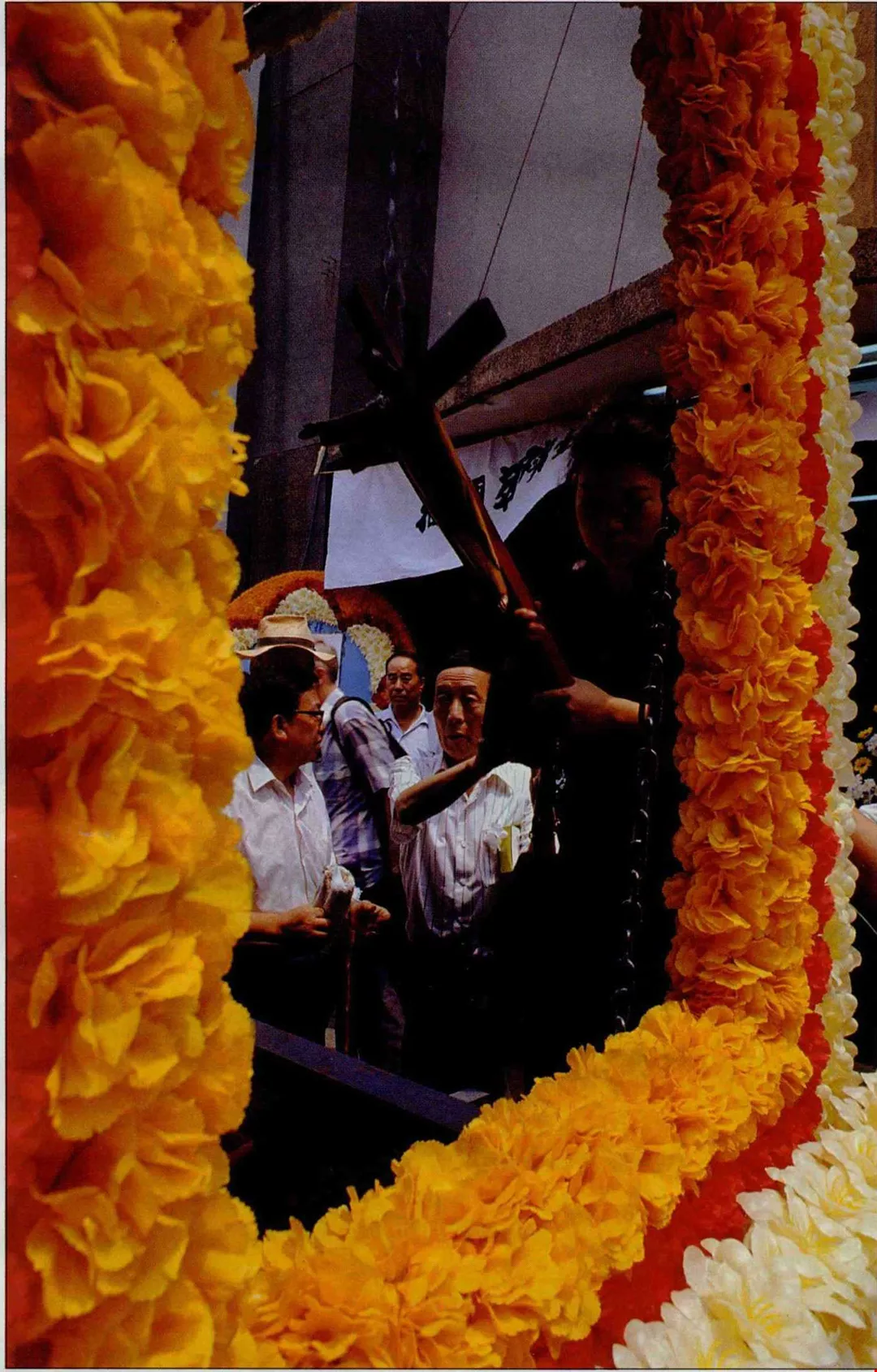
The view afforded by religion helps the deceased pass over into eternal life and the living to relieve their sadness.
Formalism:
"Now this type of hearse is already not dazzling enough," says Hsu Fu-chuan, and those with money are increasingly using floats like those in American Independence Day parades.
Though modern funerals display extravagance in form, they also reveal the lack of substance behind the form.
Just take the musicians, the group which "is most able to determine the energy level, "for example. It is understood that in many bands often only about half the "musicians" actually know how to play their instruments. The other half are just there to fill up the space. As for musicians chewing betel nut and dressed in ratty old clothes, that also shows lack of concern for anything.
A Master Hsu who has been involved in funerals for nearly 20 years says that for those who believe in an afterlife, providing a resting place is a sign of concern for one's ancestors. But now many commercial funeral homes feel that "it's OK just to copy," which ends up producing a mixture of crudity and extravagance.
"The faces of Buddhist Statues are mass produced in plastic; the frames for final resting places are carved by machines and are ragged; and course paper is used for the ceremonial spirit house," says Master Hsu, angry about the superficiality of the living. As for whether the place where the deceased reside in the afterlife will leak water or collapse, that is of course part of the gap between this and the other world, and there is nothing anyone can do about it.

Master San Tsang is a highly esteemed monk. Fortunately he is a man of learning and forbearance; otherwise, he would get impatient with the people who always ask him to lead funeral processions.
It doesn't hurt to believe:
In fact the customs of an era reflect the face of the era. Although many people criticize the form and content of contemporary funerals, it is always easier to criticize from the outside. These very sane people, when faced with the funeral of a loved one, usually can't resist the sales pressure of the funeral parlors and end up just "spending the money to go along with the custom."
In the second place comes the "it-doesn't-hurt-to-believe" mindset, which is difficult to change from the outside. Looking at many existing funerary rites in Taiwan from this angle, no matter whether it be floats, dramatic troupes, or even strippers, they all reflect different ideas and needs. It's just that the way these appear on the surface, it must be said, has already made most people feel opposed. What, after all, is wrong with them?
"It's negative education," argues Hsu Fu-chuan. Appropriate funeral rites should have considerable educational value, passing along the idea of filial concern for planning of a parent's funeral to the next generation. If funerals are over-extravagant where they shouldn't be or too crude where they shouldn't be, this will have an extremely negative educational function for the next generation.

"Flower vehicles," often appear in funeral processions in rural areas in Taiwan, complete with a woman stirring on the marchers with dance. (photo by Vincent Chang)
How to reform funeral culture:
Though the Chinese emphasize thoroughgoing preparation for the funerals of one's parents, when funeral rites no longer fit the times, and even are an obstacle to people's lives, calls for reform will naturally arise.
Some people want to use the "external power" of legislation or changing construction regulations to make funeral homes alter the "contents." Yao Hsing-hui, director of the Office of Funerals of the Taipei City Government, takes Japan as an example: Japan has passed a law stipulating that, except for the emperor, all deceased citizens must be cremated within three days. This resolves many problems of public health, land, and economics. Further, he feels that if large modern high-rises replaced temple style locations to keep ashes, it will be hard for the procession troupes, which require a lot of room, to play their role.
Others think you should start with "internal" religious beliefs. Because funerals are mainly connected to religious beliefs, this would really be the only way to get to the root of the problem.
A Taoist site located near Fulung in Taipei County has a group of young priests who hope to reform funeral customs. Master Liao Yi points out that they hope to come up with a set of appropriate rites, as simple and solemn as possible in form, with the most important thing being to allow people to understand the meaning of the forms. "For example, we might translate the sacred texts into the vernacular so that people can truly participate in the ceremony and get the meaning from it," she says. If it's consistent with the sacred texts, any form can be tried.
There are also some entrepreneurs interested in reforming funeral habits, seeing this as a potentially profitable area. They have invested large amounts of money in the business, using park-like graveyards and shining high-rise naguta (where urns are stored) to attract "customers." To some extent these alter the standard terror most people have of death. Tsai Hung-ming, the general manager of a large corporation that built itself up by managing modernized cemeteries, says: "If the operators of cemeteries can stipulate that performing troupes and bands of musicians can only come to the foot of the mountain [most cemeteries in Taiwan being on mountains], and absolutely cannot set foot in the graveyard, then over time people who come there will no longer employ those things."
Another operator, Kuo Jen-hung, talks even more expansively: "We want to rearrange funeral customs anew, and lay out new rites." Their newly designed ritual includes specially designed music and dance.

Is this for a festival competition? No, it's a funeral procession troupe.
Everything is up to the living:
Frankly speaking, if you really want to change the way people do funerals, it won't be easy, and much less so if "businessmen" want to do it.
In traditional funeral services, from the approach of death until the bones were exhumed and reburied six years later, there were more than 30 important rites in the process. This doesn't include the preparatory activities. If you want change, it's not something that could be accomplished overnight.
Some people contend that the ideal commemorative method is to donate one's body for medical research or for organ transplants, and then encoffin and cremate the body, ultimately placing the ashes in a final resting place. Of course, some people do adopt this method, but you can imagine that the vast majority of people aren't willing to accept it.
One funeral director points out that it is very difficult to change popular customs. For example, Chinese people have always favored burial in the earth. In the mainland, in order to make more efficient use of the land, the Communist authorities ordered that people would have to be cremated, and that those who buried deceased persons would be punished. But in the countryside, people still hold elaborate burials, mostly with the local government turning a blind eye.
"During the Cultural Revolution, traditional funerals were strictly forbidden. It was only in the 1980s that the prohibition was relaxed, and all the old customs immediately returned in toto, without the slightest change. It's easy to talk about change, but. . . ." he says.
No matter whether one is optimistic or pessimistic, it is worth it for busy modern people to think carefully about funeral culture. Lei Chi-chung, who worked in funeral homes for 30 years, says humorously: "The dead people who come here never complain. Only the living have opinions."
It seems that how the living define "good death" is in fact the key to all the problems.
[Picture Caption]
p.15
A hall filled with memorial couplets, the door jammed with guests. . . . Does this mean that the deceased has had a glorious passing?
p.16
It is popularly believed that though people can freely come and go when alive, after death they require the guidance of a Taoist priest to get out the door and return to "extreme joy."
p.17
Paper high-rises and mourning music are all part of the sentiments of the relatives.
p.17
To carry the "soul palanquin" where the soul of the deceased temporarily resides is to accompany the dead as they walk the last road in life.
p.18
The custom of the "offering of food" expresses the filial idea of "in death as in life." But the uniform offerings in the funeral homes, which retain merely the form, give one the feeling of a chow line.
p.18
This is even more glorious than a feast among the living!
p.19
The view afforded by religion helps the deceased pass over into eternal life and the living to relieve their sadness.
p.20
Master San Tsang is a highly esteemed monk. Fortunately he is a man of learning and forbearance; otherwise, he would get impatient with the people who always ask him to lead funeral processions.
p.20
"Flower vehicles," often appear in funeral processions in rural areas in Taiwan, complete with a woman stirring on the marchers with dance. (photo by Vincent Chang)
p.20
Is this for a festival competition? No, it's a funeral procession troupe.
p.21
The floral hearses first used for state funerals have become beloved among citizens. The photo is from the funeral of the late president Chiang Ching-kuo. (photo coutesy of the Department of Party History of the Kuomintang)
p.22
After the funeral, the red silk belts worn by the family and friends to send the deceased off are hung on trees outside the final resting place so that all grief will be carried away on the wind.

The floral hearses first used for state funerals have become beloved among citizens. The photo is from the funeral of the late president Chiang Ching-kuo. (photo coutesy of the Department of Party History of the Kuomintang)

After the funeral, the red silk belts worn by the family and friends to send the deceased off are hung on trees outside the final resting place so that all grief will be carried away on the wind.


@List.jpg?w=522&h=410&mode=crop&format=webp&quality=80)


@List.jpg?w=522&h=410&mode=crop&format=webp&quality=80)
