A Taste of Japan in Eastern Taiwan
Tsai Wen-ting / photos Chuang Kung-ju / tr. by Geof Aberhart
May 2005


Fengtien. The name-Toyota when read in Japanese-is steeped in Japanese flavor, and tells of Japanese immigration to the area almost a century ago. But time and tide have continued to roll on. Several old wooden Japanese-style guesthouses and densely overgrown breadfruit plants, remnants of times gone by, stand along the streets, the air is suffused with the scent of orange jasmine, and crumbling walls dot the scene. All of this combines to silently reveal the lifestyle enjoyed by the Japanese immigrants of old.
Over a decade ago, an old lady visiting Taiwan with a tour group arrived in Hualien and was overwhelmed by feelings of depression. After talking with her, the tour leader discovered that this old lady had in fact been born in Hualien. The leader headed out with her by taxi to Fengtien, and after asking around a bit, the old lady finally stopped in front of an old wall, propping herself up against it with her hand, and began to sob uncontrollably.
After asking a few of the elderly people in the township who could still speak Japanese, this elderly Japanese lady found and pointed out an old cement wall with the two characters Tabara clearly inscribed on it. She explained that when her mother fell pregnant, her father happily built the soon-to-be family a new house. Unfortunately her mother died giving birth, and in his grief her father used his finger to draw their surname, Tabara, in the still-wet cement as a memorial to his wife. This wall and its sad story have survived the decades, becoming part of the tale of the Japanese immigrants of the time, and the spot is still known by the locals of Fengtien as "the weeping wall."

The "doctor's house" ,the ashes in the funeral pagoda. The many cultural relics to be found in Fengtien tell of the blood, sweat and tears of the Japanese immigrants who once lived there.
Go south, young man!
The community of Fengtien is part of Hualien County's Shoufeng Township, about 25 kilometers from Hualien City. Although there was no part of the district officially known as Fengtien, this is the name the locals of the villages of Fengshan, Fengli, and Fengping know the area by.
Fengtien's modern history begins in the late 19th century, when there were still relatively few Han Chinese living in eastern Taiwan. Large-scale clearing and cultivation of the area really started, though, with the Japanese occupation.
In 1899 the Japanese company Kagata established a presence in the areas now known as Hsincheng and Shoufeng, with the intent of working in the sugar and camphor industries, but their efforts were frustrated by a number of factors, including the weather. Later, the colonial government ordered a series of evaluations and inspections around Taiwan as part of their plan to encourage immigration from Japan. In light of the difficulty of securing land on the west coast and the unwelcome possibility of immigrants being assimilated into the Taiwanese population, in 1912 the Japanese government established new immigrant villages at Yoshino (modern Chi-an Township), Toyota (Fengtien), and Hayashita (Fenglin Township's Tajung and Peilin Villages). These villages served as an outlet to help ease the population pressure in Japan and also as a testing ground for Japan's planned advance into the South Pacific. Of these areas, Fengtien is home to the most remaining relics of times gone by.
"The train pulls into a little station-this is Toyota; this is where I will live out my days. This so-called station is a station in name only. It's more like a toilet, or a tiny little bathroom, and is absolutely not what I expected." In the report "Taiwan's Japanese Immigrant Farmers-An Example of Government-Run Immigration," by Chang Su-fen, an associate professor in Tamkang University's Department of History, we find first impressions like this of the area from newly arrived Japanese immigrants, still full of dreams of being pioneers of these new "southern lands."
Unlike the majority of Japanese arrivals, who were public officials or businessmen, these farmers from the "mainland" had sold everything they owned and invested themselves entirely in the unfamiliar little island of Taiwan. They made their way into wild areas the Chinese had not opened up, in the hopes of setting up nice, peaceful lives for themselves, building their own homes, and owning their own parcels of land. Standing out in the fields one can still see today a memorial tower which is home to the remains of many of these Japanese, with the phrase "Here we are gathered" engraved on it, as sign of their dedication to the area.

the Green Lotus Temple for the ashes in the funeral pagoda. The many cultural relics to be found in Fengtien tell of the blood, sweat and tears of the Japanese immigrants who once lived there.
Tales of the old days
In July 1913 the first group of Japanese farmers arrived in Toyota/Fengtien from Hokkaido and Shikoku. The immigrant villages were still incomplete at that time, and as well as having to adapt to the hot weather-a dramatic change from their cold hometowns-the newcomers also faced the specter of various tropical diseases and the threat of wild animals. Subsisting on a diet consisting of rice and drinking water with high lime content, adjusting was difficult.
In 1917, eastern Taiwan was hit by two powerful typhoons in a row, causing extensive damage to the village infrastructure that the farmers had worked so hard to establish. Paddies were flooded, residences destroyed, and these, along with the diseases that followed in the wake of the typhoons led to the loss of many lives. In one field stands a gravestone engraved with the name Katsuki, and the details of over 20 members of the Katsuki family, the youngest only a little over a year old. Things like this make the hardships these pioneers faced starkly clear.
In the process of setting down roots in these pioneer areas, the relevant governmental and educational facilities were set up one by one, including the area's most major facility, the Toyota "immigration command HQ," the site of modern Fengtien's community center. The old medical clinic, known locally as "the doctor's house," is still home to a uniquely crafted "ghost stone," which as ever stands proudly at the door, protecting the building from evil spirits. In front of the Toyota Shrine (now Pilien Temple), the area's spiritual center, sits an adorable stone dog, praying to the stone lanterns on the street and looking out toward the shrine's distant torii, or outer gate. At the Toyota elementary school (modern-day Fengli Elementary), the students would stick shinai, the wooden swords used in kendo practice, into the ground, which have now grown into some 50-odd densely leafed trees.
In the early days, important buildings like the school and shrine had tiled roofs, while ordinary citizens lived in wooden houses thatched with straw. After the opening of the Alishan Mountain Railway, cypress wood became easier to obtain, and this style of building gradually gave way to the Japanese-style guesthouses we see there today, with walls crafted from a combination of bamboo, clay, and straw, while the outer walls had an extra layer of interlocking cypress wood. The houses were surrounded by the orange jasmine the Japanese so love, while in the courtyards breadfruit trees, brought in from the South Pacific, were planted, both of which continue to flourish to this day.

After the war these Japanese, who grew up in Fengtien, organized a "Fengtien Society." Members regularly fly back from Japan to their "home town." Here they reminisce beside an old tree or the ruins of an old wall. (photo by Lai Peng-chih)
Changing lanes
According to contemporary records, Toyota at that time had nearly 180 households, with a population of 911 Japanese farmers, and the three villages of Toyota, Yoshino, and Hayashita had a combined population of 3386.
At the end of World War II in 1945, the Japanese surrendered unconditionally and Taiwan was handed over to the Republic of China. To those farmers who had worked the lands of Hualien for over 30 years and sworn that this was to be their final resting place, this was a bolt from the blue.
Despite their fervent desire to remain in Taiwan, in March 1946 these farmers were forced to sell off their land and property for little return and bid farewell to Taiwan, leaving with 1000 Yen and a few meager possessions, returning to Japan virtually penniless to start all over again.
The Japanese pullout left behind rich green paddies and Japanese-style buildings. The story of Fengtien's immigrants moved into a new chapter, as the area became populated 75% by Hakka and 25% by immigrants of Fujianese descent. In 1955, a number of people from Yunnan in China, detained by French forces in Vietnam, were resettled in Fengtien. In the 1980s, the area's deep green jade earned it a reputation as Taiwan's home of jade, and Fengtien enjoyed a period of prosperity, as well as the arrival of another group of migrants, from the Aboriginal Amis tribe.

"places of rest" for the ashes in the funeral pagoda. The many cultural relics to be found in Fengtien tell of the blood, sweat and tears of the Japanese immigrants who once lived there.
The never-ending story
Those Japanese that grew up in Fengtien and had to leave set up the Nihon Zenkoku Toyotakai, or Japanese Fengtian Association. Around May or June each year, just before the start of the typhoon season, they return to Fengtien to check out their old home. And the Hakka, formerly laborers in the area, and the Taiwanese who now live in the Japanese buildings have formed their own society, the Taiwanese Fengtien Association, which keeps close contact with these friends with whom they share such a unique bond.
Thus, Fengli Elementary's students occasionally see old Japanese men hugging the school's trees and silently weeping, or visiting the old buildings and residences they recognize from those days, lingering for what seems like forever.
Now that most Japanese Fengtien Association members are in their 70s, they've gone over to biennial visits, and their numbers are dwindling. As they gradually disappear, the story of the immigrant village may be disappearing with them.
"Fengtien is an immigrant village. My father came here from Yunnan," says the community's general secretary Yang Chun-pi, who is also clearly also part Aboriginal and sports a strong Taiwanese accent. Japanese, Hakka, Fujianese, Yunnanese, Amis; they've all played their own different parts in the story of this piece of land, giving Fengtien its unique style.
Generation after generation have passed on, but now the Fengtien Community Association is working to gather the stories of the area's immigrants into a book series. The tale may be an old one, but as it is passed down it will continue to unfold and have new chapters added, never to end.
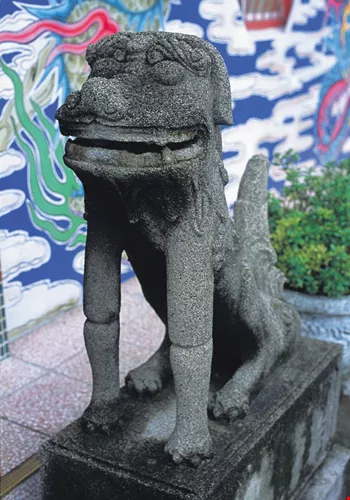
the stone dog for the ashes in the funeral pagoda. The many cultural relics to be found in Fengtien tell of the blood, sweat and tears of the Japanese immigrants who once lived there.


@List.jpg?w=522&h=410&mode=crop&format=webp&quality=80)


