Taiwanese Grandma, Business Leader--Hong You-mien
Kaya Huang / photos Hsueh Chi-kuang / tr. by Anthony W. Sariti
May 2008


The Hongs are a well-known businessfamily in Taiwan, and the "Kuo-chi" home electronics brand (later known as "National" and since 2003 as "Panasonic" under Matsushita Taiwan) created by Hong Chien-chuan and Hong You-mien is familiar to every Taiwanese. Not only was Hong You-mien Hong Chien-chuan's better half, she was his most important business partner. So much so that more than ten years ago when both Hong Chien-chuan and their eldest son Hong Min-lung passed away, she took over the heavy responsibility of chairman of the board in her capacity as "board chairman's wife." She was the only female board chairman during the early years of Taiwanese international joint ventures.
She remained in that capacity until, at the ripe old age of 80, she passed the baton to her second son, Hong Min-hung. Today, 92-year-old Hong You-mien still goes to the office each day to assume overall command. With her short hair, refined smile and eloquent speech, she could certainly be described as the mother best able to represent Taiwan's spirit and values.
On Po-ai Rd., past the bustling Taipei Railway Station, the crowds suddenly thin out and old-style baroque buildings come into view, a testament to the city's changing landscape. A huge door plate announcing No. 57 is enveloped in a nostalgic atmosphere. This is the location of the National Electric Appliance Co., Ltd. and the place where "Grandma Kuo-chi" made her solemn promise to "stay at my desk as long as I live." Fifty years ago, this was the Hong family's house. Not only the Hongs' own four sons and two daughters, but their schoolmates and the children of relatives spent their youth here. The family had "a big pot and a big stove," and many people took their meals there. No matter how busy she was, each day Hong You-mien would get her six children's lunch boxes ready on time and send them off to school with a full complement of motherly love.

Spare the rod?
When she is asked, "How did you raise your children?" Hong You-mien, who just celebrated her 92nd birthday, gives a huge smile and says, "Oh, I can't answer that!"
"Studying is the most important thing. Kids who like to study naturally don't do bad things," says Hong. "Parents should be examples for their kids to follow, do what should be done, work hard to the end. Seeing their parents act like this, the kids won't go astray."
When the children were young her husband was busy developing the business. Teaching the children was almost all Hong You-mien's responsibility. Recalling his own schooling, second son Hong Min-hung has only a vague image of his father. By contrast, his mother's picture constantly comes to mind and she had a profound influence on him.
In his book about his father, third son Hong Min-chang says his image is of a father rarely home and of a mother who was very strict. To prevent the children from taking on the habits of rich kids, she repeatedly drilled the idea into them of being "strict with yourself and lenient with others."
"As for hitting, that didn't happen very often. I would more often give them a talking to," says Hong You-mien. "There is a saying, 'spoil the pig, and he lies down on top of your stove; spoil the child, and he is not filial.'" Hong You-mien says with great feeling: "Spare the rod and spoil the child. You should teach the child when you can."

Teaching business
Not only was Hong a skilled partner and a help to her husband in business, her homemaking skills were also first class. When employees frequently arrived late to work because of taking an early breakfast at home, Hong You-mien said when she got to the office she would fix something for them. With a concern for man's most basic need, not only did she treat employees like family, even distributors and Japanese joint venture partners were the beneficiaries of her great skills and wonderful hospitality.
In addition to her entertaining and cooking, Hong You-mien also boasted a photographic memory and terrific grasp of numbers. She was responsible for the company accounts from all over Taiwan, and was legendary in the industry for taking care of the accounts for decades
Aside from her tenacity, Hong You-mien was good at using a woman's keen power of observation. With her husband's respect for women and his faith in her abilities, Hong You-mien actively participated in her husband's affairs, even accompanying him on trips to Japan to discuss business. She observed during negotiations that the Japanese were very polite, very indirect, and had a very systematic approach. Detailed items were first discussed and agreed upon by employees privately. When meeting face to face, Japanese do not like to raise demands that are too direct.
She used this observation in teaching her children. She admonished them not to get angry in discussions with others if they felt something was wrong, but to find an excuse to break off for a while and cool down. They should also put themselves in the other person's shoes to help him be more imaginative; each side can then take a step back and gradually find a position both sides can accept.

A moving story
Although the Hongs are the embodiment of a life of dignity and honor, Hong You-mien's childhood was in fact characterized by severe ups and downs. Her original family circumstances were not bad, with an older sister and two younger brothers. Her eldest sister, four years her senior, being the first child of the family, had the given name of kui ("precious") and was loved like a treasure by the family. But Hong You-mien was the second-born "girl child"-not what the family had been hoping for-and was given a name that meant "unneeded." At two months old she was sent to another family for adoption.
"Although I was adopted as an intended daughter-in-law, I had no intention of marrying the son of the family when I grew up. My adoptive mother, however, insisted there were only two choices-if I wasn't willing to marry her son, I would be sold off to the south somewhere, which meant being sold to a brothel." But she did not submit to the fatalistic attitudes of traditional Chinese women. At only 13, Hong You-mien decided to move out. She was granted her freedom on condition that she would earn money and support her adoptive parents. She decided to learn to be a seamstress at the Matsuyama Western Clothing Store, run by a relative. After 80 years, Hong You-mien still calls this the biggest, hardest decision of her life.
It wasn't until she married Hong Chien-chuan at age 22 that her destiny began to take shape. Hong You-mien worked as a seamstress for seven years. Thanks to the originality of her designs and the skill of her work, everyone knew there was "a really good girl working in the Western clothing shop." This news found its way to the ears of Hong Chien-chuan. It was love at first sight. But on Hong You-mien's account, Hong Chien-chuan rejected his own family's "adopted daughter-in-law," whom he was expected to marry, and this planted the seeds for misunderstanding and dislike on the part of Hong You-mien's new mother-in-law.
"I had to keep accounts, cook, take care of the children, greet guests-but I just did it, and did a good job so no one had reason to complain," she says without emotion.
Hong You-mien had only a sixth-grade Japanese education. To learn to read Chinese, at age 13 she saved up her meager earnings and studied hard for six months. Because she had not received much formal education, her husband once laughed at her, "Your characters are ugly, I can't let you help with the accounts!" Refusing to admit defeat, Hong worked hard on her writing so that her husband finally had to admit defeat himself and give her the responsibility for keeping the accounts.
"My mother-in-law's philosophy was: even if you don't treat me right, I will do my job well; if you treat me nicely, I will be grateful the rest of my life." Celia C. Hong, who has lived with Hong You-mien for over 40 years, describes her mother-in-law's attitude as "repaying a drop with a torrent."
Keeping the best
For business families, passing on company control and dividing family property are major events. If not handled properly it can go from a small problem between brothers to a major fight involving incessant court cases that endangers the survival of the business. The Hong family had a dispute. Kid brother Hong Min-tai (founder of the Proton and Taiway brands) lost a great deal of money but then turned around and accused his older brothers of trying to take over his business. Finally, however, the three brothers let bygones be bygones and Min-tai, who had announced he was leaving the family business, returned to the bosom of the family with the loving support of his brothers. The primary reason-Hong You-mien, the senior family elder, treated family members with respect, fairly and without favoritism, preventing the dispute from developing further.
Although surrounded by filial children and grandchildren, Hong You-mien has decided to live alone at the National office building in a 35-square-meter suite with an office next door
"Living by yourself gives you more freedom. When it gets to 8 a.m. I just open the door and I'm at the office. There's no need for people to wait around for one another." Hong You-mien says, "I feel satisfied now. Everything is prepared for. I earned my money myself and I've signed all the papers. Four daughters-in-law, two daughters-everyone will get the same amount. This way, no one will have anything to complain about."
Looking around Hong You-mien's office, one sees the frugal and simple face of a first-generation Taiwanese business family. But now, in addition to Hong's sons and daughters, the 14 nieces and nephews of the third generation have entered the frame and have various responsibilities in the company, including coming up with creative ideas for, and managing, family gatherings. All of this fills Taiwanese grandma Hong You-mien with pride and is her biggest comfort.

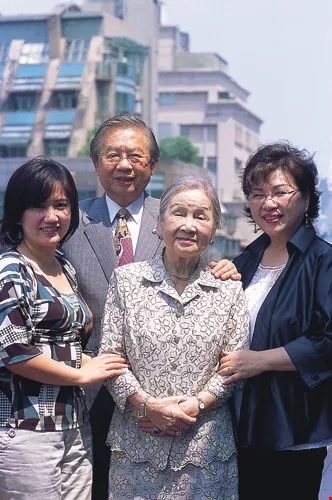
The success of her children and grandchildren has given their mother her greatest satisfaction. From left to right are daughter-in-law Hu Fei-wen, second son Hong Min-hung, Hong You-mien herself and her youngest daughter Hong Hui-chu.


@List.jpg?w=522&h=410&mode=crop&format=webp&quality=80)


