A Helping Hand--Remedial Education Offers Kids Hope for the Future
Chang Chiung-fang / photos Jimmy Lin / tr. by Scott Williams
March 2009


In the 19th century, wealth derived from land. In the 20th, it came from labor. In the 21st, it seems likely to be the fruit of knowledge. Will the knowledge economy then relegate disadvantaged children with limited access to educational resources to lives far outside the "winners' circle," lives at the economic margins?
No. Poor children aren't stupid. Nor are they lazy or bad. Lee Chia-tung, a senior advisor to the Office of the President, has for years been advocating doing our utmost to help disadvantaged kids with poor grades. His exhortations have set Taiwan afire. From urbanites, rural folk, university students, and retired teachers, to evening tutoring programs, the After School Alternative Program (ASAP), the Yonglin Foundation's Hope Elementary School, and the Eden Foundation's Elephants program, it seems nearly everyone is seeking to lend Taiwan's disadvantaged children a hand, pledging to rescue their educations to give them a fair start in life.
In 2006, the Organization for Economic Cooperation and Development's Programme for International Student Assessment, which compared 15-year- olds, ranked Taiwanese students number one in the world in mathematics. But the high ranking obscured a crisis. According to Sung Yao-ting, a professor with the Department of Educational Psychology and Counseling at National Taiwan Normal University (NTNU), the Taiwanese scores ranged from pole to pole and had the highest standard deviation of all the nations in the top ten. The emergence of an M-shaped educational system isn't just a crisis of campus and classroom, it also points to a much larger, much more serious social crisis still to come.
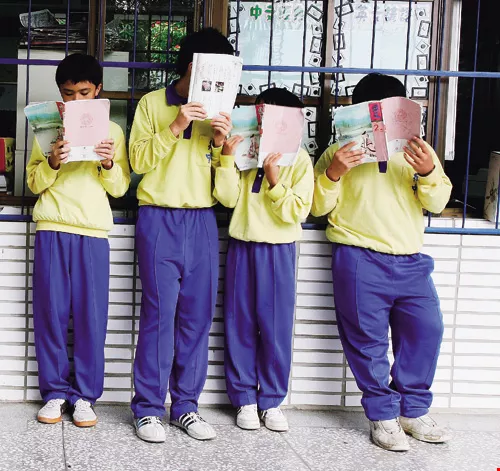
The gap between rich and poor and imbalances in family capabilities are moving us towards an M-shaped educational system. This, in turn, is having a negative impact on the outlook for our children and our society. In the photo, four boys who haven't learned their lessons are made to stand and review the text. Their embarrassed looks can't help but bring a smile to one's face.
Giving kids a push
"When educating, you needn't gild the lily," says Lee. "The important thing is to know how many students are falling behind, and just how far behind they are." Lee sees a pattern in the 2008 College Entrance Examination scores: The English test scores show a clear double peak, with 27% of students scoring in grades 11-13 (15 was the highest grade), and another 21% scoring in grades 3-5. Worryingly, in the just-released results of the 2009 College Entrance Exam, out of 140,000 candidates, 20,000 scored zero in English. The math scores make the severity of the problem even plainer. Some 47% of students failed to score higher than grade 5. On a 100-point scale, these students' scores were in the 20-30% range.
There is also a clear urban-rural divide. On the 2008 middle-school Basic Competence Test, applicants to Taipei's prestigious Jianguo High School needed a minimum score of 290 points (including composition, the maximum score on the test is 312 points). In contrast, there are rural high schools where the school average is only 50-some points. Scores of students admitted to Taitung Senior High School, which is also a public high school, ran the gamut from just over 100 to more than 300 points, a spread of nearly 200 points. "No matter how poorly they score on the exam, students can find a high school somewhere that will admit them," says Lee. He cites the Hualien area as a case in point: its public and private high schools have space for 8,800 senior high school students, but only 4,000-some are actually enrolled. With so many spaces available, students have little incentive to study hard.
In fact, differences don't just exist between rural and urban schools. At urban schools, too, rules against creating classes based on ability have resulted in shocking disparities between students in the same class.
At a parent-teacher conference for the seventh graders at one middle school on the eastern outskirts of Taipei, teachers air their grievances to parents. They are having a very difficult time teaching their classes, particularly their English classes, because there are just shocking differences in the levels of their students. A single class can include some kids who have studied English both in Taiwan and abroad for many years-students who are sufficiently fluent to give speeches in the language-together with others who haven't yet learned the alphabet. The teachers have no idea how even to begin to teach classes that are so mixed.
"The seventh grade is a crucial time in a kid's educational life," says Huang Hsiu-shuang, president of National University of Tainan (NUTN). "It's the point at which many decide they are going to give up on their studies precisely because the differences among students in a single class are so great. If no one lends these frustrated children a hand during this phase, they're likely to give up on themselves. They go from considering themselves stupid to thinking of themselves as bad people and ultimately perhaps even to joining a gang."
Disadvantage vs. poor grades
There is a close relationship between students' grades and their families' socioeconomic status.
"The majority of kids who do poorly on their schoolwork come from disadvantaged families," says Lee. "And most kids from disadvantaged families do poorly at school." He emphasizes that there is a nearly perfect correlation between a family's socioeconomic status and its children's grades at school. Lee argues that we will be doing these children wrong if, knowing this, we fail to act to break this vicious cycle.
NTNU's Professor Sung Yao-ting says that resource limitations and educational inertia lead schools of all levels to utilize unified curricula and teach students in large classes. This approach addresses the needs of only the middle tier of students; it fails those at the poles. Brilliant children can have their own high IQs and possibly support from their parents to keep them moving forward. But students who are behind typically have nowhere to turn and need a helping hand.
In fact, the need for remedial education has long been recognized.
"Disadvantaged children's grades aren't just not good enough, they're terrible!" exclaims Lee, shaking his head. He points out that our national education system doesn't provide for students to repeat courses, much less whole years, and lacks any assessment mechanism. Many children in their last years of elementary school still can't do arithmetic or read a single Chinese character, but are nonetheless promoted into middle school.
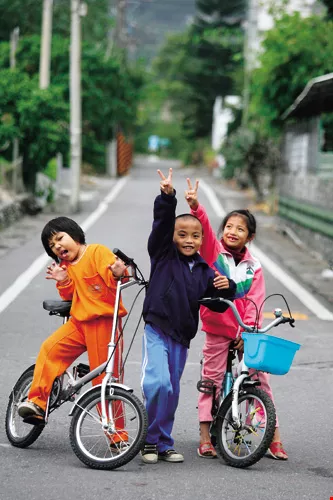
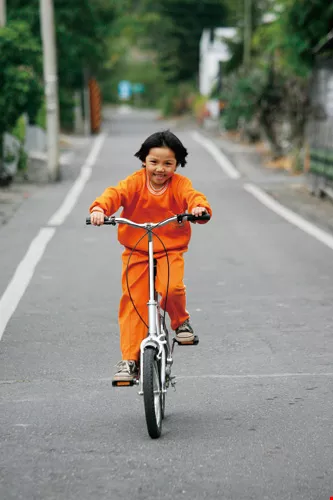
You don't achieve victory just by raising your fist in the air. Disadvantaged children in remote areas need a helping hand to guide them into the winner's circle. The photo shows Taitung's Jianhe Village.
Taking hope home
A former president of Taiwan's most remote institution of higher learning-Nantou County's National Chi Nan University-Lee began sounding the alarm and working towards the resolution of the educational problems of disadvantaged children from remote areas a decade ago.
Supported by the private sector, in 2002 he founded the Boyo Social Welfare Foundation, an institution that recruits university students to assist poor children with their studies. The foundation seeks to help disadvantaged kids with their educations through the most practical and direct means. To date, Boyo has provided free tutoring to some 1,663 elementary- and middle-school students in remote areas, including Nantou's Puli and Xinyi Townships, Taichung's Shalu Township, and Hsinchu's Zhudong, Wufeng and Jianshi Townships.
"The biggest [educational] problem that disadvantaged families face is that the kids don't do their homework," says Lee. The Boyo Foundation therefore sees providing homework assistance as its first step.
Kids go to Boyo six days a week, getting three hours of homework assistance every day Monday through Friday, participating in reading activities on Saturday mornings, and watching movies and writing essays on Saturday afternoons. The activities are intended to broaden their perspective while also sharpening their ability to reason, identify key ideas, and express themselves.
Boyo has devised its own tutoring model, and puts the focus on English and mathematics. "If you want students to do well in school, you have to build a foundation in elementary school," argues Lee. Because kids invariably need more time with concepts than class syllabi allow, Boyo's program ignores school curricula. "Instead, we begin with whatever it is they don't understand, and work with them until they get it," says Lee.
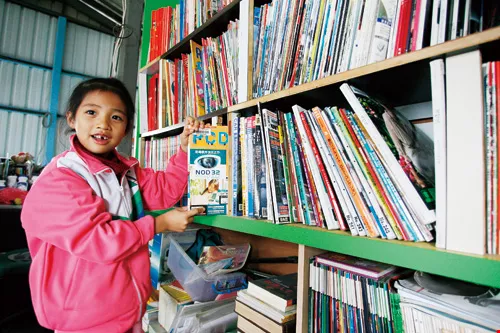
Study less, study well
Boyo's educational materials also differ from those found in schools and bookshops.
"Our objective in math isn't to teach a lot," explains Lee, "but to get students very familiar with a few things." Lee believes that today's elementary-school mathematics is too complicated and difficult. It includes coordinates, right triangles, π, and cones. "I didn't understand π until I was in middle school, and didn't learn coordinates until high school," recalls Lee. "Cones were part of the university calculus curriculum. Our elementary school students are being introduced to overwhelming amounts of material and not even really learning basic arithmetic." Lee therefore developed very clear, very simple materials: they consist of just "Arithmetic," "Algebra 1" and "Algebra 2."
Boyo's English materials take advantage of computers to help students practice their pronunciation, listening comprehension, and spelling, and completely eschew multiple-choice questions. Students must spell every word on their vocabulary quizzes correctly, and must produce complete, grammatical sentences when they translate from Chinese to English on their grammar tests. "These are the most difficult tests in the nation," claims Lee.
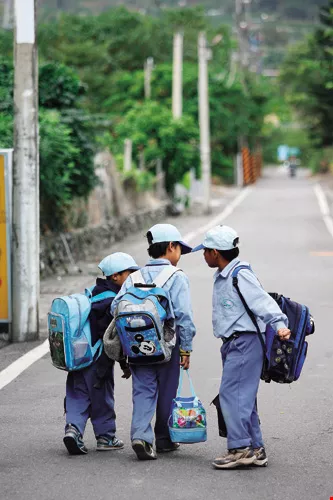
Children with older brothers and sisters to lend them a helping hand while growing up are much less likely to lose their way.
Seeing progress
When kids complete a level, such as English Grammar Volume One or Mathematics Positive and Negative Numbers, Boyo awards them a certificate. All of Boyo's students have now passed the Level One English Vocabulary Test, which means that all know at least 121 English words. "It wasn't easy," says Lee, very satisfied with the fruits of his foundation's labor.
Boyo trains local university students to tutor its kids, hiring them from National Chi Nan University for the Puli center, from Providence University for the Shalu center, and from National Chiao Tung University for the Zhudong center. To ensure that all receive the individual attention they need, Boyo also keeps classes small. At the Puli center, for example, 70-80 tutors work with just 360 kids. "We find a class size of eight is most effective," says Cheng Zhuqin, a group leader at the Puli center.
The foundation depends entirely on donations from the private sector and individuals; it has never received any government funds. Lee says that though they don't pay their tutors much (NT$120 per hour, plus a student-advancement bonus of NT$80 per hour), its jobs offer hard-up university students a little extra money and an opportunity to grow.
The two centers located in mountain townships that lack nearby universities-Jianshi and Wufeng-have a more difficult time finding tutors. Lee says that none of the locals at the two locations have attended university, leaving them without anyone to teach basic English. Boyo therefore developed a "village mother" plan aimed at improving the English skills of mothers in the townships and turning them into teachers. Some 60 parents are currently involved with the program. "We are probably the only institution in the country teaching English to parents," jokes Lee. Aware that they're doing this for their kids, the mothers work extra hard, which is having spillover effects in their communities.
Lee, a results-oriented electrical engineer by training, keeps very detailed data on the results of Boyo's tutoring efforts.
His first breakdown is student performance by grade. From 2003 to 2006, just 14% of the Puli center's first graders ranked in the top half of their class prior to starting at Puli. After a year at the center, 32% ranked in the top half. After two, 48% did.
Lee also relates that when the first group of 35 middle-school-aged Boyo students took the Basic Competency Test last summer, they averaged 155 points, nearly matching the national average of 157, and 12 scored more than 200.
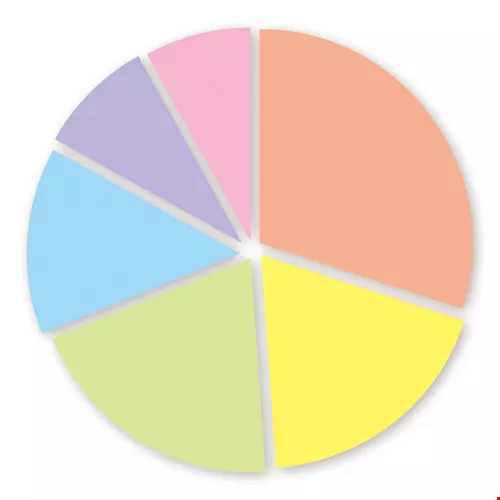
Students participating in ASAP in 2009 / source: Department of Elementary Education, MOE
Going national
The Ministry of Education (MOE) actually began implementing its own "priority regions" program for educationally under-resourced mountain areas and outlying islands back in 1996, before Boyo, the Yonglin Foundation and other such institutions became involved in remedial education. The MOE's objective was to assist students in those areas by providing them computer systems, nutritious lunches, tutoring, and communications support.
Since 2007, the MOE has consolidated its assistance programs into a larger initiative aimed at erasing educational deficiencies, the After School Alternative Program (ASAP).
To keep students in the program from being unfairly labeled, Wu Linhui, a section chief in the MOE's Department of Elementary Education, observes that students always differ in their abilities. "ASAP's objective is simply to ensure that kids don't miss out on educational opportunities because of their socioeconomic background," she says.
"The government's remedial education targets are students from poor families who are doing poorly in school," says NUTN president Huang Hsiu-shuang. According to Huang, ASAP's target students must meet two criteria: they must be doing poorly in school and they must be disadvantaged in some way, e.g. by being from a single-parent family, being raised by grandparents, being from a low-income family, being the child of a recent immigrant, being Aboriginal, being themselves handicapped or having handicapped parents. The program defines "poor academic performance" differently depending on where students go to school. For urban students, the standard is a ranking in the bottom 20% of their class. In rural students, it is a ranking in the bottom 35%.
Up and running for two years, ASAP is still growing in both scale and budget. Between 2007 and 2009, it expanded from 120,000 students to 210,000, and from 70% of Taiwan's public elementary and middle schools to 90%. In short, the program has cast its net nationwide. Program subsidies have expanded similarly, rising from NT$450 million in its first year to a current figure of NT$730 million.
"Since 2008, the MOE has placed non-ASAP schools on a watch list," says Wu. Some of the 9% of schools that don't participate in ASAP simply don't need it because they are already part of the MOE's priority regions program. Others receive help from private groups that provide tutoring, like Boyo and the Yonglin Foundation.
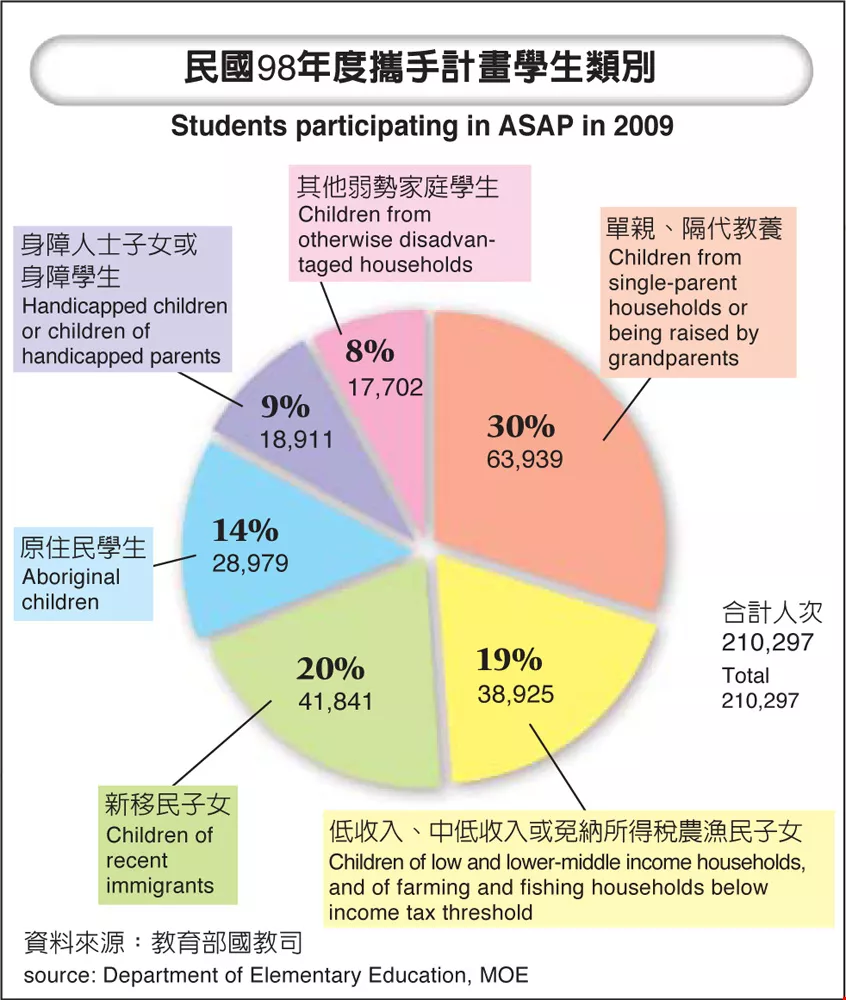
Students participating in ASAP in 2009 / source: Department of Elementary Education, MOE
Same wine, different bottle
Though ASAP's approach is sound, it is a taxpayer-funded program and expectations are high.
Lee worries that the MOE is concerned only with the distribution of funds, not with results. "We should examine the quality and effectiveness of everything we do," argues Lee. "Remedial education shouldn't be any different."
"ASAP has the right idea," says Huang, a program sponsor who avers that the MOE's policy is necessary. Nonetheless, he admits that local governments are implementing it in their own fashion with varying results.
Huang's inspection visits revealed that some cities and counties were very conscientious in their implementation. He cites Haiduan Junior High School in Taitung County as a case in point. The school is so remote and its district so large that the tutors even pick up and drop off the children. On the other hand, some districts need guidance and regulation. "One principal even asked whether the funds could be used on the gifted students, completely warping ASAP's intent," marvels Huang.
ASAP differs from Boyo's program in its use of professional teachers, a decision resulting from pressure for it to be fair, rapidly implemented, and large. In fact, 80% of its teachers are professionals. Only 7% are students currently enrolled in college or university.
"Schoolteachers are more aware of their students' circumstances and abilities," says Wu. "They can dive right in and use remedial education to build on what goes on in the classroom, whereas tutors have to spend time getting a handle on students." Wu admits that university students are young, creative, and get along well with the kids, but argues that they don't have teaching experience. Moreover, whether they're part-time workers or volunteers, turnover among the tutors from the universities is high, which can result in an erratic learning experience for the kids. ASAP also pays its teachers well, NT$400-450 per hour to tutor groups of six to 12 kids. That kind of money for non-demanding work is a powerful incentive to teachers.
On the other hand, many overcommitted and overworked elementary- and middle-school teachers aren't interested in participating because they see tutoring disadvantaged kids as a grind.
"Students are busy from 7 a.m. to 7 p.m.," says Leo Li, dean of academic affairs at Chihpen Junior High in Taitung County. "After 12 hours of study, they're tired. Their teachers are tired, too." Chihpen receives support from the Jianhe Library (see p. 23) and is one of the few schools in the country that participates in ASAP without using its teachers. Li believes that changing settings, teachers, and methodologies gives the kids a bit of a break. He also points out that the whole reason these kids are receiving remedial tutoring in the first place is that the ordinary educational system has failed them.
A survey conducted by Chen Shu-li, an associate professor in the Department of Education at National Taitung University, showed that 91.3% of professional teachers in the ASAP program had had no training in after-school or remedial education.
"Remedial education differs from ordinary education," observes Chen, who argues that ASAP overlooks the necessity for expertise in the field. Instead, it provides elementary-school students with tutoring oriented towards helping them with their homework, and middle-school students with something akin to exam prep. It lacks any overarching attention to individual students' needs, choosing to treat symptoms rather than the disease. In Chen's view, ASAP may be a big program, but it lacks depth and fails to get at the root of the problem.
Ideals and reality
The nation may have become wildly interested in helping disadvantaged kids with their studies, but an underlying paradox is being ignored.
Chen's survey on the tutoring of elementary school students reveals that the more remote the school, the greater the tutoring resources available to it. Poor, remote, and ethnically diverse Taitung County, for example, has only 16,000 students enrolled in its elementary schools, or just 1% of Taiwan's total, but in 2006 accounted for 10% of the MOE's spending on ASAP. Where a typical school district might be allocated enough funding to tutor one out of 10 students, Taitung gets enough for one of every two students. Will this uneven distribution of resources leave poor urban kids so completely ignored that they become the most disadvantaged students of all? The question deserves a good, hard look.
On the other hand, there's no guarantee that throwing money at a problem will solve it. Chen notes that Taitung County students' scores on the Basic Competency Test have ranked the lowest in the nation for four years running, far behind those of even the second-worst performing region. "This suggests that large amounts of tutoring haven't enabled Taitung County to catch up."
Huang's response to this is that education is concerned with long-term effects that aren't reflected in a single county's scores on a single test.
"The program was only fully rolled out last year," says Huang. "It will take three years before we see results." Huang asks that the public be patient and not rush to judge ASAP's success or failure.
Wu adds that ASAP's objective is not to ensure that kids earn admission to middle school or high school, but to promote learning of the fundamentals and ensure that they understand at least 80% of the curriculum. The MOE has asked NUTN to develop testing tools that are expected to be ready in June. Regardless of local differences in methodology and ideology, there's no question that helping kids is the way to go. As ASAP moves forward, it will continue to lend kids a helping hand.

Lee Chia-tung, a senior advisor to the Office of the President, has been working for years to salvage the educations of disadvantaged kids. These days, he's worried. With the economy in the tank, corporate donations to his Boyo Foundation have dried up. "No matter how poor we are, we can't impoverish our children!" exclaims Lee, who hopes everyone will come together to help keep kids in the Boyo program.Boyo website: www.boyo.org.tw

Kids have to express their passion, but their creativity needs to build upon a solid educational foundation. Otherwise, it runs the risk of becoming purely an excuse to escape the real world.
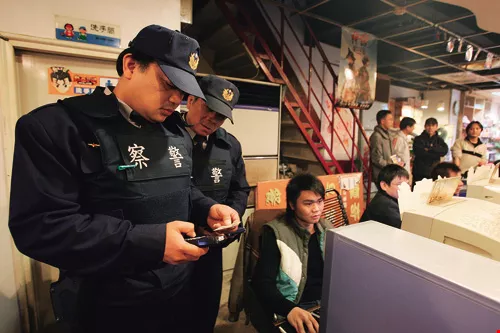
Is it really true that the only way kids with poor grades can gain even a moment's sense of accomplishment is by beating a video game? Pictured here, police check IDs at a net cafe.
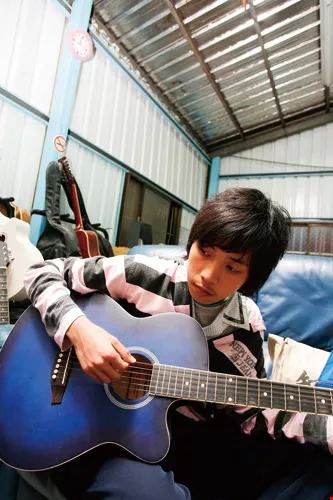
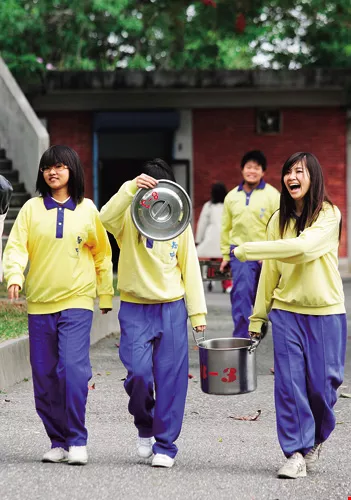
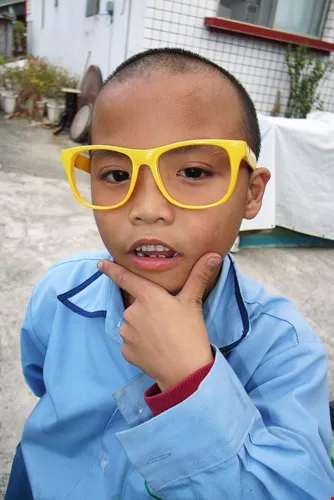
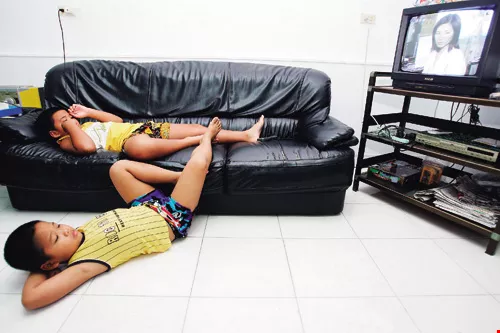
Children of recent immigrants from Southeast Asia, mainland China, Hong Kong, and Macao are among the targets of the Ministry of Education's After School Alternative Program (ASAP), and account for 20% of the students participating. Some come from good homes, but their parents work so much that there's no one to keep an eye on them after school.