New Hope for Our Children
Chang Chiung-fang / photos Chuang Kung-ju / tr. by Geoff Hegarty
November 2005


Most people dream that by the time they reach the grand old age of 60, they'll be surrounded by at least 30 or 40 delightful laughing children and grandchildren, congratulating them and helping them celebrate--the picture of a harmonious and prosperous family home. This dream, however, is becoming ever more remote for the modern nuclear family--unless, that is, they are willing to take on the responsibility of looking after other people's children and become foster parents.
Lin Chih-cheng and his wife of Chungho in Taipei County had just such a dream. They began fostering children and by simply helping, encouraging and deriving strength from each other, have been able to achieve their dream and courageously fulfill their role as a foster family.
But fostering a child is not an easy road; unless you've actually been there, the experience is one whose trials and disappointments are difficult to imagine.
In our modern age of individuality and regard for the self, some people feel that one child is already quite a burdensome task, while others shy away from even this responsibility and choose not to have children at all. How and why would someone be willing to take on the work of being a foster parent, with all the extra anxiety that such a decision entails?
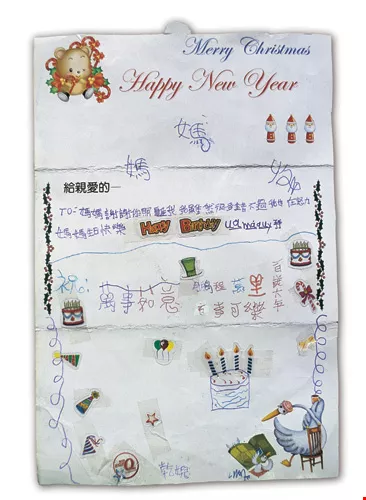
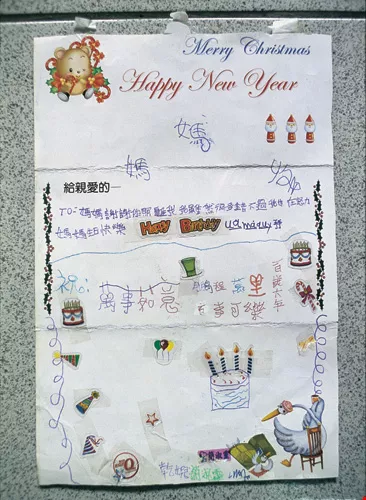
On Mother's Day the children presented their foster mother with cards to express their thanks and best wishes.
Rewards of a different kind
A survey by Taipei County's Center for Children and Families (CCF Taiwan) ranked people's motives for fostering as follows: firstly, it was considered to be an important contribution to society; second, it's an effective way of caring for unfortunate or unwanted children; third, people simply want to be charitable and perhaps accumulate credit in heaven for their beneficence; next, parents find that they've got either plenty of free time, or lots of space in the family home; some people simply enjoy having children around them; and for others, it's just a way of earning extra income.
The Lin family belongs to the third group. Chang Ching-chun is aged 40, but still has the looks of a young, beautiful woman. She also has a strong sense of compassion bolstered by her involvement in Tzu Chi, a Buddhist charity organization. "My two children are teenagers and I have to look after my mother-in-law, so I can't go out to do volunteer work for Tzu Chi. One of my friends is a foster parent, so when they told us about this very simple way of doing charitable work, we decided that fostering children was the ideal way for us to give something to the community," she says.
Fortunately, her husband Lin Chih-cheng not only approves of his wife's decision, but in fact spends a lot of his own time and energy sharing the responsibility of providing a good home environment for the children.
It's obvious that to foster successfully, you need a passion for what you are undertaking and a genuine enjoyment of bringing up children. But there are also some more down-to-earth requirements.
Essential conditions for families considering fostering are set by CCF Taiwan: they look for two-parent families, aged between 25 and 60. Both parents must have at least a junior high school education, and the family needs a stable income. One of the parents must be a full-time homemaker, and the number of children in the family home under 12 years old (including foster children) cannot exceed four.
The Lins, a middle-class family, applied to CCF Taiwan to become a foster family more than two years ago. Shortly before this important step, Lin Chih-cheng had got out of his restaurant business and become a postman with the Shangta post office. Chang Ching-chun stays at home to look after the house. Of their two natural sons, one is studying first year in senior high school, and the other is at junior high school, also in first year.
Over the past two years, the Lins have cared for three foster children, all of whom have now returned to their original homes. In the beginning, there was a lot of upheaval, at times bedlam, but gradually they gained experience and became seasoned foster parents.
In addition to those three, they are presently caring for two junior-high-school girls. Hsiao-chi (name changed) has been living with them for two years, and Hsiao-mei (name changed), for four months. They instinctively call their foster parents "father" and "mother." There has been a distinct lack of daughters in the Lin family, so these two girls have brought a type of happiness that they couldn't experience with their boys. Girls are generally more intimate with their parents and often spend their free time chatting with their foster father. And of course they are closer to their mother than the boys were, regularly sharing female secrets and new experiences.
Tolerance brought by love
At the beginning, however, the arrival of the girls was like a shock grenade thrown into the normally peaceful Lin family home. For the two boys, the sudden appearance of two new "sisters" was like having a stranger come to steal their parents' love away. The younger son even complained to his schoolteacher by writing in his weekly diary a story posing the very difficult question: "Why do I have to share my parents' love with someone else?" The boys thought that as well as usurping their parents' affections, the girls misbehaved badly, helping themselves to the boys' belongings with no "please" or "thank you." The boys were simply not used to this sort of behavior and conflict was the inevitable result.
Who would choose to live with a foster family if they had any alternative? After some heart-to-heart counseling from their parents, and allowing a period of time for them to adapt, gradually the boys accepted their new "sisters," who after all have no blood ties and will probably leave at some time in the future.
The Lins were a bit taken aback by their sons' reactions, but they treated it as any sensible parent would. Chang Ching-chun believes that having to learn tolerance, having to share and provide help at this early stage in their lives, is going to be of benefit to her (sometimes a little spoiled) sons in the future. The two boys are no longer actively hostile to the fostered "brothers and sisters," but because they are teenagers, they rarely mix unless it's for a special excursion together. They're friendly on the surface, but the boys' sense of distance is there nonetheless.
There are more serious problems than these that constantly challenge foster families.
Despite having to confront problems with the children they foster, like stealing more than ten pairs of shoes from kindergarten and repeatedly stealing money, the Lin couple try to remain as tolerant of their failures as is possible, preferring to patiently explain the wrongness of their actions rather than dressing them down.
Because of the mental trauma of separation, the needs of the children who are missing their families and the attachment to their original parents are difficult for foster parents to replace.
The Lins never question their children about their original families or any unhappy experiences of possible abuse; instead they quietly observe and try to be there when they are needed. On one Mother's Day, for example, one of their foster children rode a bicycle to the park and sat alone seemingly in a daze. Another child had been abused by her father, but was constantly expecting to see the father appear. Sometimes when meeting her real parents, in order to impress them, the child would accuse the foster parents of not loving her, or of doing terrible things, like denying her food.
"In the beginning at times like that I really felt bitter about the whole business," says Lin Chih-cheng. Having given his heart to the children in his care, he had to bear the thought that the child was totally unmoved by his love and was in fact criticizing him behind his back. With time, he could understand that after all they were just children having to survive in an almost impossible situation, so naturally they have learned their survival skills well; they were, like the Chinese saying "steering by the wind," acting as the very difficult circumstances demanded. Whatever the foster parents do for their children, they can't control their lives and can never take the place of their real parents. The fact that you are merely a temporary stepparent has to be squarely faced, so you just have to do your best and try to feel no qualms about some honest self-evaluation. In these circumstances, you can't afford to worry too much about a little innocent defamation.

The road back home is long and rugged. Although they have a place to stay, abused children in foster care often seem vexed and unsettled.
Treating them as their own
On the brighter side, most foster children are quite appreciative of the care that their foster parents take to look after them. Hsiao-chi, who has quite a history of running away from home, had already experienced three foster families before she came to live with the Lins; now, she doesn't want to leave.
During the first birthday party that she had ever experienced, celebrated with the Lin family, she was so moved when she saw the beautiful birthday cake on the table that she burst into tears. That touched the Lins deeply. Lin Chih-cheng told us that Hsiao-chi's parents were divorced, and then later her father deserted her, so he has always done his best to replace the love she could never hold on to.
Love of course doesn't mean a limitless supply of material goods. And anyway, middle-class families like the Lins can't offer their children a life of luxury. Lin Chih-cheng remarks that "as long as we do everything equally, the children will not complain or feel badly treated." The Lins make a real effort to treat their own and their foster children as fairly as possible. They provide them with identical living conditions and treats, but equally dish out the same punishments. For example, they have the same amount of pocket money--NT$600 per month; they read books together from 8 p.m. to 9 p.m.; but if they do the wrong thing, they have their pocket money reduced or limits placed on TV time, and other similar penalties. If everything is done impartially, the foster children will naturally come to believe that their temporary parents cherish them as they do their own children.
Under these conditions, the Lins have found that foster children who had previously been unable to adapt well to other families have gradually changed their attitudes and settled in, a result which has made them very proud. They find great contentment when foster children return to thank them for their care.
On both Mother's and Father's Day, the girls treated them to restaurant dinners paid for with their savings from pocket money. While the Lins were telling this story, they proudly displayed the cards made by Hsiao-chi and Hsiao-mei. In imperfect language, the girls express their thanks to and good wishes for their foster parents.
Costs associated with looking after foster children are paid by the government: for children under the age of 12, parents receive NT$17,540 per month per child; for older children, the monthly amount increases to NT$19,290. However, the benefit to the child's life and the appreciation of that benefit by the children themselves are together the real compensation for the foster family. Although there is some financial incentive to foster, it is impossible to compare the outgoing in love and responsibility for the foster children with any financial reward the foster parents might receive.
So it is quite amazing, and quite wonderful, that despite this imbalance between what must be given and what is received, some people like the Lins are still happy and willing to take on such a tremendous task. They look forward to the day when they can celebrate their 60th birthday surrounded by 30 or 40 happy children. Lin Chih-cheng believes that "If that day ever comes, all the hardship will have been worthwhile."
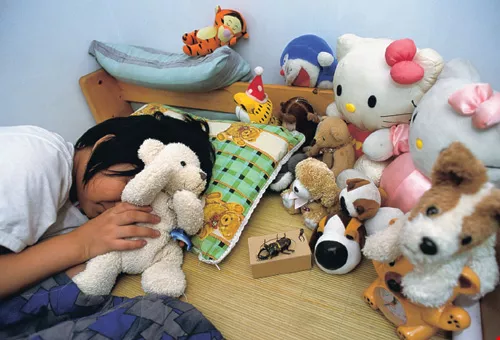
Japanese dolls Doraemon and Hello Kitty help to fill the emptiness.
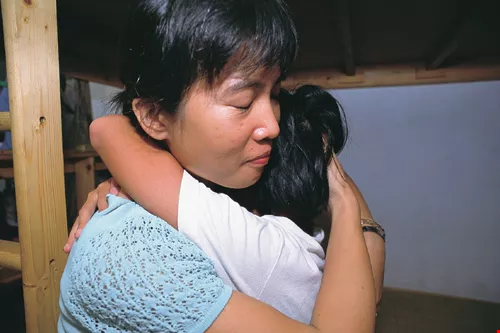
Chang Ching-chun treats the foster children as her own, and her love has been rewarded by their trust.
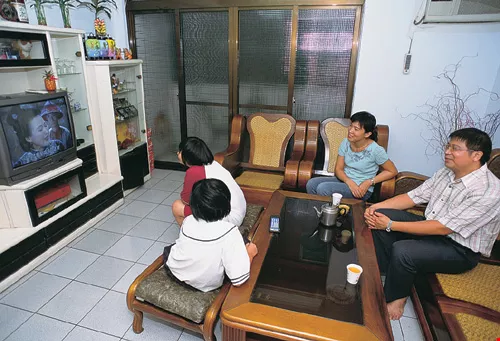
The Lin couple have had over than two years experience being foster parents, but they regard the bittersweet process of raising other people's children as a way of increasing credit in heaven for their beneficence.


@List.jpg?w=522&h=410&mode=crop&format=webp&quality=80)


