Job Hunting in Lean Times
Teng Sue-feng / photos illustrations by Lee Su-ling / tr. by David Mayer
August 2001


University students in Taiwan are fond of saying, "Graduation day is unemployment day." This year's graduates are finding the phrase especially applicable. Joblessness has been rising steadily since October of last year, and there is no end in sight to the deteriorating employment situation.
For a graduating seniors with ideals and vision who don't want to wait idly for an opportunity to drop into their laps, what fields today offer the best employment prospects? How does someone just entering the work world plot out a course for the future? What kinds of skills and abilities are needed in today's constantly changing job market?
The biggest job fair of this year's graduation season was held on July 21-22 at New York New York Exhibition Shopping Center, in Taipei's Hsinyi Development District. Over 80 firms had booths there, including IT firms like Compal Electronics and Silicon Integrated Systems, and service sector companies such as Cathay Life Insurance and PC School.
A young Mr. Lin stops at the Compal booth and inquires about the requirements for a process engineer. Lin holds a degree in mechanical engineering from Da-Yeh University, and has recently completed his compulsory two-year stint in the military. He retrieves a resume from his backpack, hands it to the person manning the booth, and asks whether he'll be able to have an interview. In the meantime, business management graduate Ms. Li has been once around the exhibit hall and mumbles to herself, "I don't think there's anything quite right for me." Big crowds of job seekers throng to the booth of the National Youth Commission (NYC), where they register their personal information on the NYC website.
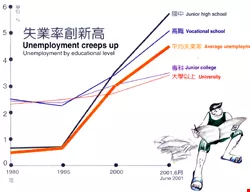
The following day, the Directorate-General of Budget, Accounting and Statistics reports that unemployment figures in June have once again hit new highs. The unemployment rate is 4.51%, with 442,000 persons out of work and 1.026 million directly affected by unemployment (topping one million for the first time).
Slim pickings in the job market are bad news for the 180,000 people who graduated this year from Taiwan's institutions of higher education.
Hsu Wan-yun has a degree in education from National Taiwan Normal University (NTNU) and hopes to work in public relations, but she laments, "New graduates have really got it rough because the great majority of job openings out there require at least one year of experience." She ignores the requirements and sends resumes anyway, but she hasn't gotten any response yet on the dozen or more resumes that she has sent out so far.
Tsou Ya-chuan, who graduated at the end of last year from Shih Hsin University's Graduate Institute of Communication, has seen even more frustration than Hsu, however. He has no idea how many resumes he mailed out during his job search, often dispatching them by e-mail in batches of eight and ten at a time. After five months of searching and seven or eight interviews, he finally landed a job in marketing planning with Advanced Semiconductor Engineering. Although his friends and former instructors never said anything to pressure him, he felt pressure from them nevertheless, and it was a big relief when the job search was finally over.

Unemployment is being pushed upward by factory closures, bankruptcies, and the migration of industry to offshore locations. Over a thousand workers took to the streets on May Day to demand that the government and employers take measures to protect their jobs. (photo by Pu Hua-chih)
Reshuffling the workforce
Young job seekers can't help feeling a bit victimized by the bad timing of their graduation. Even the economists are surprised at the severity of the current downturn.
According to Hsin Ping-lung, a research fellow specializing in labor economics at the Chung-Hua Institution for Economic Research, unemployment last peaked in Taiwan in 1985 at 2.91% but quickly fell to under 2% by 1987, thanks in part to global economic recovery. The fact that Taiwan was well situated at that time to profit from the international division of labor also contributed to the drop in joblessness.
Notes Hsin, "Most of the people in the earlier unemployment peak were looking for their first jobs, but this time around they have previous work experience. They've got families to support, and are not going to pull out of the job market without a real good reason, so the unemployment figures won't be dropping any too quickly. People are pessimistic about this wave of unemployment because many of the positive factors that formerly propelled economic growth in Taiwan have disappeared. No one knows when we'll be bottoming out."
From a historical perspective, it appears that the cause of today's unemployment can be attributed to economic restructuring.
In the 1960s Taiwan's economy was based on low-tech, low-cost, labor-intensive, export-oriented industries. Taiwanese firms turned out high-quality products at low prices. A hard-working labor force made Taiwan a key manufacturer of textiles, shoes, clothing, and more. In the latter part of the 1980s Taiwan began liberalizing its economy. The pace of industrial restructuring quickened. Labor-intensive operations started migrating offshore, while industries here became increasingly capital- and technology-intensive.
The migration of traditional industries to Southeast Asia and mainland China eliminated hundreds of thousands of jobs in Taiwan. A small portion of the people thus displaced found other employment in the manufacturing sector, while some others got jobs in the new service sector. It was at this time that Taiwan's information technology industry began to grow rapidly, and for a while it attracted the lion's share of society's resources, absorbing huge amounts of capital in the stock market and snagging all sorts of government tax incentives. A relatively large supply of jobs opened up for people with high-tech skills and a high level of education. There came to be a relative abundance of jobs involving intellectual labor and a relative scarcity of jobs requiring physical labor.
As industry has restructured, workforce distribution has naturally followed suit. The agricultural workforce is declining steadily, and accounted last year for only 7% of the total working population. Changes in industrial workforce distribution have varied, depending on the sector. While the number of manufacturing jobs has remained fairly constant, employment in the building trades has dropped sharply from a 1995 peak of 1 million to only 750,000 last year. This sector has contributed greatly to rising unemployment figures.
It's a different picture in the service sector, which made up 45% of the total workforce in 1990, 52% in 1996, and 55% last year. Employment has expanded especially quickly in wholesaling, retailing, food services, the "social services" category (i.e., health care, media and communications, etc.), and communications and transportation.

Taiwan has undergone large-scale industrial restructuring in the past 20 years. White-collar service jobs will soon become the mainstream occupation, and few will be willing to do dangerous and dirty manual labor. (photo by Hsueh Chi-kuang)
Rooting out the opportunities
Virtually every segment of the economy has been hit by layoffs in the past two years. Amidst the carnage, however, some sectors have clearly generated more job opportunities than others.
According to Anita Liu, director of the Manpower Planning Department at the Council for Economic Planning and Development, "Young people are in greater demand than older job seekers. Lots of companies, both domestic and foreign, lay off current employees and recruit new ones at the same time. The only ones not doing it are companies that are neglecting to pursue long-term management objectives. Glancing at some statistics in her hand, Liu points out that for the past two years, graduates of higher education have had a lower unemployment rate than other groups.
So where are the job opportunities? What fields offer the best prospects? Does choice of major affect one's chances for success?
104 Job Bank carried out a survey last March in which companies were asked about their willingness to hire first-time job seekers. The results showed that 50% of the respondents had no plans to recruit such people this year, while 35% did plan to recruit. The reason most often cited for not hiring first-time job seekers was that the company needed people with work experience. The next most common response was that the weak economy prevented such hiring. Breaking down the survey responses by industry, we find that IT firms were the most likely to hire applicants without work experience, followed by companies in the service sector.
An online survey carried out by United Daily News in June, however, yielded more encouraging results. In the poll, 57% of 200 human resource professionals indicated that their organizations were planning to hire this year, and 72% of the people in this group said that their companies would be hiring first-time job seekers. Companies had the greatest need for people to work in sales (49%), followed by product developers and creative personnel (33%). Bringing up the rear were administrative, marketing, and customer service jobs.
Lin Tsu-chia, an associate professor of economics at National Chengchi University, has done a comparative study of the job hunting success of people who graduated from higher education the year before last. According to Dr. Lin, "What you majored in doesn't make as big a difference as what level of education you've attained. University graduates found jobs more quickly than junior college graduates, and with better pay and conditions." Junior college graduates generally joined at the bottom rung as secretaries or the like, and their average pay, at NT$27,000 per month, was well below the NT$34,000 earned by the average university graduate.
Dr. Lin discovered that in 1999 59% of university and junior college grads found a job within one month after graduation, while for all graduates it took an average of 1.37 months to find a job. The job hunt was relatively easy for those who had studied science (chemistry, physics, biology, etc.) and engineering (mechanical engineering, electronic engineering, etc.). Over 59% of all graduates found jobs related to what they had studied.
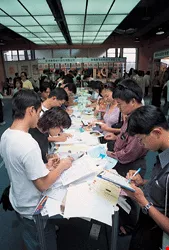
Big crowds of first-time employment seekers fresh out of school carefully scan job listings at a big summer job fair. (photo by Pu Hua-chih)
Where the jobs are
Although industries across the board have been affected by this year's economic slump, it appears that high-tech firms, which have been stellar performers for a decade, still have excellent growth potential.
Taiwan's information technology (IT) industry had an output of US$28 billion last year, and the island held number one market share for a number of IT devices, including monitors and motherboards. In a report focusing on how to expand the capacity of Taiwan's information infrastructure, the Council for Economic Planning and Development forecast that rapid development in this sector will generate a demand for over 40,000 engineers. In the meantime, there will only be something over 26,000 persons capable of filling these positions, which require persons who have a bachelor's degree or better in engineering, or have undergone on-the-job training to give them the necessary qualifications.
In addition to telecommunications, information technology is another sector that has been providing a lot of employment.
According to Li Tai-an, of the Ministry of Economic Affairs' Industrial Development Bureau (IDB), "Taiwanese industry is clearly in transition, moving away from production and toward high-tech R&D." Li explains that the IDB is planning to push for Taiwan to become the world's main producer of G3 mobile phones, and hopes to see the island's output reach NT$300 billion by 2005. With new developments in such areas as cordless phones, pagers, intercom systems, mobile phones, and Bluetooth technologies, the IDB expects an annual shortfall of 6000 R&D staff in the wireless communications industry.
But that doesn't mean that those with degrees in the liberal arts, law, or business need give up hope. Although they don't have it as good as those who have studied science or technology, they can still make a go of it. They just have to take a hard look at what's available in the service sector, which closely tracks trends in society.
Christina Ongg, president of Career magazine, notes that the average age of Taiwan residents is on the rise, and feels that people have embraced the idea of healthy and happy living. In this sense, Taiwan is squarely in the global mainstream. The quest for good health and longevity is giving rise to interesting new social phenomena, and new service-sector business opportunities are expected to emerge in such fields as health food, medical services, leisure, and psychological counseling.
The field of media and communications, which provides both information and entertainment, also holds out great promise to job hunters. Even though some major media firms have laid off employees this year, many new publications have been launched. The trend toward greater specialization and creativity in Taiwan's media promises to provide very challenging jobs to graduates with liberal arts degrees.
In the financial services industry, now that the legislature has passed the six major financial reform bills called for by the Ministry of Finance, scholars expect competition to heat up as firms begin to merge and expand into lines of business formerly off limits to them. There are likely to be a lot of job opportunities in the near term, but hiring appears likely to slacken off eventually. Job postings on CT Career, an employment search website run by China Times, show that Taishin International Bank, Chinatrust Commercial Bank, and Citibank are all still hiring in northern Taiwan, but the drastically deteriorated finances of credit cooperatives and credit departments at farmers' and fishermen's associations have prompted many new banks to turn their attention to developing markets in central and southern Taiwan.
Says Ongg, "There's demand in every field. It's just that it's a buyer's market right now. Employers are getting picky about what applicants have majored in, and sometimes even about what school they've graduated from. When firms are hiring at a slow pace, like now, they naturally choose more carefully."

(photo by Pu Hua-chih)
Make me a match
Experts at job banks and job placement centers agree that today's high unemployment is due in large part to the difficulty of achieving a better match between job skills and the requirements of employers. The mismatch stems mainly from the fact that most of the available jobs today involve low-paying manual labor. Choosy older job seekers tend to shun such work, while young people entering the job market for the first time are heading in droves for the more attractive service and high-tech sectors.
According to statistics released by the Council of Labor Affairs' Employment and Vocational Training Administration, more than 63,000 people sought employment in May, but only 8214 of them actually found jobs. Taking a closer look at the more than 54,000 whose job hunts were not successful, we find that 50% of them could not find anything they were qualified for, while another 22% had opportunities but turned them down for one reason or another, the two most common reasons being unsatisfactory pay and benefits, and an unacceptable work environment.
Huang Meng-ju, director of the Council of Labor Affairs' Taichung Employment Services Agency reports that the center consistently has over 30,000 valid job offers available. Of these, 40% involve physical labor, another 40% are clerical, and 20% are in such fields as planning, research and development, and financial auditing, where experience is required. Jobs requiring manual labor go unfilled, while everyone competes for office jobs, generating a serious imbalance.
According to 104 Job Bank's Simon Juan, "The job market has changed a lot since the third quarter of last year. There were 1.06 jobs per seeker in October, but by May the ratio had gone down to 0.46." The situation is even worse with general clerical work, because so many are able and willing to do it. In this category there are about ten candidates for every available position.
In competing for jobs, new entrants into the market cannot expect a lackadaisical approach to yield results. They must make a clear-eyed appraisal of their abilities and do everything possible to get what they want.
The Taichung Employment Services Agency helps an average of 150 graduates of higher education find jobs every month. Director Huang Meng-ju states that people with degrees in science or technology generally have pretty good luck finding jobs on their own, but based on past experience, she expects liberal arts graduates to start visiting the agency in greater numbers toward the end of the year to seek help after their own job hunting efforts fail to turn up anything.
Although the economic downturn has led some first-time job seekers to lower their expectations, there are still a lot of university and junior college grads who can't find what they want and don't want what's available. Director Huang notes that some people demand a monthly salary of NT$30,000, which is above the going market rate. He adds, "First-quarter statistics show that 20% of young recruits got fired within three months. If they're not feeling so good, they'll take the day off. If they don't finish their assigned tasks by clock-out time or are having trouble with something, they'll just go off and leave the task unfinished. They've got to develop a more serious attitude toward their jobs."
Adds Huang, "People who are just joining the workforce should use each opportunity as a stepping stone to the next opportunity. They should sharpen their skills while on the job. The longer you stay out of work, the worse it is for your job skills."

(photo by Pu Hua-chih)
One-trick pony
Human resource professionals and other experts familiar with the changing nature of the job market provide hard facts about the market, but they're also there to encourage young job hunters. If you've majored in a field where job opportunities are scarce, what should you do?
104 Job Bank's Simon Juan cites the example of a young woman who had graduated from National Chengchi University with a degree in Arabic. Realizing that her options were limited, she enrolled in a training program at the China External Trade Development Council (CETRA) to enhance her marketability.
Says Juan, "Job hunting is complicated. What you major in makes a difference, but mileage can still vary considerably for different people." The survey by 104 Job Bank revealed that more than half of new entrants to the job market work during the first year at a job connected with what they've studied, but as time goes by their work either veers off in another direction entirely or goes even deeper into their chosen field of study. Juan notes, "This tallies with our finding that with 52% of the jobs offered through 104, the employer doesn't care what the applicant has studied in school. It is clear that many people can still find a job that isn't connected with what they've studied."
Juan advises new job seekers, "Everyone wants to find a job they like, but at a time like this, when opportunities are scarce, if you can't find something you like then you just have to take whatever you're qualified for."
Banking and financial advisor Chiang Cheng-wei writes that many people who've studied business dream of working in the financial sector, but he warns them not to get their hearts set on sitting around at a bank counting up bills in air-conditioned comfort. The financial services industry is headed for a shakeup, with lots of mergers soon to take place between financial institutions. These will result in layoffs, and the employees getting the pink slips will be those who contribute little to the bottom line or lack solid expertise in the field.
Chiang warns, "If you take a bank job, you'd better be ready to bone up on the financial industry, sharpen your sales skills, and become a multi-talented money management advisor." Financial products are complex and come in infinite variety. Banks badly need powerful systems for integrating financial information, so computer specialists with a strong quantitative grasp of the business will be highly valued by their employers.

In addition to field-specific expertise, employers also value people who have a zest for learning, a strong work ethic, and the ability to be a good team player. First-time job seekers need to ask themselves whether they've got what it takes.
Personalized placement
In a position paper focusing on how to develop Taiwan's human resources, the Council for Economic Planning and Development forecasts a surplus of workers with medium skill levels and a shortage of people with advanced specialties or management expertise. A shortage of people willing to do general labor is also predicted. The expected surplus of workers with medium skill levels has a bearing upon plans to expand higher education.
According to Hsin Ping-lung at the Chung-Hua Institution for Economic Research, "It isn't necessarily a good idea to herd everybody into universities, because a lot of jobs don't require a university or junior college education." But education resources are limited, and once they've been expended you can't let graduates go without jobs. Schools have a responsibility to help graduates get themselves placed.
Says Hsin, "The people of Taiwan have always been told that low unemployment and rapid economic growth are somehow guaranteed, but an economy cannot keep expanding at a rapid rate indefinitely. People used to think they wouldn't ever experience unemployment, with the result that we aren't able to deal with it very well." Hsin advises that a social safety net alone is not enough to deal with unemployment. In addition, he argues, schools should provide students with a semester of instruction in how to get ready for the job market. The preparation should include aptitude tests to diagnose each student's abilities and interests, and students should be taught needed skills. In addition, ongoing efforts by the government, private sector, and schools to cooperate on job training could be incorporated into school curricula. Says Hsin, "If job placement is to be effective, it has to be personalized and carried out more aggressively, with greater attention to the needs of individuals."
Business programs present a good case in point. According to Wu Se-hwa, dean of National Chengchi University's College of Commerce, there are mismatches between course offerings and what graduates are going to find in the real world. Small- and medium-sized businesses constitute the backbone of the Taiwanese economy, but the school teaches principles that apply mostly to major corporations, because the management expertise of large corporations is much better developed and offers more depth.
Says Wu, "Both schools and employers bear responsibility for making our curricula correspond more closely to the reality of the workplace. Schools are responsible for imparting useful knowledge, and employers must make good use of what students have learned." Wu notes that a graduate of a physics departments in the United States might end up working as a science and technology reporter, and a history grad might become an outstanding editor of children's books or a museum guide. Taiwanese schools and employers have yet to get together in this way.
Practical knowledge
Liu Chung-ming, a professor of atmospheric science at National Taiwan University, points out that at this year's National Placement Test, companies were recruiting one person with at least a bachelor's degree in atmospheric science and ten with lesser qualifications, but he estimates that a far greater number of people graduate every year from university and junior college programs in atmospheric science-135 bachelor's degrees, 30 master's degrees, and 5 doctorates. Liu estimates that at least 150 such graduates will have joined the ranks of the unemployed this year.
Because of Taiwan's geographic and meteorological conditions there is a great need for people with meteorological expertise, but Liu laments, "Just look at all the private TV and radio stations who aren't willing to shell out for professional meteorologists. They hire regular reporters with no field-specific expertise. These jokers just stand out in storms, posing in front of the camera and talking a bunch of unscientific nonsense."
Liu asserts that important industrial facilities throughout Taiwan need trained meteorologists to monitor atmospheric conditions where expensive equipment is installed, otherwise they will be unprepared to take preventive measures before sudden power outages, storms, or floods occur, and they won't be able to seek compensation afterward. All they can do is curse their bad luck. Every year during the typhoon season, the Central Weather Bureau becomes the most important news source in the country, but the bureau alone cannot satisfy everyone's needs. Local governments also need trained meteorologists to monitor harbors, railways, and important highways and bridges.
Says Wu Se-hwa, "We have to make sure that students acquire useful knowledge, but traditional universities have always fixated on theoretical knowledge while holding practical knowledge in disregard, as if it were somehow vulgar. But there's a difference between vulgarity and practicality."

Age of the chameleon
The book Employment Trends notes the tremendous pace of change in industry today, and states that the only comparable period in history is the Industrial Revolution of 200 years ago. Machinery propelled industrial development, then factories and offices grew to enormous size, which brought increasing specialization. The trend toward specialization is now reversing, however, thanks to the dizzying pace of advances in science and technology, and the spread of automation. The way we work is changing once again. Gone are the days of "one radish per row," as the Chinese saying goes. The one-trick pony, in other words, won't get far in today's world. Employers want people who can take on multiple responsibilities. They want chameleons.
When asked what skills are most useful in helping employers keep their footing in these uncertain times, many human resources professionals list computer skills and English proficiency as the most basic requirements, but others put greater stock in professional expertise.
In Wu's opinion, "You simply must have a specialty, and you should be really good at it. Then you should complement it with an appropriate breadth in terms of general knowledge."
Hsin Ping-lung suggests that new job seekers should avoid stampeding with everyone else into fields with the hottest demand, and points to the plummeting fortunes of dot.com businesses, one of last year's ten most popular fields for job hunters, as an example of the dangers inherent to this approach: "No matter what the industry, it's scary when every company out there is in a life-or-death battle for survival. An employer might hire big in a bid to capture market share, but this type of demand is short-lived. Once the industry stabilizes, the company will start cutting people again."
Li Jui-hua, deputy head of the human resources department at Taiwan Semiconductor Manufacturing Corporation, feels that the hunt for a job is similar to the hunt for a mate. Rather than try to package yourself to appear to be someone you're not, you should just have a clear idea of what you want and search for a job that is appropriate to your skills and wants. You should also put yourself in the other person's shoes, find out what kind of person the employer is looking for, and show your strengths as quickly as possible. Transparency and honesty are always the best policies.
Says Li, "Even more than technical expertise, what employers are really looking for is someone with strong learning ability. Knowledge cycles are shortening. There is an old Chinese saying: 'Live to old age, learn till old age.' But now it would be more appropriate to say: 'Learn till old age, or you won't make it to old age.' Learning shouldn't be something you do at random, either. You should have a goal, and pursue it with discipline." If you want to become a mechanical engineer, you have to plan your life around your goal. You have to learn all about machinery and manufacturing processes. Then later on you might join management, at which time you would need to pick up expertise in business management.
Many agree on one piece of advice for first-time job seekers: Even though the economy may be in a slump, you must not let yourself get discouraged. In the future there will be no such thing as a "steady job." The market will just keep getting more and more competitive. Graduation day is a time for goodbyes, so get ready, young graduates, to bid farewell to the carefree life you've known. Graduation day is also a launching point. Prepare to enter a new phase of your lives.
Case study1
Lu Chia-lung, 25
Information systems engineer
I couldn't be described as new to the work world, but as far as my current job is concerned, I definitely seem like just a newcomer. I've worked and studied part time ever since I graduated from secondary school. I've helped out in a canteen, cooked, and worked on the production line at an iron foundry. While I was at the foundry, my hand was injured and I had to stop working for two months to recuperate.
I'll graduate with a two-year associate degree next year from the Department of Information Network Technology at Yuan Ze University. My classes are at night, so I wanted to find a full time job. I applied to many companies; I often had to go to a lot of workplaces in one day. Is work difficult to find? I'd say that about 70% to 80 % of my job applications have been successful. I was mostly looking for work as an Information Engineer and in the end I chose this communications technology company.
Why did I choose this particular company? One reason is that I live in Chungli and it's not far from there. Another was that it's a new company. A new company is often smaller in scale so you can be involved in a great variety of things and grow along with the company. If you want a position as an information systems engineer, specialist computer skills are an absolute must. My first contact with computers was back in my secondary school days but that was just playing computer games. I only really started to get into the more professional side of things after I began studying at Yuan Ze. Most of my fellow students were already in their 30s and 40s, and when it came to professional skills and knowledge, some were far ahead of the teachers. They were just there to get a degree. So as it happened, I actually learnt more from the other students than from my teachers.
I don't care about what salary I can get. I currently earn about NT$28,000 a month. With the economy the way it is, it's quite difficult to get a salary in this range.
In fact, given how long I might live, I still don't have a really clear idea of what I should do or what I'm best suited to. I'm really interested in learning something about doing business, and in another two or three years, I'd like to go and learn how to run one. When I say "business" I'm just thinking of setting up some kind of food stall selling snacks and refreshments because the overheads for setting up a shop are too high. I'm also getting ready to sit the entrance exam for graduate school because I'd like to teach in a cram school. My second preference would be to move over to a large company. I feel like there's no way for me to bring all my specialized skills into play in my current job. As for what the future holds, I'll just have to wait and see!
(interview by Yang Ping-hsun/tr. by Sue Jollow)
Case study2
Chou Hsin-yi, 22
Majored in Spanish at Fu Jen Catholic University.
I started looking for a job before I'd finished university and I started working immediately after I graduated. I've been working as a business secretary in a sewing machine trading company for more than a month.
You can find job opportunities on the Internet but it's no use just entering your resume there and waiting for some response. The only companies that might contact you are into direct marketing or insurance. I sent my resume to four companies. Three were trading companies, and two of these wanted a graduate with a particular major, such as international trade or a foreign language. I thought they were after English skills but I contacted them anyway.
All four companies asked me to attend an interview, and three offered me a job. One was an investment consulting firm. The job would have been very challenging and it was very tempting as I have no idea about the finance world and they were prepared to train new employees. However I would have been under a lot of pressure to produce results and there was no set base salary. After thinking it over I realized I might not be able to put my Spanish skills to use there so I didn't pursue it further. Of the other two trading companies, one hadn't been established very long whereas the other had been in business for 20 years. I wanted to learn a whole lot of things in a new job and I thought I could do this better in a company which had been around for quite some time. The pay is quite all right: NT$28,000 while I'm on probation, and then it goes up to NT$30,000.
As far as majors in the humanities go, I'm not sure about Chinese or history, but it's easy to find work with an English major. And many companies want people with a third foreign language, like German or French. It goes without saying that Japanese skills are highly sought after. With Taiwan being so close to Japan there will definitely be a great deal of ongoing trade contact. I once did some work at the World Trade Center and there was a business manager of one company who spoke five languages. In that company, if you could only speak English and Chinese you weren't really up to par. The company where I am will be able to use my skills. I think that having Spanish puts me in an excellent position because the company has business dealings with Central and South America.
There's a lot of pressure on students to find a job. Many of my classmates found work before they'd graduated. Everyone feels that that's the best thing to do, because once it's June the fresh graduates pour onto the job market and the competition becomes intense. I began looking at the beginning of May and had found a job by the end of the month. I spent a lot of time searching on the Internet. My main criterion was a suitable locale and next most important was to find a job where I could use my Spanish. It really is true, if you don't use you lose it.
Something I hadn't realized was how tiring work would be. I live in Keelung and spend two and a half hours every day traveling. The company only employs nine people and I have to attend to all kinds of things, including price inquiries, price quotes, answering customers' letters, getting the products shipped out. In future if I get the opportunity I'd like to move over to a bigger company.
(interview by Teng Sue-feng/tr. by Sue Jollow)


