

This year marks the 400th anniversary of Matteo Ricci's arrival in China. In honor of the occasion, scholars from around the world and Roman Catholic Church figures organized a commemorative conference in Taiwan this September. The conference stressed that Ricci was not only a missionary, but a leader in Sino-Western cultural interchange.
At the end of the sixteenth century, the countries of the Orient were closed to outsiders. The Chinese of the time thought of people from other countries as barbarians. But the entry of missionaries, who risked the consequences of these attitudes, infused new life into Chinese culture. Matteo Ricci's contribution was especially important.
Ricci was born in 1552 in Italy. He entered Macau in 1583, after studying mathematics and law in Europe. He had by then joined the Jesuit order. The next year, he began staying in the capital of Kwangtung province, perhaps the first foreigner for centuries to live in China.
Ricci's approach to missionary work included deep acquaintance with local customs, and especially, with the Confucianism dominant at that time. He thought sacrifices to Chinese gods and worshipping of ancestors need not be discouraged. He wore the robes of a Confucian scholar, after having first worn a Buddhist monk's habit. In 1601, he was permitted to stay in Peking, and thereafter consulted with the scholars in the imperial court as an equal.
Since this was the early period of European sea voyages, and since Ricci had studied mathematics under the famed Christopher Clavius, Ricci thought he could gain access to the court by bringing knowledge of geography, mathematics, and astronomy. In 1602, he published a world map, the K'un-yu Wan-kuo Ch'uan T'u, which included the latest information available to Europeans--such as the existence of America. This was different from the Chinese notion of China as the "Middle Kingdom," and introduced to the Chinese language many names of hitherto unknown places.
In 1607, he published, with the help of Hsu Kuang-ch'i, a translation of the first six chapters of Euclid's Elements, and also wrote Ts'e-liang-fa I (Essentials of Surveying [Trigonometry]). This was the first modern treatment of trigonometry in the Chinese language. Ricci collaborated with Li Chih-tsao to produce T'ung-wen Suan-chih (literally, Combined Languages Mathematical Indicator), a general treatise on European arithmetic. Historian of science Joseph Needham, in his Science and Civilisation in China, volume Ⅲ, pages 52-53, notes that these books "were followed by books on more advanced geometry and surveying.... From this time onwards the Chinese mathematical literature becomes voluminous, but, though still somewhat isolated, it is part of the world literature."
Ricci also brought astronomical knowledge--and speculation--to China. (To put this in historical perspective, we should note that Ricci arrived in China well after the publication of Copernicus's heliocentric theory. On the other hand, the first use of the telescope for astronomy by Galileo occurred only in the last year of Ricci's life, and Ricci apparently never heard of it.) Ricci and his colleagues published works on astronomy and constructed instruments such as astrolabes. In Needham's estimation, this served more as interchange of techniques and theories than as a one-sided teaching of the Chinese, since their astronomy was also highly developed.
In his religious work, Ricci published a book known to the West as Secure Treatise on God, or The True Idea of God. This work introduced Western philosophy. Ricci and the whole Jesuit order in China advocated allowing Chinese to continue the traditional practices of ancestor worship even after conversion to Roman Catholicism. But later, during the early Ching Dynasty, the pope, on the urging of other orders, ruled that continuing such ancestor worship was a form of syncretism--mixing religions--and banned it. Whereupon the Ching emperor decided this less compromising Roman Catholicism should be banned from the empire, resulting in centuries of barriers to Christian missionary work in China.
Ricci also translated the Four Books, the Confucian canon, into Latin, thus contributing to a two-way East-West exchange of ideas.
The conference commemorating Ricci's arrival in China held this September was attended by scholars from a variety of countries. Most of the scholars will attend a similar conference in mainland China later this year, but doubt it can match the openness and all-around success of the Taipei conference. At the end of the conference, The Most Reverend Stanislaus Lokuang, rector of Fu Jen Catholic University, summed up the conference: "The conference discussed not only religion, but also pointed out that in Sino-Western cultural interchange, Chinese culture must play a positive and selective role. 'Positive' means not taking the Chinese way as the standard way, 'selective' means following Sun Yat-sen and using what we need from the West, but not taking everything as a whole." The scholars advocated this attitude for the future.
[Picture Caption]
Left, Matteo Ricci, sixteenth-century Italian Roman Catholic missionary, introduced Western civilization to China, and introduced Chinese ethics and philosophy to the West, making a great contribution to East-West cultural interchange. Right top, The three sponsors of the conference commemorating the arrival of Ricci in China, left to right: Director of the National Palace Museum, Ch'ing Hsiao-i; Director of the National History Museum, Huang Chi-lu; and Rector of Fu Jen University, Stanislaus Lokuang. Right, below, Former President of the Republic of China, Yen Chia-kan, reminded the conferees not to forget the Orient's spiritual culture.
Conferees numbered ninety, from nine countries or regions, and discussions were lively.
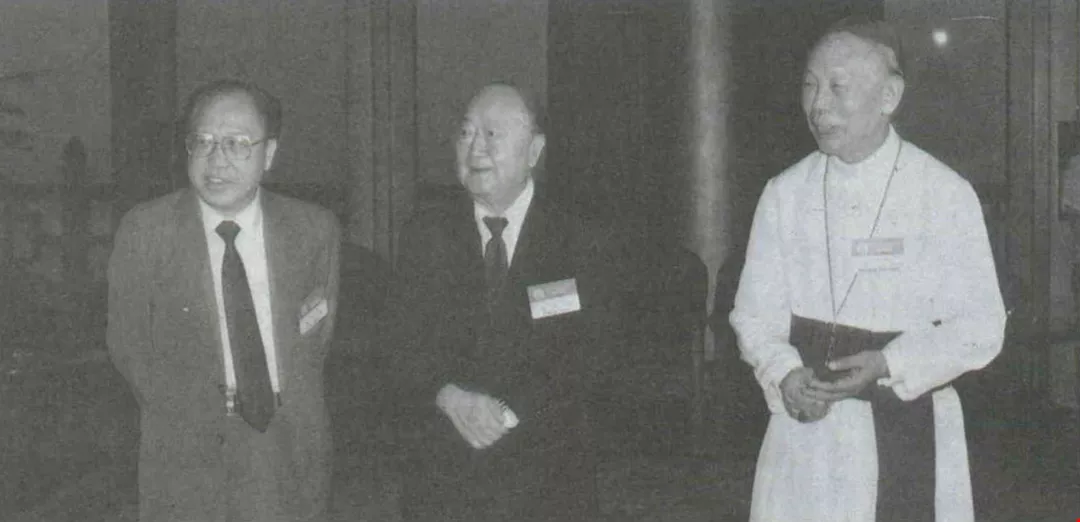
Right top, The three sponsors of the conference commemorating the arrival of Ricci in China, left to right: Director of the National Palace Museum, Ch'ing Hsiao-i; Director of the National History Museum, Huang Chi-lu; and Rector of Fu Jen University, Stanislaus Lokuang.
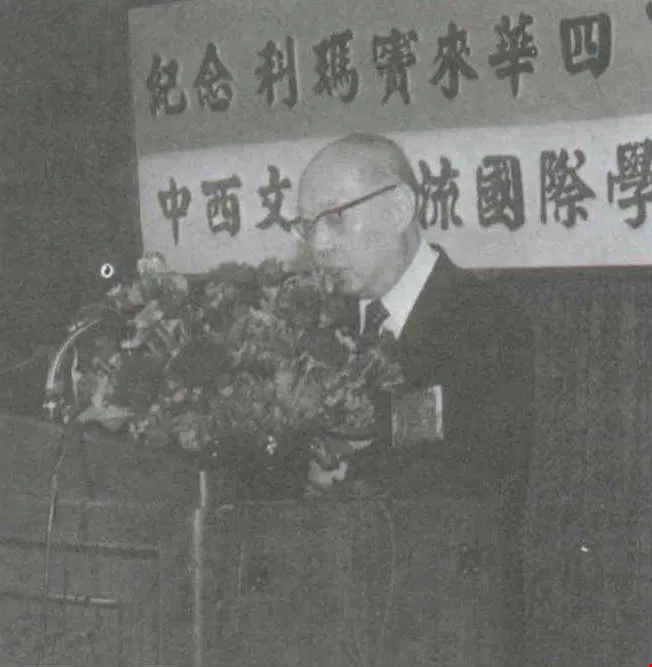
Right, below, Former President of the Republic of China, Yen Chia-kan, reminded the conferees not to forget the Orient's spiritual culture.
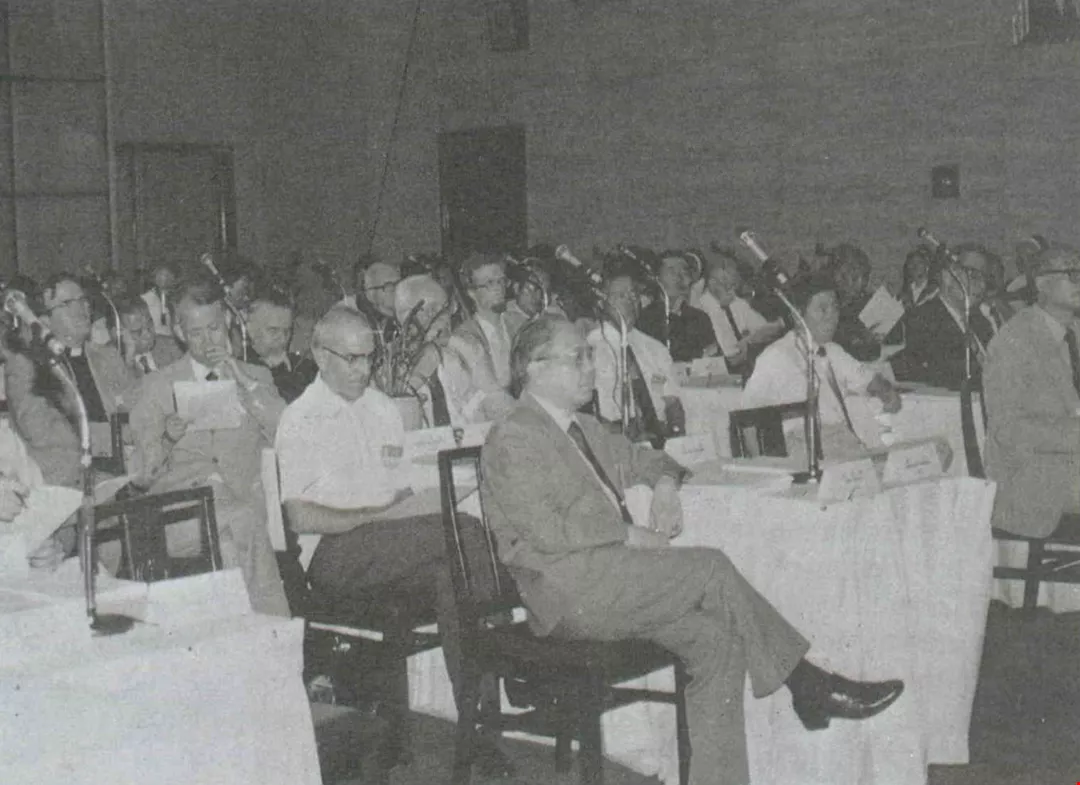
Conferees numbered ninety, from nine countries or regions, and discussions were lively.


