Tender Care--Art Therapy
Tsai Wen-ting / photos courtesy of Sheng Cheng-te / tr. by Jon Babcock
August 2003


As the number of SARS cases in Tai-wan climbed, the faces hidden behind our SARS masks grew tenser every day. Now that the threat is receding, life is returning to normal. But frontline medical workers, patients and their family members have all discovered the need to readjust mentally and banish the lingering shadows from their hearts. In this "post-SARS" era, art therapy can help people penetrate their psychological defenses and free the troubled soul within from discomfort and illness.
"I now see painting as a way of salvation, a course of treatment for the self. The process of daubing paint on paper allows me to show my psychic scars both realistically and abstractly and to express what oppresses me," says artist Sheng Cheng-te, chronic depression sufferer, who uses words and pictures to describe his experience with art therapy.
The mention of "art" alone is already enough to confuse people. But add "therapy" to "art" and they are unlikely to have any idea what is being talked about.
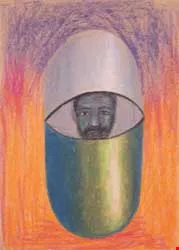
Art is good medicine for curing depression and building a colorful bridge between patient and therapist.
Unspoken words of the spirit
What then is "art therapy"? The American Art Therapy Association (AATA) defines it thus: Art therapy is the use of music, dance, drawing and painting, drama, etc., as therapeutic tools or media. It allows us to use verbal and non-verbal expression and the experience of artistic creation to investigate individual problems and discover hidden resources as part of the process of attaining a well-balanced physical and mental life.
When you first hear the term "art therapy," it seems very mysterious. But in fact, art therapy is one kind of psychological therapy and like any other psychological therapy, its object can be differentiated based on health status (the mentally ill and those with non-clinical mental health problems), on age (children, adolescents, the middle-aged, the elderly), on type of illness, or stage of illness (early, terminal), on patterns of behavior (smokers, non-smokers) and so forth. But unlike traditional psychological therapy, which is limited to the spoken and written word, art therapy uses such media as painting, dance and music to facilitate "non-verbal" expression which can provide the patient and the therapist with additional opportunities for communication.
"Because it is not limited to verbal expression, it is fundamentally more effective than conventional psychological therapy," says Professor Liona Lu of the Graduate School of Visual Arts of Taipei Municipal Teacher's College. She was the first in Taiwan to receive her art therapist qualifications from the United States. When art therapy, which uses mental symbols and intuition, is applied to mental illness, sexual abuse, child abuse cases, or to children whose verbal understanding is limited, it is able to gradually lower the patient's defense mechanisms, build a better relationship between patient and therapist and unearth the old stories that lie buried in the deepest recesses of the subconscious.
A child, suspected of being the victim of abuse, who had repeatedly run away from home, when caught on yet another attempt, showed extreme fear and paranoia, and was afraid to say what had happened to him. During his initial art therapy sessions his works were filled with jeweled swords, shields, and other kinds of hard, aggressive objects. When Liona Lu gave the child an empty bottle and some modeling clay, the child formed a baby bottle nipple on the top of the bottle. Then he made a face, rejected it and molded it again. At this point Liona Lu knew that the child had been able to release some of his pent-up feelings and was beginning to open up. Taking advantage of the opportunity, both she and the social worker immediately embraced and comforted the child. The boy finally started to talk about the daily abuse that he suffered from his father.
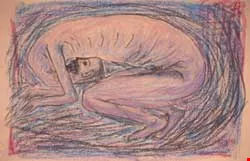
"Like a pangolin, I rolled up into an impenetrable ball of self-made self-protection, where avoidance had become a necessity," says Sheng Cheng-te.
Inside out
Nowadays, the first challenge that an art therapist faces when dealing with a case is how to convince those involved that creativity is something that each of us has from birth. Our Chinese ancestors long ago said: "Poetry is the extension of intent. Dwelling in the heart, it is intent. Expressed in words, it is poetry. Emotion is set in motion within and finds outer form in words. If words are not enough, we just sigh. If sighing is not enough, unawares, our hands and feet express it in dance." Art is the most direct method for accessing the spirit and the emotions. Children, for example, pick up a brush and paint away with utter freedom and confidence. It is only in the highly specialized and regimented society of today that art has become the sacred temple of the artist alone, and generally most of us give it up upon recognizing this.
By the 1930s and 1940s the two great Western psychologists Freud and Jung had already pointed out the intimate connection between artistic creativity and mental health. By then also, artists and dancers were volunteering to go into mental hospitals and help the patients express their artistic creativity. The resulting breakthroughs in cases gave rise to the first use of the term art therapy. In use now for the past 40 or 50 years, art therapy is no longer confined to therapy for the mentally ill. Hospitals, the court system, cancer centers, special education centers, alcohol treatment centers, prisons, help lines, elder care facilities, and schools at all levels also employ art therapy as an accepted part of their respective programs.
The earliest to introduce the use of art therapy in Taiwan was the Department of Psychiatry at Taipei Veterans General Hospital. In 1981, the occupational therapist Lu Shu-chen joined forces with the dance teacher Li Tsung-chin to introduce dance therapy to this institution. Then, in 1989, painting therapy was introduced by Liona Lu after she returned from the United States where she had qualified as an art therapist. Lu opened the way for many others to enter the field which eventually flourished.
Nevertheless, domestically, most medical centers restricted the application of art therapy to psychiatric departments and wards for the terminally ill, and it did not attain the status of an independent course of medical treatment. "At present, not only is the status of art therapy unclear, but the term is often used carelessly," Liona Lu says.
In Taiwan, doctors, nurses, social workers, and occupational therapists have long all operate under a legally recognized licensing system, but certification for therapists was not approved until the end of last year. At present art therapists can sit for the psychologist exam, but it includes nothing of art or art therapy and is therefore not particularly appropriate. A good art therapist, says Liona Lu, needs more than just a psychol-ogist's license, but also specialized training in art therapy per se, as well as a minimum of at least 700 hours of practical experience.
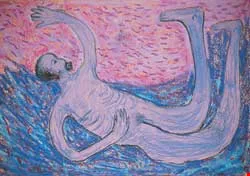
"The body is suspended in space, or you could say it dwells in a deep chasm where there is no possibility of ever touching bottom. You can keep on diving and never get there," says Sheng Cheng-te.
Painting away pain
Art therapy is divided into two schools. One says that "art production is the therapy." Scientific experiments have shown that when a person is concentrating on drawing, painting, music, or dancing, not only are the muscles more relaxed, but breathing becomes longer and deeper, and brain waves, hormones, sugar levels, and blood pressure change accordingly. Mentally, there is relief from worries, an escape from the confines of time and space, and a feeling of unrestricted freedom and confidence. Because of this, the person can attain a unification and sublimation of body and mind which allows him to forget his physical pain.
Husband and wife Kuo Yu-cheng and Moh Shwu-lan graduated from the Italian National Milan Art Academy. After coming back to Taiwan, they worked as art therapists at National Taiwan University, Veterans General Hospital, the Tri-Service General Hospital and similar institutions. From their combined experience they have acquired a large repertoire of moving stories about the effectiveness of art therapy.
The two of them recall the time they met Grandma Su, who was about 60 years old. Because of liver cancer, her entire body itched, but scratching would result in injury. Along with this problem she had the feeling that her illness made her useless. She was thoroughly depressed and had lost all self-respect.
While chatting with her, Kuo Yu-cheng and his wife learned that Grandma Su used to be a maintenance worker who swept the streets. They asked her if she would like to paint. Grandma Su thought of herself as a mere street sweeper who could hardly be expected to know anything about painting. But Kuo said to her: "Grandma, wielding a broom to clean the streets is also a creative act that helps beautify the earth." Upon hearing this, as Moh Shwu-lan continued to ask questions, Grandma Su started to remember the beauty of the lush green grass she used to see when sweeping Chinshan Township, and straightaway she picked up a green ink pen and began to paint the "itches" of her body onto the paper.
Once started, Grandma Su painted faster and faster, and the faster she painted, the more energy she put into it, allowing her inner feelings to flow onto the drawing paper. In no time she had finished three sheets. Kuo Yu-cheng then gave her a pen of cooling blue hue and asked her to paint soothing circles on the paper while imagining sea breezes blowing through the grass. Again, Grandma Su focused all her attention on the paper and carefully drew circles. Slowly she began to relax and the previous urgency dissipated. Later, Grandma Su realized that during these 20-minute sessions, she had forgotten about her incessant itching, and as soon as her primary doctor saw her painting, he was able to understand how much those itches irritated her.
Moh Shwu-lan explained that this seemingly arbitrary sketching process "contained a good deal of experience, autobiography, self affirmation, creative expression, diversion, and other themes."
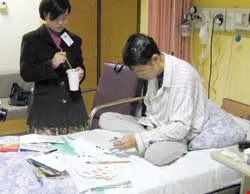
In the user-friendly therapy room at Taiwan University Hospital, Kuo Yu-cheng, art therapy teacher at the Ta Te ward of Taipei Veterans General Hospital (above), and his wife Moh Shwu-lan (below), have terminal cancer patients use painting as a way to think over their lives and do away with remorse. (courtesy of Kuo Yu-cheng and Moh Shwu-lan)
The story in the art
The other school of art therapy considers the creative process as only part of the therapy. More important is the information that the resulting product yields to study and analysis, which employs symbols as an aid in its investigation of the mental condition of the patient.
Dance therapists find that the same activity will be expressed in various ways. Some patients act like a bionic man with extraordinary strength, possibly showing violent tendencies. Some appear to move effortlessly, as if they were light as feather. In each case the movement is a reflection of the patient's current psychological state. Likewise, by observing the structure of the lines, the realism of the style, or the arrangement of space in the composition, a drawing therapist can "overhear" the unspoken words that emanate from within the patient's heart.
Thus it is necessary for an art therapist to be well-grounded in both art and medicine, whether they are applying clinical psychology to seriously ill patients or handling a consultation for an ordinary outpatient. Given this background, they will be able to apply the basic practices of psychological therapy to assess the appropriate response to the patient at any given time and to prescribe the proper media, themes, and activities. At the same time they will know when to just listen and offer support, when to pursue something deeper, and when to bring things to a halt.
"For example, the liquidity of the art-making materials themselves (water, colors, ink) allows for great intensity, and a capacity for cathartic self-expression, and these, as well as support functions such as snipping, cutting, and trimming, all play their special roles," said Liona Lu. Give a patient a piece of modeling clay and whether it is thrown away, pulled apart, or squeezed into some shape, and with how much force, are all important considerations used by the therapist to evaluate the mental condition of the patient in order to determine appropriate therapeutic methods. This is different from what an art instructor does. "Teachers of fine arts understand materials and themes, but to properly evaluate the process is something that lies within the purview of the psychological therapy professional," Liona Lu points out.
Music therapist Hsu Li-li, who got her graduate degree in Japan, first studied music education. Later she let music act as the go-between between patients and herself. Her overriding consideration is that the music be acceptable to the patient. There is always a full selection of music on the many tapes in her pockets, including classical, spiritual, old national songs, popular Japanese songs, Taiwan folksongs, and Fujian Opera.
One of the old Mandarin songs, "Everlasting Love," is especially effective at pulling up memories from middle-aged and senior patients and getting them to speak of long-hidden secrets. One hospitalized woman was in the habit of randomly emitting loud sighs and admonishing people by saying, "Children must obey!" Hsu Li-li had her listen to several music tapes, and when she came to "Everlasting Love," she started to sing along and then cry. Finally, she began to speak of her regrets. When she was a girl she had disobeyed her family and run away with her boyfriend. From that point on, all connections with her family had been cut off. After becoming a mother, then a grandmother, she became more and more ashamed of herself vis-a-vis her mother. Once Hsu Li-li had become aware of the problem, she encouraged the woman to lose herself in the music and pretend that she was speaking with her long-deceased mother. The patient felt as if she had returned to her youth and that her mother had already forgiven her.
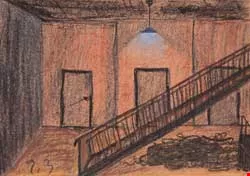
Penetrate the layers of consciousness, enter the core of the psyche. By analyzing his dreams, Sheng Cheng-te enters the deep and murky subconscious world of the psyche.
A double-edged sword
"Art therapy is a double-edged sword. Once unsheathed, it can become a kind of provocation. How deep to cut, and where-such things require due caution," says Hsu Li-li, who previously worked in music therapy at Taiwan National University Hospital. This is especially true for terminal patients. Even if the therapist is able to reach the patient's long-repressed emotional fetters, whether the patient will respond positively or not is a judgment call that requires the evaluation of the therapist.
The ability to "read" the created work depends on the professional maturity of the art therapist. In fact, the biggest misunderstanding and the most ill-placed expectation of art therapy entertained by most people is that the therapist will be able to tell them what it all means as soon as the patient produces his first painting, just like a fortune-teller.
"A truly professional art therapist will not show off her ability to interpret paintings. On the contrary, she'll keep this coolly to herself until the individual has acquired the needed courage, until the patient's timid spirit has grown strong enough," Lu Su-chen, art therapy consultant for the Student Counseling Center of National Tsing Hua University, has written. In any event, appropriate timing is also a matter of judgment. Therapists must respect their patients. To prematurely open Pandora's box before the relationship with the therapist is fully secure is to endanger the patient. "You never just plunge in all at once. Art therapy proceeds gradually, from the surface downward, with treatment that is appropriate for each level," says Liona Lu.
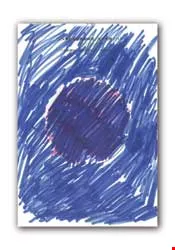
Painting is a talent we are all endowed with from birth. Terminally ill liver cancer patient Grandma Su externalizes the itches on her body in vigorous daubs and endless circles while recalling the good times of life. (courtesy of Kuo Yu-cheng and Moh Shwu-lan)
Start from the fingertips
"Never regard art therapy as some kind of panacea," says Lu Shu-chen, director of occupational therapy at the Department of Health's Pali Psychiatric Center, who has made extensive use of local Taiwan dance in rehabilitation therapy. Some of her mentally ill patients will confine their movements to their hands or arms alone, while the rest of their body remains stiff as a board. Some avoid all eye contact. "So it is extremely important that they loosen up first," Lu says. The movement in her dance studio may be called dance, but it always begins by moving the tips of the fingers. Only after the patients have grown accustomed to the rhythm of the music, does she begin to search out the pains and pleasures, joys and sorrows that lie within.
Because many mentally ill patients are taking medications, which can cause an increase in appetite, dance therapy is a good way to allow the physical energy of the body to express itself appropriately. Patients who suffer from hypomania become hyperactive during an episode, and others do irrational things such as buying a dozen houses at once. Such patients must be able to channel their impulses and excess energy into something else.
Whether simply walking, running, jumping, or beating a tambourine, the activity can stimulate the healing powers that lie within the patient. Those who are strong enough to play the tambourine are unable to sit still. This kind of dance is so stimulating and exciting, it cannot be used near the end of the session without keeping patients overtime to calm them down. "Otherwise, the patients may harm themselves or others once they have returned to their rooms," Lu Shu-chen says.
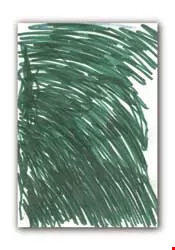
Painting is a talent we are all endowed with from birth. Terminally ill liver cancer patient Grandma Su externalizes the itches on her body in vigorous daubs and endless circles while recalling the good times of life. (courtesy of Kuo Yu-cheng and Moh Shwu-lan)
The dance studio mirror
"I think the main thing about art therapy is not what the therapist discovers, but what the patient discovers," says Kuo Yu-cheng. The real effectiveness of art therapy almost always consists of going through the process of creating art in order to become clear about what one really thinks, to understand the true origin of one's pains and suffering and thereby to gain freedom.
During one of the dance sessions, Lu Shu-chen had patients dance with a large balloon. One of the younger patients, aglow with hatred and resentment, struck and squeezed the balloon. The child said it was his mother and that he hated her. Lu Shu-chen did not attempt to contradict the boy, but let him continue punching and squeezing. Finally, just as the balloon was about to burst, the child let it go. He had realized that what he really felt deep in his heart toward his mother was love, not hate. No only did he not hate his mother, but he wished that his mother, who had remarried, would love him more. Upon his next trip home from the clinic, he didn't again treat his mother in a violent way. On the contrary, he brought her a figurine he had craved himself, and the estrangement between them began to dissipate.
Once a successful middle-aged man joined a group. While taking part in a privately-run workshop for spiritual development, the art therapist had the group members crawl about, imagining they were spermatozoa, swimming in the river of life. After they had been crawling and wriggling together on the floor for a while, this man stopped and lay quietly still. Subsequently, during the wind-up session, he confessed that while he was crawling, he felt as if he had become a baby once again, lying inside his mother's womb. He had felt so comfortable and safe that he had no desire to move at all. He discovered that he was "tired, very very tired."
As the oldest child, from the time he was a little boy he had been made to shoulder a heavy load of family responsibilities. On the one hand, he cared greatly about receiving the approval of his parents and elder relatives and on the other, he felt that his parents loved his younger brothers and sisters more, and he envied their freedom from responsibilities. Those few minutes of curled-up rest were more comfortable than an entire day's sleep, and he was able to heed the cry for help from his body and mind.
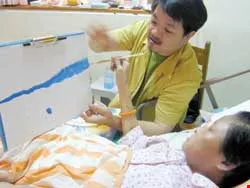
In the user-friendly therapy room at Taiwan University Hospital, Kuo Yu-cheng, art therapy teacher at the Ta Te ward of Taipei Veterans General Hospital (above), and his wife Moh Shwu-lan (below), have terminal cancer patients use painting as a way to think over their lives and do away with remorse. (courtesy of Kuo Yu-cheng and Moh Shwu-lan)
Holistic care
In the clinical care system, the art therapist must fit in unobtrusively with the doctors, nurses, occupational therapists, social workers, etc., who constitute the medical profession wherein each member plays a well-defined role. But in so doing, an art therapist can still redirect the focus of healing away from the old emphasis on "illness" to a new emphasis on "life," the object of holistic health care.
After medical staff have given up attempting to actually cure the disease, a terminal ward patient faces life's final test, to persevere in the face of the cruelty of fate, anger, inevitability, and a sense of helplessness. Hsu Li-li says, "For those patients on the verge of death, detachment alone allows them to pass on without remorse." According to 1999 statistics from the Palliative Care Ward of National Taiwan University Hospital, the rate of acceptance of music therapy by terminally ill patients was very high, at 86.6%. From this we can recognize that the effectiveness of art therapy, a humanized approach to health care, is quite high.
There was one patient who was hard of hearing. As soon as the nurses or orderlies entered the ward, they would hear this individual carrying on in a loud voice. Music therapist Hsu Li-li had him sit next to the speaker and feel the rhythm of the sound waves booming forth. In the end, this elderly gentlemen developed such a fondness for "listening to music" that shortly before his death he wrote a short essay in which he said, "Music opened a door into my heart and allowed me to enter another world, to forget the pains of my illness, the misery of my past, and to rouse my spirit to enter another realm." From this single example we can appreciate the extent to which music can lift the spirits.
In fact, Hsu Li-li's transition to music therapy from music education was motivated by her own experience. She was born into a doctor's family. Following a stroke and hospitalization in Japan, her mother sank into a state of depression. When music student Hsu Li-li heard her mother's main doctor say to the family, "Let her listen to music!" Hsu began looking for music that would boost her mother's spirits.
For the sake of her rehabilitation, Hsu Li-li would often take her mother to the department store. But in front of a moving escalator, her mother would freeze, unable to move. Only when they sang a Japanese nursery rhyme together, or sang the lyrics to a children's song, "Go, go, go, hand in little hand, we go," was her mother able to easily step foreward onto the escalator. The power of music far transcends what people may imagine.
With regard to those who have been living in fear of SARS, the soft-spoken Hsu Li-li proclaims: "Give yourself over to the music, dare to make it part of your life!"
As part of the medical system, art therapy can be thought of as that most pleasant, most elegant of medicines. Art therapy, which gives its patients a brush, has them set their body in motion in dance, or merge with the rhythms of music, is like a beautiful multicolored rainbow that bridges the chasm between the sunken spirit of the patient and the therapist.
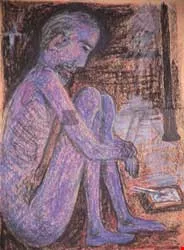
"I worry about drifting aimlessly and never returning. I worry about giving up things. I worry even more about poverty of spirit. I see the lights along the streets, but those are other peoples' homes. My fate vacillates aimlessly and finally runs its course"-Sheng Cheng-te.
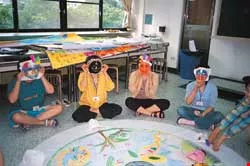
Victims of the September 21 earthquake of 1999 continue to come forward to seek help with the accumulated stresses of life in the disaster area since then. The photo shows art therapist Liona Lu conducting a group therapy session with some of them. (courtesy of Liona Lu)


@List.jpg?w=522&h=410&mode=crop&format=webp&quality=80)


