School Daze-Taiwanese Students in China
Teng Sue-feng / photos Jimmy Lin / tr. by Scott Williams
December 2008


Shanghai has a population of more than 18 million living in an area about one-sixth the size of Taiwan. That kind of density has resulted in the world's most intricate transportation network, consisting of more than 3,000 intersecting roads carrying more than 2 million vehicles every day.
Historically, Shanghai's international settlements each had jurisdiction over their own street planning. But growth rates have soared since economic liberalization, and these decrepit, narrow streets have deteriorated badly. To relieve the tremendous traffic congestion, in 1990 Shanghai began building an elevated highway infrastructure consisting of a box-shaped ring road, bisected by north-south and east-west highways. From the air, this transportation nexus resembles the petals of a flower blossom. It includes the main arterial link connecting Puxi and Pudong across the Huangpu River, and extends even further, joining the prosperous financial district with the residential districts.
First time visitors to the city, zipping across the elevated highway through downtown in a taxi traveling at least 70 kilometers per hour, can feel as if they're being transported through a giant maze and often lose all sense of direction. A moment's inattention during rush hour by your driver-Shanghai cabbies tend to keep their accelerator pedals to the floor-can lead to a missed exit and a complete loss of orientation. It almost never fails to take several tries to get to your actual destination.
To the 600,000 Taiwanese businesspeople and family members who live in Shanghai, the selection of a school for their children from among the Shanghai Taiwanese Children's School, international schools, and local schools can be as anxiety-inducing an experience as seeking an exit from the ring road. Every twist and turn opens up new vistas. You could end up among the highrises along the Bund, where what is soon to be the world's tallest building is rising, or wedged into the crowded little alleys of old Shanghai where there's hardly room to turn around.
In the 20 years since cross-strait exchanges were liberalized, the families of many Taiwanese businesspeople in the mainland have been through several phases, including "airborne," "reunited," and "putting down roots." But from the early years, when breadwinners worked alone in China, to the present day, where we're seeing the immigration of entire families, these Taiwanese families have always been deeply concerned about ensuring that their children have educational continuity.
Since the founding of Guangdong's Taiwan Businessmen's Dongguan School in 2000, three Taiwanese schools have arisen in the Pearl and Yangtze River deltas where Taiwanese have congregated. Now that these schools are available to Taiwanese children in the mainland, why are so many kids still bouncing around from school to school? What does the future hold for a generation of Taiwanese schoolchildren growing up outside of the Taiwanese educational system?
With only 100 days remaining until Taiwan's late January 2009 university entrance exams, Fang Kuan-hao jumps out of bed and shouts three times to relieve the intense exam pressure building inside him. Since the start of the academic year, he's had evening tutoring sessions and evening study halls followed by a return to his dormitory for still more study. All this work is in pursuit of a dream: getting into the Department of Life Sciences at Hsinchu's National Tsing Hua University.
Fang, who came to Jiangsu with his parents six years ago and is currently enrolled at Kunshan's Huadong Taiwanese Children's School, says firmly: "I really don't want to study at a university here. I have to test into a Taiwanese school." Three years ago, his parents agreed to let him return to Taiwan to study if he did well on the Basic Competence Test for Junior High School Students. Fang's score got him into Taichung's Second Senior High School, but his parents kept him in China because they "would have been worried at him being on his own, and thought that the family should be together."
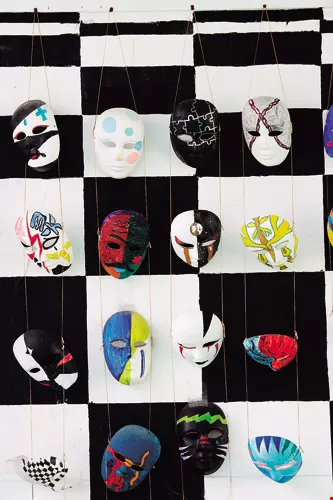
Different looks
Fang, who never adjusted to Chinese schools, says that he first studied in the domestic division of Kunshan's model middle school. The mainland teachers pressed the students hard, but Fang couldn't get over his feeling that the simplified characters used in the mainland were "uncultured and ugly." As a result, he never wanted to pick up his texts and didn't do very well. He also received demerits for his refusal to wear the red scarf the school required.
In the eighth grade, he transferred to the school's international division, where he didn't have to take political classes. But the international division conducted all its classes in English, and only offered students one general science course, not separate physics and chemistry classes. Wanting to ensure continuity with his future university education, he transferred again, this time to the Taiwanese school.
But Taiwanese kids like Fang, unsure how to advance their educations, represent just one point along the broad continuum of Taiwanese students scattered across the sprawling mainland. How many Taiwanese kids are studying in the mainland? How are they distributed? What kind of schools are they studying at? Neither the Taiwanese nor the mainland Chinese government has precise figures, but based on Taiwanese investment patterns, the largest concentrations of Taiwanese are almost certainly in the Pearl and Yangtze River deltas, which are constantly evolving, have modern architecture, and offer a high standard of living.
According to the PRC Ministry of Commerce, more than 76,000 Taiwanese-invested firms are currently operating in the mainland, primarily in its coastal cities. But figures from the ROC Ministry of Economic Affairs indicate that since 2000, Taiwanese investment has been moving away from the Pearl River delta and into the Yangtze River delta. During January to October in 2008, 58% of all investment in China ended up in Shanghai and Jiangsu, 4.6 times the 12.5% taken in by second-ranked Guangdong.
If we assume that Taiwanese firms in the mainland have each based about ten Taiwanese workers there, then include mainland-based Taiwanese working for foreign firms, and the Taiwanese businesspeople operating small-and-medium-sized sole proprietorships, there are probably 800,000 to 1 million Taiwanese businesspeople in the mainland. This figure suggests that there are probably at least 100,000 Taiwanese kids studying in the mainland.
But there are only 1,220 kids enrolled in the Shanghai and Kunshan Taiwanese Schools, and another 1,436 at the Taiwan Businessmen's Dongguan School. That is, these three Taiwanese schools account for fewer than 2,700 of these estimated 100,000 students.
In other words, after considering where they live and the advancement of their educations, the vast majority of Taiwanese students have chosen not to study at the Taiwanese schools and have instead enrolled in the very different mainland educational system. What kind of twists and turns has this decision thrown into their path?
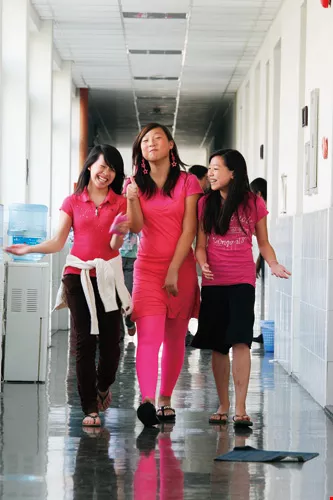
The SMIC School integrates Chinese and Western approaches to education. The school has staffed its Chinese division with mainland Chinese teachers and its international division largely with foreign teachers. Many Taiwanese parents would love to get their children into the school's international side, where most of the smiling students are the children of foreign workers or of Chinese who have studied abroad.
More choices
We've had cross-strait exchanges for 20 years now. Businesspeople who went into China early on had to feel their way around the Chinese system and market, but didn't have to invest a lot of thought into their kids' educations-most just put them into the international schools.
Yeh Su-chu, who took her first- and second-grade sons with her when she moved to Shanghai with her husband 12 years ago, set her kids on what turned out to be a one-way educational track.
In those days, there were no Taiwanese schools and the mainland educational system was primitive. She therefore enrolled her kids in the Puxi campus of the Shanghai American School. The situation in Shanghai was quite different from that in Taipei, where the American School only accepts children who have at least one parent with an American passport. In the mainland, Taiwanese children were considered non-nationals and were therefore eligible to enroll at any of the international schools. As long as there was space and their parents could afford it, they all got in.
Though it was easy to get into the school, Yeh says: "My sons were like mutes during their first year there. They didn't understand the language and couldn't speak. They just sat at their desks, then came home, cried and asked to go back to Taiwan to be with their grandmother." Still a little saddened at the memory of their troubles, Yeh recalls that she spent US$45 per hour on after-school English lessons with a foreign tutor. It was a full year before the boys finally adapted.
Her sons studied at the American School from elementary through middle school, but then transferred into a different high school when her husband began thinking about the rise of China. Deciding that the boys needed better Mandarin skills, he put them into a mainland school. He didn't realize that the schools assigned a lot of homework, gave a lot of tests, and expected students to memorize classical poetry. The boys, who didn't read or write well in Mandarin, struggled badly, often scoring only 40% on their exams. "They already had the foundations of an English-language education," says Yeh. "They had trouble adjusting again when they were forced back into a Chinese system."
Yeh explains that part of the reason for the transfer was that the American School was too expensive; they were worried they'd use up all the money they'd set aside for the kids' education before they even started university. Tuition at the American School was US$45,000 per year. At an exchange rate of NT$35 to the US dollar, the family would have spent more than NT$30 million on the boys' education over the course of ten years. For that kind of money, they could have bought a luxury apartment in Shanghai!
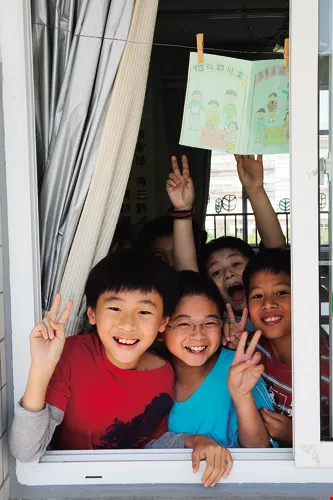
Parents love to see smiles brightening their children's faces, wherever they happen to go to school.
Dream choice
As more Chinese bearing graduate degrees returned from abroad and more foreign capital poured into China, foreign firms and institutions began establishing greater numbers of international schools, including as many as seven or eight American-style schools.
In 1997, there were only seven international schools in Shanghai. Today, there are 23-including the five model schools with international divisions administered by the Shanghai Municipal Education Commission-offering bilingual Chinese-English education from grades 1-12.
Shanghai's Minxing District, located in the southwest part of the city, has a truly international character. Currently home to American, British, Japanese, Korean, and Singaporean international schools, it will soon have a Canadian school, as well. With Shanghai planning to build East Asia's largest train station here prior to the 2010 World Expo-a station that will include a stop for a mag-lev train that will make the journey to Beijing in just 4.5 hours-the district's outlook is bright.
In recent years, international schools have sprouted all over Shanghai. Well-to-do Taiwanese parents concerned about their children's education have been paying registration fees and visiting multiple schools in an effort to ensure that their children have the broadest possible educational opportunities. But the superabundance of options on offer has itself become a headache, and Taiwanese parents are now struggling with numerous knotty issues. Those thinking about an international school have to choose one, figure out how to get in, find out what's on the entrance exams, and even potentially deal with requests to drop their child to a lower grade because his or her English isn't good enough. Meanwhile, those looking at the international divisions of the model schools must decide whether to have a well-connected intermediary to approach the school on their behalf, and figure out how to deal with requests to pay the school a one-time "supplemental fee" of RMB80,000.
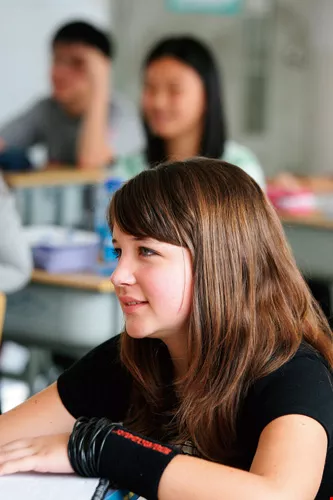
The SMIC School integrates Chinese and Western approaches to education. The school has staffed its Chinese division with mainland Chinese teachers and its international division largely with foreign teachers. Many Taiwanese parents would love to get their children into the school's international side, where most of the smiling students are the children of foreign workers or of Chinese who have studied abroad.
The orthodox choice
Outsiders often believe that Shanghai's two Taiwanese schools are the conventional choice for the city's Taiwanese families, but the reality is otherwise. Most of those who forego the incredibly expensive international schools for the Taiwanese schools are middle-income Taiwanese. Since the duration of these families' stays in Shanghai are uncertain and beyond their control, the turnover rate among the schools' student body tends to be high. Faculty turnover is high as well.
Built three years ago at a cost of more than NT$200 million, the Shanghai Taiwanese Children's School has enrollment of just 433 students and fairly limited facilities. It is located in the Minxing District's international school "village," where each school's funding (or lack thereof) is readily apparent.
Five years ago, when the Taiwanese Children's School needed a chairman with an educational background to be permitted to open, the board chose Chang Pei-fang, who had served as the first principal of Taiwan's Hsiulang Elementary School and was at the time of his hire doing business in Tianjin. The 80-year-old Chang heeded their call to help educate the next generation of Taiwanese and took on the task of getting the school open.
"It's like when you open up a restaurant and people don't yet know whether the food is any good," says Chang. "Some don't even know it exists. So the school still has room to grow." Chang explains that though the ROC government pays NT$15,000 of parents' tuition costs every semester, the school's facilities just can't compare to those of the American School and the Singaporean School. The school badly needs more support from businesses, parents, and the government if it is to compete with the other international schools in the area.
"You can't help but feel a little twinge in your heart at the start of every school year," says Tseng Hsueh-o, principal of the Huadong Taiwanese Children's School in Kunshan, "because so many students have been uprooted again." Tseng says that in September, just two weeks into the semester, a listed company sent four of its Taiwanese employees back to Taiwan, forcing them to immediately arrange a school transfer. In 2008, the school has accepted 102 transfers, 38 of which were from local schools.
Tseng observes that the number of elementary school students at the Taiwanese schools has fallen in recent years, while the number of middle- and high-school students has risen slightly. The reason is that many families believe that elementary-school kids needn't study in the Taiwanese system, that they can take advantage of other options. These parents invariably discover that their kids aren't doing as well in school or that they have trouble integrating into the even more competitive and even more exam-oriented mainland schools, and hurriedly transfer them into another school.
Parents can get away with waffling over elementary- and middle-school selections. They may end up wasting time and money, but it's not like their kids won't have somewhere to study. Choosing a high school is a much less forgiving process, and no one is yet sure whether the relatively new high-school sections of the Taiwanese schools will live up to parental expectations.
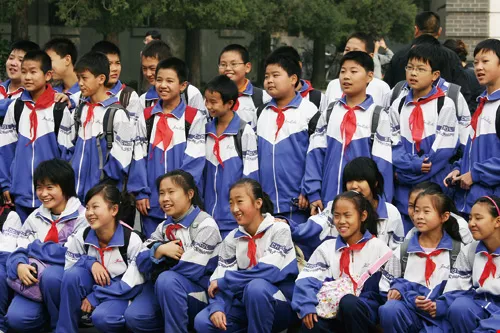
Many Taiwanese kids are very uncomfortable wearing the red scarf required by mainland Chinese schools.
The SMIC School
There are other options besides the international schools, with their largely foreign faculty, and the Taiwanese schools, with their largely Taiwanese faculty. The private SMIC School is a case in point. Located in Pudong's Zhangjiang Technology Park, the SMIC School utilizes both the Chinese and Western educational traditions and has attracted numerous Taiwanese students.
In 2001, Richard Chang, the Taiwanese-American CEO of Semiconductor Manufacturing International Corporation (SMIC), spent RMB124 million to establish the SMIC School. His goal was to ease his employees' concerns about their children's education by creating a school in Pudong for kids in grades 1-12. The school currently has about 1,700 students, 65% of whom are from Hong Kong, Macao, and Taiwan (about 700 are Taiwanese); 10% of whom are the children of mainland Chinese who received graduate degrees abroad; and 25% of whom are of other nationalities.
SMIC's international division utilizes Texas' curriculum standards, employs more than 100 non-Chinese teachers (43% of its faculty), and conducts classes entirely in English. Graduates of the school have gone on to attend top US universities. Unlike the Taiwanese schools, SMIC's Chinese division does not employ the Taiwanese curriculum or Taiwanese teachers. Instead, it follows mainland Chinese educational guidelines. SMIC's use of mainland Chinese teachers and mainland Chinese textbooks to teach Taiwanese students seems a bit odd.
"Taiwanese parents don't want the curriculum to be too demanding; they want their kids to enjoy learning," says one parent. "But the mainland teachers' question how kids in a laid-back learning environment can pass the middle-school and high-school entrance exams. It's difficult for schools when all the parents have different expectations."
According to Zheng Yangding, an award-winning mainland teacher who now serves as the principal of the SMIC School, the school attempts to integrate Chinese and Western approaches to education, balancing the acquisition of knowledge with the development of the whole person. "We assign coursework, but it's not too heavy," says Zheng. "The teachers make some demands, but the students are relatively happy."
The school overhauled the Chinese division curriculum four years ago to better meet the needs of students from Hong Kong, Macao, and Taiwan. It studied and drew on Taiwanese textbooks from Lungteng Cultural Company, as well as mainland textbooks from the People's Press and from Shanghai's East China Normal University. Materials that appeared in all three sets of textbooks were considered canonical and were included (65%). The school's standard for the inclusion of other materials was that it had appeared on the mainland's unified university entrance exams.
Last year, the SMIC School graduated its first group of students to apply to Chinese universities via the special track for students from Hong Kong, Macao, and Taiwan. All seven did well on the university entrance exams, and two even tested into Shanghai's Fudan University.
Zheng, who is intimately acquainted with the stringent demands mainland schools place upon their students, says that even the smartest of the Taiwanese attending local schools have a hard time of it. The reason is that the mainland high-school and university entrance exams are so fiercely competitive. Admissions are so limited that students must devote their lives to study, reviewing materials until they know them backwards and forwards. They can't miss a question if they want to get into a good school.
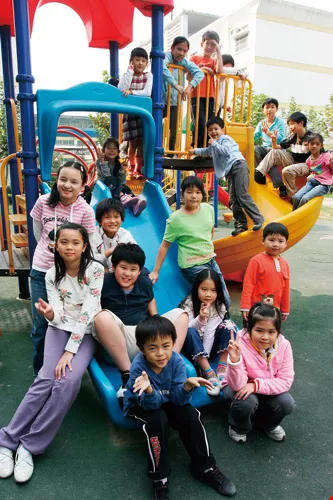
Childhood's end marks the start of educational choices that have important consequences. At the Huadong Taiwan Businessman's School 70% of students hope to attend Taiwanese universities while another 20% are likely to remain in China. The school therefore teaches both the Taiwanese and Chinese curricula, increasing the pressure on students.
Not putting down roots
Generally speaking, mainland curricula "move faster and delve more deeply" than Taiwanese. For example, the mainland math curriculum goes into equations with one unknown variable in the fourth grade, inequalities in the fifth, and trigonometric functions in middle school. On average, materials are introduced about one-and-a-half years sooner than they are in Taiwan. The Chinese language and literature curriculum is similarly advanced, with about 30% of the material in classical Chinese.
Besides the intense competition, most Taiwanese parents don't want their children studying in mainland schools because they are concerned that the political courses will confuse their children's sense of identity.
Chen Keng-jen and Wu Chien-hua, both graduates of National Taiwan Normal University who have taught at the Taiwan Businessmen's Dongguan School, conducted in-depth interviews with 17 of the school's fifth graders in 2005, three of whom had spent more than four years studying in mainland schools. The children regarded the sermonizing of the political courses as "a little boring," and felt they "couldn't idolize the Chinese heroes in the books." All 17 also retained fond memories of Taiwan and a sense of connection to their hometowns which was supplemented by visits home every summer and winter vacation.
Making a similar point, Wang Ming-ke, a fellow with Academia Sinica's Institute of History and Philology, comments that immigrant communities are "hotbeds of structural amnesia," but notes that it takes generations for these communities to lose their memories of their homeplaces. Even then, they are always able to forge new identities through collective root-seeking. He sees these activities as a kind of "new memory creation" that reflects both a sentimental and rational choice.
Kids are prevented from losing their sense of Taiwanese identity by their parents' sentimental attachment to their homeplaces and by their own very reasonable fondness for life in Taiwan. (For example, they feel that Taiwan is safer and cleaner, and that its people are more polite than those in the mainland.)
The connection that Taiwanese kids have to Taiwan is a good thing, but is also often an obstacle to integration into the place where they actually live. With China emerging as a global power, improving its educational system, and advancing its thinking, it is inevitable that more and more Taiwanese will choose to have their children educated in its schools. The next big hurdle for Taiwanese in China is to figure out how to get their kids into ordinary mainland schools.
Chou Su-yan went with her husband when his company sent him to Shanghai to work in a computer-and-electronics emporium. She also brought their first- and fourth-grade daughters. The two girls were quite happy in the Chinese division at the SMIC School for two years. They didn't have much homework or feel much pressure, and nonetheless easily ranked at the tops of their classes. Everything was fine until Yi-ching, the elder of the two girls, graduated from elementary school. Then Chou learned that only three of Yi-ching's classmates would be continuing on in the school's middle-school program. The other parents had transferred their kids out because they didn't want them to continue "wasting time" in SMIC's Chinese division.
She thought she could perhaps put Yi-ching into the more demanding international division, but Yi-ching's 66 on the English exam was far below the minimum of 90 required by the international division. That left Chou with no choice but to find another school quickly. She was okay with the idea of a local school, and when she saw the facilities at the new Tianshan Middle School in the Changning District, she decided to give it a try. When she learned that the school had no openings, some of Shanghai's Taiwanese recommended the more distant Xianxia Middle School, which still had spaces. Yi-ching took Xianxia's entrance exam and was promptly admitted.
"When my daughter first started at the school, she didn't speak much in class," recalls Chou. "She just had this sour expression on her face and was always asking when she could go back to SMIC." Chou told her that Pudong to Puxi was a three-hour round trip, and hoped she'd drop the subject. "We've already bought a home here," she said. "We're not going to waste that kind of time commuting."
Fortunately, Yi-ching had a sympathetic young homeroom teacher at Xianxia who wrote notes praising her progress. The competitive young girl soon found herself among the top students in her class and winning numerous awards. Her teacher even recommended her for membership in the Communist Youth League. Chou thought this was a little inappropriate. "We're Taiwanese," she reminded him, before asking delicately: "Would it be possible for her not to join?" The teacher readily agreed.
Chou says that as long as her husband experiences no major upheavals at work, her daughters are likely to end up attending mainland universities.
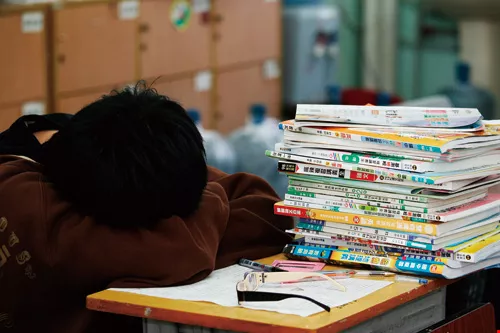
Childhood's end marks the start of educational choices that have important consequences. At the Huadong Taiwan Businessman's School 70% of students hope to attend Taiwanese universities while another 20% are likely to remain in China. The school therefore teaches both the Taiwanese and Chinese curricula, increasing the pressure on students.
Planning ahead
The problems Taiwanese kids encounter may be similar, but there is no one-size-fits-all solution to them. When they are young, they don't have the ability to choose for themselves and must follow their parents' lead. But once they enter their awkward, rebellious, opinionated teen years, you have to pay some attention to their views.
The thinking of many Taiwanese parents in Shanghai runs something like this: "The best thing to do is first figure out where you want to attend university. Once you know the prerequisites, you can figure out which way you need to go."
Unfortunately, sometimes changing events outpace the best of plans. With that in mind, it might be better to impress upon your kids as early as possible the idea that any school will do. But the reality is that after dragging their kids to China, many Taiwanese parents feel guilty for having pulled them out of a good, familiar academic environment. They then overcompensate by going along with what their kids want, sometimes making an utter mess of their educational trajectories.
Mrs. Chang's daughter began studying in the SMIC School's Chinese division in the seventh grade. Though she yearned to be like the kids in the international division, who might someday attend university in the US, she couldn't pass the division's entrance exam. Instead, in the ninth grade, she transferred to the international division of Shanghai Middle School, a school with a very liberal admissions policy. Perhaps because she had a difficult time fitting in at the mainland school, her plans changed again when she graduated-to her parents' dismay, she wanted to return to Taiwan for high school. Her mother began gathering information on Taipei's private high schools, and ultimately decided to go back to Taiwan with her younger daughter, leaving her husband behind in China. With their older daughter already in her first year at National Cheng Kung University's Architecture Department in Tainan, family members are now again living three different locations.
In early November 2008, the Straits Exchange Foundation signed four agreements with its mainland counterpart. Among other things, these will increase the number of destinations available for cross-strait charter flights from five to 21, increase the number of charters to 108 per week, and straighten routes, cutting Shanghai-Taoyuan flight times down to 80 minutes. Will these changes create a "day trip" situation for Taiwanese businesspeople's families, enabling husbands to come home at the end of every week to have dinner with their wives? Will they make it easier for husbands to leave their families in Taiwan? Will the number of Taiwanese kids studying in China decrease? We'll have to wait and see.
Following where their parents' careers take them, Taiwanese kids are leaving home early, setting out on roundabout educational journeys that are introducing them to the wider world. Their future achievements may not end up being markedly different from those of kids growing up in Taiwan, but their time abroad will certainly remain with them for the rest of their lives.

What sorrows and joys do Taiwanese families experience amidst the glitz and glitter of Shanghai?
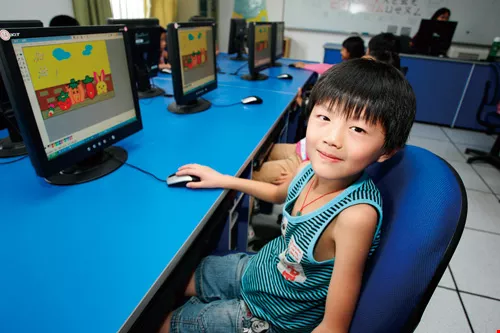
Established three years ago amidst the cluster of international schools in the Minxing District, the Shanghai Taiwanese Children's School still has room to grow. Most of its current enrollment of 400-some students are in elementary school.


