The Hakka of Singapore and MalaysiaHakka Culture in Singapore
Lim Kian Seng,Wang Peiqi/research by Tan Lai Hua and Lu Laide / photos courtesy of the Char Yong Dabu Association / tr. by Scott Williams
October 2008


Guangdong and Fujian have traditionally been wellsprings of Chinese emigration overseas. But many equally outstanding Hakkas have also been sprinkled amongst these Cantonese and Fujianese putting down roots in the world's soil.
Originally Han residents of China's heartland, the Hakka fled south to escape the chaos of successive wars. Settling in Fujian, Guangdong, and Jiangxi, they intermarried with the local She and Yao peoples, giving rise to a distinctive ethnicity with its own language and culture.
The world's Hakka population now stands at 35-40 million. In addition to the nearly 30 million who live in mainland China, Hong Kong and Macao, and 3 million in Taiwan, some 2.8 million live in Southeast Asia.
The Hakka have a custom of gathering together with friends and family in autumn. In Singapore and Malaysia, they reflect on the struggles, industry and thrift of the early Hakka settlers and remind the younger generation to always remember the Hakka spirit.
Most Singaporeans don't know much about the Hakka. Most recognize yong tao foo, a stuffed-tofu dish, as Hakka cuisine. But many are only familiar with the stereotype of Hakka as stingy, insular, arrogant and secretive. Few realize that many of Singapore's most notable personages-Minister-Mentor Lee Kuan Yew, his son, Prime Minister Lee Hsien Loong, former diplomat and senior minister of state Lee Khoon Choy, former chief justice Yong Pung How, scholar-businessman Lai Ah-kiew, famed doctor of traditional Chinese medicine Chen Panxu, travel magnate Zeng Liancai, pawnshop operators He Qianxun and Rao Shangren, broadcasters Li Rongde and Wang Lizhen, renowned lawyer Hee Theng Fong, authors Tian Liu and Chong Han, and Tiger Balm creator Aw Boon Haw-are all Hakka.
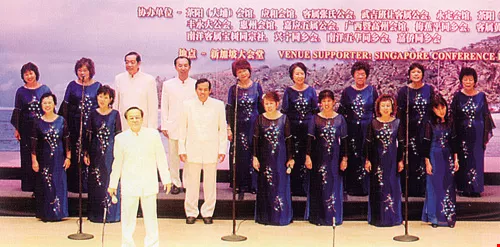
In multiethnic Singapore, where cultural equality is a watchword, Singaporean and Malaysian Hakka are fighting to pass on their own cultural traditions. (top:) The Johor Bahru Hakka association choir sings "The Shining Moon" and other tunes during a November 2007 Hakka song festival. (above:) Zhang Jinmu, Zhu Shunjiao, Yang Tongsheng, and Peng Meilan sing call-and-response-style Hakka folk tunes.
Loke Yah Teng
Zeng Ling, a professor of history at Xiamen University, has written that when Stamford Raffles founded what was to become modern Singapore on behalf of the British empire in 1819, its Chinese community was fragmented into native-place associations with the Fujianese, Chaozhou, Cantonese, Hakka, and Hainanese comprising the five largest ones.
Facing social limitations, the Hakka and Cantonese immigrant communities broke down the parochial boundaries separating the different Chinese groups and together formed the Kwong Wai Siew Association. It then merged with two other large Hakka associations-the Kaying Five Districts Association (made up of immigrants from Meizhou) and the Fong Yun Thai Association (made up of immigrants from Chaozhou and Yongding)-to create a united front: the Loke Yah Teng Association.
Loke Yah Teng served as a bridge between Singapore's Cantonese and Hakka communities, which originated in different regions and spoke different languages. This enabled it to play a decisive role in the island's Chinese community, where its 11 present-day meeting halls still wield tremendous influence.
This year, the Char Yong (Dabu) Association, a group subsidiary to Loke Yah Teng's Feng Yong Thai Association, shone a spotlight on Singapore's hitherto relatively inscrutable Hakka community with a 150th anniversary celebration.
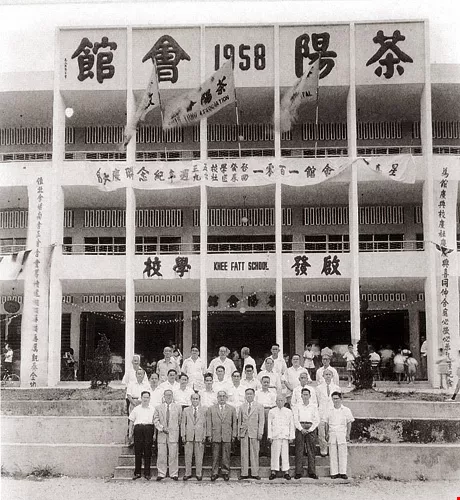
The Hakka have kept nose to the grindstone for more than 100 years to earn livings for themselves in foreign lands, never forgetting to give back to the overseas Chinese community when they acquire personal wealth. The photo shows the expanded Char Yong Association building.
The future
To commemorate the anniversary, Char Yong and 19 other Hakka organizations organized a Hakka culture festival. In addition to encouraging contact with people from the same ancestral place residing in Singapore and elsewhere, the festival exemplified Hakka notion that while the heart remains with home and country, ambition bestrides the world. It also promoted Hakka culture and raised funds for local charities with a book exposition and traditional food fair that gave Singapore's Hakka an opportunity to give back to their community.
Native place association meeting halls functioned as the center of early Hakka immigrants' lives. They took care of the old and infirm, and educated the young. The Char Yong Association, for example, established a school in 1906. But times change, and the associations changed with them.
What does the future hold for the Hakka associations in Singapore? Ho Phang Phow, secretary of the Char Yong anniversary celebration organizing committee, says that the associations should first support research into the Hakka's cultural heritage and increase the associations' cultural value by sponsoring lectures and publishing books. He also believes that in addition to celebrating the usual holidays, festivals, and events, the associations must work for the good of all Singapore's ethnic groups and of the nation. Because Singapore is an island, he argues, the associations cannot only look inward; they must turn outward if they are to keep pace with developments in the larger community. Finally, he sees cultivating the young as crucial to the associations' survival.
All Singapore's native place associations are dealing with the problem of attracting young people. One major reason for this is that young people simply aren't very familiar with them. They assume that they are just clubs where senior citizens get together to drink tea and play cards. Young people don't feel any connection to the associations; they just figure they're not their thing. Instead of asking, "What can I do to keep the associations alive?" they wonder, "What do they have to offer me?"
If the associations are to innovate and attract young people, they must look out for the interests of seniors, the middle-aged, young adults, and children alike. It's the only way they'll be truly able to work for the good of all Singapore's ethnic groups.
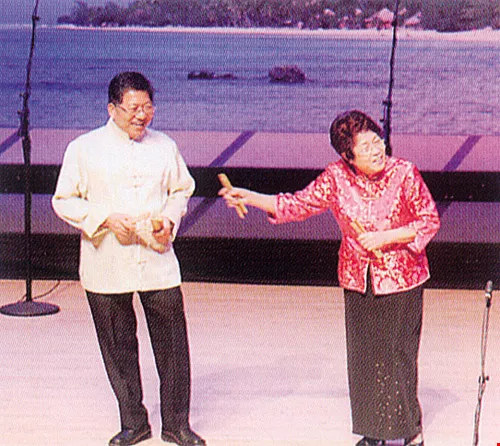
In multiethnic Singapore, where cultural equality is a watchword, Singaporean and Malaysian Hakka are fighting to pass on their own cultural traditions. (top:) The Johor Bahru Hakka association choir sings "The Shining Moon" and other tunes during a November 2007 Hakka song festival. (above:) Zhang Jinmu, Zhu Shunjiao, Yang Tongsheng, and Peng Meilan sing call-and-response-style Hakka folk tunes.
The Hakka spirit
To that end, Char Yong has organized a number of visits to Dabu, the association's native place. In May 2008, the association provided a group of 80 senior citizens (age 65 and over) with a free trip back to Dabu to visit relatives. In this globalized era, these associations are not only emphasizing maintaining contact with their ancestral hometowns, but also arranging exchanges with Malaysian and Taiwanese associations to create an inter-regional cultural network. The anniversary celebration's Hakka Culture Show was very well received and featured performances by Hakka who traced their origins back to a variety of locales, including Dingzhou, Meizhou, Huizhou, Ganzhou, and Guangxi, as well as Malaysia.
The celebration's Hakka food fair offered up Hakka cuisine from a number of regions, including the rich, salty "abacus beads" (steamed balls of taro and tapioca flour served with stir-fried mushrooms and shrimp), rice-wine chicken, yizi ban (stuffed glutinous rice dumplings), and laoshu ban (steamed, leaf-wrapped glutinous-rice dumplings with a variety of fillings). It was a feast not to missed.
Though Char Yong's anniversary celebrations will soon be wrapping up, with a dinner banquet planned for 4 October and a closing ceremony and book launch for 5 October, the Hakka spirit they aim to promote will continue to burn brightly, passed down through the generations for ever more.


