Waiting for the Light-Taiwan's Visually Impaired
Chang Chiung-fang / photos Hsueh Chi-kuang / tr. by Scott Williams
July 1998


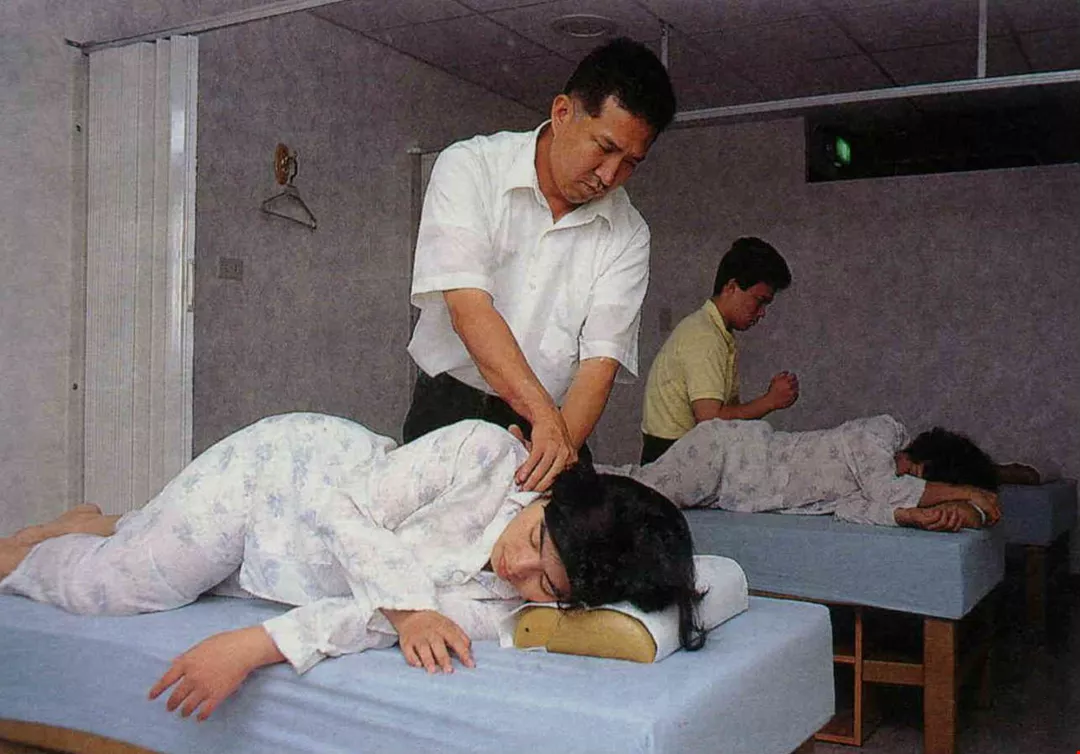
(left) Although it requires a high degree of skill and pays well, massage is exhausting work that receives little respect.
Some refer to them in Taiwanese, calling them chimiya. Others use the Mandarin xiazi, "blind person." Still others call them "dragon pinchers," a derogatory term for masseurs.
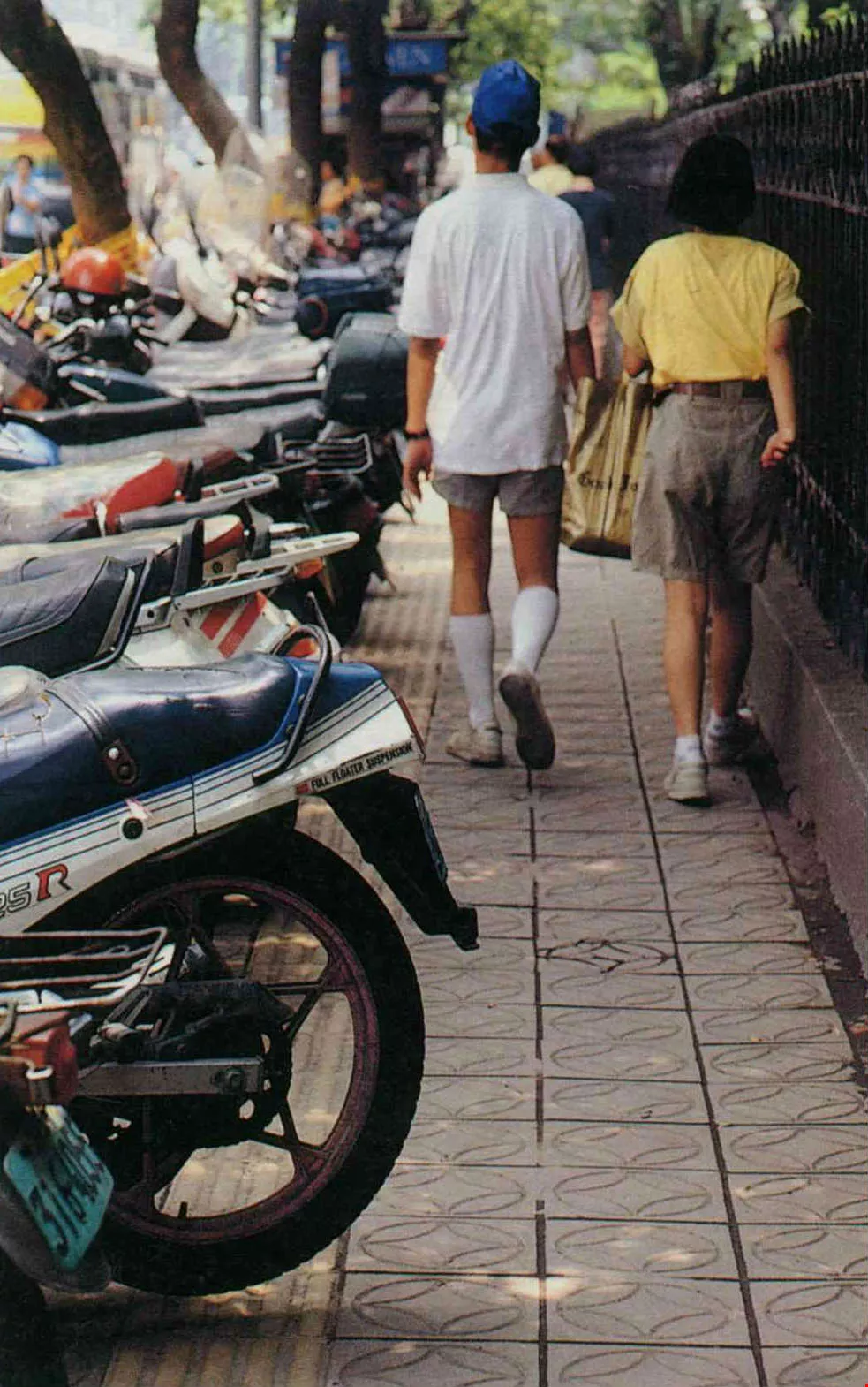
Tiles set in the sidewalk to guide the visually impaired instead delimit the boundaries of a motorcycle "parking lot." (photo by Diago Chiu)
For most people, the black of night is always followed by the dawn. For the vision-impaired, however, life's long road is traveled alone in the dark. They must seek far harder than most to find "life's light."
During the revision of the "Law for the Protection of the Physically and Mentally Handicapped," two originally unconnected groups, the visually impaired and hairdressers, became involved in a political tug-of-war. The reason for the conflict was related to an early draft-version of the law which stated that "those not visually impaired as defined in this law may not engage in the massage business."
The hairdressers felt that preventing those with good eyesight from working as masseuses infringed on their constitutional right to work. They therefore wanted the massage industry to be opened up. The visually impaired, on the other hand, wanted protection for their means of making a living. They felt compelled to hit the streets to call for the "return of the blind's right to survival," and even staged a 72-hour sit-in protest.
With the help of visually-impaired legislator Cheng Lung-shui, who threw himself into the negotiations, the "Law for the Protection of the Physically and Mentally Handicapped" finally passed its third reading, bringing the conflict between the blind and the hairdressers to a temporary halt.
In the final draft, the visually impaired got what they wanted-the massage business remains their exclusive domain. But did they win?
It seems that perhaps they didn't. Not only is the law against working as an illegal masseur barely enforced, but the fines for those caught remain a paltry NT$10,000-30,000. Not surprisingly, illegal masseurs continue to operate. Further, there is still rampant exploitation of the massage business as a cover for the sex trade.
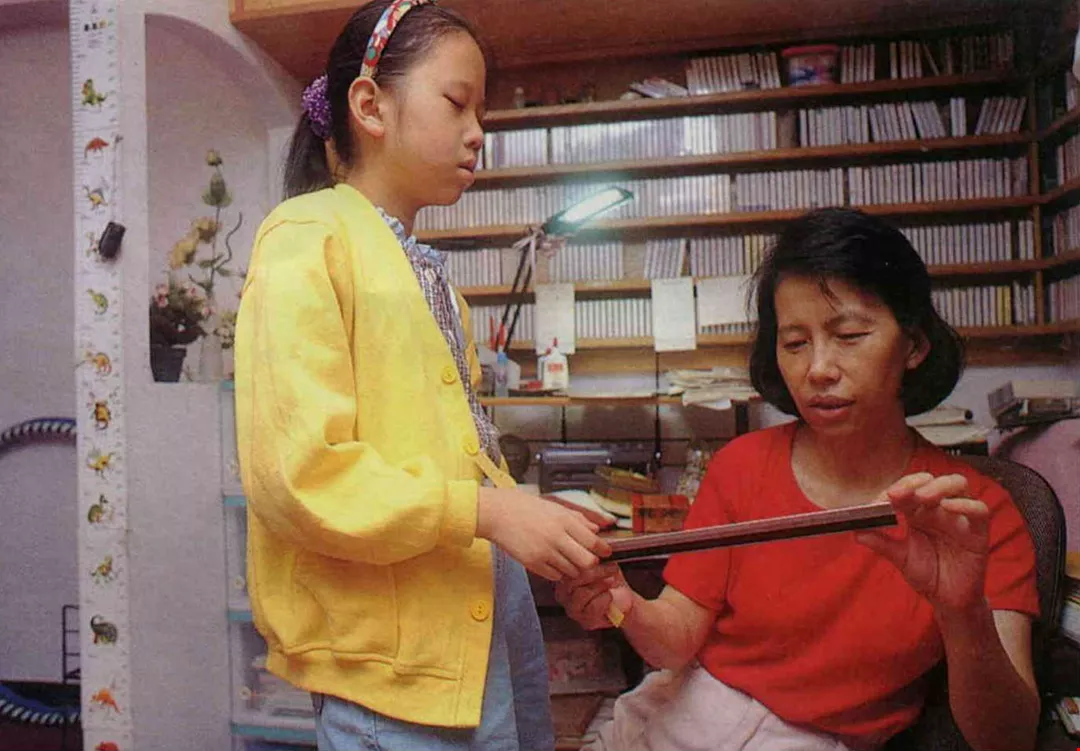
Under her mother's devoted tutelage, Wang Peng, who refers to herself as the "little blind girl," has excelled in all her subjects, thus disproving the stereotype that blind people are only able to do well in the humanities.
And though the new law may have protected their means of making a living, the visually impaired do not necessarily enjoy working in the not-much-respected position of masseur. In fact, many feel the blind's exclusive rights to the massage business are actually the result of society's unfairness, its injustice and its lack of charity.A closed window
Impaired vision is a handicap which comes in varying degrees. Those with corrected vision in the 0.2 to 0.01 range are said to have "weak" vision. Those with corrected vision of below 0.01 are legally blind.
People with weak vision can see, and thus read, with the aid of prescription glasses or magnifying glasses. They therefore have fewer problems than those who are blind. Those who are legally blind, on the other hand, can at best see light and unclear outlines. At worst, they can see nothing at all. They are therefore unable to read standard writing, and instead must use Braille.
How is it that some people are visually impaired while others are not? Lin Lung-kuang, director of the Vision Protection Center at National Taiwan University Hospital, says that most people with weak vision suffer from a congenital abnormality such as cataracts, clouding of the cornea, an unopened iris, or a high degree of congenital myopia, which prevents the normal development of vision.
While blindness, too, can be congenital, it is not always. Congenital causes of blindness include congenital glaucoma and Terry's Syndrome.
The most frequent causes of non-congenital blindness are accidental injuries from car accidents and impact injuries. Blindness may also be caused by disease of the eye, such as glaucoma, or other conditions, such as diabetes and brain tumors.
Though the loss of vision is not, in itself, life threatening, the loss of the most important sense and learning tool we possess is a source of great suffering to anyone so afflicted.
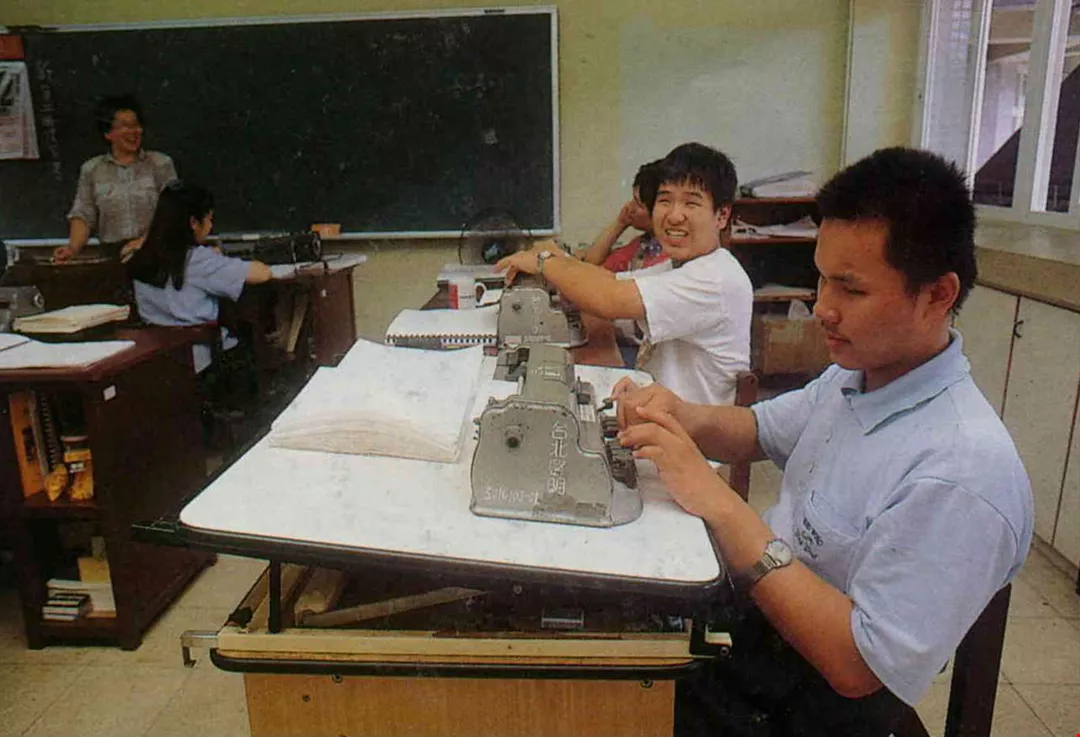
Education for the visually impaired is coming under pressure to "return students to the mainstream." But are all the necessary measures in place to do so? And a re "regular" schools ready to accept blind students?
Lin states that injuries to the cornea and the lens can often be treated with surgery. However, damage to the retina or the optic nerve is beyond the power of modern medicine to treat. And although loss of vision due to problems such as glaucoma and diabetes can be predicted and prevented, many patients are not aware that they have a problem, and lose their vision because they wait too long before seeking treatment.A love-hate relationship
There are currently about 30,000 persons certified as being visually impaired in Taiwan, but the actual number is probably much higher. About 30% of those certified and between the ages of 18 to 50 are working. Of these, 90% work in the massage industry.
In other words, massage is virtually the only profession open to the blind regardless of whether their blindness is congenital or not.
The visually impaired have something of a love-hate relationship with massage-they may dislike the work, but they can't leave it. And although the island's masseurs are sometimes more politely referred to as "masters of health protection," as Chen Ching-chun, a one-time teacher at the Institute for the Blind, says, it is nonetheless, "an exhausting, low-status job which keeps you on a vampire's schedule and sees you heavily discriminated against. Its only good point is that the pay isn't bad."
Working 15 hours a day, Taiwan's masseurs can make between NT$30,000 and NT$40,000 per month, a level at which supporting oneself is not a problem. Another benefit of going into this line of work is that blind people don't have to face having doors slammed in their faces again and again by prospective employers. Instead, they can work independently or open a clinic with a few friends. It really is the path of least resistance for visually-impaired persons trying to make a living.
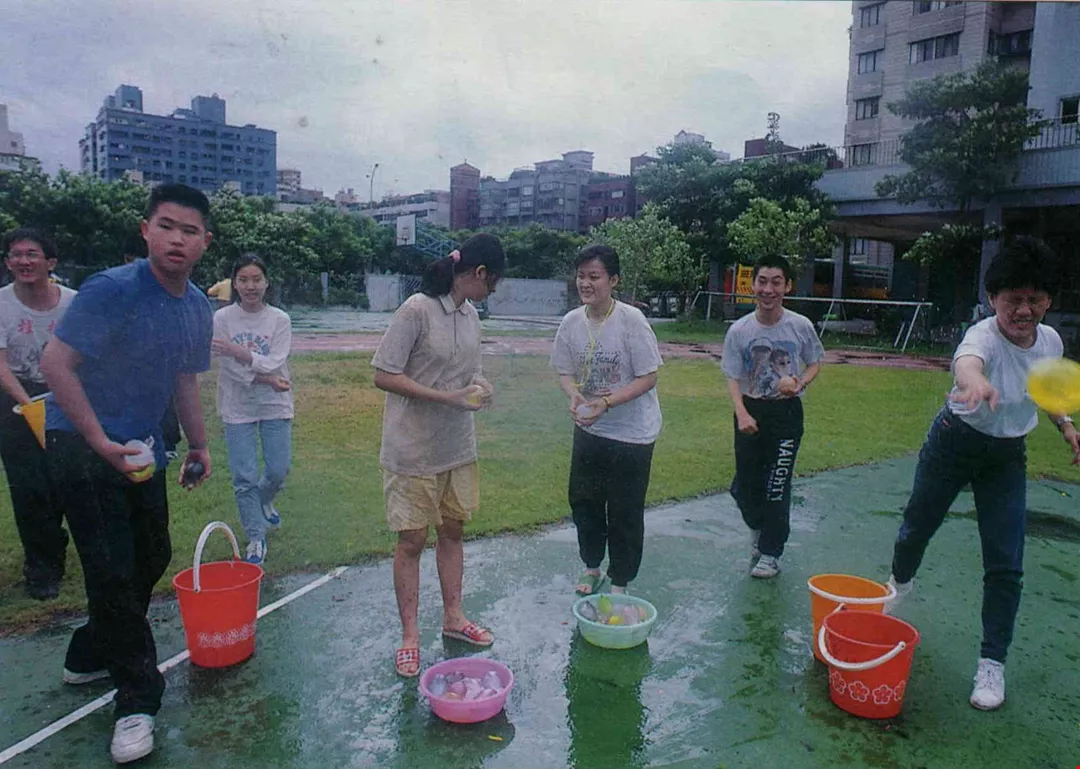
Graduating students and teachers at the school for the blind have a water balloon fight on the school's athletic field. So what if it's not at all clear who is friend and who is foe, everybody is having a great time.
Hsu Yung-chang, who was left nearly completely blind by an accident, has tried his hand at a number of jobs. He was a good worker; whether working in a bicycle factory or an electronics factory, his output was always comparable to that of the other employees. At one place, he was even the second most highly rated employee in the entire factory. But in spite of this, he was always paid less than the other workers and was always passed over for promotion. Angered by the unfairness of such treatment, Hsu felt his only option was to leave factory work and take up massage.The only choice
Hsu, who has been a masseur for 17 years now, says that it is a job at which "you sweat blood to earn your wages." He says that sometimes, after giving several massages in a row without a break, his hands are too weak to hold his rice bowl and chopsticks. In the past, Hsu had to wait by the phone at all hours of the day and night. As soon as he got a call, he would be off to serve the client. The year before last he joined the Loving Blind Association massage center. Now he has regular working hours and has finally begun to feel "settled." He has done well at the center and this year was sent to a new clinic in Neihu where he was made head masseur. As such, his responsibilities are to hone the skills of the other masseurs and ensure that all are using the same techniques.
It's not easy to become a "dragon pincher." Not only must you study physiology, anatomy, massage, pathology, the circulatory system and acupuncture points, you also have to be familiar with how to apply pressure with the fingers, how to massage the soles of the feet and how to mobilize vertebrae. After two to three years of professional training, you still need to pass the Employment and Vocational Training Admin-istration's massage skills certification. Only after doing all of this can a visually impaired person begin to earn a living by massage.
But these very professional skills have yet to receive the respect they deserve. Ko Ming-chi, director-general of the Institute for the Blind in Taiwan, says that in Japan the blind practice acupuncture and massage as something akin to a medical treatment and thus have higher social status than in Taiwan. In mainland China, there are hospitals devoted to massage, and the masseurs are referred to as doctors. But in Taiwan, where massage is viewed as a service-industry job, masseurs are known derogatorily as "dragon pinchers" and have low social status.
Why is the situation of the visually impaired different from that of the non-handicapped, who have so many choices in the job market and "regular jobs"? Ko thinks that one of the reasons is the lack of an "obstacle-free" environment.Barriers everywhere
Ko relates a biblical story in which Jesus' disciples asked him whether a blind man had lost his eyesight because of his own sin or that of his parents. Jesus responded that the man's blindness was the result of neither, but was to show the power of God at work in him.
However moved a blind person might be on encountering this story, he must still face the difficult real world on his own.
Ko still remembers how he felt the first time he went out on the streets. "I was nervous and scared. I walked and walked until I walked into a truck parked by the side of the road!"
Many of the devices the blind use to help themselves get around, devices such as ultrasonic "seeing eyes," seeing-eye dogs and special "guide-tiles" on the street, are useless in Taiwan.
The ultrasonic "seeing eyes," for instance, emit a beep when the carrier approaches an obstacle. After trying them out, it was realized that they were not appropriate for Taiwan because they began beeping non-stop as soon as they were taken out the door. Carrying one was worse than having nothing at all.
The situation with seeing-eye dogs is similar. Ko once took a seeing-eye dog which he had gotten from the Institute for the Blind out on a walk. When they reached an intersection, the dog stopped. After giving it repeated commands, the dog finally moved forward again-leading Ko into a puddle.
The "now you see them, now you don't" guide-tiles, which are meant to mark a path for visually impaired pedestrians, are yet another "travel aid" that leaves blind people not knowing whether to laugh or cry. Some describe them as the line separating the sidewalk hawkers from the parked motorcycles. Others say the tiles have been laid for those who can see.
Balu Huang, chairman of the Cultural and Educational Foundation for the Blind, says that the tiles are only needed at intersections and other places where a choice must be made. They are not necessary where the path is straight. Currently, however, all of these tiles are laid on straight paths, with some even having been placed next to trees and telephone poles.
Most amusement parks also lack any aids for the blind. Teng Pei-wen, who is writing a film script about blind people, once took a trip with a few sightless friends. She was extremely dissatisfied with the lack of assistance provided to the blind at amusement parks, which typically just left them to "feel their way around." She describes the documentary film they made of the trip as "a disaster film of blind people on a holiday outing."The long, hard road
Obstacles in the physical environment make it difficult for Taiwan's sightless population to get out and about. But it is "barriers" in the psychic terrain of the non-visually impaired which keep the blind from getting a fair shake in the workplace.
Many feel the greatest difficulty facing the visually impaired is not their own lack of sight, but the rest of the world's misconceptions about what that lack of sight means.
The "Law for the Protection of the Physically and Mentally Handicapped" stipulates that 2% of the staff of public institutions employing more than 50 persons must be handicapped. At private enterprises employing more than 100 persons, this figure is 1%. However, many public and private organizations fear problems with handicapped employees and would rather simply pay a fine for not hiring them. Even if they are willing to hire such a person, they still aren't interested in someone with impaired vision.
Two years ago, the special education center at National Taiwan Normal University conducted a survey of Taiwanese firms which made the above bias all too clear. The results indicated that bosses were most willing to hire handicapped persons whose disability involved their arms or legs. The next most "popular" were the hearing impaired, followed by the mentally retarded. Visually-impaired persons did not make a single boss' list.
The blind child-poet Wang Peng, who achieved fame by submitting a winning entry to a contest which put poetry on city busses, gets excellent grades in all her classes at school. But even so, her mother doesn't hold out much hope for the girl's future prospects. Commenting on the situation of blind people in Taiwan today, her mother says sadly, "Now everybody says how bright she is, but when, someday, she goes looking for a job, all they'll say is that she can't see."
"Most people don't know what visually-impaired people can do," says Balu Huang. Even the government just deals with them perfunctorily. Take the blind person who passed the civil service exam for the handicapped last year. The department he tested into hired him, but didn't know what to have him do. Finally, they just had him transcribe documents into Braille for Cheng Lung-shui, Taiwan's only visually handicapped legislator.Attitudes are the biggest problem
Two years ago, Cheng Lung-shui proposed a plan to Chung Hwa Telecom in which blind people would be used as directory assistance operators. In March of last year, after a year of preparation, the plan was implemented. But after only two months of training and testing of the three blind persons who had been selected for the job, Chung Hwa killed the plan, citing sub-par performance as the reason.
In fact, though blind people cannot see, with extensive training, their performance on the job is comparable to and sometimes even exceeds that of their sighted colleagues.
Tseng Wen-hsiung, director-general of the Institute for the Blind, cites the example of the Kung Hsue She Trading Company in Chungli in his lectures. The company, which produces bicycles, hired eight students from the institute to put spokes into wheels. At the outset, they weren't as productive as the other employees. But after six months, they were keeping up, and after one year, their productivity was higher than that of employees who could see. The situation prompted the factory manager to jokingly tell his employees, "If we don't hit our production target, management is considering having all employees wear eye patches to work."
The blind are also capable of doing many different kinds of work. Cheng Lung-shui states that in the US blind people are employed in more than 140 different kinds of jobs including market surveyor, bank analyst and telephone marketer. When Lee Chia-tung, president of Providence University, was working on his PhD in the US, he even had a blind thesis director.
Huang Hsi-ming, who is responsible for the blind students' resource center at Tam-kang University, points out that when Tam-kang succeeded in developing a computer for the blind in 1995 which converts between Chinese characters and Braille, the programmer who worked on the project was blind. In fact, the network in the resource room is also maintained by a blind person.
Of course, the first step to achieving this kind of ideal situation is to provide as complete an education to visually impaired students as is given to sighted students.Returning to the mainstream
Strangely, in the past vision-impaired and hearing-impaired children all attended the same school. With one group unable to see and the other unable to hear, communication between the two was virtually impossible. And as might be expected, they didn't get along.
Chen Ching-chun, who graduated from the Dahlung Dong School for the Blind and Deaf, recalls the conflicts between the blind and the deaf students at the school. "I couldn't see. At mealtimes all I could do was hear the tables and chairs moving, the plates and bowls flying; I never knew who was winning and who was losing," says Chen. "Whenever I bought something to bring to school, it would be snatched. I didn't know who had taken it; all I could do was moan and feel myself unlucky."
Fortunately, those days are past. Since 1975, blind students and deaf students have each had their own schools.
The schools for the blind include kindergarten and primary and secondary schools. However, because there are only two in Taiwan, one in Taipei and one in Taichung, most blind students must leave home at an early age to live at school.
This situation has led some city councilors to propose that visually impaired students should be sent back to the warmth of their own families and that they study in "normal" schools to help them adapt to society. In June of last year, when the Taipei City Council's committee on education was evaluating the education budget, some councilors wanted the school for the blind to create a plan to return children to their own homes within five years before they would consider the school's budget.
Kuo Yi, president of the Taipei Municipal Chiming School for the Blind, says that this insistence on the part of some councilors is not reasonable. He points out that the principle of returning students to the mainstream has been a part of Taiwan's special education system for 30 years. But he asks why it is that those who attempt to study in normal schools always end up coming back to the schools for the blind? Why is it that after 30 years this idea is coming into vogue once again?
"The idea behind returning children to the mainstream is a good one; it's the right direction to be moving in. But are all the measures necessary to make it work in place? Does your average school have the teachers and the facilities? Is society prepared to accept this?" Kuo wonders.Relying on yourself and a little luck
At this point in time, returning students to "normal" schools is no easy task.
Wang Peng left the Taipei Municipal Chiming School for the Blind to begin attending the Sanyu Primary School in the third grade.
"The road to the mainstream is an exhausting one," laments the tenacious Mama Wang, who must often deal with the Taipei City Bureau of Education herself.
Although there are guidance counselors who make the rounds of the schools to talk to the blind students, there are too few of them. This means that the help given to blind students is extremely limited, and most must rely on their parents' help and a little luck.
Wang Peng, who lost her sight while still very young, is lucky to have such a steadfast mother. In order to make it easier to get her daughter to school and home again, Mama Wang has moved the family several times. And not only does she take her daughter to and from school every day, she must also go to the school for each test and quiz in order to read the questions to Wang Peng.
In addition, because most teaching of mathematics is done on the blackboard, blind students face difficulties in learning it. Therefore, Mama Wang has always taught Wang Peng her mathematics at home, racking her brains to create materials to teach the sightless Wang Peng about space and geometry. For example, they have been studying about volume recently, learning to calculate the volume of a cylinder, so Mama Wang made some cylinders that Wang Peng could touch and feel. Such physical objects allow Wang Peng to really understand what is meant by concepts such as length, width, height and thickness.Reading with your hands
"Everybody's afraid of a hassle, so they don't give the visually impaired a chance," says Mama Wang, who goes to all the trouble she does just to give her daughter a fair chance at an education. "Wang Peng has natural talent. We can't sacrifice her opportunity to study just because we can't come up with any materials for her."
When Wang Peng was small, Mama Wang made more than 100 tapes of herself singing children's songs and reading stories for her daughter to listen to. Now that Wang Peng is bigger, she's lost interest in these. Her new love is "reading." The problem is that there are very few Braille books in Taiwan.
"She's got almost nothing left to read." Mama Wang points to some of the Braille books Wang Peng has read and says, "These were given to her by the resource room at Tamkang University. They're her only treasure!"
Huang Kuo-yan, who this year won a government-sponsored scholarship to study overseas, almost lost his chance at higher education. He says that when he lost his vision during the second year of middle school, his father wanted to send him to the Institute for the Blind to study massage. But Huang didn't want to go. He wanted to continue his academic studies. "I had the impression that there were people who read with their fingers." Huang was convinced that being a masseur was not the only choice for a blind person; if one path didn't work out, another one would present itself. His father was persuaded and sent him to the school for the blind where he began to learn to read with his hands.
Huang eventually graduated from the special education department at NTNU, and now teaches at the Taichung school for the blind. He says that it frustrates him that his blindness has limited the development of his talents. "I spend more time asking people to make Braille books than I do actually reading," he says.
Not only is there a lack of books for the blind, but of all the areas of special education, theirs is the one which faces the most severe shortage of teachers.
Mama Wang was able to get a computer for the blind for the primary school where Wang Peng studies. This computer is able to convert Braille input into standard written words. Sightless individuals are also able to "read" any information on the computer. But the computer has been sitting unused for a semester because there is no one to teach them how to use it. "They aren't expecting me to learn how to use this by myself, then teach everyone else?" Mama Wang asks incredulously.Open, sesame!
Study in regular schools has its difficulties, but schools for the blind also have many areas that need improvement.
Kuo Yi, who returned to the Taipei Municipal Chiming School for the Blind as its principal two years ago, admits: "Returning to the school, I felt the same way that I did 30 years ago. In 30 years, our education of blind students has not improved one iota!"
Wang Pao-tsung, who was one of the roaming guidance counselors for the blind before being transferred to his current position at the Taipei Bureau of Education, says that many families feel that once their kids begin studying at a school for the blind, it is difficult for them to reenter the regular educational system.
Mama Wang explains that the content of many classes has been pared down, and that this is especially true of math classes. In the past, the university entrance exams for the vision- and hearing-impaired didn't test students' math, so many teachers gave up trying to teach it. As a result, "There was no way that students who graduated from the schools for the blind could test into math or business departments."
Kuo Yi says that it wasn't that math wasn't taught, but that it wasn't strongly emphasized. Beginning in 2001, however, the special entrance examinations for the vision- and hearing-impaired will begin testing their math, which means that the teaching of math at the schools for the blind will have to improve.
Another change is that more schools are open to blind students now. In the past, while students were allowed to choose whether they wanted to study at a school for the blind or a regular school during their primary and middle school years, they had to attend a high school for the blind. This was because regular high schools would not accept completely blind students. Last year, however, Taipei's Sungshan High School became the first school to act in accordance with Bureau of Education policy by accepting a blind student. Rumor has it that another blind student will be admitted this year.
On the college and university level, Tamkang University started the trend to accepting blind students in 1969. And while Lee Chia-tung was its dean of academic affairs, National Tsinghua University made history by throwing open admissions tests for every department to blind and deaf students. Equality and universality
"The basic human rights of the handicapped are still not respected," says Cheng Lung-shui. He feels that society should build facilities according to people's needs, and should not value a person according to what facilities are available. "You can't have the government or the general public telling blind people that they must be masseurs or that they can only study humanities because there are no facilities available, or because it would be a hassle to get them into other areas."
Fortunately, new doorways have been opened to the visually impaired with the development of computers which they can use. "A computer can be a blind person's eyes," says Hung Hsi-ming. With the aid of a computer, they can readily access new information and communicate with the outside world. The removal of this barrier heralds a dramatic increase in opportunities for the blind to work in any number of fields.
Equality and universality are basic premises of the United Nation's declaration of human rights. They should also be society's goal in the treatment of the visually impaired.


@List.jpg?w=522&h=410&mode=crop&format=webp&quality=80)
