Xiong Wei: Living Tai Chi Legend
Vito Lee / photos Chuang Kung-ju / tr. by Jonathan Barnard
May 2009


Tai chi (taiji quan) is a martial art, a way of keeping fit, and a philosophy of life. Passed down through the ages, this ancient culture of the human body is tightly connected to Taoism. It is a healthy path toward uniting the mind and the body-and, at a deeper level, a way of seeking harmony between an individual and the myriad things of the universe.
Born in Hunan Province, Xiong Wei was a weak and sickly youth. He first practiced tai chi to grow stronger. At various times, he studied the Yang, Hao and Chen schools of tai chi. Taking the best parts from each, he created taiji daoyin, a school of tai chi that has taken Taiwan by storm.
Its sequence of martial arts forms appears to be quite simple at first glance, but it is in fact very meaningful. Emphasizing stretching and regulating the breath, it is easy for beginners and consequently has become quite popular, attracting an estimated 100,000 students in the 40 years of its existence. Among its most famous practitioners is Zhang Zhongren, former US tai chi champion and the martial arts director for Lee Ang's film Pushing Hands.
Small and thin, and clad in simple martial arts garb in every season of the year, Xiong keeps a low profile and has steadfastly refused to take a more commercialized approach to promoting his school despite possessing outstanding martial arts skills. Nearly 80, he still diligently practices and gives lessons. He has had a great influence on his students. Whether university professors or small or big business owners, they all greatly admire him.
From a lowly soldier who crossed the Taiwan Strait during the chaos of war, to a master who has carried the torch for a martial arts discipline with a long tradition and also staked out new ground within that tradition, Xiong Wei has lived a life reminiscent of the ancient masters of the martial arts world-only his is a story set in contemporary Taiwan.
The first secret of taiji daoyin is its rotations, which relax the body and make it supple. In order to demonstrate rotating, Xiong Wei moves the five fingers of his hands in toward his palms, creating a wavelike movement that in turn leads his hands and wrists to move slowly. Next, he leans his torso at a slight angle, and makes a rotating motion that starts with the tips of his fingers and moves upward to his wrist, elbow and finally to his shoulders, which rise and sink, slowly making a circle.
Taiji daoyin is split into 12 forms. Six of these are daoqi forms, which aim to channel the body's energy by regulating the breath. The other six are yinti forms, which focus on stretching the body. A student starts with the yinti forms and then moves on to the more difficult daoqi forms. Sitting in his living room in Xindian, Xiong is demonstrating the first yinti form that a novice learns: "rotating the wrists and arms."
Although nearly 80, Master Xiong is still very muscular. After three minutes of demonstrating the form, the individual muscles in his forearm are distinct and slightly protruding, bowing toward the center of the circle he is making.
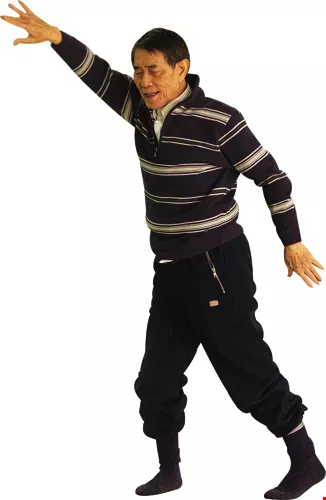
Xiong Wei demonstrates such forms as "single whip," "cloud hands," and "six sealings and four closings." According to legend, tai chi was invented by Zhang Sanfeng, a Yuan Dynasty martial arts master. Numerous schools of the discipline have appeared in the years since, and taiji daoyin draws from the best points of each. Its sequence of forms can be viewed as a great way for martial arts novices to build a foundation of basic skills.
Suppleness and strength
To demonstrate "rotating the wrists and arms," Xiong Wei asks Ji Liancheng to spar with him. Ji, who has been studying with Xiong for more than 20 years, aims his fist toward the chest of the master, who immediately grabs it tightly. In one smooth motion, Xiong avoids the fist, locks up his opponent, and applies downward pressure with his leaning body. As his opponent lies conquered on the ground, the master's gaze, formerly benevolent, has become sharp and penetrating.
"When my opponent is still, I am still; at my opponent's slightest move, I pounce," says Xiong, whose Mandarin has a thick Hunan accent. Explaining that tai chi imitates nature, he quotes a famous Chinese expression: "If heaven doesn't rotate, it meets destruction; if the earth doesn't rotate, it collapses; if people don't rotate, they wither." Through the vibrations of continual rotation, one can deeply massage the muscles, achieving a state of thorough relaxation. But when you need to apply force quickly, rotating can also be turned into a source of great strength.
"It's like how a bullet, which finds its trajectory from its own forward motion combined with the rotation imparted by the rifling of a gun barrel, leaves a gun with great power and speed."
Xiong Wei picks up a towel to make another analogy. He grips the towel with both his hands, and then, rotating his hands in opposite directions, twists the towel along a central axis. "These fibers are like a body's meridians. After deep rotation, the movement applied to the outside layer will necessarily stimulate the muscle, tendons and blood vessels on the inside, alternately relaxing and tightening them. After a while, the body will naturally grow relaxed."
Likewise, it's not especially effective to apply pressure straight from the top or bottom when trying to squeeze water from a wet towel. The best method is twisting (rotating) it. If the angle is right, and you apply a little force intelligently, you can squeeze out the last drop. This is akin to how the "silk reeling energy" of tai chi is applied.
Xiong Wei stresses that the rotation in taiji daoyin is three-dimensional and multilayered. In the terminology of "silk reeling"-neigong ("internal kung fu") movement principles found in most tai chi schools-there is compliance and defiance, the inner and the outer, the upper and the lower, advancing and retreating. When performing these exercises, the waist is at the center, and it leads the movements of the body's nine major joints (shoulders, elbows, wrists, waist, spine, neck, crotch, knees and ankles) in simultaneous rotation. The movements are startlingly powerful.
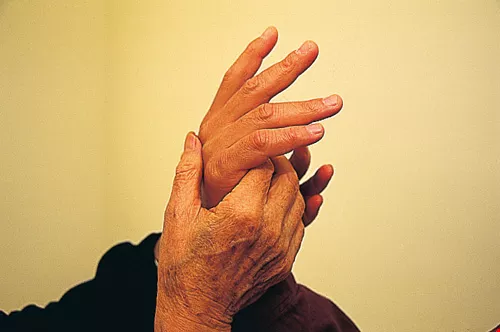
Don't be misled by the leisurely pacing and the soft lines of tai chi; once a master begins to spar, lines of strength open up from various places in the body which are very hard to defend against. The photos show Xiong Wei using the "linked hands" method to spar with a student.
Self reflection, relaxation
With all this constant rotating and striving to relax, the Chinese words that may best serve as guiding principles for students of Xiong's tai chi are "song rou"-"relaxed and soft."
Ji Liancheng, who constantly reminds students during class that there are "no limits to softness," explains that tai chi is a kind of qigong that takes inner skandha and transmits it outside. If you want to take the qi in your body, which is a form of energy, and convey it directly outside, then you must eliminate all obstacles. "It's like how hardened earth won't absorb water, but soil that has been thoroughly loosened will immediately absorb it."
It sounds simple, but in practice sometimes you have to "relax the waist" and "drop the crotch;" sometimes you have to continually stand erect and then crouch down; sometimes the arms must be raised and extended as they turn; sometimes the back and the waist must lean forward and then backward, repeatedly.... When you are sore, it's hard for your muscles not to tense up. And what can you do about that?
Ji Liancheng explains that maintaining a state of relaxation when practicing tai chi requires continuous self-observation. As soon as you discover that there is stiffness somewhere in the body, stop. Don't try to tough it out. And don't allow yourself to get caught up in rigid notions about the relative prettiness of your movements. Because you must constantly be self-aware, your mind must be focused. Adopting a state of consciousness in which you are both seemingly present and seemingly absent, you should-extremely delicately and slowly-be led by the movements, constantly observing the smallest of changes to your body.
When you are extremely relaxed, you "empty out" into a state of mind-body unity. This is a state that not only expands the space within but also allows you to lengthen a single breath so that the qi can reach every part of the body. Furthermore, when practicing tai chi in such a state, it almost seems effortless, or as if one is half asleep or half drunk. It's like the line in Laozi's Dao De Jing: "The way is elusive." It is easy and comfortable.
Constantly using his body as a place to practice Taoism, Xiong Wei, who strives to use the martial art of tai chi to prove Laozi's philosophy, notes that the Dao De Jing includes these lines: "Is not the space between heaven and earth like a bellows? When it is emptied, it loses none of its power. Moved again, it sends out more air." A bellows is like an empty box for wind: when pumped, it can create a limitless amount of wind. The space between heaven and earth is likewise "empty." Only in such an empty space can qi have free and fluent movement, and can wind and water enter to unleash tremendous amounts of energy.
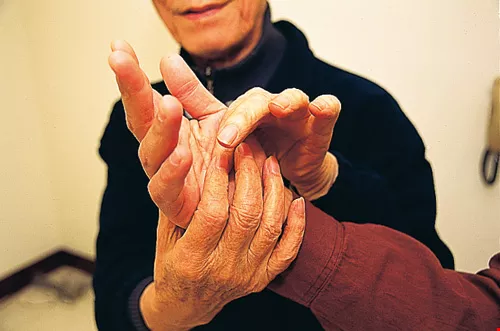
Don't be misled by the leisurely pacing and the soft lines of tai chi; once a master begins to spar, lines of strength open up from various places in the body which are very hard to defend against. The photos show Xiong Wei using the "linked hands" method to spar with a student.
Strange destiny of a weak soldier
Xiong Wei's fated relationship with tai chi likewise demonstrates the Taoist idea that misfortune and good luck are closely linked. If Xiong had not been a sickly youth, at the threshold of death at one point, then he wouldn't have so resolutely pursued the path of the martial arts (see "It Was Written-Xiong Wei's Legendary Youth," p. 107).
Xiong Wei recalls that in 1960, when he was just starting to study the Yang school of tai chi with Li Shoujian, he often felt exhausted due to his lack of strength. Several times he considered quitting. Fortunately, Master Li, who was then over 80, continually encouraged him, pointing out various principles contained in classic works of martial arts instruction. After Xiong slowly gained insights and his physical state also improved, he realized he wanted to work hard at learning this ancient art.
After studying for three years, Xiong was knocked unconscious when he was hit a by speeding ambulance while taking a walk. Brought to the hospital, it was thought that he had a severe concussion and that surgery was necessary. But when the doctors were taking a second spinal tap, Xiong Wei miraculously awoke. He was released from the hospital several days later. The turn of events surprised the doctors no end.
"It was 'song' (the state of being relaxed) that saved me," analyzes Xiong Wei. When he was hit and flying through the air he was in a relaxed state, not expending much energy in resistance. And there was also little energy in the rebound, so that although he was hit hard, it wasn't fatal.
Apart from studying under Master Li Shoujian, Xiong sought out many other teachers for instruction: He studied Hao school tai chi with Zhou Zenglin and Chen school tai chi with Wang Jinrang. Back then there was strict differentiation between the schools, and little tolerance for "disloyalty to one's master." With his freewheeling ways, Xiong Wei couldn't help but get scolded harshly.
Xiong Wei recalls one time when Master Zhou angrily said, "What use is there in the sluggish style of the Yang school? Do you want to study with him or with me?" Making an analogy to the conflict between the Nationalists on Taiwan and the Communists in mainland China, Zhou further argued, "If you believe in the three principles of the people, you must oppose communism." Xiong Wei, meanwhile, countered by playing "the need to know your enemy" card and argued that "adherents of the three principles of the people have even more reason to 'study' communism." That tack didn't lessen his master's anger, however, so Xiong stopped studying with Zhou. Yet much to Xiong's surprise, Master Zhou came on his own initiative to Kaohsiung three months later to find Xiong. It moved Xiong deeply.
Why did the master treat him so specially? Was it that Xiong's body was particularly suited to the study of martial arts? Xiong Wei says that he frankly doesn't know. All he knows is that he has gotten along well with people, and when he was practicing pushing hands with people from the same school, he never worried about having the upper hand. He wasn't scared of being pushed over, and he happily taught others. In fact, not only did the teacher think highly of him and teach him without charging tuition, but Xiong even began to make a name for himself within the army. Many fellow soldiers began to ask to study under him.
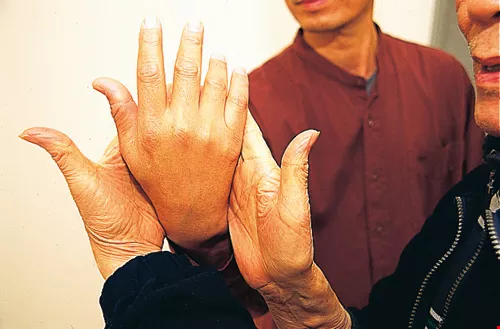
Don't be misled by the leisurely pacing and the soft lines of tai chi; once a master begins to spar, lines of strength open up from various places in the body which are very hard to defend against. The photos show Xiong Wei using the "linked hands" method to spar with a student.
The nation of the body
Xiong spent much time studying with masters, but the longer he studied, the more doubts he had. For instance, the classics of martial arts instruction included passages such as these: "The tendons and bones should be relaxed, whereas the skin should attack," "Softness to convey qi, hardness to strike," and "Not the weight of a feather or bug more." What do these passages ultimately mean? How could he put their wisdom into practice? He couldn't find the answers. His tai chi teachers were extremely skilled, but when it came to describing the philosophy behind the art they had little to say.
Seeking answers to these questions, Xiong Wei devoted virtually every waking moment of his life to the study of tai chi. He tried to combine his practice of the forms with the philosophy outlined in the classics of the field, slowly groping his way toward understanding.
As an example, he cites a phrase of Laozi: "Sages treat their body as a nation, their spirit and qi as the nation's people. If the people scatter, the nation will fall apart." He says, "Think about it: You are the premier of the nation of your body. Are not your organs like your various ministries? If you want to do something well, should you not coordinate within first?" And to coordinate within, you must first shut out outside distractions. "When the eyes don't see outside things, spirit flows to the liver," goes a passage famous among tai chi adherents. "When the ears don't listen to outside things, soul goes to the kidneys. When the nose doesn't smell outside things, essence goes to the lungs." The consequence of turning toward inner cultivation is that the mind calms down and focuses, gaining a full understanding of each part of the body. It is only by so doing that one can fully transform oneself.
"If my body is a nation, then its leader must be constantly on the go, visiting all its provinces." Xiong Wei compares his ankles to the "remote Nantou countryside," and his knees to Taichung. Most people may pass their lifetimes without ever giving much thought to their bodies. But he understands that "every area has its own scenery and problems. One should think about each slowly and carefully. Don't just rush through."
There are numerous acupressure points in the area around the knees, among which the xiyan ("eye of the knee") is dominant. As Xiong describes, "The xiyan says, 'Every day I move up and down, expending a lot of energy. Why don't you come and help me?'" This image was the inspiration for the basic first form of taiji daoyin: "double knee rotation." From a standing position, one rotates one's knees leftward and downward to a squat, and then rotates them rightward and upward to stand erect again. This exercise rotates the right, central and left acupoints of the knees. It builds endurance and flexibility, helping practitioners overcome obstacles to their study of martial arts.
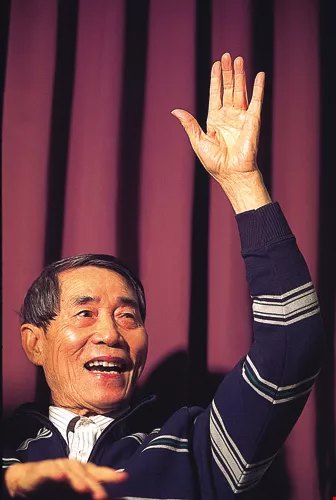
Xiong Wei's movements possess an easy, free-flowing feeling. The "ball tai chi" that he has been demonstrating recently offers an opportunity for self-exploration amid fun. It never fails to impress.
Daoyin born of chance
He had many similar inspirations. "Breath energy is like a nation's treasury," he says, "and emotions and desires are bandits. They are constantly stirring things up and causing trouble, trying to rob me of my breath energy." He believes that the qihai acupoint in the dantian area beneath the navel represents his arsenal and reserve forces, and his two arms are his weapons. When this kind of kung fu has been fully cultivated, its practitioner can use any part of his body to apply force against an opponent. In that state "a single move brings movement everywhere" and "every part of the body can be used like an arm."
It was mere chance that led to Xiong discovering taiji daoyin.
Xiong Wei recalls that Li Shoujian was demonstrating a move wherein the arms are extended with the hands in the "sitting wrist" position (palms facing forward) before the arms rotate right and left. He said that this exercise would bring qi to the arms, making the arms sore and numb and providing vibrating massage for inside the body. Xiong returned home and ruminated on what Li had said. One day he suddenly realized: couldn't rotations in every area of the body bring this internal vibrating massage throughout?
With this realization, Xiong began to add rotational movements to the original framework of tai chi. For the upper body, there was "rotating the wrists and arms"; for the torso, "rotating the waist and spine"; and for the lower body there was "rotating the ankles and crotch." Xiong made further progress via continual exchange of ideas with students. Although taiji daoyin formed slowly, it ended up as its own coherent discipline of martial arts.
"It's not that I'm opposed to tai chi, but I don't want to be constricted by its forms." Xiong believes that once you master this movement or that form, you begin to realize that "visible things aren't that powerful." He explains: "It's like water trapped in a wooden bucket. Even if there is a vast sea all around it, that's no help to the water in the bucket. Only when you can cast off the bucket and become one with the sea can you realize the meaning of the vast sea and sky!" Afterwards, it doesn't matter what shape the bucket is, or how small, you can proceed unfettered and free from doubts.
As Xiong Wei explains that tai chi was originally conceived as a foundation that would support further study of martial arts, but it can also serve as its own coherent system of kung fu. For students of other martial arts, taiji daoyin is an excellent way of training one's qi. For working people who have no interest in studying martial arts, taiji daoyin is an excellent way of keeping in shape. And because the circles within circles and constant rotations of taiji daoyin are beautiful movements, study of the discipline has become de rigueur for members of the U Theatre and Cloud Gate Dance Theatre companies. Its movements were the basis for the choreography of Cloud Gate's Moon Water.
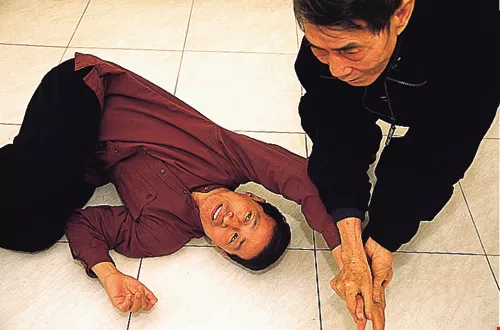
Don't be misled by the leisurely pacing and the soft lines of tai chi; once a master begins to spar, lines of strength open up from various places in the body which are very hard to defend against. The photos show Xiong Wei using the "linked hands" method to spar with a student.
Hard work and innovations
Of course, tai chi is a complete martial arts discipline in itself. And abstract conceptualization will only bring you so far, whereas hard work at training is always most important. Xiong Wei's training methods approach being masochistic. And the way he puts his students through the wringer always leaves a deep impression on them.
"Back then we'd train three times a day, typically for more than 10 hours a day," Ji Liancheng recalls. "Just to practice the crouch step, we'd squat for one or two hours." No matter how much work the students put in, Master Xiong would push them to do more. "On one occasion, a senior student accompanied the master when he went to Kaohsiung to make a lecture. After his speech, they returned to their hotel at 9 p.m. The master told the student to join him training. Little did the student expect that they would still be training at dawn!
While constantly seeking to advance his kung fu, Xiong was also gaining a name for himself and was attracting more and more students. Places where people regularly practiced taiji daoyin spread throughout the island. Nevertheless, Xiong Wei didn't at all set aside advancing his own kung fu. His students admired him for coming up with new movements and conceptions year after year. Lin Hwai-min, the founder of Cloud Gate Dance Theatre, has great respect for Xiong as a teacher, saying that Xiong Wei is constantly changing taiji daoyin, as if it were a form of artistic creation.
At a large gathering for adherents of the discipline at the beginning of the year, Xiong Wei brought out a ball the size of a dodge ball. He then asked students to get down on the floor to demonstrate his newest invention-"ball tai chi." When the ball rolled around on the body, and the body and the ball merged into one mass, surprised shouts echoed through the hall. Only those who had practiced this technique before knew how much of a test it was of one's toughness and flexibility when the weight of the body was pressing on the ball, which was in turn massaging the whole body.
Xiong says that his quest for change and innovation comes from taking nature as his teacher.
He notes that in the Yi Jing it is written: "The lines change and move without resting in one place, moving into any one of the six places of the hexagram. They ascend and descend, ever inconstant. The strong and the weak lines change places, so that an invariable rule cannot be derived from them. It must vary as their changes indicate." Because it courts change and is able to change along with nature, taiji daoyin has an especially lively character. And wherever the discipline is practiced its teachers can adjust the instruction to meet the individual student's needs. Students can thus work at their own pace without feeling pressure.
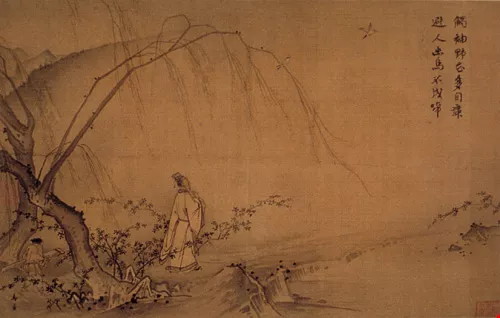
Laozi's ideas about favoring the soft, avoiding competition, and "doing nothing so that nothing is left to be done" are at the foundation of tai chi. But beneath the soft and retiring surface, there must be a foundation of wisdom and real skills. Only when in possession of these can a practitioner have full control over tai chi's forms. The photo shows Ma Yuan's On a Mountain Path in Spring, which is very Taoist in mood.
Unrivalled internal force!
As a martial arts discipline aimed at cultivating qi and keeping its practitioners in shape, and lacking the fierce fighting poses or the sound of wind as the body moves rapidly through the air, many people can't help but wonder: Can those who practice taiji daoyin actually use the knowledge to fight an opponent? Xiong Wei appears so thin and slight. How would he actually perform in a fight?
With regard to this question, Xiong Wei is accustomed to answering: "Must you fight with others? If you want to fight, put the target on your own body, and fight with your inner self!" Nevertheless, his students are convinced of their teacher's fighting powers.
"Purely in terms of neijin [internal force], Master Xiong is unrivalled in Taiwan," says Lee Fong-mao, a research fellow at the Institute of Chinese Literature and Philosophy, Academia Sinica and one of Xiong's students. Several years ago, at a demonstration at a military school, Xiong threw a few officers considerable distances with his neijin. "It was like the scene in Ang Lee's Pushing Hands, when Lung Sihung fought with the American policemen."
In fact, taiji daoyin, which draws from the three schools of tai chi, can itself be employed as a sharp instrument of attack. "Full arm double rotation" was originally a Hao school method. With the same motion, if you lock your opponent's wrist and then proceed to rotate, the opponent's arm will snap and break. The form "rotating the wrists and turning the arms" can also be used for attack. "The move attacks the joints, and it's easy to catch an opponent off guard with it," says Li Feng-mao.
Consequently, "when the master is teaching, he places special importance on moral character," says Ji Liancheng. Ji came to study under Xiong more than 20 years ago with the aim of settling a score. He came under Xiong's profound influence and today he is one of taiji daoyin's best-known instructors. "My temper is much improved, and my state of mind is increasingly open and happy," Ji says. "It's partly because of the master's reminders, and partly because the nature of the discipline."
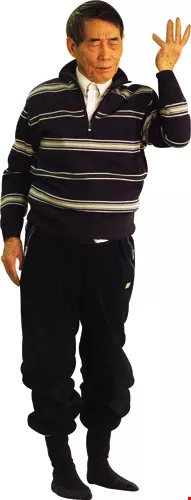
Xiong Wei demonstrates such forms as "single whip," "cloud hands," and "six sealings and four closings." According to legend, tai chi was invented by Zhang Sanfeng, a Yuan Dynasty martial arts master. Numerous schools of the discipline have appeared in the years since, and taiji daoyin draws from the best points of each. Its sequence of forms can be viewed as a great way for martial arts novices to build a foundation of basic skills.
Holding to the mean
In Xiong Wei's mind, being loose and pliant and not struggling is the highest realm of Taoism-"it's both the easiest and the most difficult." And achieving suppleness of the mind is even harder than achieving suppleness of the body. "Who is willing to let go of greedy pursuit of wealth?" he asks with a sigh. "It's not easy to set aside those desires."
At the end of our interview, Xiong Wei, who typically smiles amiably like a playful child, says something unexpected about how life is often described as being tragic: "But I think that's what gives life its greatest value. It's like how living wood can last for a thousand years without perishing only if it is turned into charcoal."
Xiong, who stresses that "life will change and one must keep a flexible attitude," takes as his life goal some lines from the Book of Documents: "The mind of man is restless, prone to err. Its affinity to what is right is small. Be discriminating, be uniform in the pursuit of what is right, and sincerely hold fast to the mean." Really achieving that would count as tasting the true flavor of taiji daoyin.
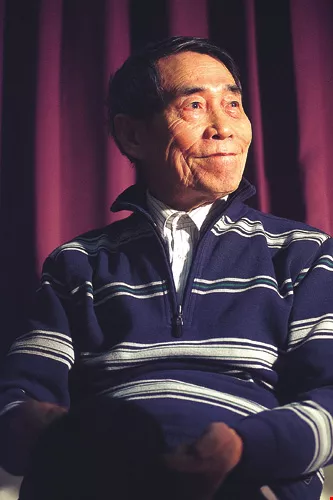
A spry 80-year-old who still flashes a sly smile from time to time, Xiong Wei aspires to demonstrate the philosophy of Laozi's Dao De Jing. The taiji daoyin school of tai chi that Xiong invented has provided an entree to the martial arts for many working people who want to keep in shape.
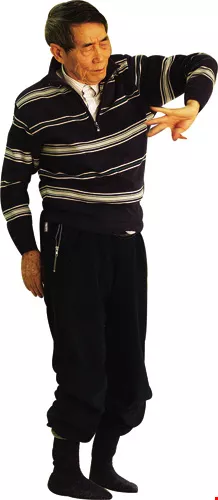
Xiong Wei demonstrates such forms as "single whip," "cloud hands," and "six sealings and four closings." According to legend, tai chi was invented by Zhang Sanfeng, a Yuan Dynasty martial arts master. Numerous schools of the discipline have appeared in the years since, and taiji daoyin draws from the best points of each. Its sequence of forms can be viewed as a great way for martial arts novices to build a foundation of basic skills.
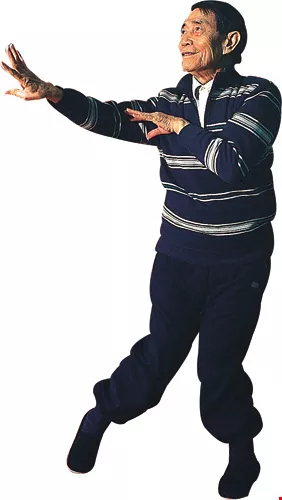
Xiong Wei demonstrates such forms as "single whip," "cloud hands," and "six sealings and four closings." According to legend, tai chi was invented by Zhang Sanfeng, a Yuan Dynasty martial arts master. Numerous schools of the discipline have appeared in the years since, and taiji daoyin draws from the best points of each. Its sequence of forms can be viewed as a great way for martial arts novices to build a foundation of basic skills.

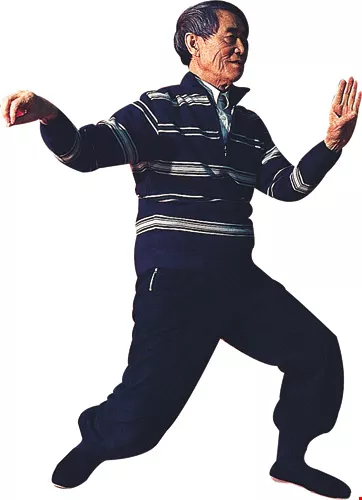
Xiong Wei demonstrates such forms as "single whip," "cloud hands," and "six sealings and four closings." According to legend, tai chi was invented by Zhang Sanfeng, a Yuan Dynasty martial arts master. Numerous schools of the discipline have appeared in the years since, and taiji daoyin draws from the best points of each. Its sequence of forms can be viewed as a great way for martial arts novices to build a foundation of basic skills.
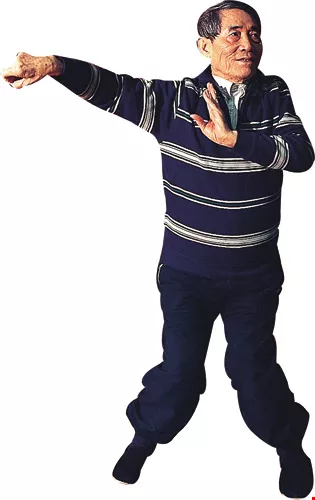
Xiong Wei demonstrates such forms as "single whip," "cloud hands," and "six sealings and four closings." According to legend, tai chi was invented by Zhang Sanfeng, a Yuan Dynasty martial arts master. Numerous schools of the discipline have appeared in the years since, and taiji daoyin draws from the best points of each. Its sequence of forms can be viewed as a great way for martial arts novices to build a foundation of basic skills.


