Just FriendsThe Legal Aid Foundation
Teng Sue-feng / photos Chuang Kung-ju / tr. by Phil Newell
October 2007


Su Ping-kun, Su Chien-ho, Lu Cheng, Hsu Tzu-chiang, Chang Fang-tien.... These names, unfamiliar to most people, are important figures in Taiwan's legal history. What they have in common is that all were found guilty and sentenced to heavy penalties without sufficient evidence, with the courts relying entirely on confessions for their convictions. After non-governmental legal and human rights groups examined the trial records, the evidence, and the judgments of the courts, numerous doubts were raised and there were calls for "eleventh-hour reprieves."
Sadly, this all came too late for Lu Cheng, who was executed by firing squad. Su Ping-kun spent ten years on the run, living in hiding, before receiving a pardon in 2000 and seeing his name cleared. Nonetheless, although he had regained his freedom of action, after a long legal battle of trials and appeals he was no longer his former self in either body or spirit, and has been haunted by the trauma ever since.
It was fortunate that in these big cases, which attracted a great deal of media attention, there were social organizations and volunteer lawyers willing to seek justice for the victims. But there are even more disadvantaged persons from the lowest strata of society, fearful of making waves, not familiar with the law, unable to afford an attorney, and unable even to understand what it says in court documents, who do not know where to turn when they run into trouble. But now, the Legal Aid Foundation, established three years ago by the government and privately managed, is there to help those who cannot help themselves.
In 2005, more than 20 companions from Vietnam hired to work in Taiwan went to the foreign priest in the Catholic church in Hsinchu and related to him that they had all been sexually assaulted by the owner and the son of the owner of the human resources firm that had brought them to Taiwan. The church then turned to the Legal Aid Foundation (LAF) for help, and the case has already gone to trial.
A woman surnamed Chen, living in Penghu, now age 39, was left to take care of her mildly retarded son all alone after she got divorced at 19. She scraped by with what she could earn at odd jobs. But in 1991, her boss refused to pay her accumulated back wages, and even beat her, leaving her unconscious for several days and brain-damaged for life. After that, the local neighborhood chief and the social welfare bureau helped her to apply for a certificate as a handicapped and low-income person, and she began to receive a small subsidy. They also told her she could turn to the LAF for help. Unfortunately, the statute of limitations (only two years) had run out on the injuries from her boss, but the Kaohsiung branch of the LAF persuaded her ex-husband to pay child support, and she finally received a settlement of NT$700,000.

(left to right) Three leading public interest attorneys--LAF secretary-general Kuo Chi-jen, Judicial Reform Foundation executive director Lin Feng-jeng, and LAF Taipei branch director Joseph Lin--are shown here unveiling a banner calling for passage of a law to help people burdened by credit-card debt.
A duty of the state
Very often, those at the bottom of Taiwan's social ladder with the fewest resources--foreign workers, single parents, the handicapped--do not understand the law nor are they able to afford legal help when they are harmed or their rights are infringed; all they can do is weep quietly to themselves. But now, if you are certified as a low-income household, or earn less than NT$48,000 per month for a family of four, then you can apply to the LAF for assistance, with the lawyers' bills paid for by the foundation.
Getting state resources to provide legal services for the disadvantaged is the result of years of effort by non-governmental legal and human rights groups. After passage of the necessary legislation and appropriations from the national budget, the LAF formally went into operation in July of 2004.
Over the past three years, the LAF has established 20 branches across Taiwan, with 3000 "semi-volunteer" attorneys (60% of all attorneys nationwide). Attorneys get only NT$20-30,000 per case, about half of what they charge for a private matter. So far the LAF has assisted in 36,708 cases.
"It's a duty for the state to provide legal aid to the disadvantaged, and it's the first step toward the creation of a just society," says LAF secretary-general Kuo Chi-jen, who is also a former deputy minister of the Council of Labor Affairs. Non-profit organizations like the Taiwan Association for Human Rights, the Consumers' Foundation, and bar associations also provide legal services, but they have limited budgets and manpower, and have to rely on pro bono services from individual lawyers.
In contrast, during its first year the LAF had a budget of NT$470 million (about US$15 million), and handled 7,649 cases, so a lot of people benefited. As word got around, the second year the number of cases nearly doubled (to 13,776) and the budget grew correspondingly, reaching NT$700 million last year.
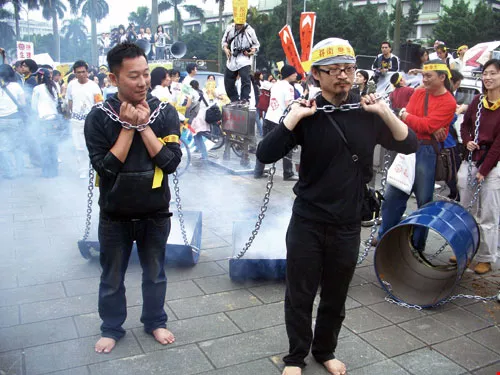
The patients at the Losheng Sanatorium in Hsinchuang have seen the institution as their home; some have been there for more than four decades. Social activist groups took to the streets in protest earlier this year when it was revealed that the sanatorium would be torn down to make way for a subway station. The Legal Aid Foundation also stepped in to appeal to the government for compensation for the displaced.
Small potatoes
That seems like an awful lot of money, but compared to other countries it's still small potatoes. The UK, which began providing legal aid services in 1949, established a Legal Services Commission (LSC) within the Department for Constitutional Affairs in 2000. In a country with a population only 2.6 times that of Taiwan, the LSC has a budget that is 105 times as big (£2 billion, or about NT$126 billion) and handles 80 times as many cases (2.6 million).
So the LAF could certainly do with more funding. But to get it will they have to change their operations to satisfy the ones holding the purse strings? The LAF's parent organization is the Judicial Yuan, which is a branch of the government. What happens when the person receiving LAF aid is being prosecuted by the state for a crime, or is seeking compensation from the government for a state infringement of rights? Is there not the risk that the "parent" will interfere in the LAF's operations?
"There is definitely a difference of perspective between ourselves and the Judicial Yuan in terms of which cases we should be spending our money on," says Kuo Chi-jen. Currently the ratio of civil to criminal cases handled by the LAF is six to four, but the Judicial Yuan would like to see them do more criminal work. This is because if the LAF helps defendants offer a reasonable defense to the charges raised by prosecutors in criminal cases, the legal process will go more smoothly, and this will help the legal system deal with cases more efficiently and reduce the burden on the courts. This is by no means an unreasonable view, and in the future the LAF aims for a 50-50 split between civil and criminal cases.
Besides serving individual citizens, the LAF also takes part in collective actions. When the police forcibly closed the Losheng Sanatorium to make way for a subway station, the LAF helped the residents--all victims of Hansen's disease and separated from the world for half a century--to seek compensation from the government. The LAF was also one of 25 social action organizations that got together on behalf of half a million persons with credit-card debt to lobby the Executive Yuan and Legislative Yuan to pass the Consumer Debt Act. They have also been helping in the case of the workers of the former RCA plant in Taoyuan County, many of whom have died or are seriously ill from cancer or other illnesses resulting from carcinogenic chemicals dumped by the company at the site over a long period. Such work is time-consuming and the outcomes are far from predictable.
In debt to the LAF
"To win justice for the disadvantaged" is the mission of the LAF. But in a democratic society, many different interests struggle for attention, and values are diverse and fractured. What the legal community considers to be "justice" may not always be applauded by society as a whole. The passage of the Consumer Debt Act is a case in point.
Joseph Lin, director of the Taipei branch of the LAF, points out that although last year there were nearly 220,000 cases of successful renegotiation of debt repayment, in 30% of the cases the debtors still defaulted. It's not always the case that debtors are unwilling to repay, but rather that the terms offered by the banks are too stringent. For example, is it realistic to expect someone who earns NT$30,000 per month to repay NT$29,000 against their credit-card debt?
During preliminary consideration of the Consumer Debt Act in the Legislative Yuan in early April of this year, the Financial Supervisory Commission and big banks collectively criticized the bill, claiming that it would allow debtors to avoid repayment.
Lin explains that the provisions of the statute are not intended to mean that debts need not be repaid. They mean that if, under the supervision of the courts, a specified percentage of the debt is repaid within a specified time, then financial institutions may not unleash debt collectors to use whatever means necessary to recover the debt.
Start from the weakest
Explaining the reasoning for the LAF's support of the bill, he draws the following comparison. Imagine that a Good Samaritan helps a person injured in the street to get to the hospital. Now imagine that the same kind-hearted soul finds a person injured at the same intersection two times, three times, 100 times. He or she would surely assume that the intersection's traffic lights and signs are all messed up. He or she would then try to change the rules of the road, otherwise there will be an endless stream of accidents. In the UK and Hong Kong, for example, bankruptcy cases take up more docket space than any other civil matter. Moreover, if society does not give credit-card debtors some breathing room, and a financial mechanism to escape from their problems, then they could be forced into rash action, leading to tragedy for many more families.
Joseph Lin was one of the key players in the Judicial Reform Association, which brought so much non-governmental pressure on the judiciary that they had no choice but to improve. From there he moved on to devoting himself to lobbying for the creation of the LAF. Lin, who approaches reform with the zeal of a revolutionary, has turned over virtually all the work in his law firm to his wife, who is also an attorney, while he spends 12 hours a day, three days a week, on the LAF, all as a volunteer.
Back during the public furor over the kidnapping and murder of the daughter of popular entertainer Pai Ping-ping, after which the kidnappers also went on a rape and murder spree, the brother-in-law of chief suspect Chen Chin-hsing was charged as an accomplice, and had no one willing to defend him. But Lin took the case. Naturally he was widely criticized: Since Chen was so evil, how could his relatives be any different? Why would anyone defend people like that?
"The legal system is filled with overlapping jurisdictions and institutions, and there are all kinds of pitfalls. For poor people, legal recourse is like an apple high up in a tree: You can see it but you can't reach it," says Lin. Chen's wife and brother-in-law were both marginal people in society, with only middle-school education. There was little evidence that they were actually involved in his crimes, but they were demonized in the social atmosphere of that time. If we just leave marginal people to the prejudices of the mainstream, how can we talk about a humane and just society?
People with power and status have plenty of opportunities; you can only really see justice at work, or see the level of good and reason in a society, from the side of the weak. This is what the LAF is all about.


@List.jpg?w=522&h=410&mode=crop&format=webp&quality=80)


@List.jpg?w=522&h=410&mode=crop&format=webp&quality=80)
