

In the second half of last year, Taiwan was flooded with a deluge of predictions in the form of divination poems.
First the best-selling book T-Day caused widespread anxiety when it cited Tang dynasty astrologer Li Chunfeng's Tui Bei Tu and the poems of Ming dynasty Zen master Huang Bo, to predict an unprecedented change in the balance of power across the Taiwan Strait; then in the runup to the provincial gubernatorial and city mayoral elections, the streets and alleyways buzzed with gossip about signs and portents for the elections' outcome, as if the candidates were endorsed by "destiny". . . .
Traditionally, the Chinese have believed in a preordained fate which rules everything from the fortunes of individuals to the rise and fall of states and nations. All were thought to be tied to the secret designs of heaven, and so all kinds of methods of divination and presagement were developed. For thousands of years, the most taboo and mysterious must have been the chenyu or prophecies, but the form of divination most widespread among the common people even today is one which evolved from the chenyu: the qianshi or divination poems.
"Great deeds are preordained / Walk east, then south / When water and fire mix, success is assured / Long life without death, an extraordinary man."
"Standing alone on a high platform, the rain descends in torrents / Houses fall and walls tumble, no good is in the air / With treacherous waters all around, where will the boat go? / The chrysanthemums are dead, the flowers fallen; th hard / The leaves are all fallen / Winter plums bloom / Their new flowers cover the branches, more beautiful than verdure / When spring comes all will be well / Joy will come to young and old and prospects will be bright."
The two verses above caused a great popular stir during last year's gubernatorial and mayoral election campaigns, because they were said to foretell the "predestined" outcome of the elections. Do you understand their hidden meaning?
The first poem was picked by a supporter of the Democratic Progressive Party's gubernatorial candidate Chen Ding-nan on a private visit to Lukang's Tienhoukung Temple, by drawing bamboo divination strips in front of the temple's image of the Sacred Mother in Heaven. Because the poem is classed as an auspicious divination and includes the characters ding and nan (as in Chen Ding-nan's name), it was used by Chen's supporters to boost his image, being interpreted as an omen of his impending electoral victory.
The second poem appeared during the last few hectic days of the countdown to the election, when it was faxed to many Taipei residents. The anonymous sender wrote on it that it was composed 600 years ago by Liu Bowen, a wise and resourceful military counsellor to the first Ming emperor Zhu Yuan-zhang. The sender also added notes next to the crucial words and phrases to indicate that the poem had another interpretation: "When the Taiwanese independence movement falls, where will Chen Shui-bian go? Chrysanthemum flowers fall, plum flowers bloom, prospects unfold for the new united front and Jaw Shau-kong." (The characters for Jaw's name appeared in the poem.) The implication was that the prophecy set down so long ago by Liu Bowen, with all his insight into the will of heaven, foretold the political situation in Taiwan six centuries later.
But in fact Chen Ding-nan did not bring about a "change of dynasty" in Taiwan Province, whereas Chen Shui-bian did take the reins of Taipei City's government. The secret of what meaning Liu Bowen really intended his poem to convey went with him to his grave; but many believers did go to Tienhoukung Temple in Lukang to ask how the temple oracle could have been so mistaken. The temple elders came out in person to make it clear that "this was probably just hearsay or even a hoax, we don't think the divination was made according to the proper practice, so of course its credibility is doubtful."
Perhaps people had misinterpreted the oracle's meaning, or perhaps the prediction itself was wrong. But however that may be, many Chinese have always maintained an attitude of respect for divination poems and prophecies, preferring to believe that there might be something in them. Wong Tai Sin Temple, known as "the protector of Hong Kong people," is always crowded with believers coming to consult the temple oracle. Especially on the second day of the Chinese New Year, the temple is packed with worshippers asking their fortune for the coming year. People spread out a newspaper to stake their claim to a little patch of floor, and the sight of everyone kneeling in rows on the ground, each of them speaking in a low voice and shaking a tub of bamboo divining strips in their hands, shows us a microcosm of China's temple oracle culture, a culture which reaches back more than a thousand years, has spread throughout China and beyond, and is deeply rooted in popular life even to this day.
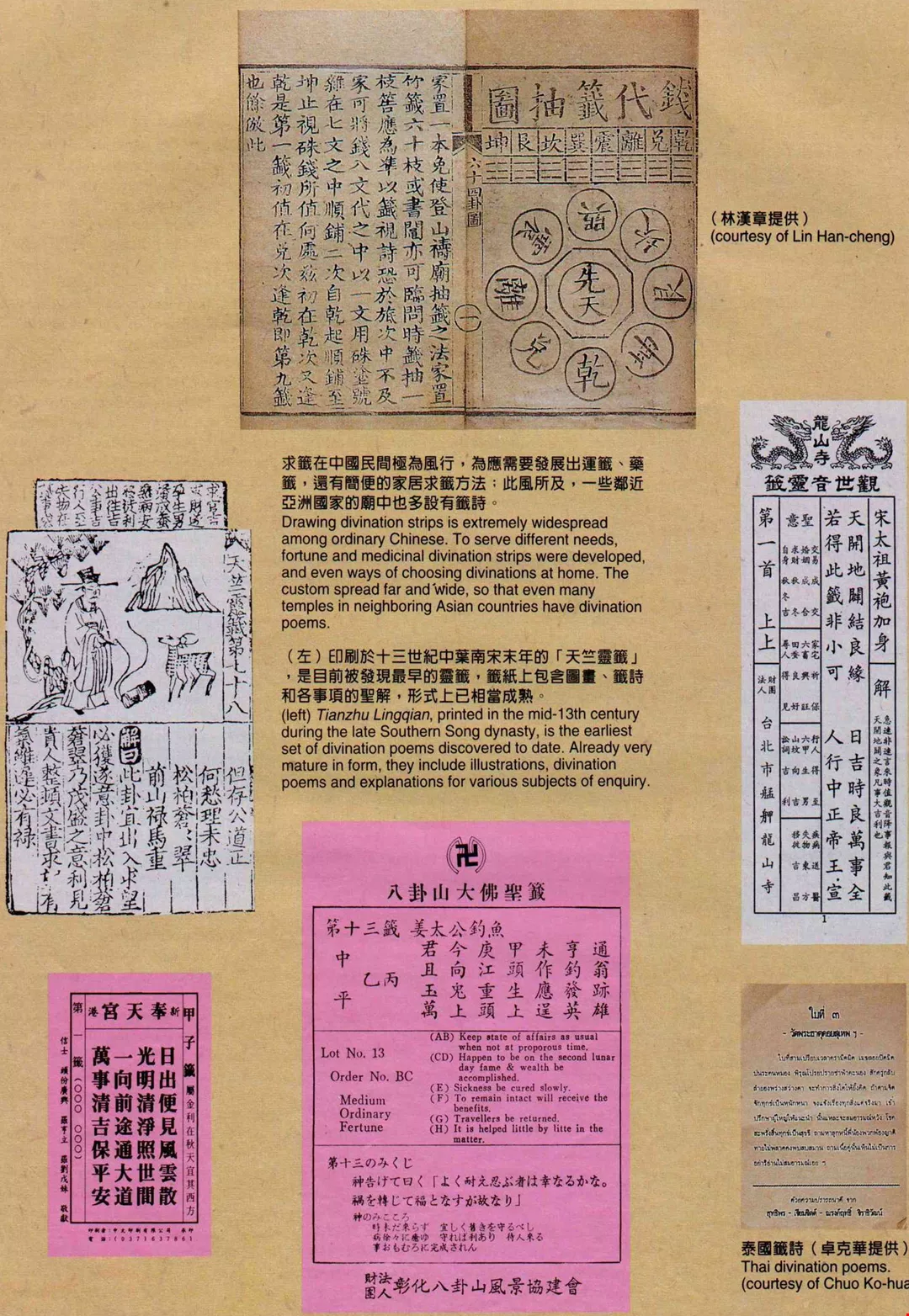
Drawing divination strips is extremely widespread among ordinary Chinese. To serve different needs, fortune and medicinal divination strips were developed, and even ways of choosing divinations at home. The custom spread far and wide, so that even many temples in neighboring Asian countries have divination poems. (left) Tianzhu Lingqian, printed in the mid-13th century during the late Southern Song dynasty, is the earliest set of divination poems discovered to date. Already very mature in form, they include illustrations, divination poems and explanations for various subjects of enquiry. (courtesy of Lin Han-cheng) Thai divination poems. (courtesy of Chuo Ko-hua)
Predictions of the spirits?
Many Chinese, when they hit a low point in their life or when faced with a difficult choice, will go to the temple to burn a stick of incense and pray silently to the temple spirit for help and guidance in finding the way out of their difficulty. Asking for a qianshi or divination poem is people's way of conversing directly with the spirit.
It is an overcast, rainy day in Taipei, but Hsingtien-kung Temple, which is widely regarded as having excellent divinatory powers, is full of believers. In front of the statue of the temple's main spirit Guan Gong, God of War, 30-year-old secretary Lin Liang-yi is throwing down crescent-shaped jiaobei blocks before drawing a bamboo strip to ask her wedding prospects. Under her breath, she recounts the problem on her mind: her boyfriend is having an affair and their wedding has been postponed. She wants to know whether things will develop for the better or for the worse. The bamboo strip she draws directs her to divination poem No. 62: "Facing people with hearts of beasts / Your struggle will rely on your own efforts alone / Success will come as autumn ends / In a town to the west, a joyous reunion." According to the explanation printed on the slip of paper together with the poem, "this prophecy mainly portends victory over an enemy." After a difficult period, everything would come right, and in the autumn she could expect a happy reunion. Before consulting the oracle Lin Liang-yi had been very uneasy, but she now relaxed and said, "Although I have a rival, it looks as though if only I persevere there is still hope, so let's see how things turn out in the autumn."
At Kuantukung Temple, construction company owner Mr. Wang is also consulting the oracle, but he is asking for guidance in business. He has been hesitating over whether to take on a construction project, for he predicts it will not bring in much profit , but will cost a great deal in effort and resources. So he has come to ask the bodhisattva Guanyin to choose a prophecy for him. The one he draws is "When the rice is in the ear / This affair will surely be complete in both regards / Return home and sit with an easy heart / Happy among your wife and children." On reading it he bursts into hearty laughter, for the gloss interprets the spirit's meaning when applied to business matters as: "It will not succeed," and this is just the answer he had been hoping for: "It will be best if I 'return home and sit with an easy heart,' and do not take on that project!"
As an indication of the numbers of people who consult temple oracles, the popular Lungshan Temple takes around seven to eight months on average to get through half a million divination poems. Almost every temple big or small throughout Taiwan has sets of bamboo strips for drawing divination poems, so clearly plenty of people use this method.
The Chinese both respect and fear heaven, and have traditionally believed there is a hidden, deeper meaning in everything from individual fates and uncertainties to the rise and fall of dynasties. Thus how to lift the veil on heaven's will in order to take advantage of good fortune and avoid bad has been a subject to which Chinese have applied their ingenuity through the ages, since the beginnings of divination using oracle bones 3000 years or more ago. Over several millennia, by observing and drawing inferences from myriad aspects of human life and phenomena in the natural world, they have developed all kinds of abstruse methods for calculating the future, such as hexagrams, eight-character divination, horoscopes, geomancy, glyphomancy and the like. But as well as these calculatory and analytical methods, there were also the very different chenyu--prophetic statements with the character of divine predictions--which were common for a period in ancient times but which have almost disappeared today, and the qianshi or divination poems which for the last thousand years have been looked down on as rather unrefined, but which in their popularity far outstrip any of the other methods of divination.
In Shuo Wen Jie Zi, China's oldest dictionary, chen (prophecies) and qian (bamboo strips used for divination) are both defined as meaning yan--predictions of gods or spirits which later come to pass. As their name suggests, these prophecies and divination poems are short pieces of text with the nature of a godly prediction. Zhong Zhaopeng, a researcher at the Institute of World Religions under the mainland's Chinese Academy of Social Sciences, writes in his book A Brief Discussion of Mystical Confucianist Divination that the divination poems which appear late in the Tang dynasty (618-907) and the Five Dynasties period (907-960) are in fact part of the same tradition as the prophetic chenyu which were current before the Wei dynasty (220-265). The divination poems are simply prophecies incised on strips of bamboo or wood.
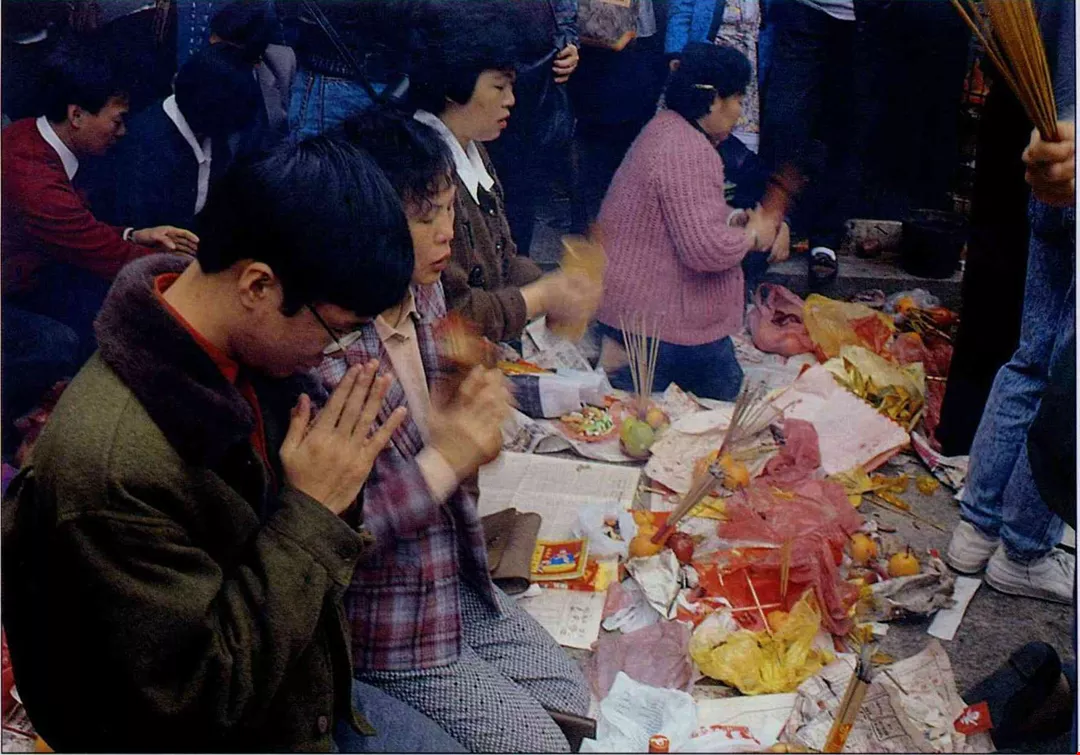
The divination poems at Hong Kong's Wong Tai Sin Temple are very well known, and one can often see worshippers kneeling on the ground clutching the pot of divination strips, reciting under their breath and asking for guidance. (photo by Chang Min-yi)
Demonic words of delusion?
The prophecies common in ancient times have another, more ominous name it the history books--yaoyan or "demonic words."
In Chinese history, whenever there was a period of social unrest or of decline and corruption in the dynastic government, the leaders of rebellious uprisings would often--deliberately or otherwise--put about some prophecies or fables purporting to reveal the will of heaven, or even turn them into songs and rhymes to be spread around the wellsides and markets by women and children, so as to crystallize popular support for the overthrow of the reigning dynasty. Hong Kong fortune teller Qiu Yiju explains that before the prophesied event took place, most people would be baffled as to the real meaning of the prophecy. Only a few masters well versed in such matters could understand their deeper significance.
For instance, in the Qin dynasty the prophecy "Hu will destroy Qin" was current. The first Qin emperor believed that "Hu" referred to the nomadic herding peoples of the north, so he sent troops to attack the Huns. But later the Qin dynasty fell just the same--in the reign of the emperor's son Hu-hai.
On the other hand, the rise of the first Han emperor Liu Bang inspired the famous story "The Red Prince Slays the White Snake." One day Liu Bang, plagued by the problem of large numbers of his troops surrendering to the Qin government forces, got roaring drunk in his camp. While in his cups he saw a great white serpent, and in a flush of heroic valor, drew his sword and hacked the worm to death. Later the legend which spread among the people told of a white snake spirit which appeared in the form of an old woman sitting by the roadside, weeping and lamenting that her son had been killed by the Red Prince sent by the Emperor of Heaven. The story implied that Liu Bang was the incarnation of the Red Prince, and was destined to become the new Son of Heaven.
Because such prophecies and legends helped the revolution which led to the founding of the Han dynasty, the art of prophecy became a subject of special interest for the Han court. In those days, anyone with a gift for concocting prophecies would be sure to rise to high office and honor, while those who opposed divination would fall from favor. And because Confucianism was the official creed of the Han dynasty, many Confucianist scholars began actively searching through the Confucian classics for passages containing clues to the future, or even began to write prophecies themselves. The science of explaining the will of heaven from the classics developed into that most arcane branch of Confucianism, chenwei or mystical Confucianist divination.
Prophecy played an important role throughout the rise and fall of the Han dynasty. At the end of the Western Han when Wang Mang usurped the throne, and later when the Guangwu emperor Liu Xiu overthrew Wang Mang and established the Eastern Han, the events were accompanied by prophecies and legends of every kind. And after Liu Xiu became emperor, he often used prophecies to decide controversial issues or matters over which he was undecided, and later even "proclaimed [a set of] prophecies to the nation."
The interpretation of prophecies often depended on a wide knowledge of such matters as yin and yang, the five elements and divination by numbers. For instance, when Liu Xiu was raising his troops in rebellion, a book of prophecies called Chi Fu Fu, which was very popular at the time, contained the passage "Liu Xiu sends out troops to capture those with evil ways / The four barbarian tribes gather in the country around Longdou / At the time of four sevens fire is in the ascendancy." Four sevens are 28, and from the time when the first Han emperor Liu Bang destroyed the Qin, to when Liu Xiu raised his army, was exactly 228 years, and this seemed to fit in with the prophecy.
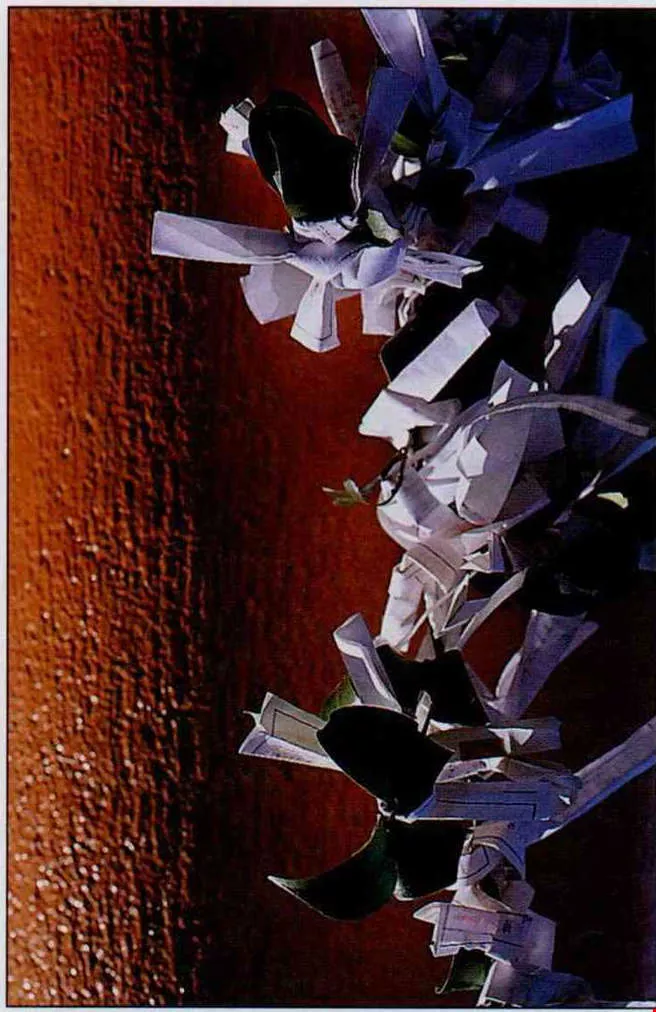
Japanese Shinto shrines also have divination poems. After drawing a poem, many people tie them to trees to let ill fortune be blown away by the wind. (photo by Li Hsien-chang)
The popularization of prophecies
How were the chenyu prophecies produced? Historians believe that as well as those written deliberately by rebels for their own ends, many had their origins in fuji or planchette writing.
Because prophecies could herald a state's foundation or its destruction, rulers from the Han onwards were keenly aware that they were a force which could mobilize the people to rebel. Thus dynasties down the ages strictly prohibited ordinary people from keeping written prophecies, calling them "demonic words." After a tough blanket crackdown by the Sui dynasty authorities at the end of the 6th century AD, many prophecies were lost.
But this does not mean that the practice of attempting to divine the fate ordained by heaven disappeared, for after a hiatus of 300 years following this political crackdown, the qianshi or divination poems made their appearance among the common people.
The Song dynasty work Yu Hu Qing Hua mentions how when Lu Duosun of the early Song was studying at a Taoist temple school as a child, he and his classmates discovered a holder full of old bamboo divination strips at an abandoned spirit shrine, and amused themselves by drawing strips to select prophecies. This story is the first mention in historical records of bamboo divination strips, and historians believe that from the story's date we can infer that the practice of divination by drawing lots must have existed at least as early as the late Tang or Five Dynasties periods at the beginning of the 10th century AD. By the Song dynasty, this method of divination was widespread in temples throughout the land. Today, a thousand years later, divination poems can not only be found in temples in Chinese communities all over the world, but also throughout the area of Chinese cultural influence in Asia, especially in Japan. They are even known in another guise in the Western world, where they reappear in the amusing form of fortune cookies.
The origins of divination poems are closely connected with planchette writings, but following the fashion for poetry in the Tang dynasty and the invention of woodblock carving in the Song, they gradually lost their air of mystery and became a rich and lively part of everyday life.
During the Tang dynasty, poets often played a divination game in which they picked out poems by choosing page numbers, and later, after divination poems developed, they were common among the literati and in elegant society. Many literary sketches of the Ming and Qing dynasties contain references to divination poems. In Lao Can You Ji, Liu E of the late Qing dynasty uses the divination poem "May all lovers under heaven be united / Wedlock is destined in past lives, do not miss your marriage fate," from the shrine to the Old Man Under the Moon (the matchmaking spirit) at Hangzhou's West Lake, as a congratulatory couplet, and the words have since become universally popular among the Chinese.
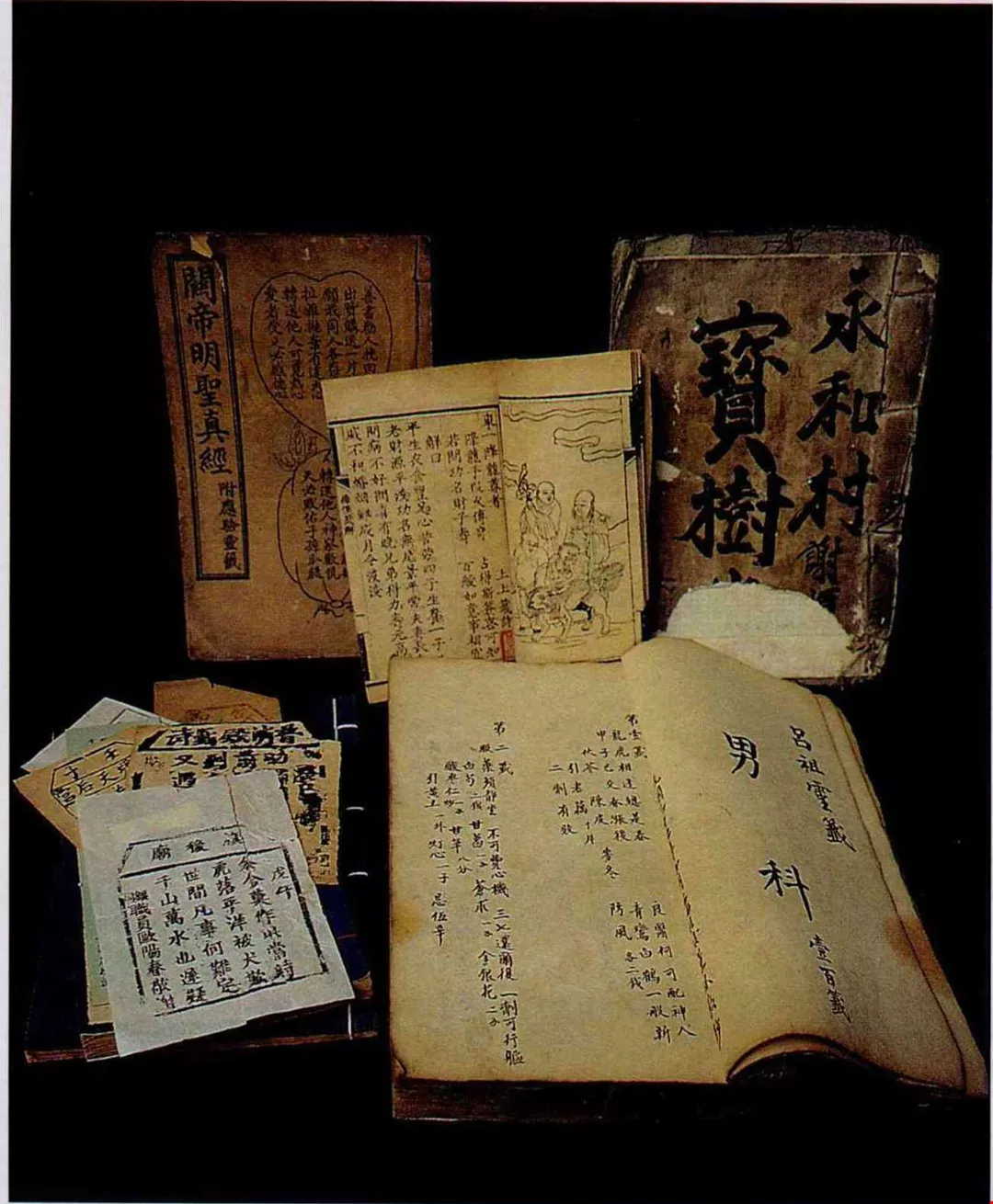
Divination poems are the most common form of fortune telling among ordinary Chinese. From the rich and powerful down to ordinary people, when they meet with difficulties or problems in life they will often use divination poems to help them find their way out of trouble. (courtesy of Lin Han-cheng)
A dash of doo-doo to cure your ills
The sets of divination poems used in temples vary in size from 24 to 120 poems, the most common numbers being 60 and 100. In most cases they are in four-line stanzas of five or seven characters per line, in a jueju meter. As well as planchette writings, divination poems were written by temple elders and local literati, and existing poems were also used. For instance, a great many of the works of the Tang dynasty poet Du Fu were used as divination poems in the Song dynasty, and the ancient Book of Songs was also prime material for this use.
To make divination poems accessible for ordinary townsfolk, temples everywhere gradually ceased to stress the poems' literary refinement, but simply tried to make them easy to understand. There even appeared illustrated divination slips bearing a drawing and a brief prophetic phrase. Later, historical allusions and characters indicating points of the compass were added by way of explanation, and finally the meaning of the verse with reference to various matters of enquiry was stated plainly.
When people had problems or questions to do with luck, fame, health, marriage, money, litigation or long journeys, they would go to the temple to seek a divination of the future, and when they were ill there were also medicinal divinations they could use to decide a remedy. The divination poems in the temples covered every imaginable aspect of life's problems and ailments.
In the days before modern medicine, choosing a remedy by drawing divination strips in the temple was the way many ordinary folk went about treating their illnesses. The temples with medicinal oracles are mostly dedicated to spirits who were famous physicians in their mortal lives, such as Baosheng Da Di (the Great Emperor Protector of Life), Hua Tuo and others. The prescriptions cover everything from women's disorders and childhood diseases to injuries and eye ailments--just like a general hospital. Chuo Ko-hua, a scholar of folk customs and ancient monuments who has spent time studying divination poems and who also has an understanding of Chinese herbal medicine, says that the remedies prescribed by medicinal oracles were not powerful and were mainly tonics, but they could sometimes cure minor ailments.
Looking at the medicinal oracles more closely, apart from the usual Chinese medicinal herbs we can also find many amusing remedies, such as: "Take one cup of breast milk / Mix in some infant's stools / This eases the flow of the blood and rejuvenates / Its curative effect is the best"; or "Seven green willow branches / Plucked from the bank of a pool to the east / Drives out evil and relieves fevers / This remedy is most efficacious"; or again: "Take a candle from the imperial examination hall / Let its light shine on you before you sleep / Before noon and after midnight / This method works best". . . . There were also a number of "empty oracles" without a medicinal remedy, such as: "You are quick to curse and scold / Heaven has punished you with sickness and pain / If you hurry to mend your ways / Perhaps your illness can be relieved"; or: "Your illness is dangerous / Recite the scriptures / Release captive animals and refrain from killing any living thing / If you wish to change your fate". . . . These reflect the Chinese medical philosophy that disease comes from the mind, so that curing the mind is the best remedy.
Pretty scary!
The crucial feature of divination poems is that people believe the spirit will invisibly guide the person seeking advice to choose the correct poem. "It's pretty scary," says Chuo Ko-hua. Once he went to Tienhoukung Temple to draw a divination because his father had suffered a stroke, and the poem indicated that although his father was in some danger, if he could only get through the next two years then he would be fully cured; later events bore the prediction out. "Another time I went to the temple to draw a divination just because I was at a loose end, and the Sacred Mother in Heaven gave me a good dressing down for wasting her time," he recounts with a wry smile.
Under the Japanese occupation, Taiwanese had limited access to higher education. Lien Wen-pin, now a famous doctor at National Taiwan University Hospital, went to the temple to ask about his academic future shortly before he finished high school. The poem he drew read "You climbed the high mountain to study the immortals / But then came the imperial edict / When the white sun shines forever in a blue sky / If you so desire your fame will spread across the four seas." At the time he could make little sense of it, but before long Taiwan returned to Chinese rule under the ROC flag with its white sun in a blue sky, and the new government opened the doors to higher education. Thus Lien was able to complete his studies and later become a well-known and highly respected heart specialist.
In Taiwan's temples today one can draw divination strips before at least 27 different spirits. Among the best known are the poems in temples to Guan Gong, which use a set said to have been passed down from the Ming dynasty, from the "Temple East of the River."
Once is enough!
The legend goes that Zhu Yuanzhang, the first Ming emperor, was sailing along a river when his boat's mast was broken by a strong wind. Seeing a tall tree growing outside a temple on the river bank, he wanted to have it chopped down to make a new mast, but the temple's abbot requested that he first draw a divination strip to ask the temple spirit's permission. The divination he drew read: "Everything under heaven has a master / A gentleman takes nothing not his own / Though the qualities of a hero are endowed by heaven / He must seek the righteous path at every step." Zhu Yuanzhang was thoroughly taken aback and abandoned his idea. But news of the temple's power spread far and wide, and the set of divination poems has been used in Guan Gong temples to this day.
But are the prophecies accurate? Many devotees of the method say that if one asks with a sincere heart, one will get an accurate answer. But apart from sincerity, following the correct procedure is also important. Chuo Ko-hua says that according to old custom, one should come with a sincere heart, and should first abstain from eating meat and strong flavored foods, refrain from indulging one's desires, and purify oneself by bathing. But today people have abandoned this practice.
When one comes to the temple, after first buying incense and candles and doing obeisance to all the temple's spirits by turns, one then goes before the spirit one believes in and begins to ask for an oracle. The main equipment is a pair of crescent-shaped blocks (jiaobei) and a set of bamboo divination strips. One first stands in front of the spirit and introduces oneself, stating one's name, date of birth, address and the difficulty one is currently facing, and then by casting the crescent blocks one asks whether the spirit is willing to help one select a divination poem. One block flat side up and the other round side up indicates permission, and one can then go and draw a strip from within the container. "No matter how many bamboo strips are in the set, you must be sure they are all in the pot before you draw one, or the result will not be accurate," stresses Chuo Ko-hua.
The divination strip itself is chosen as follows: if the pot of strips is small, one shakes them up and down, or back and forth at an angle, and the strip which falls out or the one which projects highest is the one to choose; with a larger set of strips one should lift up the whole bundle and let them fall back into the pot, then pick the highest one. Then one throws down the crescent blocks again in front of the spirit to ask whether one has taken the right strip. How many times should one cast the blocks? Some say three times, others say it depends on what one has agreed with the spirit. But aficionados of the method, and temple officials responsible for explaining the divinations, almost all say: "If the spirit really has divinatory powers, once is enough."
At the lunar new year, many temples will also choose an auspicious day and time to carefully ask the prospects of all the local trades and professions for the whole of the coming year, which they then paste up in the temple for worshippers' reference.
Emotional guidance
Having thus picked a divination poem according to the number on the bamboo strip, it is time to interpret it. The fortunes indicated by the divination poems are categorized into three types, good, neutral and bad, or are sometimes more finely divided into nine types. Generally speaking, within one set of poems the numbers of these three categories are in a ratio of about 2:3:1. Because the poems are sometimes vague and ambiguous and often also include historical references, it is hard to distinguish whether they augur good or ill, so how to gain insight into their deeper meaning is very important. The saying goes that "seeking a divination requires sincerity, interpreting divinations requires discernment." Qiu Yiju and Chuo Ko-hua both believe that the most important thing in interpreting a divination is figuring out which role in the historical incident cited corresponds to the person seeking advice.
The year before last, Wong Ka Kue, lead singer of the Hong Kong pop group Beyond, fell from the stage while performing in Japan and thereafter remained in a coma, diagnosed as brain dead. One of the group's fans went to seek a divination at Wong Tai Sin Temple, and got the answer: "A wild wind swept through the eastern garden last night / Tearing out all the flowers / But fortunately the gardener rose early / And replanted their roots to restore them to life." One magazine interpreted the second two lines of the verse as meaning that Wong might recover, but Qiu Yiju believes that as the singer's roots were in Hong Kong, but he lay unconscious in Japan, it was not possible to "replant [his] roots," and so the outlook was not good for his recovery. And in fact later he did not regain consciousness.
Hsu Hsin-huang, executive director of the ROC Gift and Packaging Art Association, who studied Chinese at university and who hopes one day to specialize in interpreting divinations, says that whether one chooses a divination poem classed as good, neutral or bad, there is no absolute good or bad, because misfortune contains elements of good fortune, and good fortune elements of misfortune. This expresses the Chinese philosophy of life whereby, in the words of the Book of Songs, "Good fortune cannot exist without ill / Ill fortune bears the seeds of good." But when most people consult divination strips it is because they are uneasy about the future and its uncertainties, or because they are faced with some difficult choice, so the interpreter of divinations must play the role of a psychological guide, helping them unravel their problems.
In one commonly-used set of 100 divination poems, one in the unluckiest ninth category reads: "After crossing a thousand snowy ridges / You will see things in a different light." Whether divining spirits really exist or not, if we measure these words against our own experience of human life, in which things so often take a turn for the better when they seem at their most hopeless, and ups and downs follow each other by turns, can we deny their wisdom?
[Picture Caption]
p.104
The most important thing when seeking a divination is sincerity. In front of the spirit you offer a stick of burning incense, then state your date of birth, your name and what you wish to enquire about. After you throw the crescent blocks and pick a divination poem, temple staff are on hand to help you interpret the message.
p.106
Drawing divination strips is extremely widespread among ordinary Chinese. To serve different needs, fortune and medicinal divination strips were developed, and even ways of choosing divinations at home. The custom spread far and wide, so that even many temples in neighboring Asian countries have divination poems.
p.106
(left) Tianzhu Lingqian, printed in the mid-13th century during the late Southern Song dynasty, is the earliest set of divination poems discovered to date. Already very mature in form, they include illustrations, divination poems and explanations for various subjects of enquiry.
(courtesy of Lin Han-cheng)
p.106
Thai divination poems.
(courtesy of Chuo Ko-hua)
p.108
The divination poems at Hong Kong's Wong Tai Sin Temple are very well known, and one can often see worshippers kneeling on the ground clutching the pot of divination strips, reciting under their breath and asking for guidance. (photo by Chang Min-yi)
p.108
Japanese Shinto shrines also have divination poems. After drawing a poem, many people tie them to trees to let ill fortune be blown away by the wind. (photo by Li Hsien-chang)
p.110
Divination poems are the most common form of fortune telling among ordinary Chinese. From the rich and powerful down to ordinary people, when they meet with difficulties or problems in life they will often use divination poems to help them find their way out of trouble. (courtesy of Lin Han-cheng)


@List.jpg?w=522&h=410&mode=crop&format=webp&quality=80)


