The Artistic Aspirations of Chuang Chun-liang
Tsai Wen-ting / photos Yang Wen-ching / tr. by Jonathan Brown
January 2006
He's part pork butcher, part artist.
He effortlessly switches hats from being a skillful, knife-wielding butcher in a traditional outdoor food market in the morning, to being an accomplished modern artist in the afternoon. On the surface, a butcher's knife and an artist's brush might not appear to have the slightest thing in common. However, Chinshan artist Chuang Chun-liang has "painted" himself something of a painterly legend around the local food market by transforming his butcher's knife into a chisel of creation.
Of the many feet sloshing through the fetid sullage of the food market are those of Chuang, who slices pork legs into symmetrical portions with astonishing speed and precision. By all appearances, from his worn for the wear chopping block, to his pig-adorned apron covered in meat spatter, he looks the part of your ordinary market butcher.
Upon closer observation, there appears to be something distinctive about the way this pork butcher carries himself that suggests he's anything but ordinary. When things are slow around the market, he might be found reposefully browsing the newspaper. Or, he just might be found discerningly gathering discarded items such as large plastic bags, cardboard boxes and fragmented chopping blocks to serve as handicraft materials. His wife, Chu Hsiu-feng, is also exceptionally resourceful. There she sits, amidst the commotion of the market, leisurely turning her hand to calligraphy, using a newspaper as her canvas.
A neighboring butcher chaffs, "Ah, he's not from around here. Just look at his hair!" Chuang's shoulder-length hair unwittingly suggests that he's different from others.

Chuang and his wife both love art and antiques, and their three children all are studying in programs related to art. This bust of his wife is one of Chuang's own creations.
A family affair
Chuang grew up around butchering. Everything from handpicking the pigs to hide singeing was learned under his father's wing. This is how he came to know the ins and outs of the business. Upon completion of military service, it was a foregone conclusion that he would take over the family business per his father's wishes.
Prior to the advent of meat-processing technologies, pig butchers had to arrive at pig farms at around two in the morning to round up pig livestock. By 3 or 4 a.m., butcher Chuang would be ready to dissect the pigs. This process began with an unflinching thrust of his butcher's knife deep into the pig's throat to drain its blood. He would then scalp the animal, dismember it and remove the offal, each step requiring adroit facility. For example, during the bloodletting process, if the knife isn't inserted deeply enough, the poor pig will invariably charge around squealing, stabbing itself even more in the process. What's more, profit is directly proportional to one's ability to trim specific cuts of meat. "I started from the basics, and look at me now--I'm a master meatman," Chuang jokes.
Starting at the age of 22, and for 30 years since then, Chuang has restlessly busied himself tending to the family butcher stand and going to the local livestock auction to purchase pigs. In addition to supplying many of the larger restaurants in the area, he also provides for the pork needs of the Chinshan Nuclear Power Plant and the 18 Lords Temple.
"Only when I lay down for the night did I truly get to take a breather," Chuang exclaims. Breaking his back all day, getting only two days off per month, he envied those with a nine-to-five free to pursue their own interests after work. While he not only didn't have the slightest inclination for leisure activities, he didn't know what things he might even be interested in.

Unconstrained by art school training, and following only his own inspiration, Chuang Chun-liang finds complete freedom in his art.
Mid-life goals
Roughly ten years ago, thanks to the stable income afforded by his pork stand as well as having closed a few successful real-estate deals, things started to look up for Chuang. The kids were all in junior high school. So, he slowly began to distance himself from the pork stand. After manning the stand in the mornings, his afternoons were free for him to play tennis and collect antiques.
The road to becoming an antiquary can be traced back to a family heirloom dish, which also set him on his way to becoming the aesthete that he is today. This was when he took an otherwise commonplace serving dish made of Taiwanese cedar to an antiques dealer he met through playing tennis, to be restored. Someone along the family line had had it varnished, but after having the varnish carefully removed, Chuang wondered in amazement at the original grain pattern of the Taiwanese cedar. From this moment on, he began to dabble in antiques, amassing quite the collection. He purchased exquisitely carved cabinets, tables and a bedroom suite which included the rarely seen traditional Chinese red bed complete with stepping-cushion and under-cabinet, all crafted of premium lumber and worth over NT$1 million.
The year was 1998. Chuang had one piece of investment property tucked away in a secluded area that he just couldn't seem to unload. He consequently took this property, which faces an ancient estate and features a view of the Yangming Mountains, and transformed it into the "Life Art Villa." It not only serves as the Chinshan community art exhibit, it serves refreshments too.
Now with a place to display art, Chuang, with the guidance of local artist couple Hsu Wei-pin and Tsao Shih-mei, began to don yet another hat--that of curator.
For his first piece, entitled "Dexterity," Chuang used one of his veteran cleavers, which he lodged into an already fragmented chopping block. He then soldered fish fins fashioned of ordinary steel wire onto the handle, and used screw-nuts and marbles to imitate fish eyes. What was once a meat-cutting cleaver used in the market now resembled a fish out of water. Many collectors have made offers for the piece, but Chuang cannot bear to part with it.
At a joint exhibit on the theme of chairs, Chuang presented his peculiar "Uneasy Chair," named so inasmuch as the upholstery was full of nails and it was linked to the ceiling by a garland of barbed wire. It made a notable impression on those in attendance. Many people might view the creative process as a perplexing one. Chuang doesn't see it that way at all. He takes a more whimsical approach.
"I think it's because I never received any training. Whenever I want to make something, I just make it. I feel unrestricted," Chuang articulates his attraction to the freedom involved with artistic creation. Plentiful time and space are all that's needed to nourish freedom. As for Chuang, he only strives to put his spirit into his creations. He doesn't enter competitions or try to to earn money from his art. "Now that's true freedom," he chuckles.
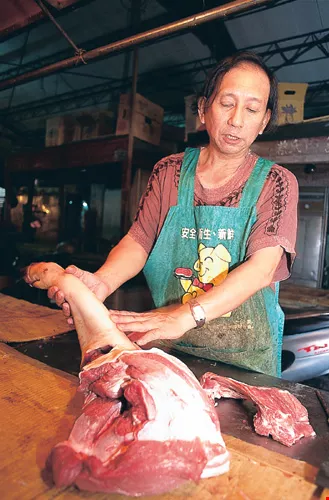
Chuang, who inherited his pork stand business from his father, is a living legend at the traditional market.

Other life goals
Having experienced the delight of creating art, Chuang then endeavored with his fellow villagers to form the "North Coast Artists Association," affording common folks selling food in the market the opportunity to enjoy creating art. All of Chuang's three children are also art buffs, each majoring in art design. Even his son-in-law is a ceramicist.
"I'm now semi-retired, so I'm free to pursue my life's interests. I would, however, tell youngsters to nurse their stomachs first." Chuang, who didn't take up art until the age of 50, cautions the younger generation to not be in too much of a hurry to realize their dreams. The experience shall be much more gratifying if you chase your dreams after first fulfilling your responsibilities in life.
