He's My Brother--Animal Welfare
Chang Ching-ju / photos Vincent Chang / tr. by Robert Taylor
September 1993


Reportedly, following the Formosan rock monkey protest incident in Changhua, wild animals may soon be out on the streets once again. Rumor has it that this time they will be demanding that having passed the "Child Welfare Law," the gentlemen in the Legislative Yuan should now give them an "Animal Welfare Law."
And soon perhaps people will have to call an animal "him" or "her" rather than "it"....
In Switzerland and Germany, recently many farmers have begun to take the view that just like people, the chickens and ducks they raise should enjoy appropriate "welfare," and one after another have decided no longer to keep their egg-laying hens cooped up by the thousands in cramped batteries with "boosting production" as the only meaning to their lives; instead, they are allowing them to roam freely through the fields and pastures, coming and going as they please.
In return for their freedom, to people's surprise and delight, and perhaps in gratitude for this unexpected benevolence, the hens lay eggs at more than twice the rate of those raised in batteries.
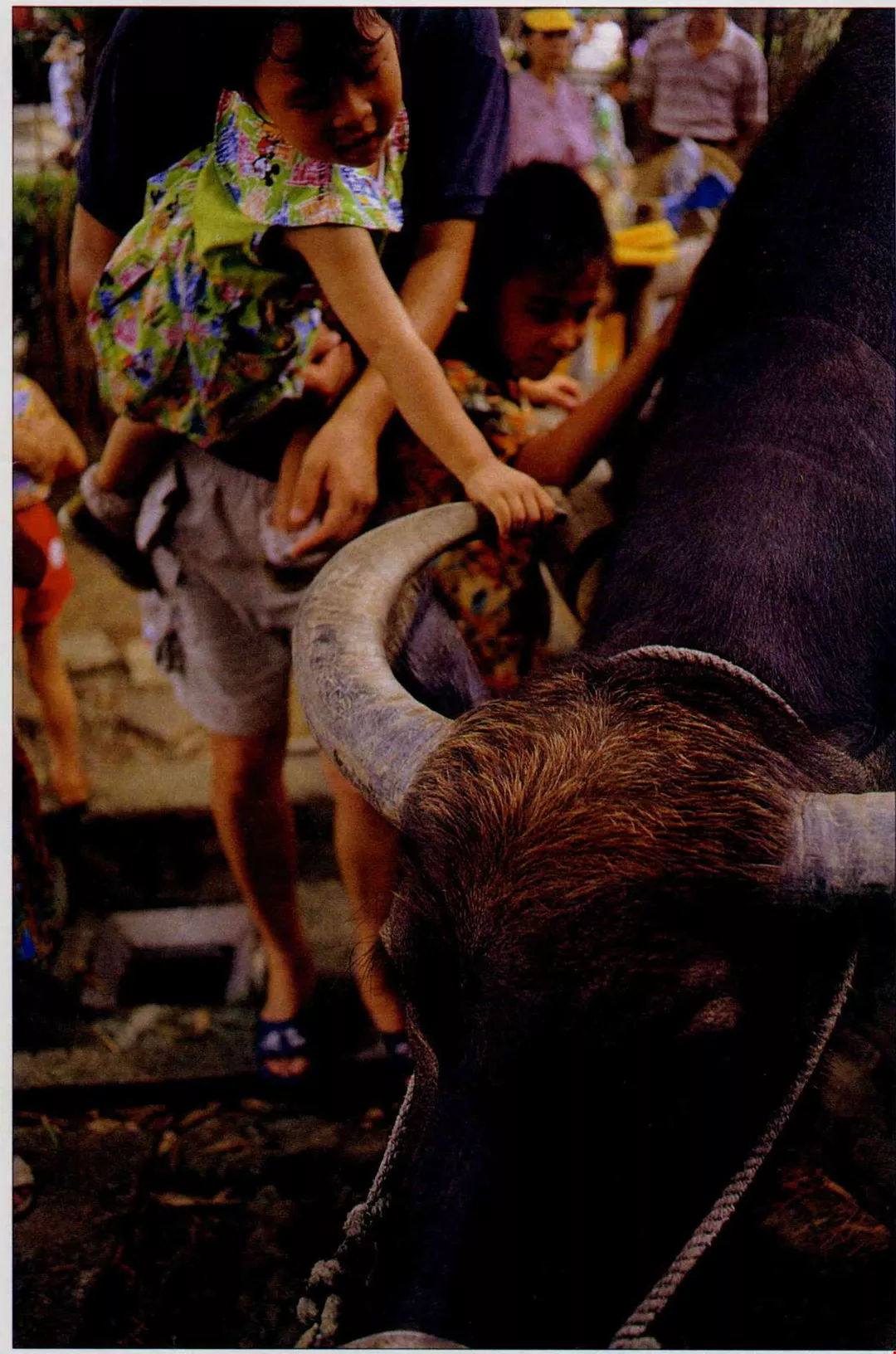
Does tugging at a buffalo's coat or grabbing its horn count as animal abuse ? Happily this game won't hurt the beast any more than "a mosquito biting a buffalo's horn." Otherwise, radical Western animal protectionists might protest. (photo by Hsieh Chi-kuang)
He's my brother:
What is "animal welfare"? One Western cartoon shows a hunter who has lain down his rifle and a deer which has set aside its antlers facing each other in boxing gloves, with the caption: "They finally decided to fight fair."
With many species gradually disappearing from the natural environment due to inappropriate human development, today people are trying to find ways to adjust their relationship with nature.
Many countries' existing animal protection legislation and hunting laws aim to allow natural resources to be used sustainably by humanity, and are based on a spirit of compassion and humanitarianism. For instance, Japan requires anglers who catch fish fry less than a hand's length long to return them to the water. America limits deer hunting to the animals' breeding season to give the herds a breathing space and the chance to reproduce, and hunting equipment is continuously "progressing" from the rifle to the bow and arrow, and even to the point where one may only load one bullet in the rifle or put one arrow to the bow. If the first shot misses, then one should give the animal its life.
But for some environmentalists, for whom compassion extends to all living things, although such laws are well intentioned they are inadequate to regulate humans' relationship with animals. Everyone is aware in theory that we ought to protect animals, but in real life humans use wild animals for commercial performances, medical experiments and even as pets. Because humans' and animals' interests are in conflict, people often fail to consider the physical and psychological effects on the animals.
This is why many people take the view that just at the basic spirit behind the children's welfare law is that children have self-esteem and need to be respected by adults, wild animals involved in the workings of human society also need people to fight for their most basic right "not to be subjected to mental terror or physical abuse," in the same way that disadvantaged groups in society are protected.
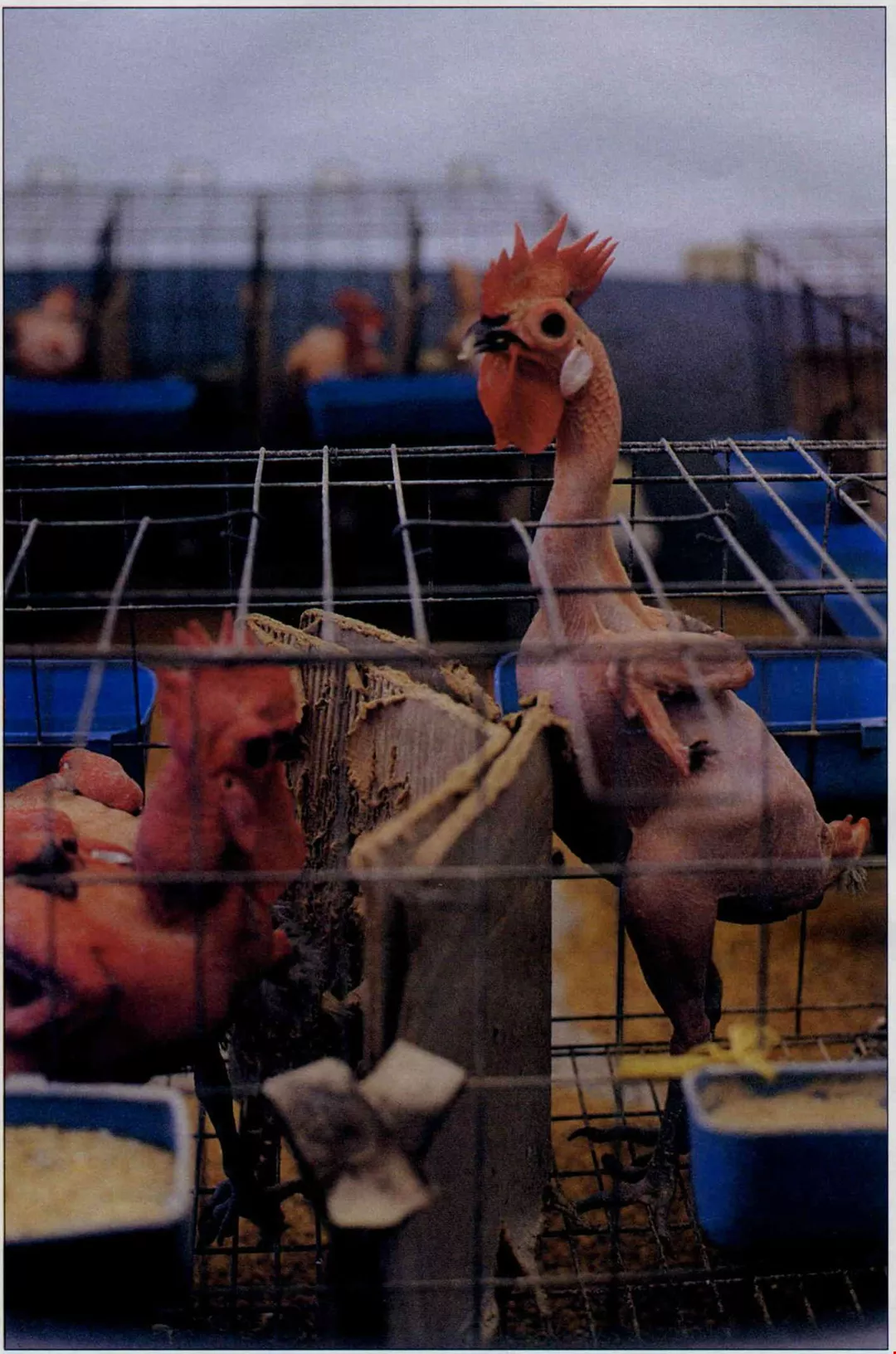
Bare chicken? As if being reared for the stewpot wasn't bad enough, these chickens have been bred into a form their own ancestors surely wouldn't recognize. To save the work of plucking, poultry breeders have created these "untraditional" featherless fowl.
What is animal welfare?
Not long ago someone smuggled in over 100 little lorises from Vietnam and abandoned them at Taoyuan's CKS International Airport, where four of them died of suffocation. Even without smuggling, when legal zoos buy and sell or otherwise transport wild animals, there is always the risk that the animals may suffer death or injury due to fright, motion sickness, jolting or other causes.
Recently, Associate Professor Chou Lien-hsiang of Taiwan University's Zoology Department has been conducting research into the transportation and movement of dolphins, one of the aims being to understand and thereby reduce injuries caused to dolphins in transit.
As ordinary people in Taiwan have gradually become more prosperous, keeping monkeys has become fashionable. Perhaps most people don't realize that other countries require people rearing primates to provide them with balls with which to pass the time. The requirements for their welfare are more advanced even than for children--human laws have never stipulated that "parents must buy toys for their children."
Professor Hsia Liang-chou of the Pingtung Polytechnic Institute, who has studied animal welfare in depth, explains that animal welfare is concerned not only for wild animals; the hope is that people will understand that it is not true that any animal "can be used for medical experiments in laboratories, so it's all right to butcher them any way one pleases;" and that one should also consider the feelings, moods, and physical responses of the domestic fowl and animals which supply human beings with rich protein. Nor should people only apply the standards of what they themselves like in caring for their pets; food which is too fine may cause early tooth decay, shortened life expectancy, and so on.
Especially where animals are kept as pets, apart from the most basic requirements of giving them adequate food and water, we must also ensure that the animals are housed in quarters which are dimensioned appropriately for their body size (for instance, primates must have a space at least several of their own armspans wide); their quarters must be kept clean and the humidity and temperature suitably controlled, with good shade and so on; and furthermore one must cater to their psychological needs, and provide them with space to play in.
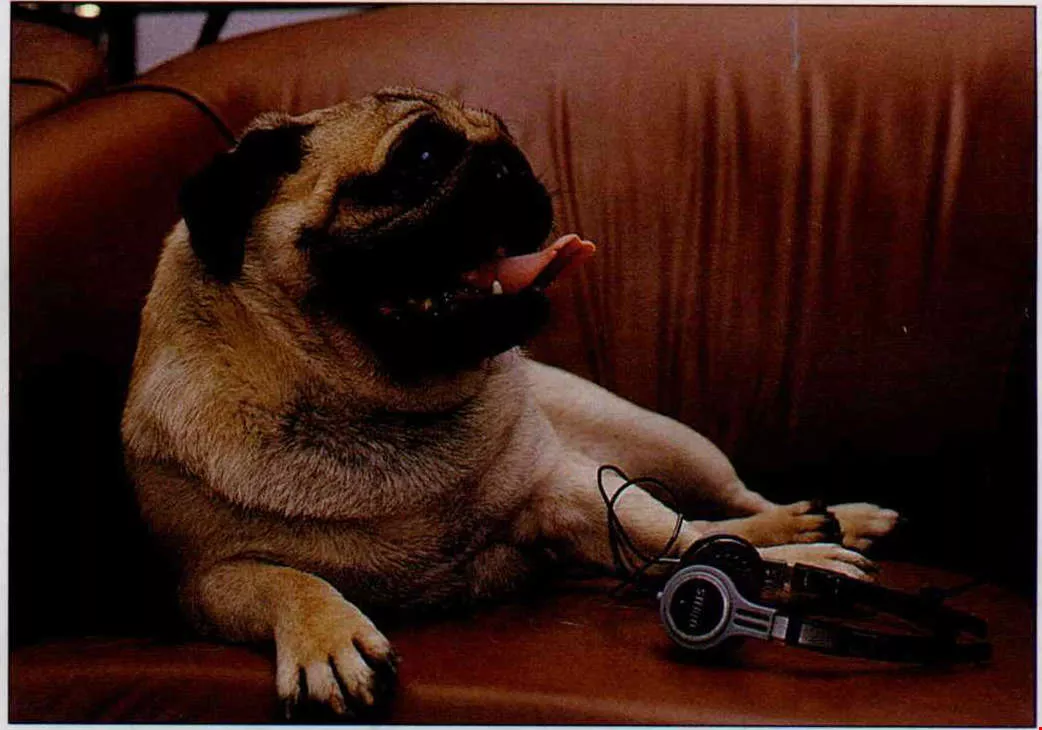
Hi-fi for dogs? Isn't this going a bit far? What level of welfare animals can enjoy often depends on humans' standard of welfare. For a pet in a rich household, lying on a leather sofa in-stead of the floor is nothing unusual.
He's his own master:
"Strict regulations on how animals must be reared can also deter a few people who just want to raise animals for their own pleasure but lack a sense of responsibility, and this will naturally reduce the number of animals subjected to suffering," says Hsia Liang-chou. Many radical conservationists go further, believing that the best way to provide for animals' welfare is not to exploit them at all.
Although the broad aims of conservationists today are the same, they are divided into many different groups and factions with different ideas. The most extreme animal protectionists are often strict vegetarians themselves and oppose any act which exploits animals for human gain. Some have even put bombs in animal research centers or tried to stab scientists who perform experiments on animals.
Just as "children are not their parents' private property," they also believe that animals are their own masters and that therefore one cannot speak extravagantly of "protection" with an attitude of superiority or of the strong protecting the weak. Instead one should say that animals also have their own rights. And of course in the language they use they also raise animals to equal status with humans.
Animal farm:
But it is still hard for attitudes which attach such high importance and status to animals, or which are overly extreme, to be accepted by the vast majority of people, who continually exploit animals and who look on man as "the wisest of all the creatures."
"Even people don't have proper welfare. What do you want with animal welfare?" is the response Hsia Liang-chou most often gets when he mentions animal welfare to other people. And how can humans tell what is good or bad for animals? Who can say just how big a cage has to be in order not to abuse an animal? How do you know whether an animal is being abused? So many people today shut themselves up in city flats not much bigger than birdcages, but aren't they still perfectly happy?
And to what lengths should animal welfare be taken? If in some countries chickens and ducks are all let out of their cages, shouldn't the pigs all be let out too? But this might cause the natural environment to be destroyed even faster, creating another even greater calamity. And should creatures such as cockroaches, which threaten human beings' living environment, also be treated with the same respect?
If I could talk to the animals:
Indeed, the laws regarding animal welfare are being applied with a sense of groping in the dark, says Hsia Liangchou, but the animal rights of which people speak today are already the product of utmost compromise.
In the normal workings of nature, all species coexist to mutual advantage, and today many extreme conservationists also recognize that as part of nature themselves, humans cannot avoid exploiting many forms of life. People have the right to propagate the concepts of strict vegetarianism or a complete ban on exploiting animals, but this does not make these concepts truth or law.
People and animals are all part of the biosphere, but humans hold the greatest power; furthermore, when the environment is damaged in the end it may be humans themselves who suffer, and it would do people no harm to take a little more care of animals' basic needs and to reduce their suffering when they are being "used."
This is why although there may be differences of degree in conservationists' attitudes, they are all working in the same general direction.
Some people take the view that unless animals themselves can speak out it will not be possible for anyone to devise what they would call a really comprehensive, equitable "animal welfare law." Nonetheless, research related to animal welfare is still on the increase. "It's not hard to understand the basic thinking behind this," says Hsia Liangchou, who has studied Western European animal welfare in depth. When speaking of animal welfare it is not good enough to make empty promises; apart from a basic considerate attitude of putting oneself in others' shoes or "not doing to others what one would not wish to be done to oneself," what is even more important is to strengthen research into animal ecology.
Do as you would be done by:
At England's London Zoo, the chimpanzees' food trough is placed outside the bars of their enclosure, and when the apes put out their hands to grasp food, they cannot pull them in again; but at the two ends of the trough the bars are more widely spaced, and so the chimpanzees slowly push their food to the ends before retrieving it. This arrangement is not made to tease the animals, but rather so that as far as possible their feeding conditions should involve an element of challenge as in the wild, and so that their life should not be too monotonous.
Just as convicts in prison have to be let out of their cells daily for exercise, animal behavioral scientists have discovered through long-term research that animals have special physiological responses to their surroundings. Hsia Liang-chou says that if many kinds of monkeys are caged for long periods, they will chew their own toenails completely away. If shut up too long in an enclosed space, they will become mentally abstracted, repeating a single movement over and over again. Animals caged up with nothing to do are not exposed to any stress at all, but this in itself may be an even greater form of stress.
Because of this, many zoos are gradually changing the ways they operate in the light of academic research, and although they cannot recreate the Fruit and Flower Mountain (the monkeys' paradise of Chinese legend), at least they can change iron bars for climbing rocks. Taipei's Mucha Zoo, fearing that the Formosan rock monkeys may suffer from boredom in their enclosure, gives them honeycombs and twigs to let them poke the honey out themselves lick by lick. Apart from helping them pass the time, having the monkeys spend time looking for food in this way also prevents them from suffering diarrhea or becoming obese from eating the honey all at once.
A dog's life:
Today, many countries have changed existing laws or enacted new ones in the interests of animal welfare. In 1989, Taiwan passed a "Wildlife Conservation Law" which is also based on a spirit of "animal welfare" and clearly stipulates that persons abusing protected wild animals and thereby causing their death may be imprisoned for up to one year. Today, "regulations for the rearing of wild animals" are being prepared in order to regulate rearers.
But for animals' welfare to receive genuine protection, what is really needed is surely a change in people's attitudes. This is even though as long as 3000 years ago China had the concepts of "all creatures coexisting," and "animals and ourselves are one," and Chuang-tzu often reminded people not to raise animals according to human concepts--which is almost the same as the basic thinking behind animal welfare today.
But turning animal abusers over to the courts is something which in Taiwan is still almost unheard of, just as although child welfare legislation has been passed, when people hear their neighbors beating their children they still say "What right have we to interfere in the way other people raise their children?" Not long ago television showed a star dog which carried on performing despite having to be put on an intravenous drip between shows because the physical strain was too much for it; but there are probably not many people who would regard this as animal abuse.
Recently newspaper reports of "dog shrinking" techniques have caused quite a stir, reporting that pet shops are selling drugs which can stop dogs from growing large; if this is true then under the animal protection laws the shop owners could be prosecuted, but unfortunately dogs have not made it onto the list of protected species.
Taking the example of the Formosan rock monkeys raised by Huang Han-fu of Changhua City, after three of the monkeys died the county government could have prosecuted him for abusing animals to death.
But to throw somebody in prison for shutting up monkeys would probably elicit the public reaction that the county government was unreasonable and making a mountain out of a molehill. Many people feel that it was punishment enough for Huang Han-fu, after having spent so much money on caring for 100 or more monkeys, to have been banned from trading the animals to earn some money for his family, and that there is no need to send him to prison.
This is why until the Council of Agriculture finishes drafting its regulations on raising wild animals, perhaps the wild animals in zoos, circuses, breeding stations and laboratories can only trust in providence. If their keepers are good to them that's fine, but if they have bad keepers it is just hard luck.
Love me, love my dog:
The Chinese have a saying that "Heaven cares for all living things," but if today being good to animals has to be made law one really doesn't know if this a happy advance or a sad reflection on mankind. Of course, the birth of concern for animal welfare shows that people are "fed and clothed well enough to think of honor," but this means that it is also part of a set of values which change with the times in response to changing circumstances. As Hsia Liang-chou says, many actions which today look like animal abuse are the result of poverty, and "before shouting about animal welfare one should first adopt an attitude of tolerance."
Some Westerners have loudly decried as inhumane the Chinese habit of hanging chickens and ducks upside down when transporting them through the streets. But when one thinks about it, if people had motor vehicles with which to transport the fowl then they would have no need to hang them upside down on the backs of bicycles. If humane killing equipment had not been invented, wouldn't people today still be using slaughtering knives as in days gone by?
It would appear that if one wants to ensure animal welfare, one must first look to the welfare of the people who will provide it.
But recently it has been "rumored" that some animals think that even so, this is still much better than humans simply being concerned to live their own lives in comfort, without sparing a thought for whether the other living creatures around them live or die.
[Picture Caption]
p.84
What is the right way to look after an animal? Animal rights advocates in other countries believe strict regulations are required to reduce animal abuse. Our photo shows a dog with gastroenteritis on an intravenous drip.
p.85
Does tugging at a buffalo's coat or grabbing its horn count as animal abuse ? Happily this game won't hurt the beast any more than "a mosquito biting a buffalo's horn." Otherwise, radical Western animal protectionists might protest. (photo by Hsieh Chi-kuang)
p.87
For goats which once lived among jagged mountain crags, a block of wood can help to alleviate homesickness. To let animals live in surroundings like their original habitat, zoos are changing their way of working. Perhaps chains will one day be a thing of the past. (photo by Hsueh Chi-kuang)
p.88
Bare chicken? As if being reared for the stewpot wasn't bad enough, these chickens have been bred into a form their own ancestors surely wouldn't recognize. To save the work of plucking, poultry breeders have created these "untraditional" featherless fowl.
p.89
Hi-fi for dogs? Isn't this going a bit far? What level of welfare animals can enjoy often depends on humans' standard of welfare. For a pet in a rich household, lying on a leather sofa in-stead of the floor is nothing unusual.
p.90
For wild animals, there is no greater welfare than their freedom. (photo by Cheng Yuan-ching)


@List.jpg?w=522&h=410&mode=crop&format=webp&quality=80)


