

"One in 7.5 babies born in Taiwan is a 'new child of Taiwan'!" Taiwan's demographic composition has been undergoing a quiet transformation in recent years. For almost a decade, a steady stream of foreign and mainland Chinese spouses, mostly women, have been migrating into Taiwan. There are some 340,000 of them on the island, and it is becoming increasingly evident that they are changing the demographic structure of the infant population. As the children of these immigrants grow up and begin going to school, Taiwanese society is shifting its attention from foreign spouses to this new generation of Taiwanese citizens.
Unfortunately, a wave of concern for the children of foreign spouses has become a heavy burden for the community of recent immigrants. In a society that suffers from a thinly veiled superiority complex, these "new children of Taiwan" have come to be regarded as a social burden. Negative news reports are common, and they deepen anxiety about and discrimination against these children.
Recently, these concerns have also produced much soul searching: Are the children of foreign spouses really somehow inferior? Some children do have learning or behavioral problems, but who is ultimately responsible? How should we treat the innocent fruits of unions between Taiwanese men and their foreign wives?
It's October in Pingtung County, and the scorching early autumn heat and sea breeze seem to slow everything down. Tungkang Elementary School's tutoring class for children of foreign spouses meets first thing on Thursday mornings. Today is the last day of class, and the children have been asked to share their thoughts and feelings about school and to exchange postcards and letters.
In one letter, an older girl encourages a male student: "Liven up a bit, don't look so gloomy all the time." She writes, "The first time I saw you, I could tell that you couldn't talk about all the things that troubled you. I sympathize with your feelings. If there's anything you need to get off your chest, you can talk to me about it. I hope you'll be able to change." Although the letter makes the student blush, he cheers up when the teacher says a few encouraging words. Before the class is over, the teacher urges everyone to swap phone numbers and e-mail addresses and not to hesitate to contact each other often.
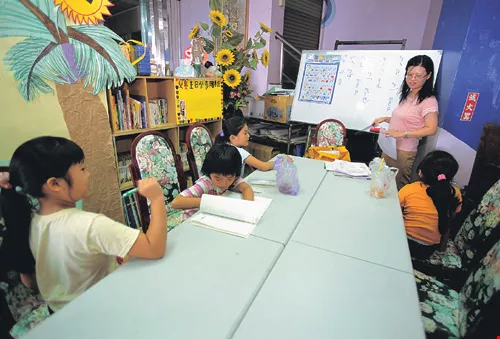
"Mommy goes to class next door. We go to school here." In recent years, foreign spouse support centers have formed an important support network for foreign spouses throughout Taiwan.
Building a support network
"We hope this class will enable the children to establish an emotional support network," explains Kuo Chin-e, an educator hired from outside the school to run the tutoring program. At first, some of the children were a little defensive and reticent because they were afraid that if they talked too much they would be the butt of jokes. But once everyone signed on to the rules to be followed and the teacher made it clear that everything said in class would stay confidential, the students began to trust each other.
Ms. Kuo has observed that the children's level of self-confidence depends on their family environment. The students who are pretty confident tend to come from normal families or have a mother with strong Chinese language skills. Conversely, children whose parents are divorced or whose father is away from home for long periods of time, or who are being raised by grandparents, tend to be shy and withdrawn.
In recent years, psychological guidance and after-school tutoring have become a key component of "preferential education" throughout the country. The steady rise in the number of "new children of Taiwan" who are entering school has prompted substantial government investment in preferential education.
According to Ministry of Education statistics, more than 40,000 children of foreign and mainland Chinese spouses attended Taiwanese primary schools during the 2004 school year. That is 2.2% of the primary-school population. Around 5,500 children with a foreign parent attended junior high school, accounting for 0.6% of students. Although they have a ways to go to reach their current share of over one-eighth of the total number of births, in the past two years the number of "new children of Taiwan" entering schools islandwide has grown 1.6-fold, and the trend is accelerating.
It is widely assumed that most Taiwanese men who marry Southeast Asian or mainland Chinese women are economically disadvantaged, advanced in age, or mentally or physically disabled, and that the Southeast Asian brides are young and ignorant, have had little schooling, and cannot speak or write proper Chinese. Many people worry that these factors, which adversely affect children of such couples before and after birth, are the reason why they lag behind in school and may ultimately "lower Taiwan's future human resource quality."
The apprehension felt by society has been exacerbated by a slew of negative reports in the media: "Sixty-four percent of children of foreign brides show signs of developmental delay"; "The 10,000 children with developmental delay born to foreign mothers each year will be a drain on Taiwan's social welfare resources within a decade."
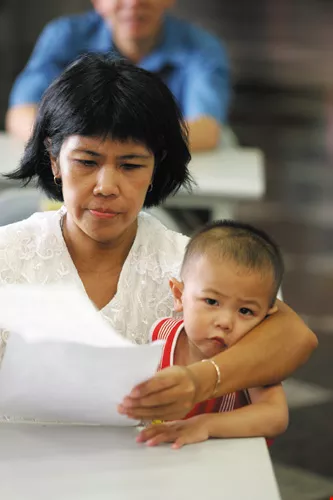
Foreign mothers often bring their young children to the "Adjusting to Life in Taiwan" class or the Chinese language class. This Indonesian mother has three children and a very demanding job, but has diligently attended classes for several years.
A biased view?
"All kinds of negative news reports about the 'new children of Taiwan' are being published, but they aren't based on factual research," notes Hsia Hsiao-chuan, an associate professor at Shih Hsin University's Graduate Institute of Social Transformation Studies, who has immersed herself in the issue of recent female immigrants for many years. As for the problem of "developmental delay" that is on everyone's lips, Professor Hsia writes that current estimates are based on the number of children diagnosed with problems after seeking medical advice. Because foreign spouses tend to live in financially difficult situations, are not medically well informed, and don't have a support network of relatives and friends, they usually fail to realize in good time that something is wrong and therefore don't seek help for their child. By the time they do see a doctor, the child's condition tends to be serious. Hence screening tests show a higher incidence of developmental delay among children with a foreign mother than among ordinary Taiwanese children.
Moreover, brides from Indonesia, Vietnam, and other Southeast Asian countries are often prevented by the Taiwanese family from speaking their own language with their child. Because they speak halting Chinese, there is often no language for mother and child to communicate in. Children who miss out during the golden period of language acquisition when they are babbling out their first words can easily be thought to be suffering from language delay, especially when compared with children who are already talking up a storm. This does not necessarily mean these children are inferior in any way. As long as they get appropriate guidance and tutoring once they start school they will make quick progress. Unfortunately, clinical reports usually fail to explain this, which can easily lead to misconceptions.
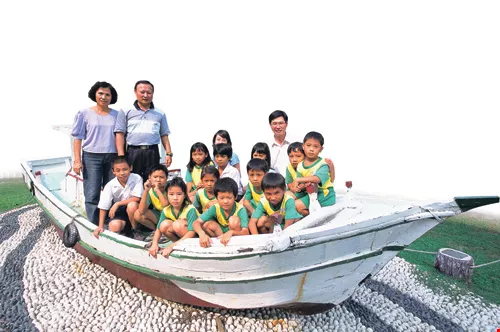
The "new children of Taiwan" are gradually reaching school age. Their educational circumstances are very diverse. The photo shows staff and students at Yenchou Elementary School in Pingtung County, where 15% of students are children of foreign spouses.
Let the numbers do the talking
In June 2004, the Ministry of the Interior published the results of the first national survey of living conditions of foreign and mainland Chinese spouses. The survey found that a relatively high proportion of Taiwanese men married to foreign spouses have a high-school education. Eleven percent of them are classified as having a mental or physical impairment or a low income. Foreign wives have a birthrate of 1.04 and mainland Chinese wives 0.73, which are both lower than Taiwanese women's birthrate of 1.24. 0.1% of children of foreign and mainland mothers suffer from developmental delay, which is also lower than the national average. These figures show that the image of the men who marry foreign women is changing gradually, and they put paid to all sorts of preconceptions about foreign wives "breeding like rabbits" and having children of "low quality." Unfortunately, these conclusions aren't sensational enough for the media and have been largely ignored by them. As a result, stereotyped images remain deeply rooted in society.
The recently published Don't Call Me a Foreign Bride records the thoughts and feelings of numerous Southeast Asian women: "Whenever there's a problem with my child, my parents-in-law accuse me of not teaching him how to behave properly. But whenever he does something right, they say he got it from his father." No matter how hard they try, foreign wives bear a mark of opprobrium that invites belittlement.
Huang Lan-ching, director of the Hengchun Foreign Spouse Support Center, says that judging by what she has seen over the years, most Southeast Asian women who've traveled so far to come to Taiwan possess great strength and courage. Although they have difficulty helping their children with schoolwork, they are no different from Taiwanese mothers as far as looking after them and giving them emotional support is concerned. In fact, the birth of their child is a turning point that makes them want to settle down in Taiwan, and it strengthens their motivation to give their child a good education.
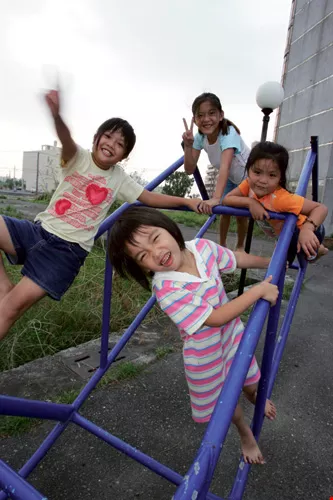
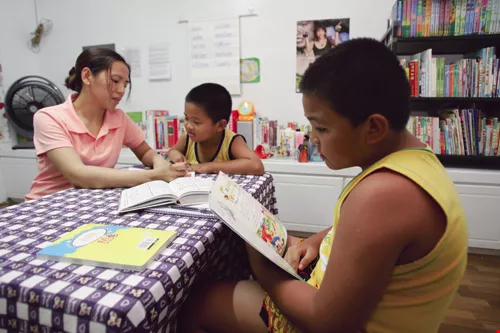
Children having fun after their tutoring class on Wednesday afternoon at the Tungkang Foreign Spouse Support Center.
Speaking the mother('s) tongue
If foreign wives are to be "good mothers," they must first be given the full rights and status that come with motherhood. At a most basic level, this may involve something as simple as teaching the child to speak his mother's language. Because many Taiwanese families have spent a lot of money to "import" a foreign bride and feel culturally superior to her, they treat her as a childbearing tool and domestic servant. When they refuse to acknowledge her status as a wife and mother and prevent her child from having a close and loving relationship with her, they are harming the child as well as the mother.
To overcome such prejudices, in recent years many experts have urged Taiwanese families to let the foreign mother speak her own language with her child more often. When a mother is free to speak the language she is most familiar with, she can interact with her child in a more natural and effortless way. As mothers grow in self-confidence and are no longer unable to express themselves, children's problems stemming from a language barrier and lack of stimulation can be avoided.
Does a child's ability to speak Bahasa Indonesia or Vietnamese affect his or her sense of national identity or ability to learn to speak and write Chinese well? Linguists demonstrated long ago that children have an innate language-acquisition ability. As long as they are immersed in a language, they will learn it naturally. Speaking the mother tongue is actually beneficial to childhood development. As for the question of identity, a child can embrace both the mother's and the father's homeland. Families should not deprive children of the opportunity to identify with and have an attachment to their mother's homeland.
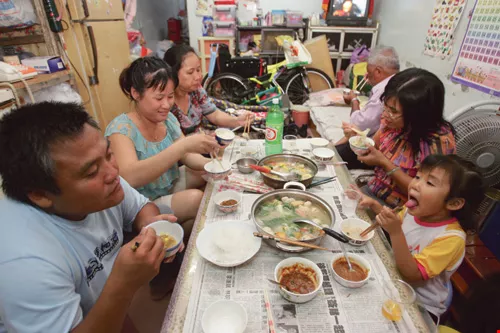
The Shao family in Hengchun enjoys a hotpot dinner cooked by a Vietnamese mother who knows how to bring a smile to her children's faces.
Seeing ourselves in our children
Allowing children to speak their mother's language is one side of the coin. The other side is the fact that Chinese is their principal language once they start attending school. To prevent them from losing face because their foreign mother speaks halting "Southeast Asian Mandarin" and to help mothers integrate faster into Taiwanese society, in recent years government agencies at all levels have promoted Chinese literacy classes for foreign spouses. Unfortunately, some husbands and their families won't let the foreign spouse attend a literacy class, thinking that her only job is to look after the children. One often hears comments like "If she starts going out, she'll be exposed to all sorts of dangers and could easily fall in with the wrong crowd."
"Marriage agencies often warn the husband's family that trouble lurks outside the home and that they had better keep close tabs on the foreign wife," notes Huang Lan-ching. In any family, a wife's relationship with her mother-in-law can be difficult, and if the wife is from another country, friction due to cultural differences and the language barrier is just about unavoidable. And friction aggravates the feeling that the foreign spouse is spoiled or no good.
Out of concern for the children's educational future, some families do follow advice from social workers and allow the foreign wife to attend a literacy class outside the home. But according to unofficial statistics, only 20% of foreign spouses in Taiwan have ever taken a Chinese language class in an educational institution.
Based on phone surveys she conducted in the Hengchun area of Pingtung County, Huang Lan-ching believes that many families have deep-rooted, unshakable prejudices. Some families with an inferiority complex are afraid that if the foreign spouse is allowed out of the house she will become too wordly-wise for her own good, and may be corrupted by bad company or run away. Some families not only don't let the foreign wife attend Chinese classes, they also constantly belittle her, which turns children against their own mothers. During one interview for a survey, Huang heard a child say, "My mom is really stupid, don't listen to her."
Ya-hui, whose husband works in another city, has many interests besides her children and housework. More than ten years after moving to Taiwan from the Philippines, she still has a hard time getting used people looking at her differently.
Success stories
Fortunately, because people from all walks of life have joined in common cause with foreign spouses, there are also more and more heartwarming stories about mixed marriages. Huang Li-li, the first foreign spouse to be elected a model mother in Pingtung County, is one such example. She hails from an overseas Chinese family in Indonesia and is married to a Taiwanese man who works for the Pingtung Water Conservancy Committee. Always wearing an optimistic smile on her bronze-colored face, Ms. Huang has raised two bright and lively girls. For a number of years, she has attended classes at the Tungkang Foreign Spouse Support Center and is now able to work as an interpreter for them. She can often be found in hospitals assisting foreign "sisters" fresh off the boat with all sorts of problems.
"My parents-in-law are very good to me. When I first came to Taiwan, I couldn't speak Mandarin or ride a bike, and they encouraged me to learn both." When Ms. Huang thinks of foreign spouses married to men who drink and beat them, she is grateful that her own husband has a regular job. After several years with her husband, she has learned a thing or two about what it takes to build a good marriage.
Shao Hsin-yu, a teacher at Hengchun Junior High School who has a sister-in-law from Vietnam, has her own views about whether mixed marriages can be happy. She says of A-hung, who was brought over to Taiwan six years ago by a marriage agency, "Everyone in our family loves and respects her. During the last stage of my mother's life, she stayed by her bedside, looked after her, and took on a lot of household responsibilities. She and I are like sisters who've been through thick and thin together. When she quarrels with my brother, I'm the one she turns to."
Ms. Shao says that when her sister-in-law first arrived, she was very young and didn't know how to take good care of the children. When Ms. Shao's brother was temporarily laid off his job as a cook, he found himself under great financial pressure, but everyone in the family pulled together, and they were slowly able to overcome the crisis. In recent years, A-hung has matured a great deal. She is on very good terms with her husband's family and has quite a few friends of her own, and is actually much more considerate and better at taking care of her family than her eldest brother's wife!
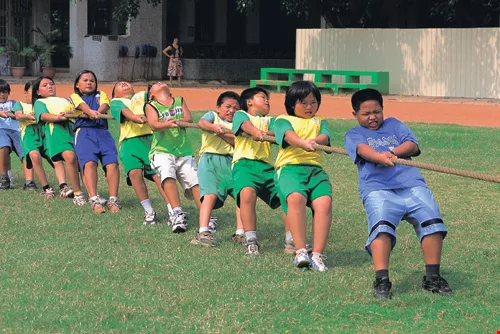
As children of foreign mothers, who account for more than one-eighth of births in Taiwan, build their own future, can Taiwanese society treat them as equals?
Family structure is key
Close examination of the differences among second-generation immigrants reveal that what divides the wheat from the chaff is actually not the mother's nationality, but family structure and interaction among family members. In harmonious and happy families, foreign spouses tend to have a positive outlook. In families where the opposite is the case, the mother and her child can experience a basketful of problems.
In October of this year, the Pingtung County government hosted a "Symposium on the Education of Children of Foreign Spouses in Nine Southern Counties and Cities." Many of the scholars in attendance called on the government to ensure that programs to assist foreign spouses in adjusting to life in Taiwan include a stronger emphasis on parenting education and gender education for the husband's family. But this is easier said than done.
Several foreign spouse support centers in Pingtung report that most husbands' families do not accept that they are part of the problem, and are not interested in attending such classes if they are offered. Because of Taiwanese society's narrow-minded and skewed value system, social workers have to take great pains to stress that "foreign women don't marry Taiwanese men and come to live here just to make money. It's only human for them to want to help their families, and it's simply not true that they are living off their husband's family to secretly help their own back home. If they were given half a chance, they would all want to set down roots here in Taiwan and build a loving family."

Are "new children of Taiwan" inferior? This street advertisement reflects the narrow-minded value system of a section of Taiwanese society.
Preschool education support
Improving the family situation of foreign mothers will take time, but children grow fast and they need help now. A question that is receiving much attention from educational professionals these days is how preschool education and childcare programs can be used to help dysfunctional families with a foreign spouse overcome their problems.
Research conducted by Professor Weng Li-fang of the Child Education Department at National Taipei University of Education shows that kindergartens and childcare centers can ease the childcare burden and alleviate weaknesses in families with foreign spouses. Frequent interaction between the kindergarten, the husband's family, and the foreign mother can also help her adjust to life in Taiwan and achieve personal growth as her child grows up. Unfortunately many children of foreign spouses still do not attend kindergarten, and Weng calls on the government to work for a cheaper and more convenient preschool education network.
What learning challenges do the children of foreign mothers encounter when they enter formal education? Numerous studies on this issue have been published in recent years, but their results vary greatly because of regional differences. For instance, in a remote mountain district in Chiayi County, children of foreign mothers who were suffering emotional difficulties displayed negative behavior. But in Taipei County 40% of children of foreign mothers were in the top third of their class, and the proportion of underachievers was about the same as among children whose parents were both Taiwanese. At Yenchou Elementary School in Pingtung County, which has Taiwan's highest proportion of children of foreign spouses, there was no discernible difference between their performance and that of ordinary Taiwanese children.
Problem children, normal children
"Some studies conclude that children of foreign spouses are prone to experience problems. Others argue that they are perfectly normal. Both conclusions are correct." During a symposium at National Pingtung University of Science and Technology, a number of scholars pointed out that different samples, social backgrounds, and experiences yield different results. Seemingly contradictory conclusions merely show that there are huge individual differences among children of foreign spouses in Taiwan, just as there are among Taiwanese children. The children of foreign spouses are not all alike.
Many practising teachers acknowledge that once they actually came into contact with such children, they got quite a different impression of them. Before he started working at Yenchou Elementary School two years ago, teacher Yang Chien-i had heard that the school had a large number of children of foreign wives. He was worried about this, but after he began teaching in the school, he realized that the media give these kids a bad reputation they don't deserve. As a matter of fact, they are no less capable than Taiwanese students.
As educators, teachers feel that children of foreign spouses should not be discriminated against. But there are still frequent reports of regrettable incidents in the schoolyard. Some children skip school because they feel their teacher doesn't like them. Sometimes children who are made fun of because of their accent, skin color, or foreign customs fight back in frustration and end up being punished by a teacher who should have talked in the first place to the whole class about the importance of respecting other cultures.
"Taiwan is relatively advanced in economic and cultural terms. It makes sense to give priority to the husband's family's culture to avoid a situation of 'one family, two systems.'" Casual comments like this, made in schools and neighborhoods, reveal people's Taiwanese chauvinism. This is a reflection of the fact that Taiwanese people have not yet learned to overcome cultural barriers and to extend friendship and hospitality to recent immigrants in a spirit of equality.
By welcoming new immigrants with open arms, the melting pot that is America grew into a superpower. If we in Taiwan could change our way of thinking, the more than one-in-eight newborns who are "new children of Taiwan" will surely represent an opportunity for our country.


@List.jpg?w=522&h=410&mode=crop&format=webp&quality=80)


