From ICs to Icing--The Yang Family and IHWA Cake Shop
Teng Sue-fen / photos Jimmy Lin / tr. by Geof Aberhart
May 2006


The city of Fengyuan in Taichung County is one of Taiwan's homes of cakes. Around the dawn of the 20th century, people began to migrate to Taiwan from Zhangzhou in Fujian Province, establishing towns and creating farms irrigated by the Tachia River. In 1920, the Japanese colonists called the area Toyohara--Fengyuan in Chinese, or "flourishing plain" in English.
The Fengyuan area is home to an abundance of cake shops, large and small, and over the past hundred years the area has developed its own unique cake culture, fusing tradition and modernity. Amongst these, IHWA Cake Shop and its signature "salty cake" have become the latest taste that the people of Fengyuan can't get enough of.
Fengyuan has earned itself a reputation as being the "town of cakes," and walking down Chungcheng Road, the town's main street, you'll find a dozen or so cake shops in the space of just a few hundred meters. Each of these shops has own unique character, as obviously without something to set you apart, making a living in this kind of situation would be incredibly difficult. And visitors walking through the town can't help but be struck by the scent of baking, giving a feeling of really being in a gourmet paradise.
There's no shortage of famous cake shops in this home of cakes, one of which is IHWA Cake Shop, established in 1935. Recently the store has struck gold, attracting much attention from the media for its "superstar" cake, the "salty cake." So, just what is this cake, and what's the attraction?
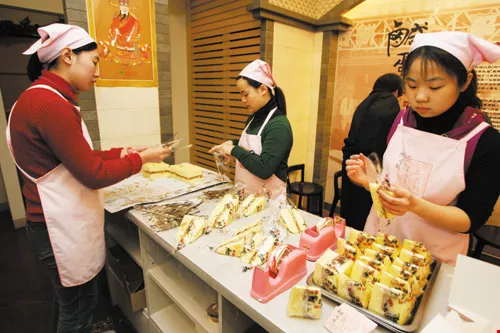
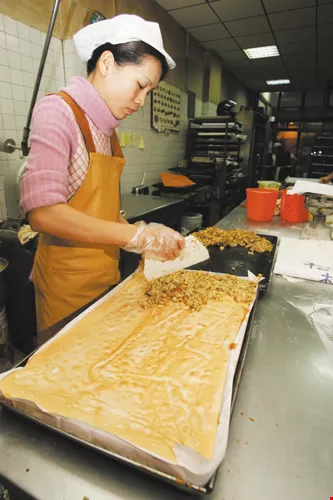
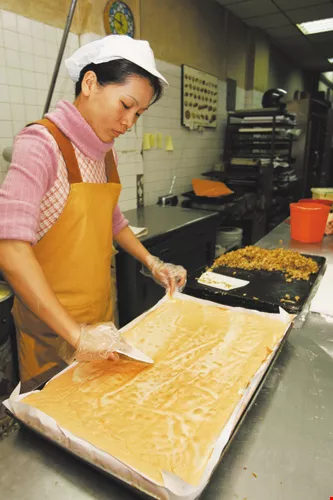
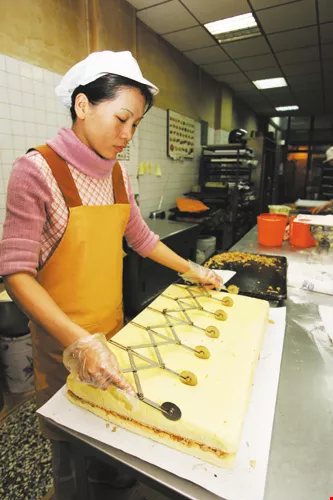
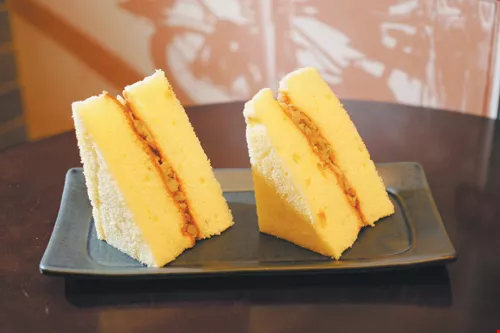
The renowned "salty cake" is a sandwich of sponge cake top and bottom, filled in the middle with a mixture of fried bamboo shoots, mushrooms, and shrimp. The finished cake is cut into portions and packaged for sale.
Old shop, new ideas
Just last year IHWA Cake Shop was completely renovated, giving its 65-square-meter floor space a brightness and flow; on the walls hang old photographs of the store from 50 years ago, and in the back the bakers knead dough and bake goods in the kitchen.
For middle-aged residents of Fengyuan the store is home to many childhood memories; during festivals local household altars would invariably sport a mung bean cake or pineapple cake, offerings to the ancestors. As well as traditional Taiwanese confections, the store has recently become popular with visitors and locals alike for new products like their salty cakes, the brainchildren of IHWA's owner.
The process by which these salty cakes are made is not an especially complicated one. First, egg whites and yolks are separated and beaten. Then they are then stirred together again and spread into a flat baking tray and baked for 30 minutes. Then shrimp and mushrooms are fried in a pan, finely chopped bamboo shoots stirred in, and then red onion is added. This mixture is fried until the unique fragrance becomes more pronounced. Then the cake is taken from the oven and allowed to cool, after which a layer of mayonnaise is added, and then the fried mixture spread on top. Once this is done, slice the cake and you've got a delicious salty cake ready to eat. This soft, smooth cake, accompanied by a salty, but not greasy, helping of bamboo shoots, is an irresistible treat.
The healthy and delicious salty cake is the creation of Yang Tsung-cheng, second-generation owner of IHWA Cake Shop. But not many people realize that this star attraction has actually been on sale for almost 15 years now, but until recently was virtually overlooked by customers.
The 55-year-old Yang says that with modern people's aversion to fatty and sweet foods, tastes have moved from the traditional pork filling of Taiwanese "salty marriage cakes" to the crisp, high-fibre bamboo shoot, and exquisite Western cakes have given way to more sandwich-style cakes like the salty cake. At first business was tough for Yang, and when he tried to get people onto the salty cakes in his refrigerator, most couldn't get past the preconception that the only cakes stored in the fridge are the ones that are getting old, while some couldn't handle the sweet/salty flavor combination.
Nevertheless he persisted, believing that "there's always a market for delicious food." Yang started offering a "buy one, get one free" promotion and giving out samples, and after a few years, as word spread through the grapevine, even other cake shops started to try and copy them.
Once the salty cakes took off in Fengyuan, Yang began to worry that this might turn out to be another passing fad, like Portuguese egg tarts had been in Taipei, with big stores leaping onto the bandwagon and eventually saturating the market. So, he decided instead to keep things low-key as always and not make a big fuss. Fortunately Yang's worst fears were never realized, and he went from making 30 salty cakes a day and not being able to sell all of them to selling over 1000 a day. Business is particularly brisk around Mid-Autumn Festival, when sales more than triple, with crowds of customers so big the five usual staff alone can't cope, and more people need to be brought in to help out.
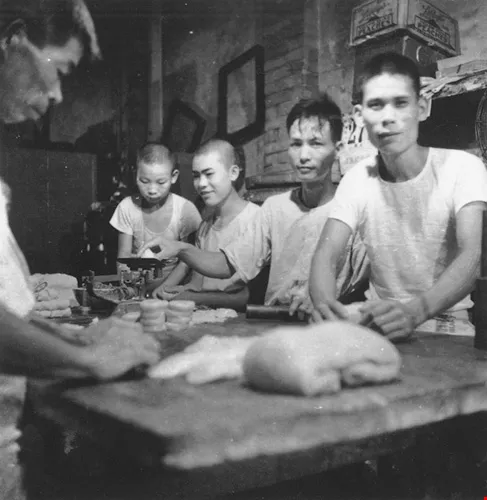
IHWA Cake Shop has been going for over 70 years, initially sporting a simple red-brick facade (top). In the old days the family's children worked with the store's bakers, kneading dough (above). (courtesy of IHWA Cake Shop).
The cake doctor
With the continuing media spotlight on IHWA Cake Shop, people have begun to wonder why Yang Tsung-cheng's 34-year-old son Yang Meng-hsiang, who has a doctorate in electronics, would give up the world of high technology to carry on the family business.
The younger Yang, who is currently doing military alternative service with the Industrial Technology Research Institute in Hsinchu, was the envy of his classmates as a child, because they all knew his family ran a cake shop. For his part, though, Yang considered cakes nothing special, having grown up around them, and after helping out during busy periods, he couldn't see any way he could really enjoy working in that industry. It wasn't until he left home to study at National Cheng Kung University in Tainan and could no longer find decent baked goods that he finally realized the sweet, sweet taste of home.
From his college days through to his doctorate, Yang Meng-hsiang immersed himself in the high-tech world of semiconductor and integrated circuit design, but in his heart of hearts he would always come back to thinking about making delicious, healthy, popular baked goods. People often ask him whether he considers it a waste to have studied such a major field as electronics only to turn back to traditional baking.
"Most of Taiwan's high-tech industry is focused on production, and even the big companies dedicate little of their resources to research, so in fact I might well be wasting my talents if I stayed in electronics!" says Yang. The cake business offers room to grow, because you won't find the vicious competition there that you do in the high tech-world. But that's not to say that this business doesn't have its own difficulties; with new taste trends like egg tarts, donuts, and hamburgers constantly popping up, many old-fashioned bakeries can be torn between trying to keep up with the times and trying to uphold tradition. After much searching, IHWA struck on a way to seek out new ideas while remaining rooted in tradition.
Last year, at the suggestion of the Good Neighbor Foundation, Yang Meng-hsiang set out to overhaul the old chaotic shelving system, where shelves were crammed with breads, cakes, biscuits, and all sorts, planning a method with much better customer flow.
And after experts tested the salty cakes available along the same street, they decided that IHWA's cakes had the best crust and the best proportions of filling, and with this, along with newly designed takeout boxes and specially designed carrybags, the store's image as the salty cake specialists was born anew. Yang has even begun offering delivery and online ordering services to serve customers in northern Taiwan, in the hopes that Taiwanese snacks can find their own place alongside the trendy Western baked goods.
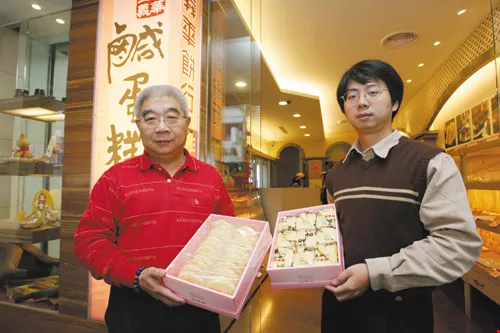
The fame of Fengyuan City's IHWA Cake Shop has spread far and wide, and many a traveler has left with gifts from their shelves. The third-generation operator of the store has reached the lofty heights of an electronics doctorate, but has decided to return home and carry on the family business.
A new lease on life
With IHWA's salty cakes bringing popularity to Fengyuan's cake street and becoming a signature product for the town, both the Yangs say they owe this to Yang Tsung-cheng's father Yang Sheng-ta, a man who was ahead of his time.
When he was 16, Yang Sheng-ta began studying how to make Taiwanese-style mooncakes and Japanese wagashi (traditional confectionery). In 1935 he opened Chiuyuehtang Confectionery, which became IHWA Cake Shop in 1946. He imported Fengyuan's first automated cake machine from Japan, ushering in the age of mechanized baking.
As time went on, traditional baking fell out of favor, but Yang Tsung-cheng stuck to tradition and struggled to find a way out of the downward slide, creating products that brought together Chinese and Western tastes, trying to give the store a new lease on life.
And now, the third generation is preparing to take over the reins of this youthful-spirited old store. Yang Meng-hsiang once hoped to standardize their cake production, and to perhaps even design his own all-in-one kneading and baking machine to ensure quality, but has since found out that there's really no point to doing this--partly because there's no great need for mechanization in baking, and partly because being "hand-made" has become a major point of differentiation for traditional bakeries in recent years, so cake shops continue to adhere to the old ideas of making things fresh by hand every day.
Nevertheless, the younger Yang is keenly aware that if a store doesn't continue to develop, it will hit a plateau, and so he has his own ambitions to open new branches. "Cake Street's getting too packed and the market here's at saturation, but we still have to wait and see how people in Taipei will take to salty cakes," he says, unsure whether he'll be able to make it in the world of high-priced baked goods and donuts of Taipei. With a year left in his military service, Yang has plenty of time to contemplate the future, but one thing is certain--the constant creativity of IHWA Cake Shop is sure to continue being part of the lives of the people of Fengyuan.
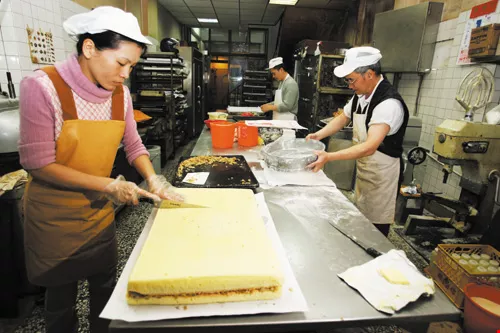
The renowned "salty cake" is a sandwich of sponge cake top and bottom, filled in the middle with a mixture of fried bamboo shoots, mushrooms, and shrimp. The finished cake is cut into portions and packaged for sale.
The renowned "salty cake" is a sandwich of sponge cake top and bottom, filled in the middle with a mixture of fried bamboo shoots, mushrooms, and shrimp. The finished cake is cut into portions and packaged for sale.
The renowned "salty cake" is a sandwich of sponge cake top and bottom, filled in the middle with a mixture of fried bamboo shoots, mushrooms, and shrimp. The finished cake is cut into portions and packaged for sale.
The renowned "salty cake" is a sandwich of sponge cake top and bottom, filled in the middle with a mixture of fried bamboo shoots, mushrooms, and shrimp. The finished cake is cut into portions and packaged for sale.
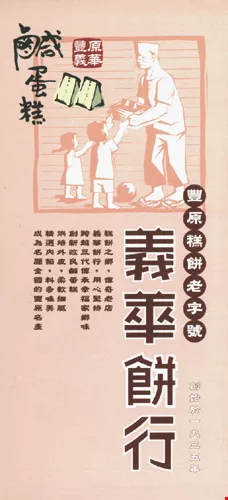
The fame of Fengyuan City's IHWA Cake Shop has spread far and wide, and many a traveler has left with gifts from their shelves. The third-generation operator of the store has reached the lofty heights of an electronics doctorate, but has decided to return home and carry on the family business.


@List.jpg?w=522&h=410&mode=crop&format=webp&quality=80)


@List.jpg?w=522&h=410&mode=crop&format=webp&quality=80)
