Breast Milk--The Best Milk for Babies
Lin Hsin-ching / photos Chuang Kung-ju / tr. by Scott Gregory
August 2009


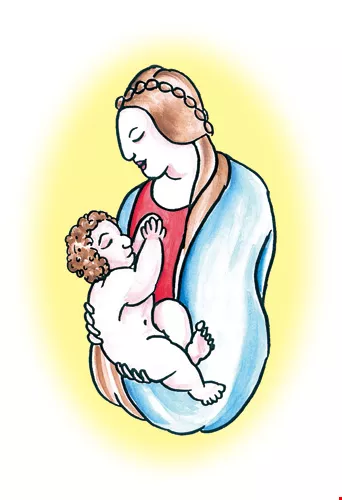
In addition to renowned works such as the Mona Lisa and The Last Supper, there is also a lesser-known painting by Italian Renaissance master Leonardo da Vinci called Madonna Litta. The painting shows Mary wearing a dark red undergarment and a blue cloak, breastfeeding a five- or six-month-old baby Jesus. With tranquility and dignity, she patiently comforts the distracted-looking infant. Joy radiates from her expression.
The image depicted in Madonna Litta is actually one we see when any mother breastfeeds. According to statistics compiled by the Bureau of Health Promotion (BHP) for 2008, 54% of Taiwanese women breastfeed exclusively for the first month after giving birth. That's up from just around 5% 20 years ago. The mistaken notion that formula-fed infants were healthier than breastfed ones is finally being corrected, and most mothers know that breast milk is the best fit for their infants' individual needs. So despite the inconvenience and the physical discomfort, they are sticking with breastfeeding.
The day before the Dragon Boat Festival holiday, the pleasant sunshine of an early summer afternoon breaks through thick curtains and warms a post-delivery care room in Taichung's Veterans General Hospital. Sun Huiyi, the new mom, is comforting her one-day-old daughter.
The baby, who's just had a health check in the nursery, might not be used to the clamor of this world yet. Her face is contorted and she is crying. Yet strange as it may seem, just when the nurse puts her to her mother's breast, she stops crying right away, and she drinks with all her might. Sun and her husband, who waits at her side, beam with the joy of new parents as they watch this new life. This is, without a doubt, the most beautiful scene in a human being's life.
"It's hard to describe the feeling of feeding mother's milk," Sun says. "It moves you to think, 'I'm finally a mother.' Seeing her so satisfied, I feel happy, too." She gives a warm smile like only a mother can.
Accept no substitutes
There are more and more mothers like Sun who insist on breastfeeding their children. In all the major hospitals such as Veterans General, National Taiwan University, Cathay General, and Chang Geng Memorial, learning to breastfeed is the first lesson for new mothers after they give birth. They've been through nine months of pregnancy, the inconveniences of carrying a child, and the extreme pain of childbirth. How are they still willing to sign on for the swelling, the pumping, and the soreness of breastfeeding?
There's only one reason, and that is that there is nothing better, more natural, or more healthy for a newborn than mother's milk.
Chen Chao-huei, chief of the Neonatology Division at Taichung Veterans General and a major force in the breastfeeding movement in Taiwan, says that the infant formulas we see on the market are for the most part designed to mimic breast milk. But while basics like protein, lactose, fat, carotene, and DHA might be easily provided artificially, other building blocks of breast milk such as immunoglobulin, immunocompetent cells, and antibodies, as well as hormones, growth hormones and so on, have been irreproducible by the formula makers no matter how much money they put into research and development.
Another valuable aspect of breast milk is that it is naturally "custom-made" for each infant.
Chen provides an example: Unlike unchanging formula, mother's milk changes with the stages of a child's development. The digestive system of a newborn is not fully developed, so the mother gives yellowish colostrum with highly concentrated protein and antibodies. Not only is it easy for the newborn to digest, it also promotes meconium discharge and helps prevent infection.
As the baby grows, the mother's milk gradually turns into white "mature milk" with more fat, carbohydrates, and minerals to meet the baby's needs. If a mother happens to catch a cold while breastfeeding, her breast milk will even have large quantities of appropriate antibodies to prevent the baby from getting sick.
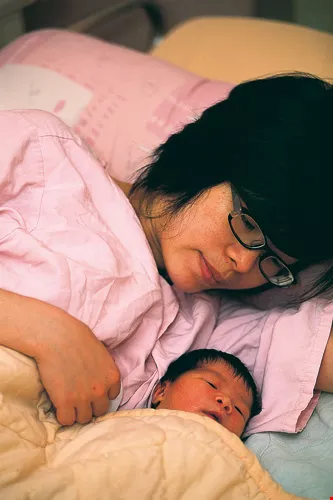
Babies born in designated "Baby-Friendly Hospitals" stay at their mothers' sides from birth, and nurses help mother and child learn to breastfeed. Pictured is Sun Huiyi and her daughter soon after delivery at Taichung's Veterans General Hospital.
Force-fed formula
The idea that breast milk is best is becoming more and more widespread. But when you look at the history of breastfeeding in Taiwan, you will discover that for 20 or 30 years, mothers-perhaps following erroneous suggestions from hospital staff, perhaps in their anxiety to get back to their jobs as soon as possible-would choose to get a shot to stop milk production just after giving birth and would buy formula for their newborns. It's only been in the last 10 years that women have been breastfeeding as they did in their grandmothers' era.
In the 1940s and 1950s most women breastfed; indeed, because Taiwan was still less developed, they had little choice. The first survey, taken in 1961, shows 94.5% of women breastfed their infants. Only wealthy families could afford to buy expensive, imported formula.
But as Taiwan's economy improved, formula was no longer seen as a luxury item. To improve sales, formula makers started pushing their wares through hospitals. They even held media campaigns urging parents to use nutrient-packed formula, saying, "Don't let your children lose at the starting line." Many mothers gave up on breastfeeding. The "progressive" minority who still wanted to breastfeed even ran the risk of meeting resistance from other women around them.
Formula use hit a peak in the 1980s. A 1989 survey showed that only 5.8% of mothers fed their children breast milk exclusively for the first month. This statistic was cause of worry for the government and other concerned parties. At the behest of many civic groups, official bodies finally began promoting breastfeeding and setting relevant policies.
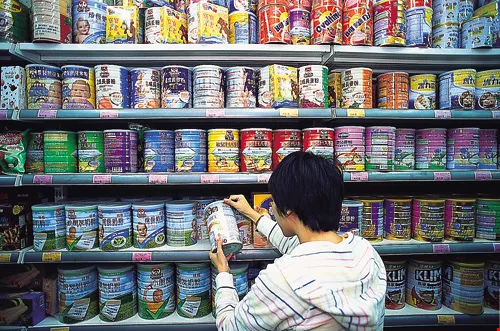
All the varieties of formula milk for sale at infant goods shops and supermarkets claim to make babies grow smart and strong. It's easy for some parents who still hold misconceptions about breastfeeding to be taken in by the relentless marketing.
Mother and child, together
In the 1990s, the government regulated advertising by the formula industry for the first time, banning television and radio ads for formula for infants one year old and under and making it illegal for formula makers to market their products directly to consumers in hospitals. But the increase in breastfeeding was only limited. In 1998, the BHP, taking into consideration the Baby-Friendly Hospital Initiative, a joint effort of the World Health Organization and UNICEF, put into place 10 policies to promote breastfeeding, including training hospital workers to promote breastfeeding, getting new mothers to breastfeed within half an hour of giving birth, and having mothers and newborns in the same room together 24 hours a day. In 2000, it also created a "Baby-Friendly Hospital" certification system. With these measures in place, the breastfeeding rate slowly began to rise.
Chen Yi-chun is the head of the most important local advocacy organization in this field, the Breastfeeding Association of Taiwan, and also an assistant professor in Taipei Medical University's School of Nutrition and Health Sciences. She says that in the past, babies were whisked away into nurseries by hospital staff immediately after delivery. By the time mothers saw them again, the babies had been given a bottle of formula and had already drunk half of it. Mothers were given the feeling that it was "only natural" for their newborns to drink formula.
"The spirit behind keeping mothers and newborns in the same room and the other policies was to turn things around and have children near their moms from birth so they could develop a feel for one another and learn how to breastfeed," says Chen Yi-chun. "Stimulated by the intensive feedings, many more mothers breastfeed successfully and are willing to continue after being released from the hospital."
As of last year, there were 94 certified Baby-Friendly Hospitals in Taiwan. As more than 90% of Taiwanese women choose to give birth in medium- to large-size hospitals, these certified institutions play a key role.
With health professionals providing guidance through pregnancy to delivery, Taiwanese women became more willing to breastfeed again. Last year 54% of women breastfed exclusively past the one-month mark. When those who combined breastfeeding and formula as well are included, the number was nearly 73%. Nearly 16% breastfed exclusively for six months as recommended by the WHO, and an additional 16% used a combination for six months.
"Is there enough?"
Though these numbers are a great leap from what they were 20 years ago, they are still low compared to statistics from developed countries. In Scandinavian countries like Norway, Denmark, and Sweden, the figure is nearly 100%; in Switzerland it is 94%, and in Britain and Germany it is around 78%. In the US, a 2004 survey showed 25% breastfed exclusively for six months and 9% more combined breastfeeding and formula. And in Japan the six-month rate was 31% in 1999. Long-term advocates of breastfeeding like Chen Chao-huei and Chen Yi-chun believe that the reason that acceptance of breastfeeding hasn't reached the levels in Taiwan that is has in those advanced nations is actually that most Taiwanese women worry they can't produce enough milk for their infants to get a full stomach. There are also concerns that family and work environments are not accepting of long-term breastfeeding. That means that many women who want to breastfeed at first give up after a month or two due to the pressure and end up using formula.
Chen Chao-huei explains that formula milk has a high percentage of casein. Casein curdles in stomach acid and solidifies, making it difficult to digest, so an infant can go four hours between servings. Breast milk, in comparison, is much more easily absorbed by the intestines and the infant is hungry again in just a couple hours. Family members will often tell a new mother that the infant didn't get enough to drink, so the mother will suspect she is not producing enough milk and will choose to add formula to the feeding regimen.
As soon as formula is introduced, the infant suckles the mother's breast less often so there's less stimulation to the mother's breast. Since it is easier to get milk out of a bottle's rubber nipple, the infant might begin to reject the mother's breast. The mother's milk production will naturally decline as well, so more formula is introduced. It's a vicious cycle, and the breastfeeding soon stops.
"The formula companies, with their advertisements saying 'A set schedule and a set amount, once every four hours,' have brainwashed too many people over the years!" says Chen Chao-huei. In her analysis, the "eat as much as you want, when you want" style of breastfeeding is more accommodating to individual needs than the strictly regimented formula feeding schedule. It also creates stronger mother-and-child bonds and reduces chubbiness from overfeeding.
If you feel like you are not producing enough milk, the best way to stimulate production is to let your infant suckle more. Your body will end up making enough to meet the infant's demand. "All mothers, even if physically frail or older in age, are able to reach the goal of breast milk only," she says.
Misinformation
Another reason mothers stop breastfeeding is that Taiwanese still hold many misconceptions about it. For example, many worry that the milk is no longer nutritious enough after six months of breastfeeding. Others, believing that breastfed children will become overly dependent on their mothers and will be unable to stop crying for milk in the middle of the night, say children should be weaned earlier so they won't develop "bad habits."
Chen Yi-chun says that neither breast milk nor formula can meet an infant's needs alone at six months and that at that stage solid foods (such as congee, pureed vegetables, or mashed fish or chicken) should be introduced. "But breast milk still contains natural antibodies at six months, and formula still doesn't come close. That's why the WHO recommends breastfeeding until age two."
As for those "night feedings" that give parents headaches, Chen Chao-huei, who has encountered countless newborns in her practice, says outright that breastfed children do find comfort in their mothers' breasts. When awoken suddenly in the middle of the night, mothers also get in the habit of giving their breasts to infants to get them to go back to sleep. This means that it does become a habit that is hard to break.
But, she adds: "Infants have their own characteristics and some breastfed ones can sleep the night through before they are even six months," she says. "On the other hand, there are a lot of formula-fed babies that want milk in the middle of the night until they are two years old." Chen recommends that parents should consult books on child rearing or discuss with their pediatrician the best way to train their infant.
A basic human right
Besides personal and family factors, society as a whole is generally unfriendly toward breastfeeding. Not only is there a serious lack of breastfeeding rooms in the workplace and other public spaces, many people still cast a disapproving eye on breastfeeding mothers. Due to this, some mothers who can't find a breastfeeding room and dare not do it in public take their infants to the restroom.
In 2005, an employee of Taipei Story House expelled a breastfeeding patron for "unseemly behavior." The incident sparked protests by the Breastfeeding Association of Taiwan. The group's efforts led the Taipei City Department of Health to rule that women always have the right to breastfeed in public; and that any person preventing someone from breastfeeding or expelling someone for doing so can be fined NT$5,000-30,000. The new rules should go into effect in October of this year.
"Breastfeeding is a basic human right that should be protected. Think about it-adults don't hide in the restroom to eat, so why should infants have to feed next to the toilet?" Zhou Jiaxin, a junior high teacher currently on maternity leave to stay home with her baby, says that she's been nursing for more than four years now. Her two daughters are still breastfed, so she usually wears nursing clothes and carries a nursing poncho so she can breastfeed wherever she goes.
"With this kind of protection, outsiders can't see a thing," she says. "If someone thinks it's 'inelegant' to breastfeed, it's their own attitude that's unhealthy!"
Healthy babies are the future of a nation. Breastfeeding is the most economical and most effective way to raise smart and strong kids. Creating a breastfeeding-friendly environment by raising awareness, providing health care assistance, and establishing laws is an important task for any nation's government. Though Taiwan has passed the lowest hurdles, it still has a long way to go.
母乳迷思大破解
| x 生產後最初三、四天常沒有奶水或奶水不足 |
o 寶寶沒有含好乳頭,才無法吃到乳房內已有的奶水,只要寶寶正確的含乳,就能吸到足夠母奶。 |
| 母乳寶寶仍須補充水分 | 不需要,母乳已有充足水分。 |
| 剖腹產、照過X光、動手術或服藥的媽媽不可以餵奶 | 大部分的麻醉、抗生素藥物、胸部X光或牙科X光,都不會影響乳汁品質,可繼續哺乳,哺乳媽媽可在有任何醫療需求前先與醫生討論,以避開真正有影響的藥物及檢查。 |
| 餵母乳到小孩三、四 歲是不正常的,對小孩也不好,會造成母子關係過度依賴。 | 讓小孩喝母奶到3歲以上並不會讓他們變得過度依賴,反而會因為有安全感而變得更獨立。 孩子自己會決定何時離乳。 |
| 一般人的乳汁不夠哺餵雙胞胎 | 只要能一開始與孩子培養默契,以正確的方式餵奶,即使是三胞胎都可能達成純母乳目標。 |
喝酒或抽煙的媽媽不能哺乳 |
合理的酒精攝取不應被禁止,因只有非常少量的酒精會分泌至母乳中;無法戒煙的媽媽則更應該哺乳,因哺乳可減少香煙對寶寶肺部健康的負面影響。 |
| 餵母乳的媽媽不能燙髮或染髮 | 燙、染髮不會影響母乳品質。 |
| 若是寶寶腹瀉或是嘔吐,媽媽應該停止哺乳 | 寶寶腸胃感染時,最好的「藥」就是母乳。病中寶寶能由哺乳得到安撫,媽媽也可以由哺乳得到安慰 |


@List.jpg?w=522&h=410&mode=crop&format=webp&quality=80)


