Traumatic Times for Taiwan's Toddlers
Laura Li / photos Hsueh Chi-kuang / tr. by Robert Taylor
April 1995


Spring is with us again, and no one will have forgotten that April brings a special day when we give our concern to mothers and young children. At this time, we look into a subject which is a great worry to many women today: as more and more mothers enter the job market, can they still maintain their traditional homemaking role? And what kind of unsettled childhood may lie in store for the children of working mothers?
Wang Mei-chen, now in her first year of elementary school, is a quiet, introverted little girl. But in fact in the six short years of her young life to date, she has seen many changes: as well as her three years at kindergarten, she has been looked after by three different nannies, old, middle-aged and young, and between times lived six months with her grandmother and spent a month going to a daycare center after kindergarten. At present, after school each day she stays with a childminder until seven in the evening, well after dark, when her mother hurries over after work to take her home.
Two-and-a-half-year-old Li Wei-yang has also been through many changes. Six months ago, the nanny who had always lavished him with affection went to work for an insurance company, and Wei-yang's mother started taking him to a daycare center. After a whole month of crying and nightmares he had finally begun to get used to the new place when the center suddenly announced that it was closing, and Wei-yang had to start going to another childminder's home. Just recently this latest nanny also let it be known that she no longer wished to look after him. With much begging and pleading Wei-yang's mother persuaded her to keep him on for the time being, but for how long? Wei-yang's mother hardly dares think about it.
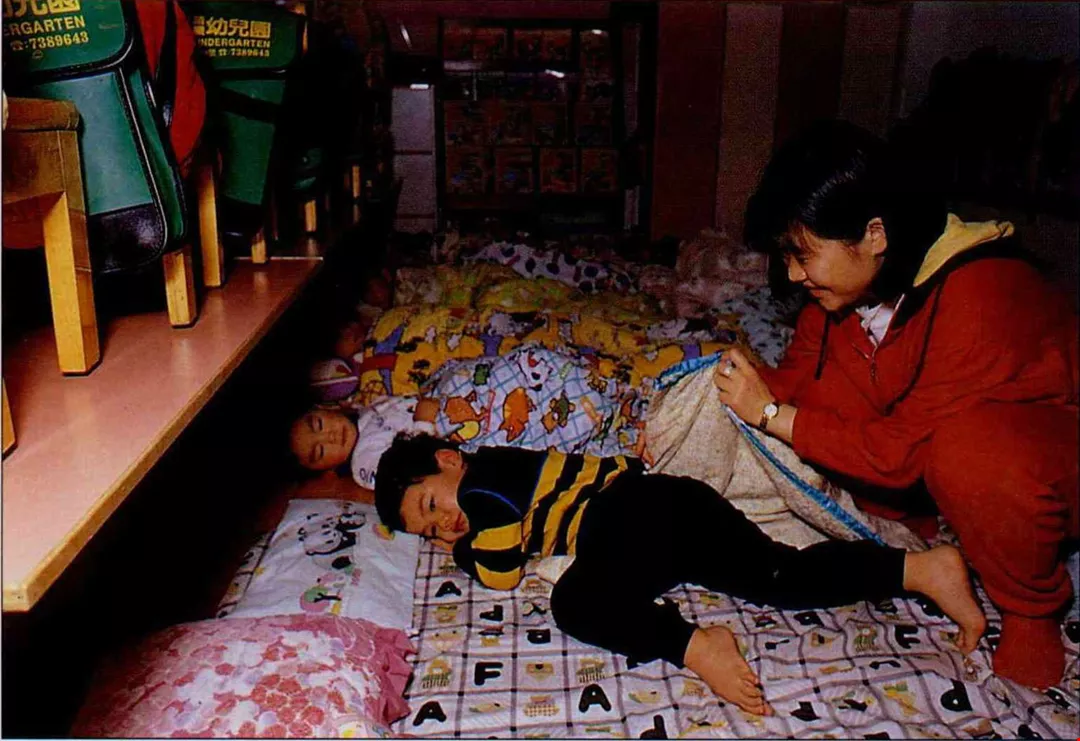
At two years old children seem ready to leave their nannies' care, but still too small to go to a proper kindergarten. One of the countless neighborhood daycare centers and creches will bridge the gap.
Children at the mercy of adults?
Mei-chen and Wei-yang are by no means isolated cases. Looking around us, the streets and alleys are full of daycare centers and creches, and the number of childminders trained by the bureaux of social affairs of city and county governments around the island falls far short of the demand. But can these substitute carers really provide the same secure, stable childhood environment as the mother herself? Judging from the way many children spend their early years being passed from hand to hand like the baton in a relay race, the answer evidently does not inspire optimism.
"At my lectures there are always mothers who ask: 'Would it be better if I just quit my job altogether and stayed home to concentrate on looking after my child?'" says well-known child psychology and education specialist You Chien-kwei, who has seen countless mothers wrestle with this dilemma.
But dilemma or no, according to figures from the Executive Yuan's Directorate-General of Budget, Accounting and Statistics, the proportion of women in Taiwan with children under six who go out to work has been growing steadily for the last three years, and currently stands at 45.73%. In other words, among the almost two million children below school age, there are many who have to grow up being looked after by relatives, childminders or daycare centers, and even after they start going to kindergarten at the age of three or four, many still have to go to "other people's homes" afterwards to wait for their mothers to pick them up.
The years from birth to age six are the most formative for children's characters, and are the time when they most need a stable environment. But children who are placed in others' care while their mothers work often have to cope with separation, changes of carer and constant readjustment.
"Society today is a place of rapid change. Everyone's ideas are changing fast: parents may change their jobs, their homes or even their spouses, and similar changes may affect the childminders. When adults' circumstances change, children have no choice but to change with them." Feng Yen, an associate professor at Taiwan University's sociology department who is currently researching Taiwan's child daycare policies, laments that the stability of agricultural society, in which people did not move away from their home locality and help was always available from the extended family, is gone without trace.
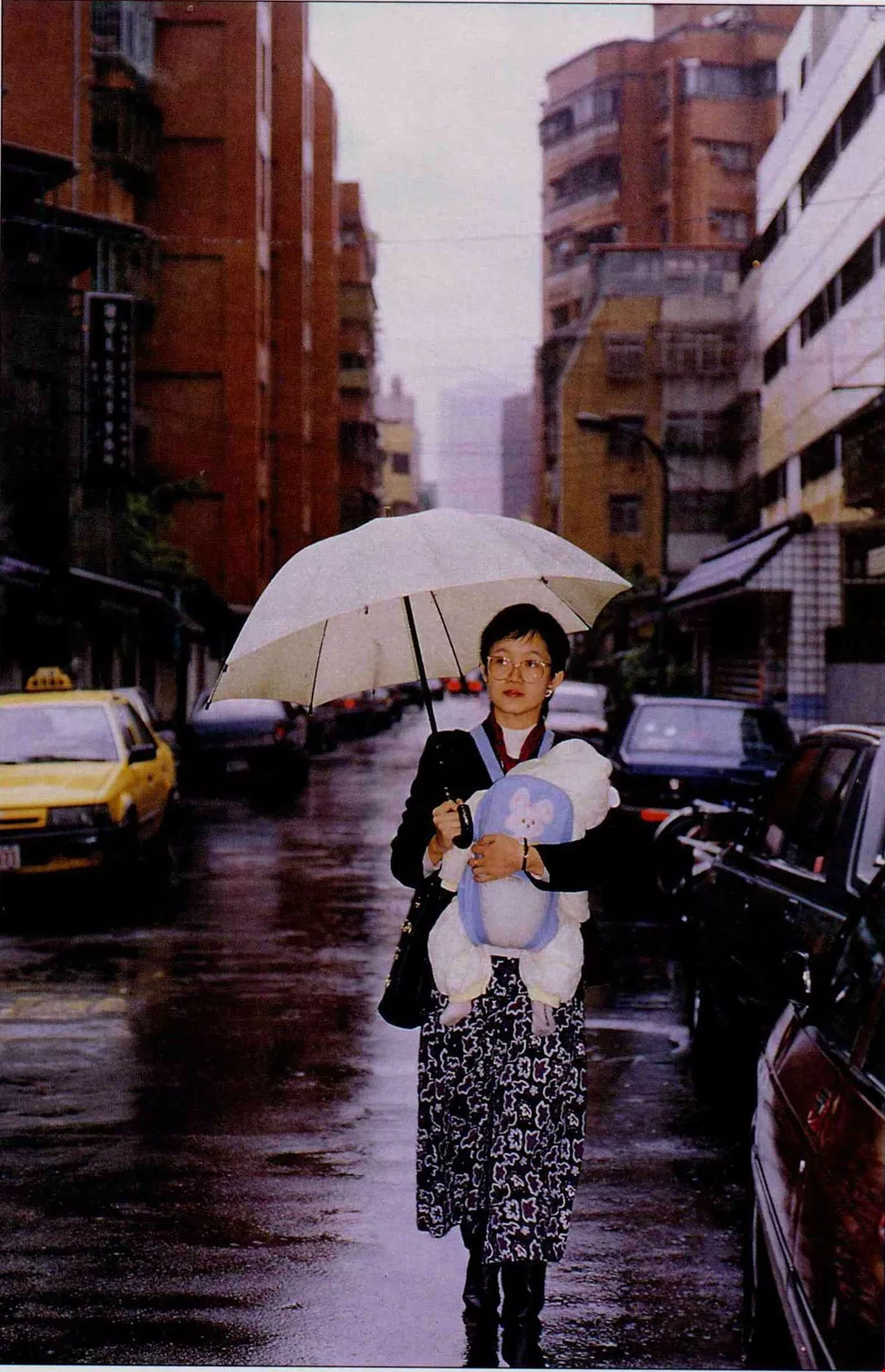
In the early morning a working mother hurriedly washes her face and puts a comb through her hair before gathering up her baby and rushing off to the nanny's house. At this moment the swaddled infant's eyes are still tightly shut.
1001 reasons for finding new carers
On closer examination, we find that many of the changes in today's children's care arrangements--apart from those prompted by changes in their external environment such as moving house, emigration or the child reaching kindergarten age--are the result of subjective choices by their parents--in the vast majority of cases the mother. For instance, dissatisfaction with the way the carer is influencing the child's behavior is a frequently-cited reason for wanting to change to a "better" one.
As for what is "better," the yardstick is sometimes entirely in the minds of the parents. Some are distressed that their child is being "bullied" by the older children at the childminder's home; some worry that their child seems to be developing rather slowly; more intellectual mothers are sometimes unhappy that the carer doesn't play enough tapes of stories or English for their children to hear, and so decide to look for someone more highbrow. . . .
"Sometimes parents demand things which the carer would never have dreamed of," says Chiang Wen-lan, president of Taipei City Nannies' Association, who has more than 20 years' experience as a full-time childminder. She notes that in other cases, at the first sign of any slight problems with the nanny, parents rush to take their children away, which is very frustrating for the carer.
When Chen Ping, now four-and-a-half, was a month old, she started going to a nanny. But when she was three months old, for no apparent reason Chen Ping came down with severe diarrhea. Although the nanny did her very best to take care of her, when Chen Ping's grandmother heard of the situation she took the child away, accusing the nanny of being "too lazy to sterilize the bottle teat properly."
In fact, this is a source of anxiety for mothers too. "Should you leave your child in a care situation which is less than ideal, or should you take the risk of changing? What's best for the child? Can anyone tell us?" asks Lin Chao-chen, a China Times reporter whose two young children have "changed hands" several times, causing her a great deal of worry.
As well as the many cases of parents giving a nanny her marching orders, nannies themselves frequently decide to stop looking after a child.
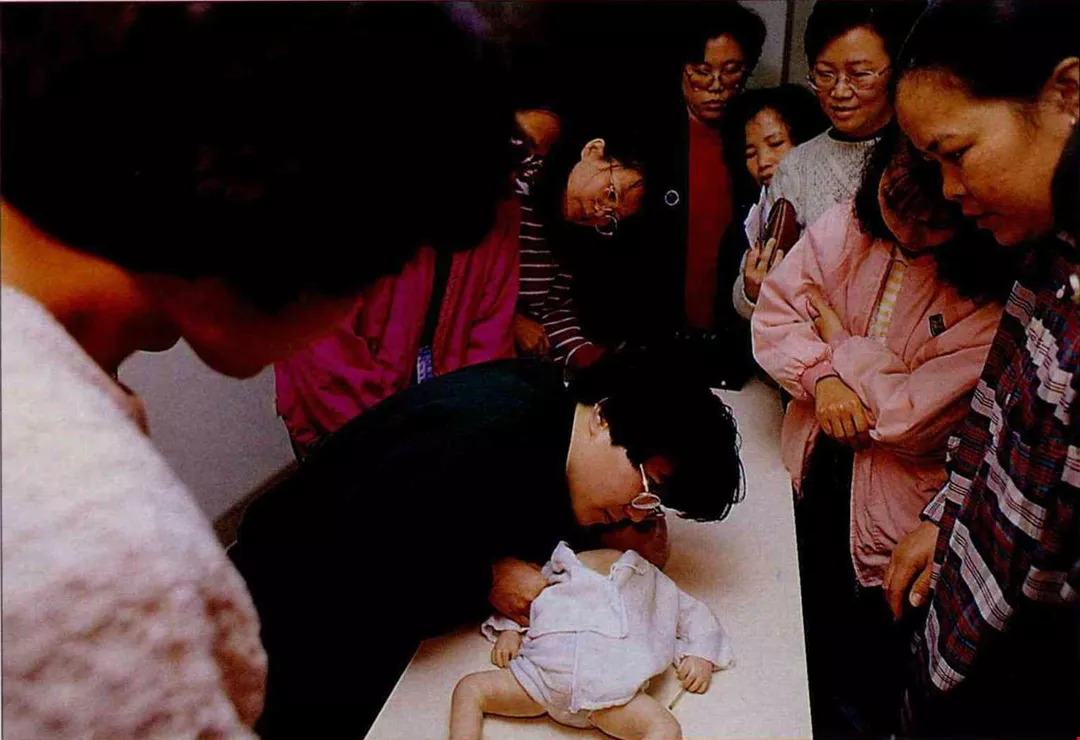
To tackle the knotty problem of young children's day care, the Taipei City government's Bureau of Social Affairs is actively training professional childminders. This year it expects to train over 700. Pictured here is a nannies' training class laid on by the Hsin Yi Foundation.
If the adults don't hit it off, the child suffers
Chiang Wen-lan, who knows the joys and frustrations of a nanny's life as well as anyone, explains that looking after children requires an emotional commitment, and that in fact the key to such a commitment is in the hands of the parents. But some parents don't respect the nanny's right to her own time, and often do not turn up to collect their children until very late, while others are too stingy and never think to give the nanny a raise or a New Year's bonus. "If after a year a nanny says she no longer wishes to look after a child, it may be a hint to the parents that it's 'time for a raise'!" reveals Chiang Wen-lan.
Apart from the latecomers and the pennypinchers, some parents are also too petty: during winter and summer vacations, when the kindergartens are closed, they send their children to their grandmothers' in the countryside, and take it for granted that they needn't pay the nanny for that period, putting her into "enforced unemployment" for two or three months of the year. Others are too carping, constantly criticizing, or even popping in all the time to "check up" on the nanny. All these attitudes create resentment, and make nannies feel that looking after children is unrewarding. So it is hardly surprising that when given the chance of a better job, many choose to give up minding children.
Fu Wen-hui, who has just closed her creche, has a different tale of woe. She has always loved children, and after many years trying unsuccessfully to have one of her own, six months ago she adopted a baby boy introduced by the parents of one of her charges. But the child is weak and sickly, and often caught colds from the other children, or was frightened by their noise. After many strong protests from her husband, to avert a crisis in their marriage she saw no choice but to brave parents' accusations that she had "no sense of professional duty" and close down her creche.
"When I think that the ten or so children I've been looking after for so long are being split up, I'm unhappier than anyone," says Fu Wen-hui, "but now I finally understand why other nannies with children of their own are in such a hurry to be rid of children if they find they're difficult to handle, for fear that their own family will be affected."
Adults' reasons for switching childminders all sound valid and reasonable, but unfortunately the little characters around which these decisions revolve rarely get the chance to voice their opinions. And what may become of them in their new environment is beyond their powers to imagine, given their short experience of life.
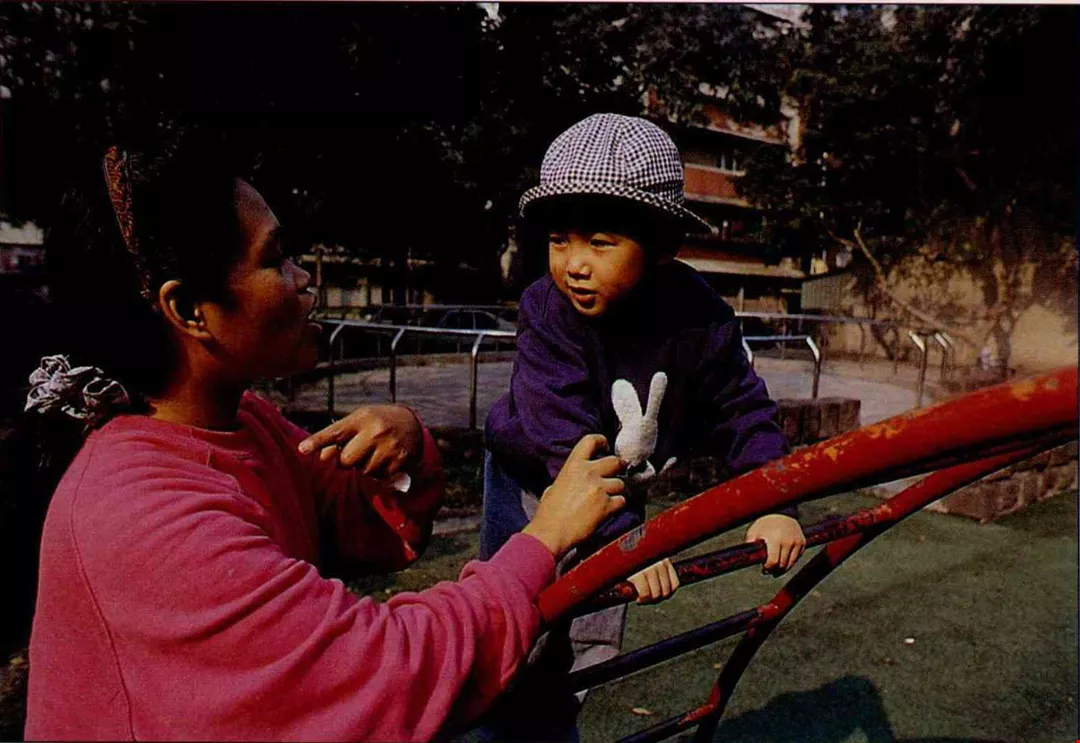
Hiring a Filipina maid to look after one's children can allow them to grow up in the safety of their own home. But the maid's culture, language and length of stay are factors which need careful consideration.
"I want my old mummy!"
In Chiang Wen-lan's experience, "refusal," "withdrawal" or "attack" are children's most common reactions to a new environment, and basically all these reactions are rooted in a deep sense of insecurity.
For childminders, the arrival of a new child heralds an unsettled period. Some children start crying and struggling as soon as they enter the street where their new creche is, clinging tightly around their mothers' necks or kicking or punching at the new nanny, or even shouting things like "I hate you, I don't want to stay with you!"
"Some children will keep on sobbing for days on end, and as soon as they come in they hide in a corner and suck their pacifiers as if their lives depended on it. Others get aggressive as soon as they come in, and push or grab hold of other children as if to warn them 'Don't mess with me'!" says Chiang Wen-lan with a mixture of frustration and amusement.
Perhaps because children do not show their insecurity until they are slightly older, some parents think that as long as they are below seven or eight months old and do not yet "recognize people," it shouldn't matter if they change carers. But Huang Lun-fen, director of the You Yuan Foundation, believes that although small babies cannot express themselves, their perceptions are very acute.
Overseas research reveals that even a three-day-old infant can distinguish different voices and shows a preference for the voice and scent of its own mother (or the person who habitually looks after it). Even though the baby is not old enough to show alarm or fear, a change of carers at this time will prevent it establishing a sense of trust in those around it.
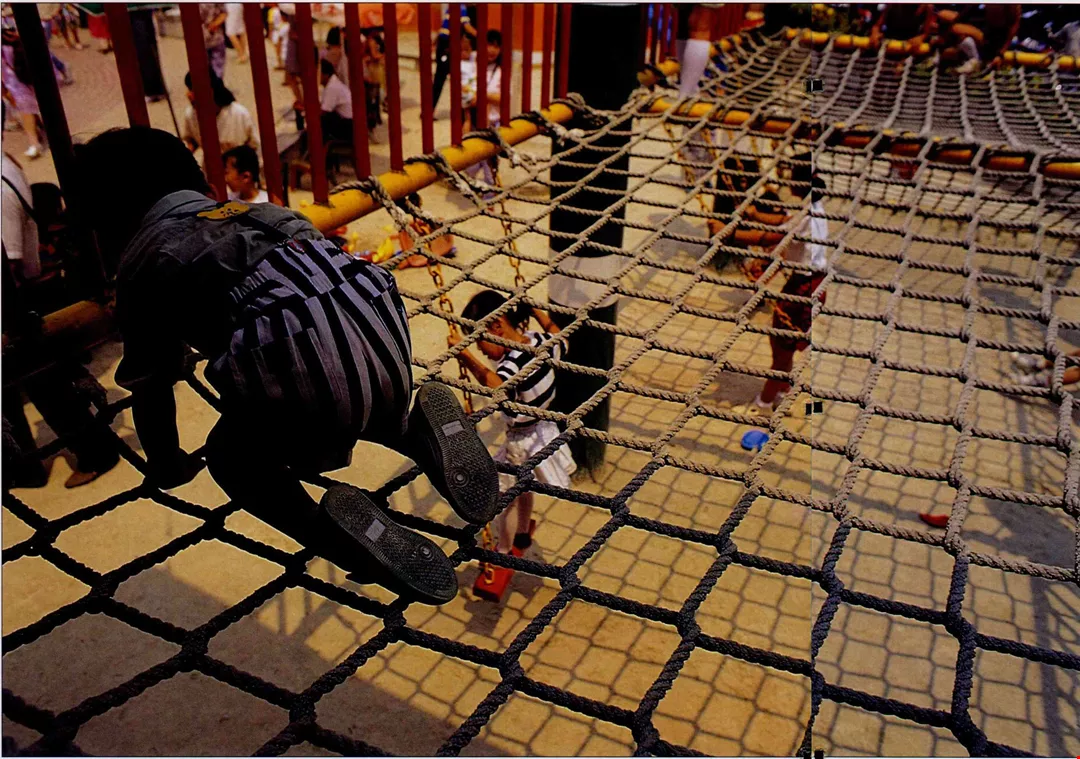
How will our child be affected by its unsettled early childhood? This question weighs heavily on many parents' minds.
Tiring for both children and adults!
Of course, each child has its own personality, and some children who have experienced numerous changes have been able to adapt very quickly to their new surroundings each time. But for others it is a very difficult process.
Hsieh Li-hui, who works for a firm of insurance brokers, looked after her brother's daughter for a time. Her niece had changed nannies three or four times before she was three, and in the end when no new nanny could be found she was farmed out to her aunt. But at that time Hsieh Li-hui's own children were still small, and after they came back from school at midday she had to give her niece to her own mother to look after.
As the child's aunt and grandmother are both her close relatives, one might think she should not have had any trouble getting used to being with them. But after being passed from one carer to another ever since she was a baby, Hsieh Li-hui's niece had lost all sense of security. Every morning when her mother delivered her she would cry for a long time, and then after taking all morning to get settled with her aunt, when she was turned over to her grandmother at lunchtime she would cry again. But in the evening when her mother came to fetch her, she would cling to her grandmother and things would end in tears and another struggle.
"We all understood how she felt--she was afraid the person looking after her at the moment would disappear just like those nannies before." Hsieh Li-hui was very distressed by the situation too, but she still finds it incredible that her niece could cry three times a day, an hour each time, for a whole six months. Luckily, in the end a good nanny was found for the girl and she has gradually settled down.
"Changing carers is hard on the child and on the adults too," says Hsieh Li-hui. In her niece's case, each of the adults involved had their own way of bringing up children, and it was hard to take on a child who had been looked after by someone else. But unfortunately adults often overlook this point, and after one or two changes which they think nothing of, the innocent child is pushed into a vicious circle of constantly changing carers.
A stitch in time saves nine
But how will this kind of unsettled early childhood affect a child later in life?
The answer to this question depends on a host of variables, for it is affected by many factors including the child's personality, the number of changes, the child's relationship with the old and new carers, how close the child is to its own parents, and so on.
Fortunately, says Huang Lun-fen, "most children are very practically oriented, and really do 'live only for today.' After all, they know they have to fit in with adults' arrangements in order to survive. With the right planning and good communication, most children will adapt to their new surroundings in the end."
Furthermore, a positive, successful changeover may even bring the child to the understanding that the outside world is not so frightful after all, and make it more relaxed and self-confident. Thus the change can even turn out to be an unexpected benefit.
However, Huang Lun-fen also warns that although most children can find ways to adjust, a minority will still be left with scars which are harder to erase. Some may even have learning difficulties, or difficulties interacting with others, which do not emerge until they are at kindergarten or elementary school, and the causes of which can then only be traced with great difficulty.
Chen Ping is one of these more difficult cases. After being passed around several times between different nannies and day-care centers, six months ago the birth of her little sister meant she had to start again with a new childminder along with her sister. But perhaps because she really didn't hit it off with the new nanny, this time this previously amenable girl became disobedient and would cry, scream, blink continuously, make strange sounds and even put her hands around people's necks to strangle them. Although her mother had the feeling that things were not right, under the pressure of looking after her new-born baby, she would sometimes let her anger get the better of her and smack or scold Chen Ping.
"At that time I really didn't give her enough attention," says Chen Ping's mother, who works for a magazine, looking back with lasting regret. Fortunately, a month later Chen Ping was able to go back to her previous third nanny, and begin attending a church-run kindergarten. After the kindergarten teacher drew Chen Ping's mother's attention to her daughter's problems, she began to take them seriously and spent a great deal of time and effort trying to make amends: "Now whenever Chen Ping wants to talk to me I will always 'drop everything' to listen to her, and I do my best to take her out somewhere every weekend."
Today, although Chen Ping is still rather withdrawn and not very lively, things are distinctly improving. The teacher's encouraging words that "There's still time to put everything right before her character becomes fixed at age six!" echo in Chen Ping's mother's mind every day.
The age of the butterfly?
From the perspective of developmental psychology, Huang Lun-fen notes, a "one-to-one dependency" is the most important emotional experience of a person's early life and is the most important step in children's establishing a sense of trust and security. If this need cannot be met or is met only incompletely, children will not be able to successfully establish normal one-to-many relationships with their peers. Perhaps the appearance nowadays of many "butterfly" children is a warning sign.
Huang Lun-fen explains: "These children are already going to school, and should normally have passed through their 'dependent' phase. But because they lack a sense of security, they still long for adults' care and attention. So each time they find themselves in a new environment they flit back and forth like butterflies, trying hard to ingratiate themselves with all the adults by turns, while ignoring children of their own age. They are unable to develop good peer relationships."
"Butterfly" children at least maintain an appearance of being bright and well-behaved. But those children who bear even deeper wounds from an unsettled early life may be left with an eccentric, coldly distant, unsociable or withdrawn character all their lives. The reasons behind the rapid increase in antisocial behavior by young people are becoming a focus of enquiry in countries around the world, and the experiences of early childhood have been confirmed as having an enormous influence throughout a person's life. "One can never be too careful about child care," Huang Lun-fen reminds us.
Of course, after a child reaches six it grows more independent and its ability to adapt to change also increases. Furthermore, for the vast majority of normal children, their dependency relationship is gradually replaced by peer relationships, and a change of childminders at this point will not create such great difficulties.
But just like adults, "today's children need to get used to saying goodbye to old friends and get used to quickly making new friends, and they must be ready for change at any time," says Huang Lun-fen with deep feeling.
Looking to the future, what kind of era will this generation of unsettled children create 20 years from now? Questions like this spring constantly from the children's anxious eyes and their parents' worries, but seem to have no answer. . . .
[Picture Caption]
p.74
"Just who will look after me?" Faced with a change of carers, little children may feel all at sea.
p.76
At two years old children seem ready to leave their nannies' care, but still too small to go to a proper kindergarten. One of the countless neighborhood daycare centers and creches will bridge the gap.
p.77
In the early morning a working mother hurriedly washes her face and puts a comb through her hair before gathering up her baby and rushing off to the nanny's house. At this moment the swaddled infant's eyes are still tightly shut.
p.78
To tackle the knotty problem of young children's day care, the Taipei City government's Bureau of Social Affairs is actively training professional childminders. This year it expects to train over 700. Pictured here is a nannies' training class laid on by the Hsin Yi Foundation.
p.79
Hiring a Filipina maid to look after one's children can allow them to grow up in the safety of their own home. But the maid's culture, language and length of stay are factors which need careful consideration.
p.80
How will our child be affected by its unsettled early childhood? This question weighs heavily on many parents' minds.


