Their Home in the City--the Ami People's Shankuang Estate
Hsueh Wen-yu / photos Diago Chiu / tr. by Robert Taylor
December 1993

Someone once asked: "Where can the largest numbers of Ami people be found?" But the reply they got was not the tribal settlements at Kuangfu, Juisui or other parts of Hualien County, but on the "Shankuang Estate" in the Changshuwan area of Hsichih in Taipei County.
Whether or not this is true, an indelible page in the history of the Ami People's urban migration belongs to Hsichih's Shankuang Estate, which was planned and built by the Ami themselves.
Ami residents once made up more than 70% of the estate's inhabitants; but over the last two years, this proportion has been continuously falling. What are the reasons for this, and how will it affect the maintenance of Ami culture?
Going onto the Shankuang Estate, all one sees on every side are high-rise buildings under construction or just completed. Without guidance from a local it would have been easy to miss these four rows of two-storey buildings amid the crowded tower blocks and the dust billowing in the wind.
15 years ago, the area around Changshu No. 2 Road in Hsichih was filled with the greenery and fragrance of the countryside. Here, far from their tribe, Ami people who had come to the city to seek work built an estate with a distinctive tribal character where Ami people could live together. Standing amid the paddy fields, the two-storey buildings of the Shankuang Estate had a particularly striking appearance.
Today, 15 years later, the tall buildings all around have almost swamped this home which was built by the hard toil of many Ami people.
Seeing how the environment around the estate has changed, Hsu Mu-chu, a research fellow at Academia Sinica's Institute of Ethnology who once researched the Shankuang Estate, could not help but sigh: "Shankuang will soon be finished!"
He is worried that with the limited economic power of the Ami residents of the Shankuang Estate, as more and more high-rise blocks are built and large numbers of Han Chinese move in, the Ami will gradually lose the advantage they have enjoyed of forming the vast majority of the local population; furthermore, each unit on the estate measures only around 65 square meters, so that as second generation residents marry, lack of space will force them to move off the estate, creating a threat to cultural maintenance.
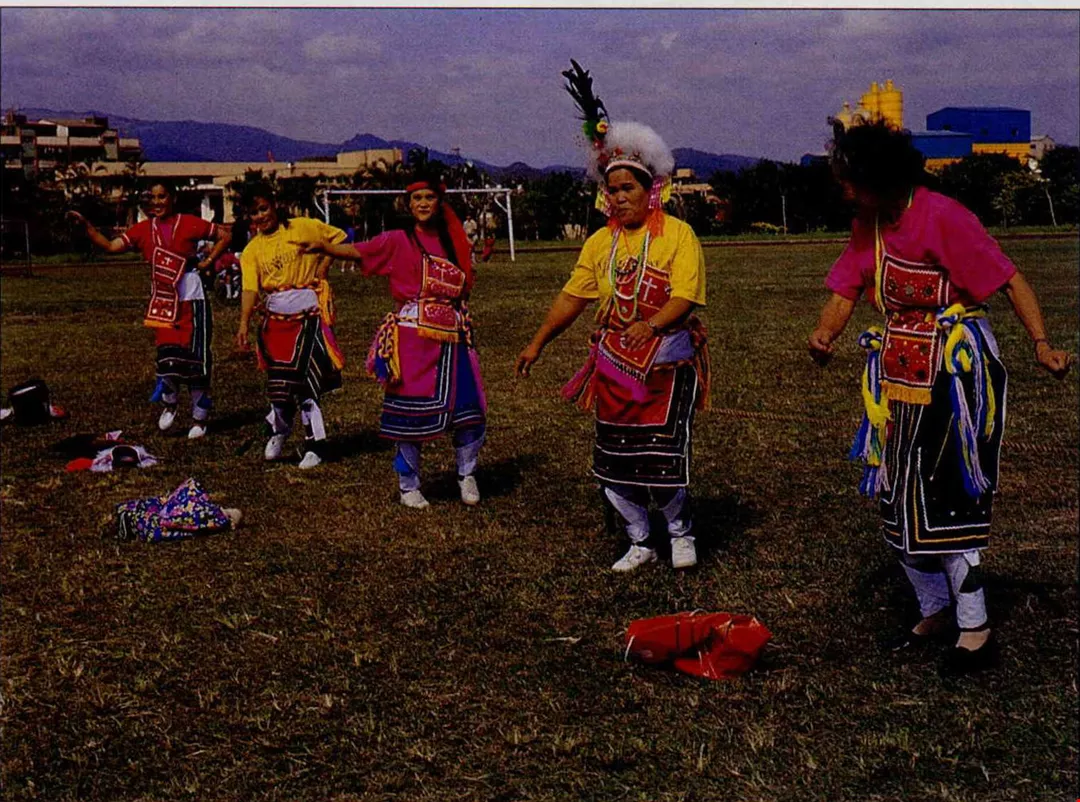
These traditional Ami costumes, usually kept stored away at the bottom of the clothes chest, are only brought out for annual events such as the Harvest Festival and the traditional sports day.
A lifestyle founded in culture:
We began our interviews with such worries in mind, but found that the Ami residents and community leaders on the estate are themselves surprisingly optimistic. The reason is that after one of the four original rows on the estate was pulled down and replaced with a row of twelve-storey high-rise blocks, a number of tribe members moved back on to the estate to live in the newly completed buildings. And in the other new tower blocks nearby, there are also many Ami families which have moved in from other areas. Moreover, the solidarity and communalism which are characteristic of Ami tribal life have not been weakened by the shift in the location of their fight for survival. Perhaps the best evidence of this is this large-scale, concentrated community itself.
Of Taiwan's nine aboriginal peoples, why have only the Ami formed such large concentrated communities?
Hsu Mu-chu points out that firstly, the Ami account for almost 40% of Taiwan's aboriginal population, and their tribal settlements, which are distributed from Hualien down to Hengchun, are all at elevations below 500 meters, close to the coastal plains and with a fairly high degree of assimilation into the Han Chinese population. When the demand for manual workers in the cities exceeded supply, the first of the aboriginals to be attracted were those living on the plains.
Secondly, in traditional Ami tribal communities, unmarried males of the same age grade had to work together collectively, performing such tasks as building a taluan or men's house (nowadays called activity centers). They accepted punishments collectively, and even ate and played together and slept together in the men's house. If someone did not go to the men's house he would be mocked by his peers, who would say: "He's grown up but he still sleeps with his mum."
The age grade system had the effect of fostering Ami people's group cohesion and mutual reliance. If one person went and found work in the city, he would tell his peers in his age grade group and they would go to work in the city together. With each person leading the next in this way, and with the lack of job opportunities and the low pay which made it hard to earn a living in their original home areas, a large-scale migration of Ami people to the cities took place. Arriving in a strange place, it was the most natural thing in the world for Ami people to choose to live, work and play together.
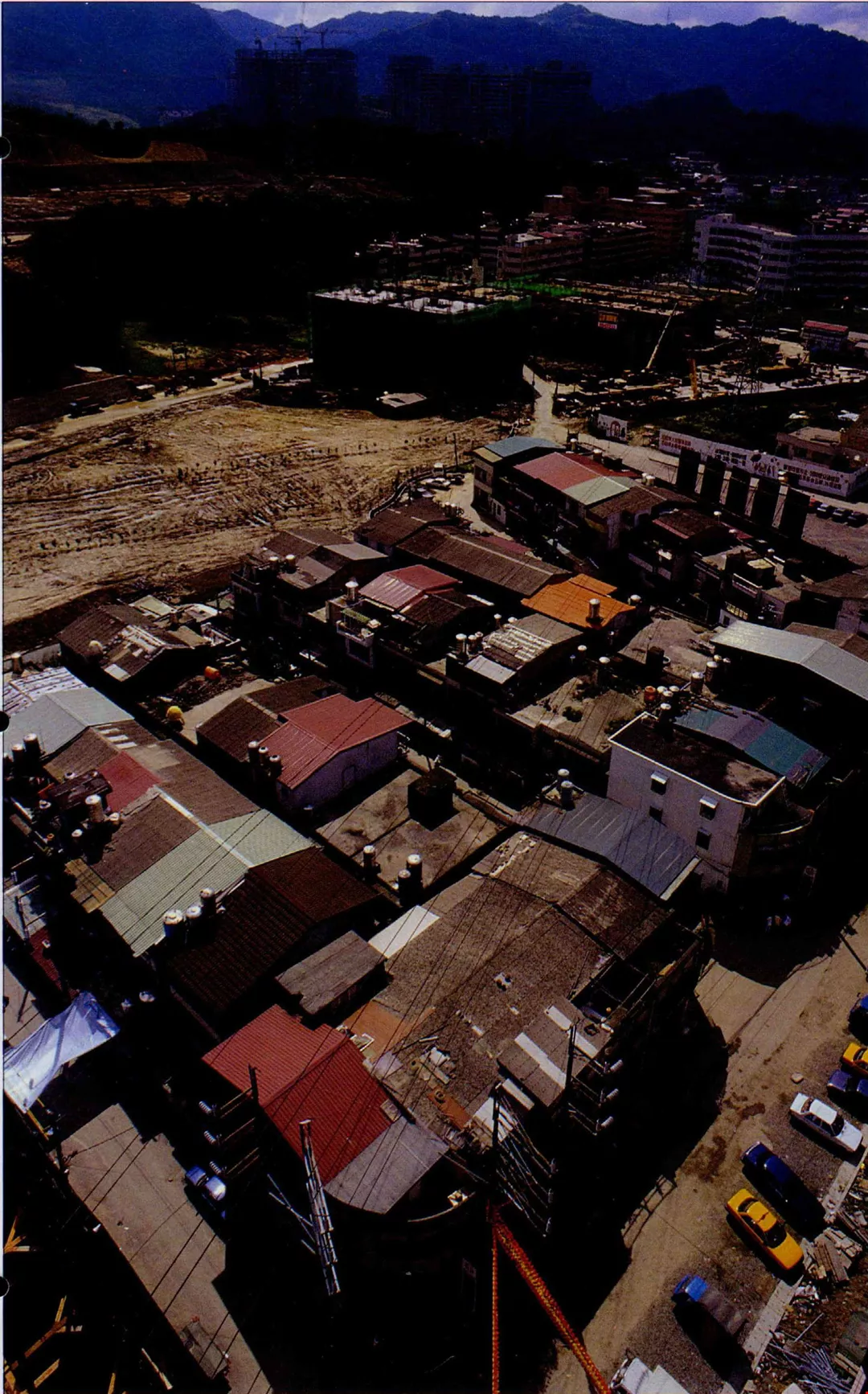
Looking down on the Shankuang Estate from a nearby tower block, its low buildings stand in stark contrast to the high-rise apartments being built all around it. Early on this Sunday morning, around the estate are parked many taxi cabs, on which residents rely to earn their living.
Mainly manual workers:
The largest numbers of Shankuang Estate residents--more than 35%--are employed in construction and manufacturing. Of these, most work on construction sites as formwork carpenters, scaffolding erectors and bricklayers, and in factories as production operatives.
The part of the Shankuang Estate which is being rebuilt is contracted and built by local Ami people. With their homes being constructed by members of their own tribe, people have no worries about the quality of the work, and the leaking roofs, peeling paint and other defects of the original houses should become a thing of the past.
Apart from working in construction, there are also many residents who drive taxis for a living. During our three visits, whether in the early morning or in the afternoon, come rain or shine, there were always a dozen or so taxis to be seen parked in various corners around the estate.
In his research on urban aboriginals, Fu Yangchih of Academia Sinica's institute of Ethnology has found that after leaving their tribal settlements, although Ami people hope to return to live in their old home areas once they retire, most regard themselves as permanent urban residents. This directly influences their willingness to invest and buy housing and property in the city.
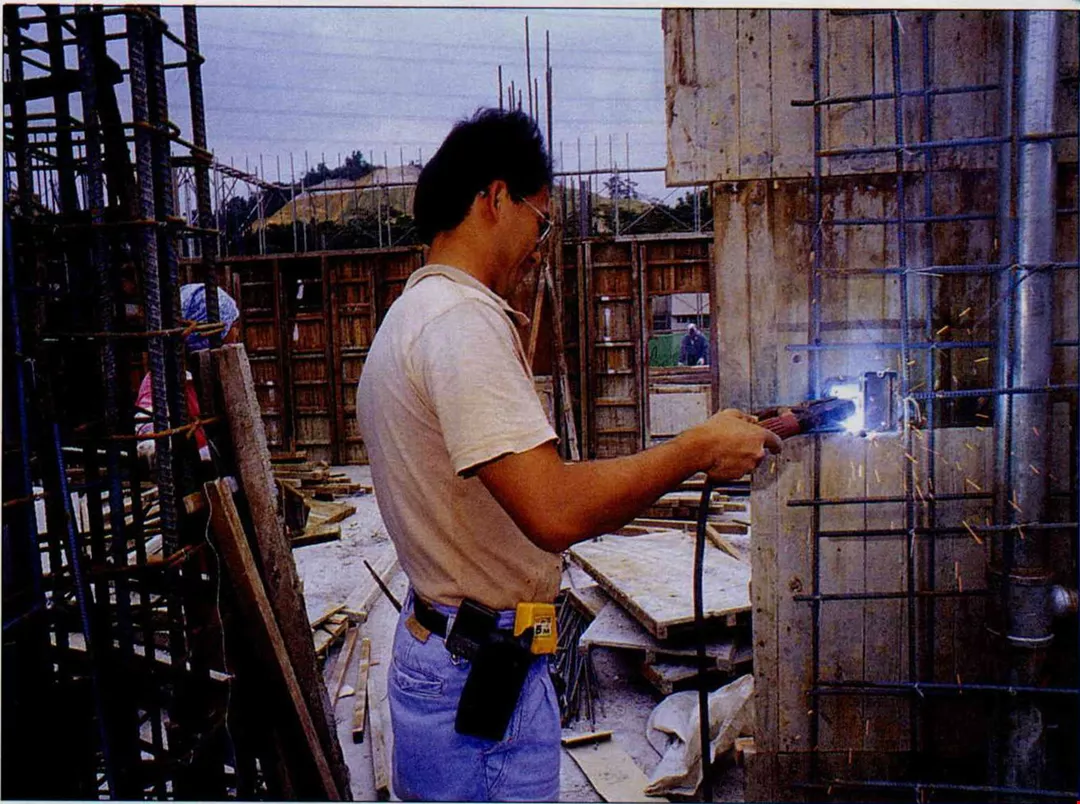
Most of the Ami residents on the estate are manual workers. The new buil dings going up on part of the estate are the result of residents' own hard work.
The Mutual Aid Association provides economic support:
One of the founder members of the community recalls that when the estate was first built, the "Yucheng Savings and Mutual Aid Association," which was set up through the church organization, provided much-needed help by giving loans to Ami people, who in those days were not at all well off. At that time, over 60 families which were members of the Association bought homes on the Shankuang Estate.
Because Association members can borrow without putting up security, and because the Association encourages them to save, since it was set up in 1976 it has grown to over 700 members, of whom over 40% live in or around the Shankuang Estate. Loans currently given by the Yucheng Savings and Mutual Aid Association total as much as NT$180 million.
This is why Huang Hui-mei, an Ami tribe member who is the Association's only full-time paid employee, is happy to stay there despite her low salary, for "I just can't describe the pleasure it gives me to see at first hand how members get the help they need."
On Sunday afternoon after church, Kao Lai-yi and his wife go to the Savings and Mutual Aid Association to arrange a loan of NT$100,000 to pay for their son's wedding. Chatting and joking with Huang Hui-mei in Mandarin interspersed with words in Ami, they say the atmosphere there is "very caring."
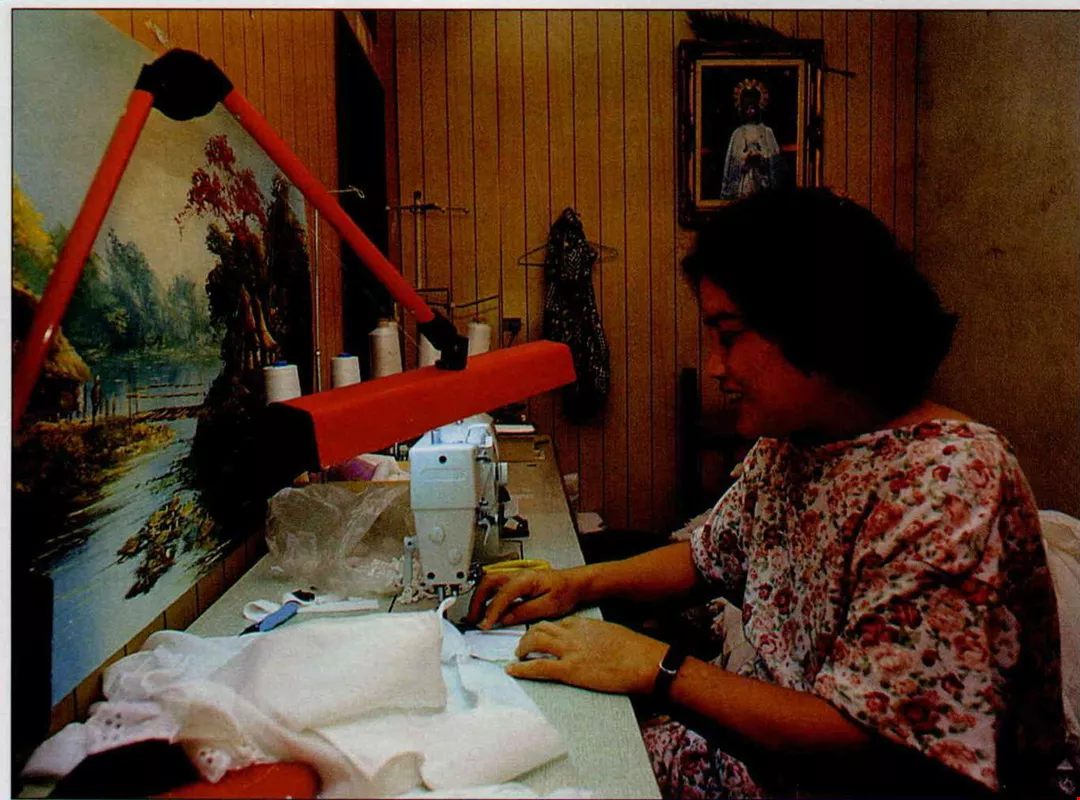
Life in Taipei is not easy; although her husband works in a factory in Taoyuan, Chiang Tai-chun still has to take in some sewing work at home to make ends meet.
Good and bad sides of the communal lifestyle:
The communal lifestyle of the Shankuang Estate undoubtedly provides social support and protection for those members of the Ami community who are less able to make their way in society at large. The community's churches are one example.
The strength of religious belief among the Ami residents can be sensed immediately when one enters their homes and sees posters or figures depicting such powerful religious symbols as Christ nailed to the cross or the Virgin Mary, which are always placed in the most conspicuous position.
Yen Yu-mei, an Ami woman, points out that the church is the biggest factor influencing aboriginal people's choice of where to live. The nearby Protestant and Catholic churches are where the people of her tribe go every week to pray and to pour out their emotions. Ami prayers and hymns drifting past the ear transcend the barriers of language, and seeing how absorbed the worshippers are it is hard not to be moved by their devotion.
The list of benefactors' names inscribed on a tablet on the wall of the estate's Catholic church gives an idea of how strongly believers are attached to their church, especially when one considers that their incomes are not large.
Apart from providing the tribespeople with psychological comfort and the convenience of having friends and neighbors close at hand (for example, children left at home when adults go out will be fed by neighbors), this kind of communal lifestyle also invisibly imposes norms and social control.
For instance, if the husband of a family arrives home late one night, then the next day the contents of the argument between him and his wife may well be told all around the estate. In a place like the Shankuang Estate, the "anonymity" and privacy provided by an urban environment are almost nonexistent. In Fu Yang-chih's opinion, "this is very similar to the regulatory effect in the tribal community of everyone knowing everyone else."
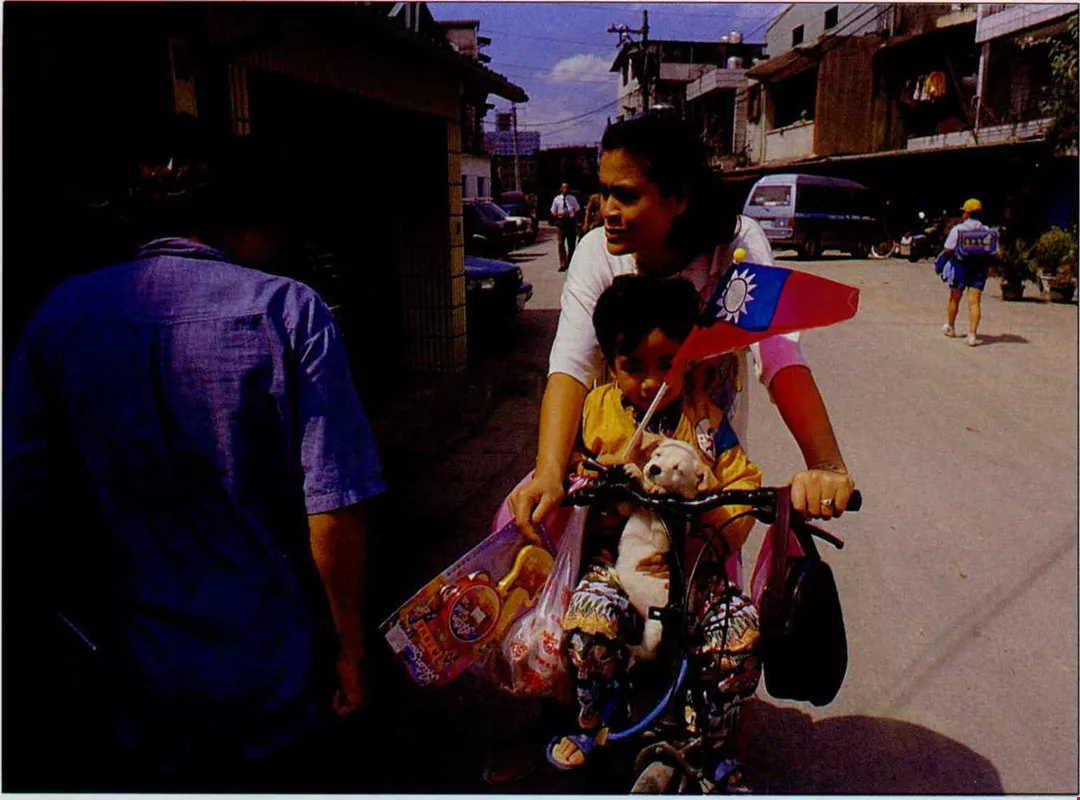
In the bright sunshine on National Day, what could be more fun than riding round the estate, clutching my beloved doggy and the present Mummy just bought me?
Mainly harmonious relations:
Of the 785 families originally living on the estate, only 30% were Han Chinese. In the future, as people move into the newly completed high-rise apartment blocks, the proportion of Han Chinese will rise year by year. Generally speaking, the Han Chinese on the estate, whether they are Taiwan Fukienese, Taiwan Hakka or mainlanders, are all able to coexist peacefully with their Ami neighbors.
When we mentioned to Chang Chao-jung, the estate's Ami headman, that we wished to interview Han Chinese families on the estate, he readily agreed, and taking his own house as the starting point, quite "scientifically" selected what was more or less a "fixed-interval sample."
Liang Kun-mu, who lives opposite the headman, is a Hakka from Miaoli. Before he moved to the Shankuang Estate, he was not aware that so many "mountain people" lived here. He says: "At first, language was a barrier, but after a while it was no longer a problem."
Mrs. Chiang runs a grocery shop on the estate. Before she moved here, she knew about Shankuang's ethnic mix. "All kinds of people can get on together, so why reject one another?" is her philosophy in life. When asked about differences in habits and customs, she immediately replied: "When they have a get-together, once they've had some drinks they start singing and dancing. This house is not that well built, so it naturally does cause some disturbance." She then asked the headman: "Has anyone else told you that?"
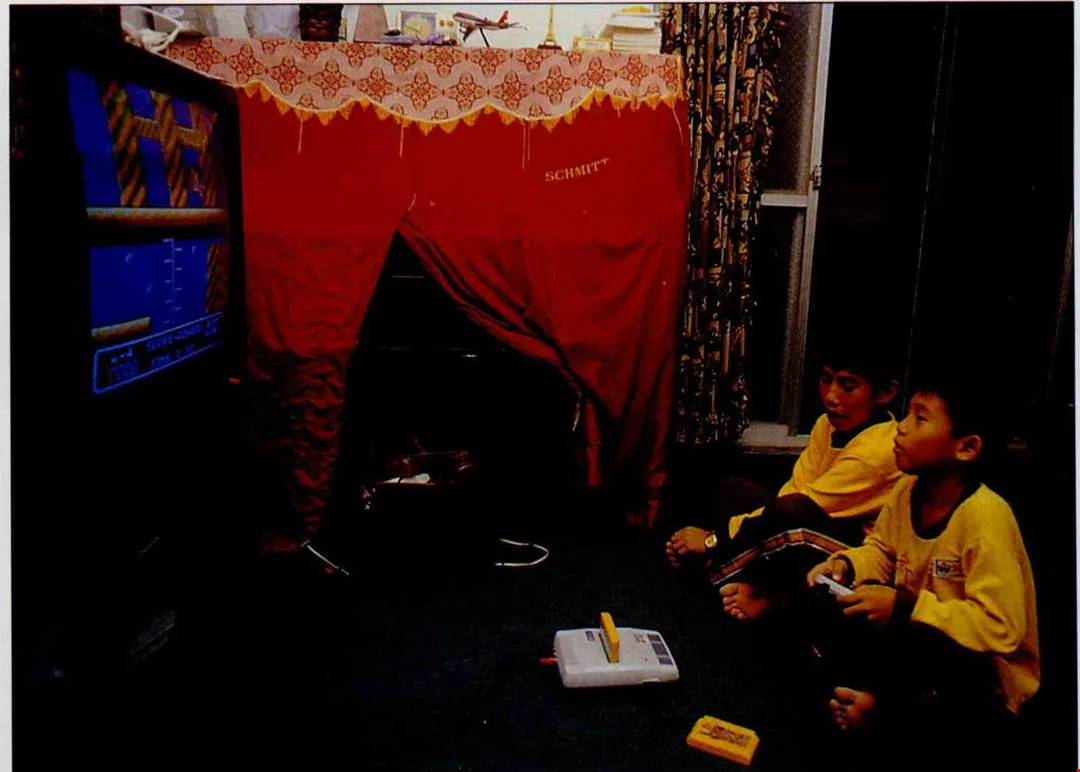
Growing up in Taipei, the moment the Chen boys get home from school they pester their mother: "I want to play video games!" Their life is no different from other city children.
Han people's "reverse discrimination" complex:
But according to field studies by Fu Yang-chih, Han Chinese still do tend to be closer to other Hans and Ami people to other members of their own tribe, so perhaps differences in habits and customs do affect the contacts between them to some degree.
For instance, at the Beginning of Winter (the 19th of the 24 solar terms of the traditional Chinese agricultural calendar, which falls on 7 or 8 November in the Western calendar), Han Chinese families all talk about preparing tonic foods and herbal medicines to keep up their strength in the winter, while Ami families have no such fixed custom; or as another example, one Ami resident often goes into the mountains to collect edible wild herbs which she brings back to the estate to sell, but they are only bought and eaten by other Ami. We ourselves saw an Ami woman selling a type of vegetable which looked a little like bean sprouts, but in fact turned out to be the leaves of the bitter melon plant. Most Han Chinese housewives would probably not even know how to prepare them.
Apart from differences in lifestyle, Fu Yangchih's research also revealed that tensions do exist between different ethnic groups on the estate. For instance, one Han Chinese said: "Living in this kind of place, we've become a minority people. All the activities sound as if they are for the whole community, but in fact they're all just laid on for the mountain people. Whenever there's a trip arranged, they only have to pay NT$200, but if we go we have to pay NT$1200."
In other words, as a "minority people" on the estate, the Han Chinese feel that they themselves are "discriminated" against.
Harvest Festival--just "singing, dancing and drinking"?
Although the first generation of Ami people living on the estate are still firmly attached to the lifestyle of their old homeland, it does not have the same hold over second-generation residents. No fence divides this Ami community from the outside world, and it cannot constrain the urban dreams of the second generation.
If one pays a little attention, one soon notices that the vast majority of Ami people taking part in church activities are members of the first migrant generation. Hu Fang-mei, the church organist, has given up every Sunday morning for more than a decade to the worship of God, but she freely admits that her children never set foot inside the church.
"My children say: "What would be the point if I did go? I could only watch you people standing up, singing, sitting down and kneeling; and I don't understand Ami anyway!"' she recounts with frustration.
Hu Fang-mei was also formerly the teacher in charge of aboriginal clubs and societies at Changshu Elementary School. She has observed that there really has been a substantial break in the transmission of Ami culture to the second generation of city dwellers. She once asked pupils at the school: "What is Harvest Festival?" The reply she got was "singing, dancing and drinking", the little Ami children had no idea of the cultural meaning behind any of the ceremonies.
The urban Harvest Festival in crisis:
For the Ami, the Harvest Festival is a major annual event. Depending on the custom of the different tribes, the festivities last from one to two weeks, but under urban conditions they are compressed into only one or two days.
According to traditional custom, between three and five o'clock in the morning on the first day of the Harvest Festival, members of the youngest age grade would go from house to house to "spread the news", telling the members of the tribe that the Festival was about to begin. But in the city, this practice has been replaced by members of the 35-to-40-year-old age grade going to Hsichih Town Hall to ask the Mayor to come and attend the ceremonies.
In past years, the Shankuang Estate always put on its own independent urban Harvest Festival celebration on the estate, but this year they invited their fellow tribespeople from the nearby Peifeng Estate and from the Hsinmao Estate in Liutu to take part in a joint ceremony. This was due to rifts within the community on the Shankuang Estate between people who had supported different candidates in the local elections, and to people from different Ami tribes insisting on their own customs. For example, in different tribes the age at which one is eligible to take part in the male initiation ceremony varies from 15 to 19. The spread of ages included in each age grade varies from three to five years, and there are also differences in traditional dress, and so on. As a consequence, this year not enough people were willing to take part, and people from other estates had to be invited.
This state of affairs causes Chen Chin-lung, who has been attending the urban Harvest Festivals on the Shankuang Estate for years, to say sorrowfully: "It was a complete mish-mash, it was really painful to watch."
Another expression of this cultural dislocation is that young men no longer wish to participate in the traditional age grade organizations. Hu Fangmei observes: "The community on the estate used to carry on the tribal customs, forming a new age grade group every five years. The members commit themselves to keep watch and help each other, and also take on many duties in Ami tribal activities. But five years ago, when they tried to set up a new group, they couldn't find anyone to join. Young people nowadays aren't very willing to take part; perhaps it's because they do not understand our culture very well, and don't identify with it."
How Ami children relate to their ancestral homes:
Chen Chin-lung, who has been working hard to compile material for a dictionary of the Ami language, and is also standing supervisor of the Taipei City Aboriginal Peoples' Development Association, is deeply concerned about this trend.
He originally hoped to take his children back to his tribe during summer holidays so that they could learn more of the Ami language from their grandparents. But when they got there he found that with the aid of signs and gestures, his parents would try to learn Mandarin from their little grandchildren. And before returning to the tribe, he first had to negotiate conditions with his children: they love to fly, so a plane trip became the most effective bait for persuading them to go back to the tribe.
Even so, once they were there the little Ami children would only be happy for about half a day, after which they began pestering their mother, asking: "When are we going home?" because they missed their Nintendo video games.
But although Chen Chin-lung has a sense of mission about keeping alive Ami culture, made more urgent by the feeling that no one else will do it, he also hopes that his children can quickly learn to communicate with people in society at large. Despite the fact that he and his wife habitually use the Ami language, when their children listen to their mother tongue they are like "ducks hearing thunder"--they just don't understand it. More than once Chen Chin-lung has said to his children. "Daddy is writing a dictionary of the Ami language; if even you can't speak it, then nobody will buy a dictionary like that." But the children stubbornly insist that "Ami is no use at school."
Wen Li-hua, who is currently taking evening classes at Tao Chiang Senior High School of Nursing and Home Economics, is one of those second generation urban Ami who identifies more closely with her mother culture. Her dark skin, bright eyes and sharply outlined features all match people's impressions of the Ami people. She cannot speak her mother tongue fluently, but she "loves to listen." Growing up in the city, it was only during winter and summer holidays and at Harvest Festival that she had the opportunity to return to her grandmother's home in the country. Just like other city dwellers who yearn to return to the countryside, going back to her ancestral home puts her in a relaxed, "holiday" mood. And the communal life of her tribespeople on the Shankuang Estate also gives her a feeling of caring and closeness.
Seeking a home for their culture:
Worried by the dislocation in the transmission of Ami culture, Taipei County Councillor Lin Wen-chih and Lin Ming-chun, Chairman of the Urban Aboriginals' Life Improvement Association in Hsichih Township, Taipei County, are currently actively seeking to build a cultural center close to the estate specially for the use of Ami people. On the one hand it would be responsible for teaching Ami children to understand the value of traditional culture, while on the other hand it would provide Ami residents with a place in which to pursue leisure activities and hold functions, and a home in which to maintain their culture. But no one knows whether this "home" will be able to restore cohesion between members of the community.
While we were eating with local Ami people, a middle-aged man came in through the door and began exchanging greetings with the people seated around the table. When they introduced him to us, we learned that he was Chen Chin-hsing, one of the small number of Atayal people living in or near the Shankuang Estate. Clapping the Ami headman Chang Chao-jung on the shoulder, he told us: "This is our big chief." Chen Chin-hsing sat down and gulped down a few mouthfuls of food, then rushed off to his afternoon's work. In their tribal homelands in the mountains, the Ami and Atayal had very little to do with one another, but now here they were drinking and joking together like old friends. Perhaps this episode is an example of how when people are thrown together as "strangers in a strange land," they will always tend to be drawn to one another!
[Picture Caption]
p.18
These traditional Ami costumes, usually kept stored away at the bottom of the clothes chest, are only brought out for annual events such as the Harvest Festival and the traditional sports day.
p.19
Looking down on the Shankuang Estate from a nearby tower block, its low buildings stand in stark contrast to the high-rise apartments being built all around it. Early on this Sunday morning, around the estate are parked many taxi cabs, on which residents rely to earn their living.
p.20
Most of the Ami residents on the estate are manual workers. The new buil dings going up on part of the estate are the result of residents' own hard work.
p.21
Life in Taipei is not easy; although her husband works in a factory in Taoyuan, Chiang Tai-chun still has to take in some sewing work at home to make ends meet.
p.22
In the bright sunshine on National Day, what could be more fun than riding round the estate, clutching my beloved doggy and the present Mummy just bought me?
p.23
Growing up in Taipei, the moment the Chen boys get home from school they pester their mother: "I want to play video games!" Their life is no different from other city children.
p.24
The Changshu church is one of the centers of religious faith for estate residents. The large mirror just inside the door seems to be reminding believers not to forget to look into their own souls.
p.26
Never mind whether you're a Han child or an Ami child or an Ami child, if we can play together them we're just good pals.


@List.jpg?w=522&h=410&mode=crop&format=webp&quality=80)


