The 921 Earthquake, a Year Later:A Consensus that Things Have Gone Awry
Sharon Wu / photos Jimmy Lin / tr. by Jonathan Barnard
October 2000


All-night vigils were held across Taiwan on the anniversary of last year's 921 Earthquake. A dance troupe came all the way from Hangzhou in mainland China to put on a charity performance in the disaster area in an effort to help people put their sadness behind them.
It has been a year since the devastating Chichi earthquake struck Taiwan on September 21, 1999. All-night vigils were held across the island to commemorate the quake and help its victims begin to move beyond it. A year ago, the public and private sectors mobilized massive financial resources and threw them into relief and reconstruction, so that the people from the afflicted areas who had suffered greatly could begin rebuilding their lives. But in the intervening period, people's enthusiasm to provide assistance has greatly cooled, while the reconstruction work has encountered one difficulty after another. A memorial vigil held to alleviate the victims' suffering had the unintended result of drawing protestors. This showed that the government is out of touch with the people's sentiments and needs to face up to its shortcomings.
At 8 o'clock on the night of September 21, the Nantou County government held a six-hour "Prayer and Peace" vigil. Entertainers included Tseng Kuo-cheng, Chia Yung-chieh, and A Ya, and a song-and-dance troop even came from Zhejiang Province on the mainland especially for this event. These performing artists came with the hope of providing some festive cheer to dispel some of the pain that the 921 quake had caused. Vice President Annette Lu specially went to the Paimao Zen Temple in Mingchien Rural Township to ring its famous "Peace Bell." Three hundred citizens were invited to attend as witnesses, and together they prayed for the peaceful completion of reconstruction work. The Taipei City government also held a vigil at the Ta-an Forest Park at 11:00 p.m. to remember and pray for the victims of the September 21 earthquake. Taipei Mayor Ma Ying-jeou and Vice-Mayor Ou Chin-der were among the nearly 1,000 in attendance.
At the same time, more than 100 victims of the quake who had lived in the Tsunlung Building in Fengyuan, Taichung County, went back to occupy the site of the building. Apart from meditating, lighting lanterns and praying, they also signed a manifesto urging the government to track down embezzled reconstruction funds and to raise the business tax for banks that aren't cooperating with government policy. The government has decided to help the beleagured banking industry by lowering the business tax from 5% to 2%. These protestors argue that the banks brought their troubles on themselves and if they aren't willing to cooperate with government policy they shouldn't be able to enjoy these favored conditions. They argue that the Ministry of Finance should raise this tax to the previous level of 5% for those private banks that are unwilling to offer mortgages to victims of the quake. The 3% difference can then be used for reconstruction and to pay off the victims' earlier mortgages.
In the wee hours of the morning on September 21, the Council for Cultural Planning and Development held a memorial activity at the railway station in Chichi, Nantou County (the epicenter of the quake). ROC President Chen Shui-bian, Vice President Annette Lu and Premier Tang Fei all showed up to light lanterns and pray. At the tail end of the activity, a group of citizens calling themselves the "Earthquake Workers' Line," showed up to protest the vigil-arguing that it was nothing but a "political show." The group pointed out that 60% of workers who lost their jobs because of the earthquake are still unemployed!
In particular, the group lambasted the government for the NT$200 million it had spent in vain on a reconstruction plan designed by academics that was impossible to implement. They argued that the new government's chief concerns should instead be with practical measures such as instituting work management controls and tracking down how reconstruction money was embezzled after the quake. It called upon the government to put an end to the tradition of plans that are unfeasible and good for nothing but creating a lot of hot air.
The earthquake memorial activities prompted many citizens to criticize the government's efforts for being too slow. The Commercial Times editorialized that much of the difficulty resolving the disaster area's problems stems from the affected area's dependence on tourism. It had been receiving 200 million tourist visits a year, but that figure dropped sharply after the quake. The negative economic effects of this decline will gradually expand over the next year, bringing financial crisis to many major tourist areas. Moreover, many of the citizens from the hardest hit areas have moved to neighboring cities, with a resultant drop in the area's population that has only added to their economic woes. Then there is the problem of rising unemployment, with Taichung County, Taichung City and Nantou County having unemployment rates far above the national average. In these three places, few reconstruction mortgages have been given out. This is because the banks typically lack confidence in the economic future of the affected areas, so that land values are depressed, and they won't accept it as sufficient collateral. Moreover, this year many banks are in trouble because of bad real estate loans. This combination of factors has made banks very reluctant to make reconstruction loans. This vicious circle of economic problems poses a great challenge to reconstructing the afflicted areas.
The leading story in the September 21 edition of the China Times noted that although the government had created a special fund for loans for which no collateral would be needed, only 60% of the private financial institutions in the afflicted areas were willing to process those loans. Many farmers' banks and credit cooperatives refused. There were also many farmers who were unable to get construction permits because of ownership and boundary disputes. After half a month, only six loans were granted through the fund. With the word going around that these are very difficult or impossible to get, there have been a lot of complaints along the lines of, "The government says it will do one thing, but ends up doing something totally different."
It's worth keeping in mind that there were many performances of music and dance that were part of the various memorial activities. Performing groups included the ROC Buddhist Musical Promotion Association, the Yinqi Symphony Orchestra and Chorus, and a music and dance group that came all the way from Hangzhou, Zhejiang Province in mainland China. These varied artistic performances spotlighted the generosity of the humanity spirit. Apart from comforting the family members of those who died from the quake, these performances also underlined that death is not the final act of life and that as long as there is love, people can work together to overcome all kinds of difficulties. At a time when cross-strait relations are chilly, the performance by the song and dance troupe from Hangzhou (invited by the Council for Cultural Planning and Development) was particularly meaningful. They performed "Ajie Drums," a number based on a Tibetan legend, amply showing people's spirit to prevail in a harsh environment. In so doing, they provided perhaps the best explanation of how life can rise from the ashes
Apart from the human warmth conveyed by the 921 memorial vigils, these events also highlighted the high unemployment, loan difficulties and industrial problems still afflicting the earthquake areas. The citizen protests staged at the memorial vigils showed that a full year after the 921 quake, the government and the people have not yet reached a consensus about how to proceed. Apart from the prayers at the vigils, this is another issue that must be faced.
p.71
All-night vigils were held across Taiwan on the anniversary of last year's 921 Earthquake. A dance troupe came all the way from Hangzhou in mainland China to put on a charity performance in the disaster area in an effort to help people put their sadness behind them.
p.72
President Chen Shui-bian, Premier Tang Fei, and Council for Cultural Affairs Chairwoman Tchen Yu-chiou stand in silent prayer for the earthquake victims.
p.73
A year after the quake many people are still living in temporary shelters. These innocent children represent our hope for the future, and we have a responsibility to press our government to take steps to resolve a number of vexing problems, including economic recession, unemployment, and the difficulty of securing mortgages.
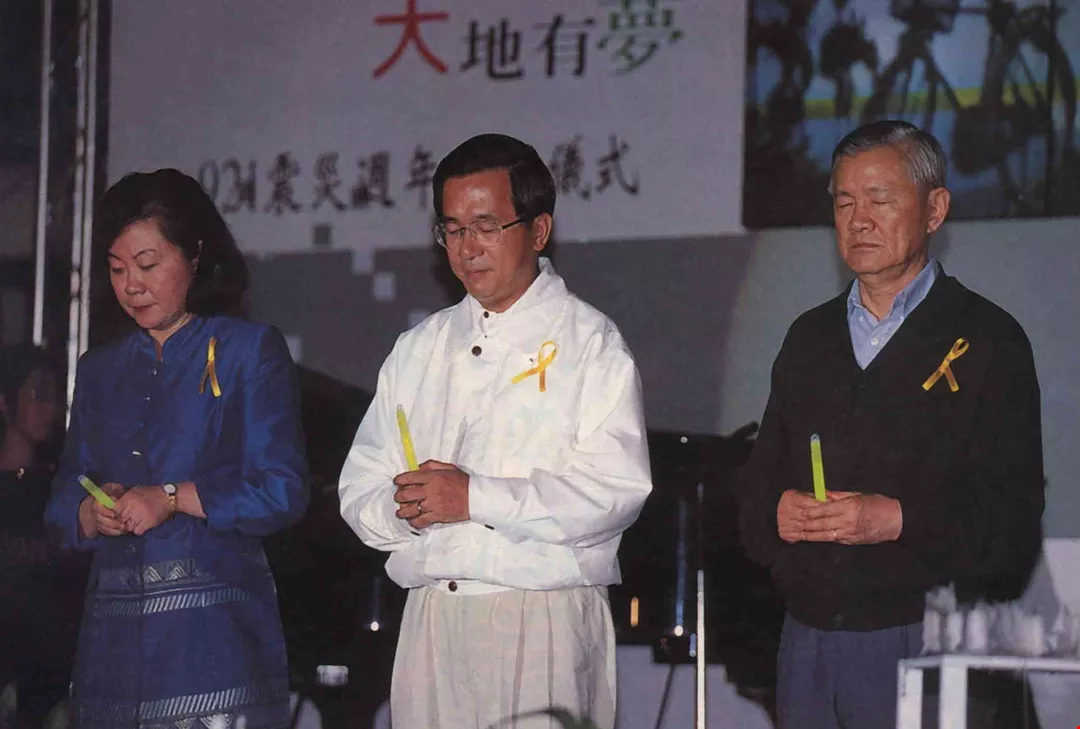
President Chen Shui-bian, Premier Tang Fei, and Council for Cultural Affairs Chairwoman Tchen Yu-chiou stand in silent prayer for the earthquake victims.


@List.jpg?w=522&h=410&mode=crop&format=webp&quality=80)


