Kao Ming-hung: Spokesman for "Taiwanese Overseas Chinese"
Elaine Chen / photos Diago Chiu / tr. by Jonathan Barnard
January 1994


During the Japanese occupation, those viewed as "overseas Chinese" in Taiwan included not only people who had never personally been overseas but even some whose family roots were long established on the island.
Among them is a family that has recently made its mark once again in the annals of history.
In April of last year, the Ministry of the Interior, the Overseas Chinese Affairs Commission, and the KMT received a petition from Kao Sung-shou. In the petition Kao described the sacrifices his father Kao Ming-hung made on behalf of overseas Chinese in Taiwan during the Japanese occupation. He hoped the government would recognize his father's contributions, entering his name in the ROC Martyrs' Shrine.
During the Japanese occupation, most Taiwanese were regarded as "Japanese subjects" with only a small number considered "overseas Chinese." These few established the "Taiwan Chinese Association," which had a membership of about 80,000 and a branch in each county. Kao Ming-hung served as its president.
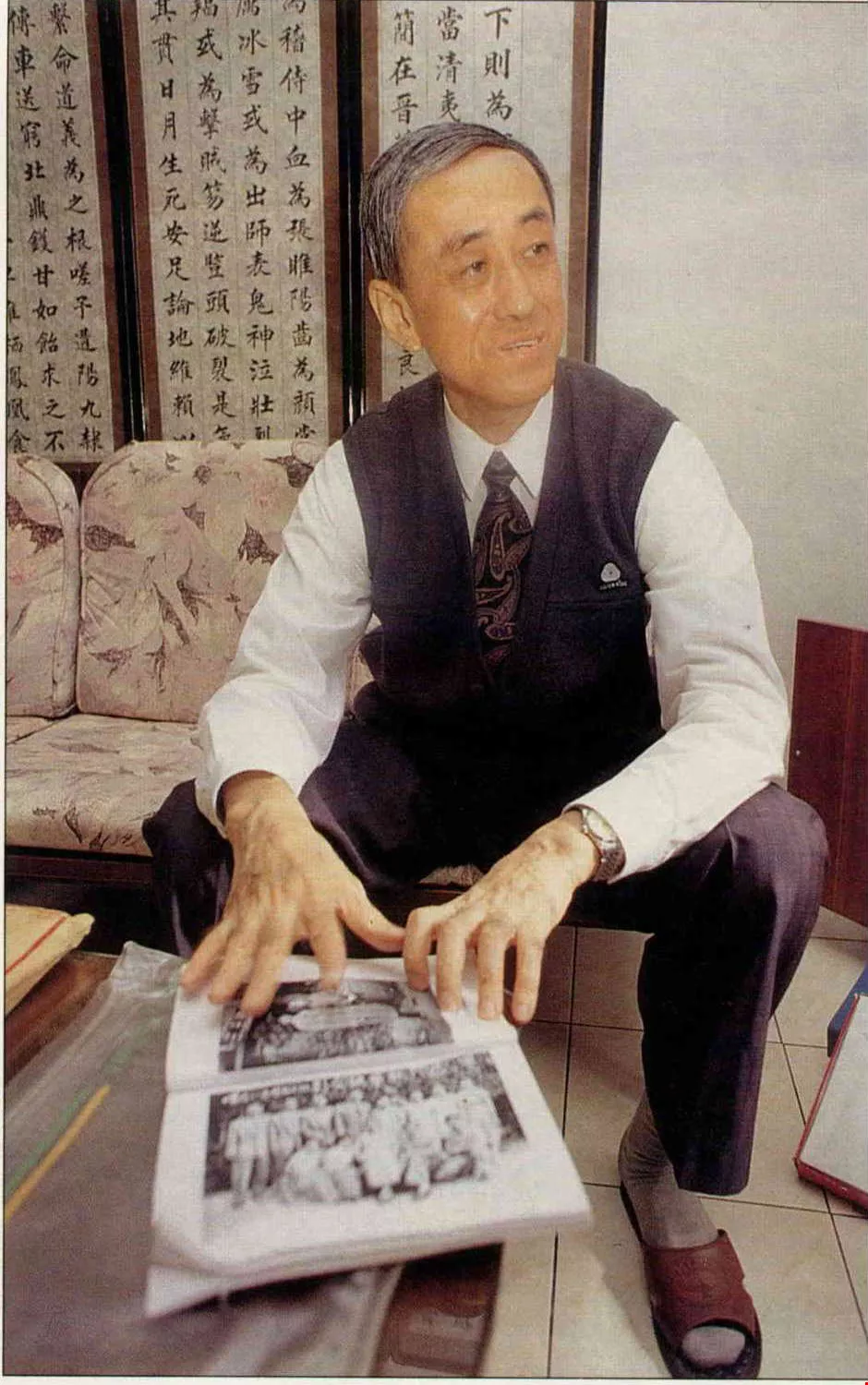
Kao Jen-ta, Kao Ming-hung's fourth son, opens The Maple House: Our Old Home, which is the last book Kao's third son wrote. The book describes all the work his father did on behalf of overseas Chinese. On the wall hangs calligraphy by Kao Hsuan-feng of "The Righteous Song of Cheng Chi-Ke." The same spirit of righteous loyalty can be seen in the Kao family.
Chinese and proud of it
"Taiwanese overseas Chinese were an odd byproduct of the Japanese occupation," explains Hsu Hsueh-chi, a researcher of modern history at Academia Sinica. After China lost the Sino-Japanese War of 1894-95, the Ching court ceded Taiwan to Japan. According to the stipulations of the Treaty of Shimonoseki, Ching subjects in Taiwan had two years to choose their nationality. All those who did not apply to maintain Chinese nationality or leave Taiwan would be considered Japanese citizens.
Hsu points out that according to Japanese government records there were more than 6000 people who returned to the mainland. "The real figure must have been much higher, but many didn't register their departure with the Japanese government."
Those who left fell into three categories. The first were intellectuals, those who had passed the Ching civil service exams such as Kao Ming-hung's father or Kao Hsuan-feng, the last Taiwanese to pass the provincial exam. Then there were those who had homes on both Taiwan and the mainland, such as the Lin family of Panchiao. Finally, there were some families of high standing who patriotically refused to accept foreign rule. Selling all they had, they up and left.
Before leaving for the mainland, Kao Hsuan-feng had trained forces of the Taiwanese militia to fight against the Japanese. Seeing his influence in society, the Japanese approached him with both the stick and the carrot, finally offering him a permit to sell opium, tobacco and alcohol to get him to accept an appointment by the Taiwan Governor General's Office. But their offer didn't stop Kao Hsuan-feng from leading his entire family back to its ancestral home in Fujian.
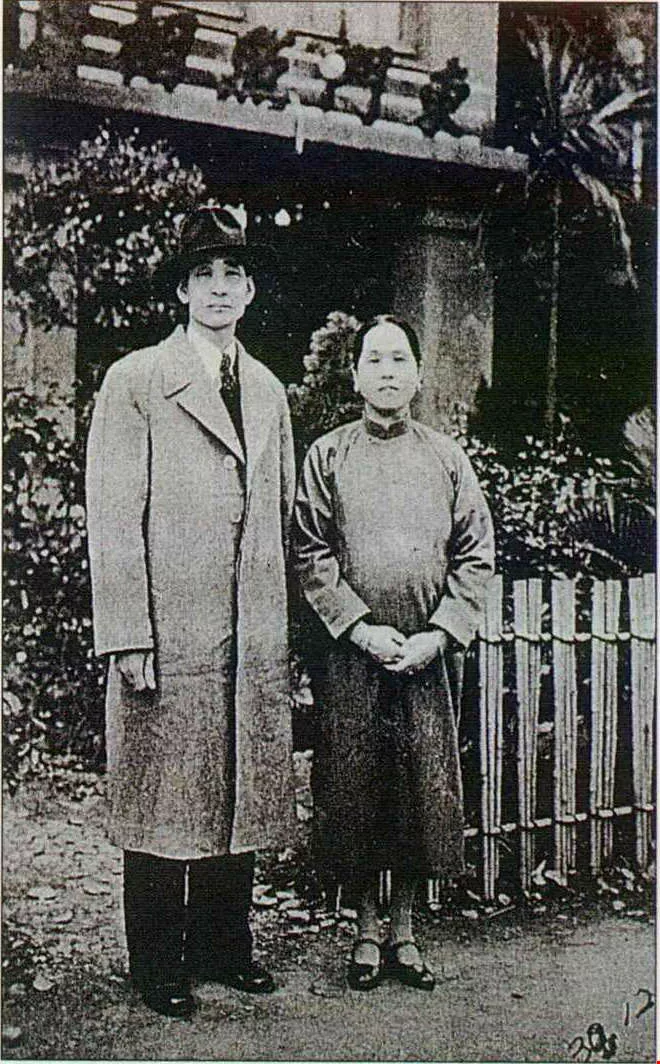
This is a picture taken in 1949 of Kao and his wife in front of their home. (rephotographed from The Maple House: Our Old Home)
Taiwan's third-class citizens
Those who returned to the mainland from Taiwan called themselves "Taiwanese overseas Chinese," which is also what the Chinese who went to Taiwan to do business and work as laborers were called.
Because these overseas Chinese who crossed the sea to Taiwan spoke the same language and were of the same ethnic group as the "Japanese subjects" of Taiwan, the Japanese government treated them with suspicion, fearing that they would stir up ethnic sentiment. They adopted strict methods to control them, restricting the type and number of Chinese laborers allowed to come to Taiwan, specifying the harbors they could use to enter the island, and requiring them to work through designated personnel agencies. Like native Taiwanese but unlike other foreign residents, the overseas Chinese were subject to a policing system of mutual responsibility, wherein a group of households was collectively held responsible for the wrongdoings of any of its members.
The overseas Chinese were paid less than the Taiwanese, who were paid less than the Japanese. Life was hard, and naturally a few of them ended up breaking the law by fighting, smuggling and stealing. Those who were caught by the Japanese were whipped, interrogated and imprisoned and possibly extradited.
"The 'overseas Chinese' in Taiwan had an even tougher time of it than the overseas Chinese in other regions," Hsu points out. "They had no right to education." Overseas Chinese schools were prohibited, and after having enrolled at public schools, they would often be told later that "the rolls have been filled," and so educations would end prematurely. Overseas Chinese laborers already came from the lowest rung of society. Without an education, they would never be able to pull themselves up.
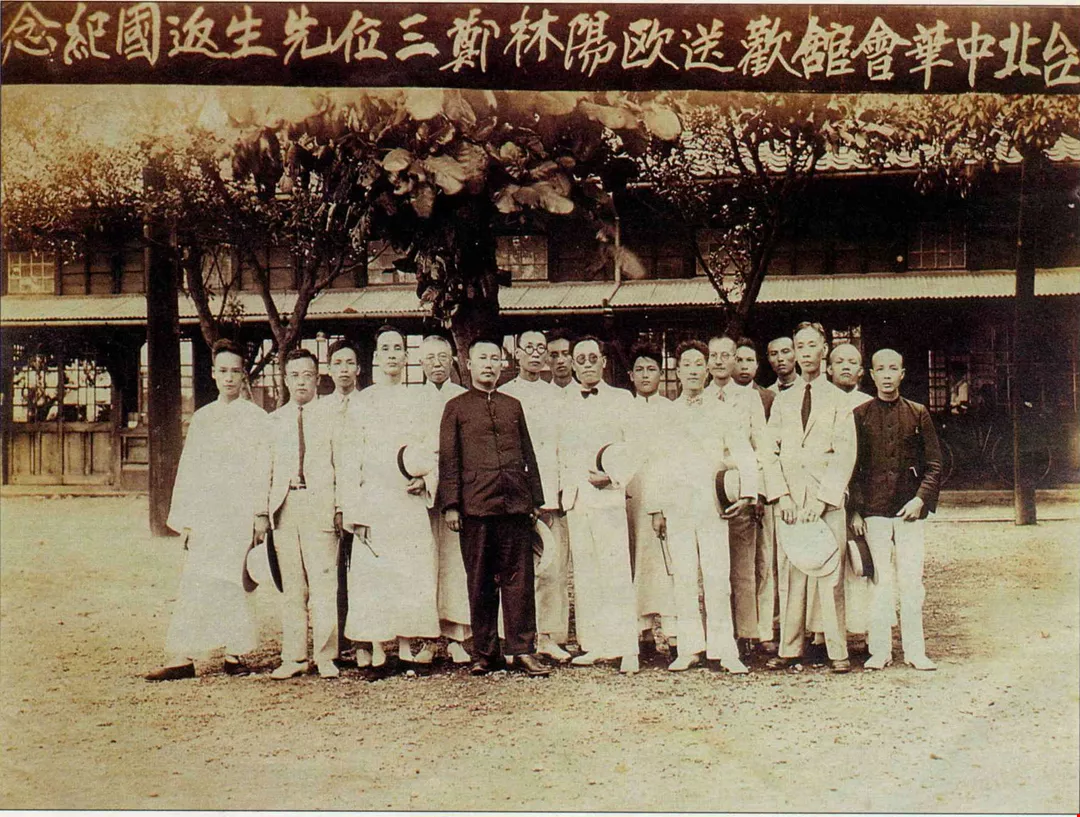
Kao Ming-hung (fourth from left) had great influence among the members of the Overseas Chinese Association when he served as its president. (photo courtesy of Kao Jen-ta)
A moment of victory
Kao Ming-hung hoped to bring together the overseas Chinese community and improve the way they were treated.
In 1898 he decided to go to the mainland with his father Kao Hsuan-feng. Then he returned to the island briefly when his father asked him to retrieve the ashes of his grandparents. Later, he decided to pursue his career in Taiwan.
In 1922 overseas Chinese tested the waters by establishing the Overseas Chinese Club, and they followed it up with the Overseas Chinese Association the next year. But because of factional disputes, the association wasn't able to live up to its promise--not, that is, until Kao Ming-hung became its fourth president. With his striving, the association made headway. More than 32 branches spanned the island from Lan-yang in the north to Hengchun in the south. The then-president of the Taitung Chapter, Cheng Pin-tsung, was the father of former Taitung County Magistrate Cheng Lieh.
In 1927, the association's headquarters was finally established. "It was a big deal in the overseas Chinese community," recalls Kao Sung-shou, the septuagenarian former deputy director general of the National Police Administration. "I still remember overseas Chinese representatives from all over the province gathering for a meeting at the Penglai Pavilion on Nanking West Road. Afterwards they stood in front of its entrance for a group photo. My younger brothers and I were peering down from behind the banister on the second floor, and we got in the picture too."
Besides negotiating with Japanese bureaucrats about overseas Chinese mistreated by Japanese police, as president he would often directly petition the governor general's office, fighting Japanese oppression of his community (such as the system of collective punishment or the requirement that overseas Chinese workers find employment through personnel agencies). He also cooperated with the government in Peking to register Chinese citizens and gather information about them, so that overseas Chinese would at least be viewed as having citizenship in some nation.
Father's copyboy
Kao's founding of the weekly The New China Times had a bigger impact on overseas Chinese than anything else he did and would eventually bring disaster upon himself.
Kao was publisher, and Lien Ya-tang, author of The Complete History of Taiwan, editor-in-chief. False accusations kept even the first issue from being published. With the help of his father and brothers, Kao went to Amoy to print it and then had it sent back to Taiwan. "He didn't think that the Japanese would also manipulate the mail," explains Kao's fourth son, Kao Jen-ta. "It would usually only take a week before such mail was delivered, but the post office held onto it so that it wasn't received until a month and a half after it had been published, making it old news." Later the Japanese would impound the paper at customs.
Thanks to Kao's ceaseless striving, the paper could later be printed and distributed in Taiwan. "When I was ten years old, I worked as a copy boy for my father," Kao Sung-shou recalls. "I'd take the articles, which had been sent from all over Taiwan, and deliver them to Uncle Lien Ya-tang's house."
But the government would later ban the paper again. Kao Jen-ta remembers that the Japanese police frequently came to house to arrest his father, who would hide in the big wooden tub in the bathroom. "One time he went to hide in the house of Taiwanese actor Chen Sung-yung's grandfather."
The Japanese were guileful occupiers. Kao Sung-shou says the northern police bureau twice issued subpoenas for his father, saying that he was being sued and should report at 11:00 Saturday morning. When Kao Ming-hung arrived at the appointed hour, he was told the responsible officer was tied up over another matter and was asked to wait. He waited and waited until the office closed, at which time he would be jailed until it opened Monday morning.
The forgotten people of history
Eventually the Japanese came to the view that overseas Chinese organizations posed too serious a threat. Since Kao could not be bought, they played their trump card, forcing him to sell the transit company he ran with relatives. At the same time, the police were assigned to monitor his every move, investigating and questioning anyone he associated with. And so they cut both his access to money and his social network.
Other leading figures in the Overseas Chinese Association were treated similarly. Cheng Lieh says his father just missed being arrested by the Japanese. Lucky to get advance notice of Japanese plans, Cheng Pin-tsung spent one night burning papers that might implicate others and then hurriedly boarded a boat to return to the mainland without even saying good bye to his wife. "Many overseas Chinese activists who did not get out in time were tortured and ended up cripples," says Cheng.
In 1930 Kao Ming-hung moved his family from Taiwan, where they had lived for generations, putting to an end the work he had done on behalf of overseas Chinese there. Shortly before he left, he did something that would have meant his death if he had failed--he stole a map detailing military deployments on Taiwan and handed it personally to Sun Ko after he came to the mainland.
And yet for all that Kao did, he was not recognized properly by his country. "Among the activists in the overseas Chinese community in Taiwan, some people would later serve as delegates to the National Assembly or would be given work during restoration. But the government never acknowledged Kao's contributions. It was almost as if no one knew that such a man existed," Hsu Hsueh-chi says.
Two years after the Japanese lost the war and Taiwan was returned to China in 1945, Kao, who had been supporting himself as a teacher in Fujian, happily took his family back to Taiwan and spent his last days here peacefully.
In 1950 Kao died of illness. At the time his sons and daughters wanted their father's achievements to be recognized, but they never actually approached the government. "We didn't partly because we were very busy, "says Kao's oldest grandson Kao Chao jan." But even if we had mentioned our hope at that time, probably no one would have bothered with us. Native Taiwanese still had little power."
Entering a temple of scholarship
And now that they have gone ahead and petitioned the government, their wish is still unrealized. The Ministry of the interior, Overseas Chinese Affairs Commission, KMT and other agencies all gave a similar response: "This request is not in accord with current regulations, and there would be many obstacles in implementing it."
Kao's children and grandchildren have accepted the result. "We're just a bit disappointed, that's all," Kao Sung-shou says. Out of filial affection, they wanted the spirit of their father to be remembered in the Martyrs' Shrine, just as the Kao family had erected a flagpole in front of the family temple when their grandfather passed the provincial examination.
Though unsuccessful, their petitioning has caused researchers to take a new look at the history of Taiwanese overseas Chinese during the Japanese occupation.
So that their petition could be appended with properly academic historical references, Kao Chao-jan, who owns dessert and boxed lunch shops in eastern Taipei, sought out Hsu Hsueh-chi, who researches Taiwanese history at the Academia Sinica. Hsu saw the Taiwanese overseas Chinese as a good topic for research, and she began to gather materials and write. Besides "Kao Ming-hung and the Overseas Chinese Movement During the Japanese Occupation of Taiwan," she also wrote "The Overseas Chinese in Taiwan During the Japanese Occupation Before the Establishment of the Overseas Chinese Association" and "The Taipei Overseas Chinese Association Headquarters During the Japanese Occupation." The latter article was presented at the International Research Symposium on the History of Taiwan During the Japanese Occupation.
Though Kao Ming-hung will not be memorialized at the Martyrs' Shrine, the Kao family has given to the Academia Sinica memorabilia that had been in the family for six decades. The largess included the certificate Kao Ming-hung was issued when elected as president of the Overseas Chinese Association, a list of association assets, and appointment letters from the Overseas Chinese Affairs Commission.
Kao Ming-hung probably didn't expect that he would posthumously be barred from the Martyrs' Shrine but welcomed into the scholarly halls of Academia Sinica. Perhaps this is an even greater form of immortality.
[Picture Caption]
p.50
Kao Ming-hung's children and grandchildren petitioned the government, asking it to recognize Kao's work for "Taiwanese overseas Chinese" during the Japanese occupation and include his name among those honored at the Martyrs' Shrine.
p.52
Kao Jen-ta, Kao Ming-hung's fourth son, opens The Maple House: Our Old Home, which is the last book Kao's third son wrote. The book describes all the work his father did on behalf of overseas Chinese. On the wall hangs calligraphy by Kao Hsuan-feng of "The Righteous Song of Cheng Chi-Ke." The same spirit of righteous loyalty can be seen in the Kao family.
p.53
This is a picture taken in 1949 of Kao and his wife in front of their home. (rephotographed from The Maple House: Our Old Home)
p.53
Kao Ming-hung (fourth from left) had great influence among the members of the Overseas Chinese Association when he served as its president. (photo courtesy of Kao Jen-ta)
p.54
(Left and right) At the ceremony for the Kao family ancestors, some of the family perform the rites in the shrine while others burn paper money outside. The flagpoles and inscribed tablets speak to family members' success in scholarship and business.
p.56
Kao Ming-hung's personal documents from the occupation that have been passed down include certificates of merit, appointment letters and poems written in his own hand.


