Taiwanese Tackle Teaching in Thailand
Coral Lee / photos Chuang Kung-ju / tr. by Julius Tsai
August 2005


In the 1960s, the Chinese Association in Thailand had to risk breaking the law as it surreptitiously worked to keep Chinese language education alive. That kind of political atmosphere, however, began to change in the 1990s. With the recent economic rise of the greater China region, Chinese is everywhere to be heard in Thailand, with language courses offered from elementary school to university, and private language schools sprouting up everywhere. For large businesses vying for top talent, fluency in Chinese, English, and Thai has become a must.
The blazing sun makes one drowsy as it beats down on an April afternoon. Cars of various hues are parked in front of the Chinese Association in Thailand. Young and old of Chinese descent from the greater Bangkok area stream into the classrooms of the Chinese Language Center, while in the first floor hallway, parents who have brought their children doze off as they wait idly by.
Today, the advanced class is reading the classic reference to how the Duke of Chou "grasped his hair and spit out his food." As Taiwanese teacher Hsu Hui-hsien explains it, the Duke of Chou was so eager to meet worthy men that he would even interrupt a meal three times if need be, or rush out even when in the middle of washing his hair, holding his wet hair in his hands to meet arriving guests. His humility and hospitality toward the worthy won him over to the common people. As they listen to this story, whose cultural import is a bit difficult to grasp, the students fire off many questions to their teacher. In the class sit gray-haired folks, young professionals, and high schoolers, all studying high school freshman-level textbooks put out by the Cheng Cheng Book Company.
Chen Wei-ling, who is 53 and manages a printing company, comes to the Center each Saturday afternoon to teach three hours of class. He hasn't missed a single class over the last seven or eight years, and teaches material ranging from beginning phonetics to classes that teach students to read their favorite history books.
"The Chinese Language Center in Thailand has been going for over 30 years now. Before, even though I knew how to speak the Chaozhou dialect, I couldn't read or write Chinese. It was something that I regretted," he says. Even though he is of Chinese descent, he had to rely on Thai translations of books on Chinese history. Now, after studying Chinese, he has discovered many errors in those translations, an example of the way in which his horizons have been opened up through his studies.
"As I get older, I feel that knowing one's culture and language is more and more important," he says, speaking slowly and enunciating each word. It was not easy for him to begin studying Chinese at the age of 47, all the while managing a business. But he was so determined that he spent two hours studying each night after his family had gone to bed. His two daughters had previously refused to study Chinese, but with its recent popularity, they too have finally joined their father in his studies.

Pop singers Jay Chou and Alan Lo have enjoyed enormous popularity in Thailand, and serve as a means for attracting Thai youth to the study of Chinese utilizing traditional characters. Popular culture can serve as an ideal selling point for the expansion of Chinese language instruction overseas.
Taiwanese-made quality
The Chinese Language Center is one of the top centers for the study of Chinese language in Bangkok. It is managed by the Chinese Association, which is over a hundred years old. The Association, with its mission of promoting Chinese culture, quickly came to the forefront of Chinese language education when Thailand liberalized its policies in 1992. The Center's president, Chang Li-ming, who studied in Taiwan in the 1950s, made the decision to primarily hire Taiwanese teachers who were university-educated and had teaching experience; most were family members of Taiwanese businesspeople living in Thailand. The reason he did so was because of the uneven nature of Chinese teachers' qualifications in Thailand. The fact that the Center charged higher tuition rates than the norm caused major challenges in the beginning, but over time its reputation was built up by its excellent teaching staff. In recent years, student numbers have continued to increase. There are now over 2000 students in over 80 classes taught by more than 40 full-time teachers.
Not many schools in Thailand can boast the Chinese Language Center's excellent teachers and array of teaching materials. According to Chang, some of the language schools started up by the Chinese Association have shut down while others have started up again in recent years. They now number around 100. While welcoming the current wave of popularity for Chinese, budgetary constraints mean that most schools can only hire local teachers, most of whom have received only short-term training before assuming their duties. The uneven nature of these teachers' qualifications has made it difficult for language schools to grow. In contrast, most of the over 100 Chinese language cram schools have hired teachers from mainland China. These teachers are more consistently qualified and utilize teaching materials from such schools as Beijing Language and Culture University and Jinan University. Such cram schools have proven popular, and many have opened up franchises.
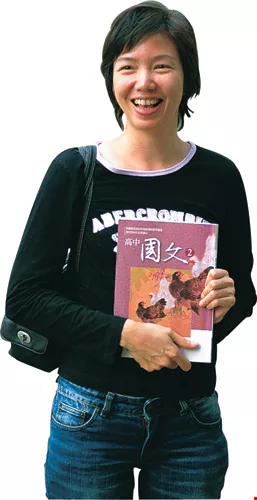
What is different about the Chinese language market in Thailand is that it allows competition between the traditional and simplified character systems. Both Taiwan's zhuyin phoneticization as well as mainland China's pinyin system are employed in instruction in Chinese.
Traditional or simplified?
Like their counterparts in the private sector, academic departments of Chinese have also blossomed at Thailand's 79 universities and 41 teachers colleges. Many departments are being established or in the process of being started up.
Most universities, however, have offered only the most elementary instruction. Only a few, such as Huachiew Chalermprakiet University, offer a variety of levels of classes. Universities have responded differently to the question of whether to teach traditional or simplified characters. Some, with an eye on reading the Chinese classics, teach both styles, and are also quite receptive to the Taiwanese scholarly world.
Dr. Hsin Shih-Chang, who heads up the Graduate Institute of Teaching Chinese as a Second Language at NTNU, says, "Thailand is quite different from other Southeast Asian countries, where simplified characters are in the mainstream."
Due to historical factors, northern Thailand generally exhibits a higher level of Chinese language proficiency than that found in Bangkok. According to informal statistics, there are more than 70 schools, established by the Nationalists' 93rd Infantry, in the mountainous area in northern Thailand bordering Myanmar. Due to its remote location, schools in this region have been subject to less governmental control. Schools offer up to 21 hours a week in Chinese language instruction and use textbooks from Taiwan. Naturally, students of Chinese language here are more advanced, making up many of the students in the most advanced classes at Huachiew Chalermprakiet University.
Despite teaching at the most elementary level of Chinese language, Thai universities face a serious shortage of qualified teachers and still need a considerable amount of support from abroad.
At Thailand's top university, Chula-longkorn University, there are just four instructors for over 100 students in the Chinese department. "Our workload is heavy, and the pressures are immense," says Pranee Chokkajitsumpun, professor of Chinese. The department has sent its staff for education abroad, and has also been cultivating its own students in the hopes of easing such pressures. For now, however, they can only persevere in this challenging time of transition.
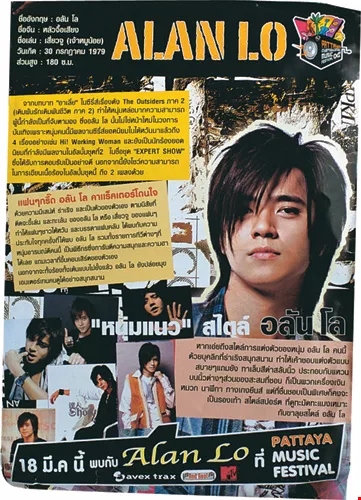
Pop singers Jay Chou and Alan Lo have enjoyed enormous popularity in Thailand, and serve as a means for attracting Thai youth to the study of Chinese utilizing traditional characters. Popular culture can serve as an ideal selling point for the expansion of Chinese language instruction overseas.
Second-language instruction
To meet the urgent need for Chinese language teachers, and in order to promote the teaching of Chinese as a second language, Chulalongkorn University is part-nering with National Taiwan Normal University's Graduate Institute of Teaching Chinese as a Second Language to run a masters program in Chinese language instruction. 12 students formally enrolled last year. Salary differentials between Taiwan and Thailand mean that Taiwanese professors have been unable to stay in Thailand for prolonged periods. Instead, National Taiwan University and NTNU professors have been coming to Thailand to offer intensive short-term instruction. "Last year, we covered 11 months of material in three weeks, and students were worked so hard that many even became ill," says Lin. This November graduate students from Thailand will travel to Taiwan for three months of classes.
"Taiwan's real area for growth lies in its ability to train Chinese language instructors in higher education," says Li Kuang-hua, who serves as a cultural secretary in Thailand for Taiwan's Ministry of Education. Taiwan cannot compete with mainland China in terms of manpower. Indeed, China's Office of Teaching Chinese can send 600 teachers from a single province into Thailand. However, Taiwan can compete by actively developing the qualifications and capabilities of Chinese teachers in Thailand.
Last year, Li persuaded the Minister of Education to invite the presidents of 21 teachers' colleges in Thailand to Taiwan, where they learned about Taiwan's experience and world-class standards in Chinese language teaching. The trip was also aimed at encouraging students in Thailand to come to Taiwan to pursue masters and doctorate level work. This would spread the work that has been done in Taiwan to Thailand's best and brightest.
Forward, Taiwan!
According to Hsin, "The use of traditional characters has declined as the use of simplified characters has risen." Since 2000, China has used its political and economic advantage to take the lead in the Chinese language marketplace throughout Southeast Asia. Many countries in the region have adopted the simplified character system at all levels of Chinese language instruction, causing a gradual shift away from Taiwan in terms of scholarly interchange. Fortunately, Thailand has continued to adopt a freer approach that has allowed Taiwan's traditional character system room to flourish.
"When simplified characters predominate in the global Chinese language marketplace, one's knowledge of traditional characters, however advanced, might simply be left by the wayside," laments Hsin. In recent years NTNU has made some inroads into Thailand, but the Graduate Institute of Teaching Chinese as a Second Language has limited capacities, and the Taiwanese government will have to actively develop policies to support Chinese language instruction to fully respond to current needs in Thailand.
"China has launched a comprehensive, nationwide effort to support and establish the Pinyin system, Chinese language teaching materials, teaching qualifications and certification," says Hsin. Even though Taiwan is not at an advantage in many areas, Hsin still feels that Taiwan has a considerable foundation that may be built upon to promote Chinese language instruction overseas. For example, the television program "Meteor Garden," starring the members of the pop group F4, has swept through Southeast Asia; such a phenomenon could be used as "bait" to attract young students to the study of Chinese. At the same time, the older generation of overseas Chinese and teachers in Thailand have been deeply influenced by Taiwan's system, and already lean towards the use of traditional characters. Finally, Taiwan's more liberalized atmosphere has made it fertile soil for higher education.
"If Taiwan really wants to succeed, then it needs more ambition and a sense of direction," says Hsin. Indeed, despite the importance of economic and political success, only in the and language and cultural sphere can lasting influence be exerted. Now that the cross-straits rivalry has moved into the realm of overseas Chinese language teaching, says Hsin with passion, "Taiwan should capitalize on its various advantages to move forward strategically, and never give up!"


@List.jpg?w=522&h=410&mode=crop&format=webp&quality=80)


