

In recent years, Taiwan has seen a surge in the number of its Indian residents, sparking a local fashion for Indian foods, scents and saris. In addition, several new offshoots of Hinduism have begun taking root in nooks and crannies with which most Taiwanese are unacquainted.
The rich tapestry of India's enduring cultural history is interwoven with myriad religious threads: this vast land is home to adherents of Islam, Sikhism, Jainism, Parsi-Zoroastrianism, Buddhism, Catholicism and Protestantism. But Hinduism is by far the most influential and widespread of the nation's religions. Intimately connected to India's traditional caste system, and combining meditative and yogic traditions, Hinduism is today practiced by more than 80% of India's population, or more than 800 million people.
For Hindus in Taiwan, the International Society for Krishna Consciousness' (ISKCON) center in Taipei's Kungkuan area functions as an important religious center.
Like many other sects that have their origins in Hinduism, ISKCON didn't form in India. Its founder, Srila Prabhupada, established ISKCON in New York City a year after arriving in the US in 1965. ISKCON arrived in Taiwan in the 1980s, but had only about 100 members here until it formally established a local branch in 1997. Since then, however, the growing numbers of South Asians in Taiwan have greatly expanded its ranks.
Sheetesh Devnath, a Bangladeshi man currently residing in Taiwan, rarely hears news from home.
Though he has access to CNN and the BBC, his birthplace--the steamy Bangladeshi capital of Dhaka in the Ganges River Delta--is far, far away and rarely makes the news.
Since coming to Taiwan in 2002, Devnath has used his English language skills to earn a living. He speaks the language with an American accent, something rarely heard in South Asia. Here in Taiwan, he rides the bus daily from his apartment in Panchiao to the Hsinchu Science Park, where he teaches commercial English to the mid- and upper-level executives of our "technology island."
"When students start to get more comfortable with me," says a smiling Devnath, "they become very curious about my homeland. It's only natural that they would be curious--so many Indians and Pakistanis have come to Taiwan these last few years, and I've met a few white-collar Bangladeshis here on business, but never one like me who was staying here long term."
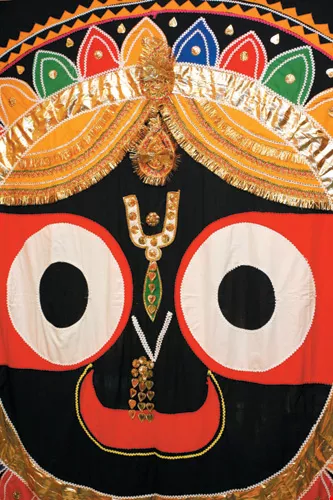
Founded in India and popular for a time in the US and Europe, the International Society for Krishna Consciousness (ISKCON) has been developing its own religious path for the last 40 years. Pictured here is an image of Krishna, the black-skinned god sometimes known as the "dark one."
Visitors from the subcontinent
A member of Muslim Bangladesh's Hindu minority, Devnath spends his Sunday afternoons in a small apartment on Taipei's Tingchou Road. There, Taiwanese, Indians, Europeans and Americans playing hand cymbals, drums and a harmonium surround an image of Krishna and sing.
The fourth-floor apartment is home to ISKCON's Taipei center. "Not all of those you see praying here are members of ISKCON," says Dayal Nitai das, the Belgian national who runs the center. "But we welcome all who come to worship Krishna because we believe Krishna belongs to no single person."
In Indian mythology, Vishnu the Preserver appears in multiple guises, human and otherwise. His human avatars have either three heads and six arms, or one head and four arms, while his non-human avatars include a pig, a fish, a horse and a turtle. Krishna, the "dark one," is Vishnu's eighth avatar. A charming cowherd during his life on Earth, Krishna is a divine hero greatly revered by the Indian people who appears in India's ancient epic, the Mahabharata.
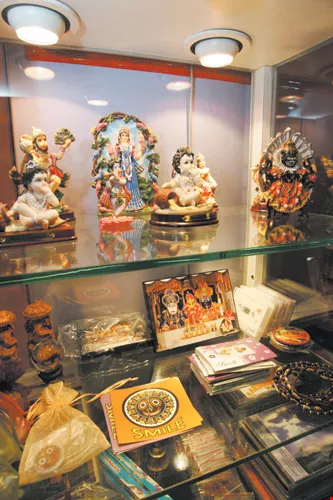
The items sold by the center, from the CDs of hymns to Krishna to the little plastic angels, all have a positive feeling about them.
Meditation and vegetarianism
When the prayers are done, Dayal Nitai das lights incense and begins a sermon on Krishna and ISKCON's sacred text, the Bhagavad-Gita, in a mixture of English and Chinese.
"Service and devotion cause people to glorify God in their words and actions," says Dayal Nitai das. "Everything should serve God because God is the true possessor and governor of all. In the material world, it is only by seeking non-selfish ends and acting to please God that we can escape the karmic cycle.
Ringing with song just a few moments before, the apartment becomes silent; Hindus and ISKCON members from around the world sit on their mats, listening intently.
"There are about 100 people who gather regularly in Taipei City and County. About 40% of them are Indian, and about 60% Taiwanese," estimates Lu Yi-hua as she looks over at the devout society members and Hindus gathered here. "There are another 50 or 60 in central and southern Taiwan."
Lu, ISKCON's executive director in Taiwan and an adherent for 20 years, says that the society's small rented center has become livelier in recent years as the number of Indians in Taiwan has grown. These Indians not only come to the center for the regular Sunday afternoon meetings, but also to worship during the week.
In addition to providing religious training, ISKCON, which stresses devotion and actively proselytizes, promoted itself for a time by offering classes in yoga and meditation. These days, ISKCON members in their distinctive multicolored robes can be seen participating in charitable events in communities everywhere.
"On holidays, we also take devotees and others interested in Krishna on retreats to the mountains in Taiwu and Laiyi Townships at the southern tip of Taiwan," says Lu. "There, we meditate and sing devotional songs in the forest. Members from the Kaohsiung-Pingtung area often invite local working people to come along and unwind a little. Our retreats have all been well attended."
"Krishna worship doesn't have a set form," explains a Ms. Tsai, a Tainan resident who has participated in Krishna-related activities. "The main thing is to let go, and to advocate caring more for the people around you. Most of the spiritual teachers who lead these activities also encourage everyone to eat less meat, to use meditation to cultivate their spiritual side, and to still their emotions. Really, it's very accessible."
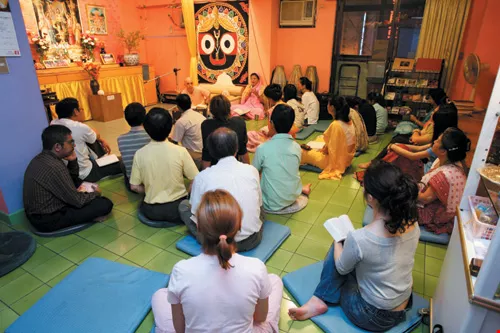
Dasa lectures on the Bhagavad Gita in the cramped Tingchou Road apartment that functions as ISKCON's Taipei center. Because members are of several nationalities, he always gives this talk in English and Chinese.
Religion or metareligion?
Interestingly, Taipei's ISKCON branch has been managed exclusively by Europeans and Americans since it opened in 1997, making it easy to forget that the religion has its origins in India.
"Though ISKCON grew out of Hinduism," argues Dayal Nitai das, "it is not Hinduism." One obvious difference is that Hinduism is polytheistic, whereas ISKCON promotes a monotheistic faith.
In addition to regularly explaining the complex links between Krishna-worship and Hinduism, Dayal Nitai das also stresses that ISKCON is not a religion at all. "In fact," he says, "in many countries ISKCON is regarded as a scientific organization that probes spirituality, or as a way of life."
Not everyone agrees. "In the US and elsewhere," says Chiu Hei-yuan, a research fellow in the Institute of Sociology at the Academia Sinica, "adherents of new religions often argue that what they follow isn't a religion at all. But if you look closely, you'll see that they have all the elements of a religion: an organization, sacred texts, special codes of conduct, and a staff."
Chiu completed a survey of new non-native religions in Taiwan in 2004. He says that in addition to ISKCON and the Osho movement that has recently become popular, several other religions of Indian origin have established themselves here. One of these is the International Sathya Sai Baba Organization, a movement advocating "human values education" that was popular for a time in Taipei's Tienmu area. The Ananda Marga Pracaraka Samgha (AMPS), which arrived in Taiwan in 1970, also has a following here. AMPS's Sarkar School, a primary school, now has several branches around Taiwan. The group has also acquired a piece of land in Tainan's Yuching Township, where it plans to establish a model community engaged in organic farming and environmental conservation. The Sant Mat movement is another recent import which, though it has its origins in Sikhism, shares some techniques with the very popular Suma Ching Hai movement. Finally, there is Transcendental Meditation, which, with 27 teachers and some 50,000 adherents in Taiwan, is the most influential of these new arrivals.
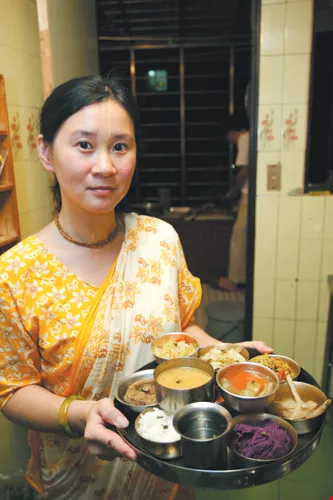
Sharing is an important part of Krishna consciousness. At the end of Sunday services, members of Taipei's ISKCON center prepare food that they offer to Krishna before sharing among themselves.
Nostalgia for better days
Though they have many names, these groups are similar in their activities and objectives. "In general," says Chiu, "they preserve Hinduism's explanation of the spirit and its pursuit of a simple life and peace of mind. Most also employ meditation in the pursuit of a transcendental state. Hinduism's influence is clear."
These religions are also similar in the route they have taken to Taiwan's shores--they typically first make their way from India to Europe and the US, develop there for a time, then spread to the non-Western world. In fact, this is just the route that ISKCON followed.
"New religions developed very rapidly in the West in the 1960s and 70s, spread by the pop culture superstars who were their adherents," says Chiu. "At that time, there were no religious leaders in the West who were both charismatic and touched by the divine. Therefore, these Indian gurus, who spoke English while also possessing a certain Oriental mystique, made a very powerful impression when they appeared on the scene."
Former Beatle George Harrison is a case in point. On an early 1970s track called "Awaiting for You All," he sang, "If you open up your heart / You'll know what I mean / We've been polluted so long / But here's a way for you to get clean... The Lord is awaiting on you all to awaken and see...."
ISKCON's Taipei center is well known to all of Taiwan's several hundred adherents of Hinduism, and plays an important role in the island's Indian community. Located near downtown and readily accessible, it has opened its arms to hundreds of Krishna devotees of other sects, allowing them to come here to worship.
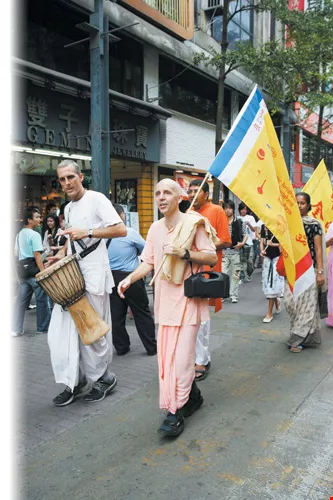
Dasa (right), the Swiss former head of Taipei's ISKCON center, takes a moment out of a visit to Taipei to preach in Hsimenting with Dayal Nitai das, the Belgian who currently runs the center.
Succor in a distant land
"Hinduism is currently the oldest active religion on Earth," says Surojit Chattopadhyay, an Indian professor in the Department of Electrical Engineering at National Chung Hsing University. "But Hinduism is a broad term, and a very flexible one." He points out that some people now violate the stricture against eating beef but are still considered Hindus.
"Hinduism is just like India's caste system, with which it is completely integrated," continues Chattopadhyay, himself a member of India's highest caste, the Brahmin. "Both have much less influence than they used to." He attributes this to the economic and social liberalization taking place around the world, which he feels are gradually changing India as well. "I really don't want to see a hierarchical system separate people again. And I no longer take my Brahmin identity as a point of particular pride."
As night slowly falls, Chattopadhyay leaves the ISKCON center, making his way down the apartment building's crowded staircase with the departing ISKCON members. Having spent his weekend in Taipei worshipping Krishna, he must now hurry back to Taichung to face the challenges of a new week at work. "I must acknowledge that I respect and fear God," he says. "But as a scientist, I cannot explain the existence of supernatural beings."
As more and more Indians go abroad to work, beliefs for which there is no scientific explanation provide them with spiritual support. When people from other lands come to Taiwan to make contributions in various fields, such spiritual succor is necessary and helps make them feel that their homes aren't quite so far away.


@List.jpg?w=522&h=410&mode=crop&format=webp&quality=80)


