

Tourism Queensland recently scoured the planet to find the ideal candidate to serve as caretaker of an island situated on Australia's Great Barrier Reef. All the lucky winner has do is watch whales, feed sea turtles, explore the reef's enchanting vistas, and then post his experiences on a blog. Oh, and for his troubles, he would receive A$150,000 (around NT$3.6 million) for six months of work. No wonder it's called "the best job in the world."
Although she lost to British charity fundraiser Ben Southall, Clare Wang, an applicant from Taiwan who was among the finalists, won accolades from people in Taiwan for her outstanding performance over the course of the competition. There are even reports that an Internet company wants to hire her to run a travel blog after she returns from abroad. Her salary of over NT$1 million would be comparable to that of a manager.
Working holidays-jobs that incorporate work and vacationing into travel, like the Great Barrier Reef caretaker job-are all the rage right now on the youth tourism market. In addition to destinations like Australia and New Zealand, starting on June 1 of this year, young Taiwanese can work in Japan-a country with close relations with Taiwan. This new program has Nippon junkies chomping at the bit.
To find a truckload of articles on the subject, just type the keywords "working holiday" or "work travel" into the forum at backpackers.com.tw-Taiwan's largest social networking site for travelers.
You'll find countless diehard enthusiasts chatting passionately about work vacations in many countries, including Australia and New Zealand, which long ago signed bilateral agreements with the ROC; Japan, which just began accepting applications; the US, which allows limited numbers of foreign students to work part-time over summer vacations; the UK and Canada, which only bestow the privilege to language students; and South Korea, which as yet has shown no signs of even warming up to the idea of opening up jobs to foreign students. Large numbers of people who have participated in these programs are more than happy to share their experiences on the site and offer advice on how to prepare. You'll also find many newbie applicants looking for someone to go with them, so they can take care of each other while living abroad.
For young people who long to see the world, being able to earn money to pay their way as they travel helps to justify their trips. It also allows them to experience in depth foreign countries, their cultures, and their people. And it's a heckuva great way to hone your competitive edge for the workplace later.
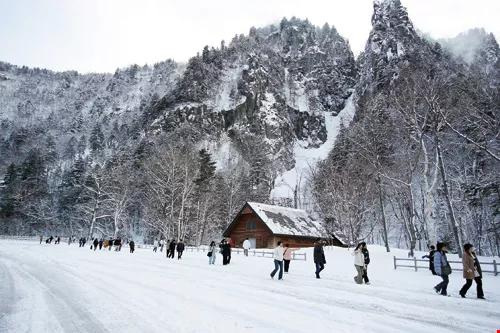
Working at a ski resort in Japan allows you to get your fill of exquisite scenery and skiing. It's an excellent working holiday job choice. The photo shows a snowy landscape in Hokkaido, Japan.
The privilege of youth
As implied by the name, "working holidays" allow tourists to earn money for their travel expenditures and their daily needs while traveling. In other words, it lets them work hard, so they can play hard. This innovative method of traveling was pioneered in Australia in 1975 primarily to encourage young people on a shoestring to see the world.
Countries normally issue visas good for a year, during which time applicants can work and travel restriction free-no need to apply for work permits and nobody getting on your back about how many hours a day you work and how many you play.
Awesome and flexible, these visas are only available to people aged 18-30 (or up to 35 in some nation) and in principle, you are only permitted to apply once per country.
Twenty-six nations in the world, including Taiwan, have entered into reciprocal agreements that permit foreign youngsters to work while traveling in their countries. The more popular travel is to a nation and the more importance its people attach to cultivating its young, the more that country tends to open up its doors to programs of this sort. For example, the Aussies, who initiated the whole idea, have signed working holiday agreements with 23 other countries, Japan has signed with 10, and Singapore with eight.
Taiwan, which only jumped on the bandwagon in 2004, presently has agreements with New Zealand, Australia, and Japan. Last year, 3,000 people applied for New Zealand which only offers 600 slots each year. In the end, lucky winners had to be decided by drawing lots.
Japan, which will start accepting youngsters from Taiwan on June 1, only plans to open up 2,000 slots the first year. Due to its closeness to Taiwan in terms of both geography and ties, Japan's program is expected to stir up a frenzy with more than 10,000 youngsters signing up.
Australia is the only country that doesn't place a cap on applicant numbers. According to Tourism Australia statistics, 6,100 young people from Taiwan took advantage of Australia's working holiday program between July 2007 and June 2008, behind only Japan and South Korea in Asia.
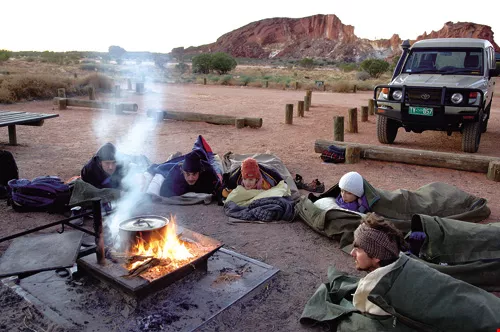
Christine slept in a "swag," commonly used by shepherds in Australia, for the first time when camping in Rainbow Valley at the national park. You slip your sleeping bag into the swag which has a canvas exterior sack with a soft pad inside. It was a novel experience for her.
Life on the farm
Taiwan backpackers agree that farm jobs are the easiest to find in the large, sparsely populated countries of Australia and New Zealand and require the least in terms of language skills. "You just need to go to some of the bigger youth hostels or other places that backpackers congregate in the country that you want to work and keep your ears open. You should have no problem finding out which farms are hiring," explains Lin Houyu, who returned to Taiwan from Australia at the end of November 2008.
Lin Houyu worked on farms near Perth in Western Australia and on the island of Tasmania off the southeast coast. She smiles as she explains that she helped in the production of some of the country's major crops, like cherries, grapes, apples, tangerines, and cauliflower.
It might sound romantic-working on a farm surrounded by idyllic beauty-but it's anything but easy. Lin, for example, almost got sunstroke after picking fruit for eight hours under the blazing summer sun in 40°C temperatures, and after bending over all day to cut cauliflower, she couldn't straighten up after returning to her hostel.
Labor costs in Australia, however, are very high and farm jobs like these that depend on physical labor pay some A$15-16 an hour (about NT$360-380). Working for a year, therefore, Lin made somewhere in the neighborhood of NT$500-600,000. After living and travel expenses in Australia, she still had enough money left to take a trip to Bali, Indonesia before returning to Taiwan.
Born to a farming family of modest means in Ilan, Lin admits that her family wouldn't have been able to support her financially to realize her dream of either studying or living abroad, but the working holiday program helped her do it under her own steam. "While working on the farms, not only did I make a ton of good friends from around the world, when I got back to Taiwan, I landed a contract job helping to run the National Youth Commission's Youth Travel in Taiwan website. I benefited in so many ways from my experience abroad."
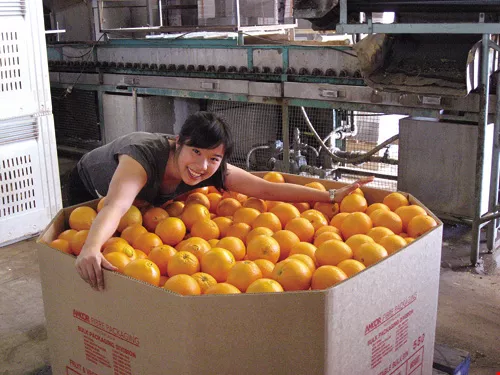
Lin Houyu also worked in a citrus fruit packing plant in Victoria. She says with a grin that it's much easier working in a factory "putting clothes on fruit" than working outside in the elements.
Model traveler
Besides being farm hands, other jobs many Taiwanese have done include sales clerks and servers in restaurants. Christine, who worked in Australia from 2005 to 2006, had the opportunity to work as a backpacker model and saw free of charge Uluru, the huge red sandstone formation also known as Ayers Rock and considered "the center of the world."
Christine recalls that while working in a bookstore in Perth, she happened to learn that Tourism Australia-Northern Territory was looking for a few "young, good-looking, daring backpackers" to take part in photo shoots at scenic spots, like Uluru-Kata Tjuta National Park and Alice Springs, to promote tourism.
As soon as she saw the job included not only room and board, but also free airplane tickets and cash, Christine sent in an application. See also mailed in a few photographs of herself that she felt did her justice. "At the time, Zhang Ziyi was really big in Australia, so I added a comment in my application that I had a sweet smile just like Zhang Ziyi," she explains with a laugh.
After being selected, she spent a week having a good time gratis in the Northern Territory. She later hitched rides with other foreign backpackers that she met along the way to places like Darwin in the far north, Broome and Perth in Western Australia, then down to Adelaide in South Australia, and finally to Sydney in the east by way of Melbourne and Canberra.
To make money and to cut down on costs during her 10,000-plus kilometer trek, Christine worked as a waitress and even cleaned a hostel's toilets for two weeks in exchange for accommodations. "Looking back on it now, I didn't feel it was hard at all, because I got an in-depth view of Australia's vast red deserts, witnessed crocodiles fighting over prey in a national park, and celebrated my 30th birthday under the majesty of the Milky Way. I will treasure these memories my entire life."
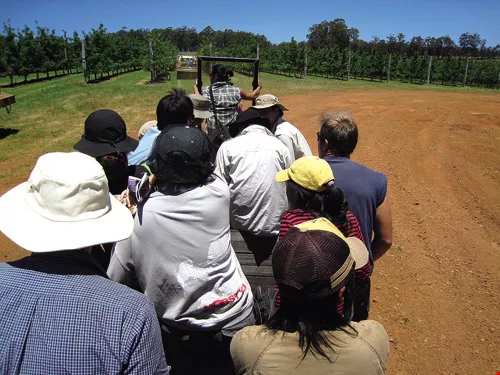
While working in apple orchards in Western Australia, Lin Houyu rode a tractor to work every day with fellow backpackers from around the world.
An attitude that works
Japan, which is just opening to Taiwan applicants, is much more urbanized and offers more diversity in terms of jobs than either New Zealand or Australia. Ariwang (an online moniker that roughly translates as "King of Japan") has lived and studied in Japan. During his seven years in Tokyo, he had a number of short-term jobs, including making business plans for a publishing house, working as a convenience store clerk, directing traffic at night, and service station attendant.
Aspiring young applicants for Japan's working holiday program can either look for jobs through the Japan Association for Working Holiday Makers (JAWHM), an officially recognized nonprofit organization, or as Ariwang points out, they can flip through free magazines, available at major bus and railway stations around the country, showing local work opportunities. With a little bit of effort, it shouldn't be hard to find a suitable job.
He also suggests, however, that young people who want to take advantage of the working holiday program "should first think about what their objectives for working in Japan are."
Ariwang says if it's to earn as much money in as little time as possible to do some traveling, males can consider grave-shift jobs like his when he worked at a filling station in Roppongi, an area with a thriving nightlife. The hourly pay for the night shift topped ¥3,000 (about NT$1,100). (That's where he met the renowned Japanese film star Takako Matsu.) If your goal, however, is a more leisurely paced life that allows you to experience Japan and its people more in depth, you might consider opportunities in scenic areas around the country.
"Take a skiing enthusiast friend of mine, for instance. He looks for work at large ski resorts every winter, so that he can make money and ski for free. What can I say? He works hard and plays hard," Ariwang explains.
When studying for his doctorate at Kyushu University, Luo Jili, assistant professor in the Soochow University Department of Japanese, had a short-term job providing airport pick-up services for an airline. He suggests that young people who go to Japan on a working holiday program learn from the Japanese in the workplace-the way they speak with others, their sense of propriety, their methodical and conscientious attitude.
He shares an example. One time, he felt it would be too much of a hassle to explain clearly how to get to Huis Ten Bosch (a famous theme park in Kyushu), despite the fact that his company required that he do so for customers who had purchased tickets for self-paced tours. As a result, the customers took the wrong bus and not only did they get lost, it delayed the latter half of their trip. "After being raked over the coals, I never again dared to slack off. I have never forgotten the lesson I learned that day."
Language skills key
Working holidays boast a plethora of benefits, but bad experiences of youths working in Australia have also been making their way into the news lately. Complaints include the high living costs and that many find job hunting harder than expected. Young people often discover they have burned through their savings before they have found a job."
In order to prevent this kind of disaster, Christine, our working holiday model from Australia, suggests that young people that want to take advantage of similar programs do their homework before setting out. They need to familiarize themselves with the local conditions, social customs, and the people of their target country as well as study information they'll need to live and work there. When you arrive, you'll need to make friends with young people from other countries also living there to learn helpful information that you can best get from other backpackers, information that will help you land the kind of job you want.
Ariwang points out that most countries don't place any requirements on language skills of applicants, but in Japan, for example, if you don't speak Japanese it's very difficult to live there, much less get a job. "If you can't even understand what a customer is ordering, how do you expect the owner of a restaurant to hire you?"
Ariwang also explains that they look for the same things in potential employees abroad as they do in Taiwan. Young people that are positive, enterprising, and who speak the language well usually find they have more job opportunities. "The real key is still your personal competitiveness."
Because of the flexibility that they offer to potential travelers, working holiday programs have been embraced by young people the world over. They are obviously not perfect, but unhappy experiences also help us to learn and grow. Doing everything in your power to prepare before setting out is the best way to ensure that you really enjoy both your work and your play during your working holiday.


