Protected by the Ancestral Spirits--Tsao Ming-sheng
Sam Ju Li-chyun / photos Jimmy Lin / tr. by Geof Aberhart
November 2008


About 90 years ago, the leader of the tribal community of Ssulin in what is today Pingtung County's Mutan Township led his people in bravely resisting the occupying Japanese forces. While they ultimately lost their fight, this brave Paiwan leader and his people nonetheless went down in history for their courageous actions.
Decades after the resistance, the grandson of that leader, Tsao Ming-sheng, would become Taiwan's second Aboriginal general. It may have been that this was his destiny, as he bears the same Aboriginal name as his great-grandfather-Bakalefa Rulong-and similarly shows the characteristic warrior spirit of the Paiwan.
By the strictest definition-being born to parents who are both Aboriginal-there have only been two truly Aboriginal generals in the Republic of China military, making them a tiny minority in the higher ranks. The first of these generals was Major General Kao Wei-ho of the ROC Air Force, who retired in 1991 and was unfortunately killed in a traffic accident five years later. The other is Major General Tsao Ming-sheng of the ROC Army, promoted to the rank in 2003 and Taiwan's first Aboriginal military leader to have started out in the combat forces. Tsao retired last year, and currently serves as general manager of Hsin Hsin Biotechnology Company, a joint venture between the Veterans Affairs Commission and the private sector.
On the day we interviewed Major General Tsao, he was a blur of activity, one moment sharing tea with guests and the next discussing with colleagues the purchasing of food processing materials, all while still finding time to go between floors shuttling documents, handling all his duties personally. Aside from his tan, there is virtually no outward sign that this is the same man that once stood in the field commanding troops, nor any indication of his commanding military demeanor. Today this short, slightly chubby man in his late 40s looks every inch the businessman.
On his computer, Tsao shows us a film he and his subordinates cut together in the military entitled The Story of Bakalefa, which documents his 30 years' experience as an Aborigine in Taiwan's army.
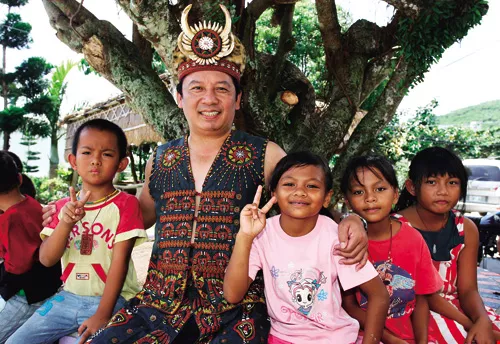
A group of Paiwan youngsters gather around Tsao Ming-sheng to hear his tales of his days in the army.
A family of leaders
Bakalefa is Tsao's Aboriginal family name, and belongs to one of the two leading families of the tribal village of Ssulin, in Pingtung County's Mutan Township. This village sits beside the Kangkou River, protected by their ancestral totem-a hundred-pace viper-and the gods of Mt. Ssulinko. Tsao is the hereditary leader of the village, and has written a vibrant, up-beat song in honor of his family called "Song of the Bakalefa." In his clear, bright singing voice, he sings a few lines describing the traditional personality of his family:
"Upright, diligent, sincere to all / Our children and grandchildren stand proud / As our family spreads far and wide / I ya naruwan...."
Born in 1959, Tsao was the second oldest of four children. Like most Aboriginal children, he accompanied his parents as they worked the fields and went into the mountains to chop firewood, and despite being a family of six and having to work hard to get by, they lived relatively well by village standards.
As a student at Mulin Elementary and Mutan Junior High, Tsao was one of the top ten students in his class, and he eventually tested into the nearby Provincial Hengchun Senior High. Having a student test into a provincial high school was regarded as quite the achievement in Aboriginal villages, and the families of Ssulin Village prepared a feast in honor of Tsao's success.
Tsao kept up his strong academic performance at senior high school, with his teachers expecting him to go on to a good college, and Tsao himself dreamed of the day he would become a freshman at college. Before 12th grade, the idea of going to military school had never even entered his mind.
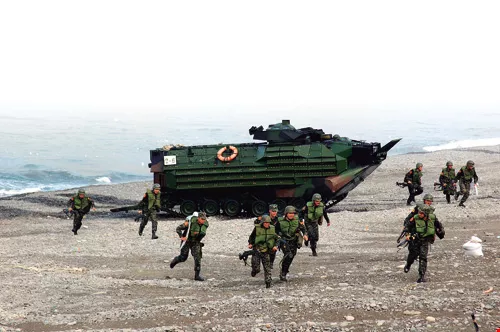
At the time of the 1996 Chinese missile tests in the Taiwan Strait, Tsao Ming-sheng was stationed on the front lines, the Kinmen-Matsu area. The troops under his command drilled hard in preparation to respond to any invasion attempt.
Plowshares to swords
When Tsao Ming-huei, three years older than Tsao Ming-sheng, got into Tamkang University, the younger Tsao only became more excited to go to college. But after starting 12th grade, something else besides good grades began worrying him:
"It's costing nearly NT$100,000 a semester in fees and tuition for my brother to go to college, and my family can barely handle that as it is. If I too go to a private college too, where on Earth will Mom and Dad find the money?"
At that time no-one from the village had ever gone to officer training school, although a handful of junior-high graduates had gone into the military at a lower level. While Tsao was busy preparing for the college entrance exams and worrying about money, the ROC Military Academy in Fengshan, Kaohsiung, sent people to Hengchun Senior High looking to recruit. It was then that Tsao discovered that not only did students of the academy not have to pay tuition, accommodation, or other fees, they also got a monthly stipend and a college diploma.
After a few days' thought, Tsao decided to try for a place at the academy. "My parents were reluctant to let me go, since they thought that the academy might be too harsh for a kid in his late teens, but they stayed positive and respected my decision," he says.
In 1977 Tsao successfully tested into the ROC Military Academy, earning a stipend each month ranging from NT$800 to NT$3,000, rising by year of study, markedly lower than the NT$5,000 monthly paycheck an elementary school teacher could expect. "Today a volunteer serviceman can make a good NT$30,000 a month, which would be enough to feed a family back in the village," says Tsao, who continues to encourage Aboriginal youth to consider enrolling at the academy.
After graduating, Tsao's outstanding grades saw him accepted into the academy faculty as an educational squad leader, marking the beginning of an illustrious military career.
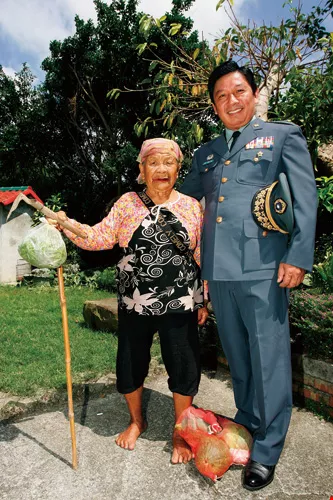
Returning to his home with the rank of major general, Tsao Ming-sheng nonetheless doffed his cap and greeted his elders with traditional Paiwan respect.
Marshalling the troops
In 1979 Tsao was dispatched to Kinmen to serve as a platoon leader and head of the "Invincibles," a squad of troops specializing in hand-to-hand combat and small arms. In 1990 he was accepted to a graduate program in the Army Command and General Staff College at Armed Forces University, returning to Kinmen the following year as a brigade commander. Later, in 1995, he took up work at the Kinmen Defense Command as head of the operations section.
During the 1996 Taiwan Strait Crisis, when the Chinese conducted missile tests in the Taiwan Strait with missiles landing in Taiwanese waters off Kaohsiung and Keelung, concerns grew that China's People's Liberation Army might raise troops to take one of the ROC's outlying islands. With people on Taiwan proper worried about the possibility of military escalation, many chose to leave the country, either temporarily or permanently. According to the Directorate-General of Budget, Accounting and Statistics, the number of Taiwanese that left Taiwan in 1996 was 119,144, a substantial increase over the combined 1994-1995 total of 111,494.
Tsao, at the time serving at the Kinmen Defense Command, was tasked with planning for a possible Chinese attack on Kinmen, Matsu, Tatan, or Erhtan, and with leading exercises in preparation for such an attack in order to shore up Taiwan's front lines.
"During those exercises the troops on the front lines went without sleep for days at a time," recalls Tsao. With military tensions at a peak, many high-level military officers ended up collapsing with fatigue and being put on IV drips, but thanks to his hardy Aboriginal constitution Tsao was able to persevere, keeping his head clear and his will strong. This let him lead his troops calmly, and even helped calm the nerves of the men at the front.
More importantly, says Tsao, the willingness to die protecting their homeland is something that flows in the blood of Taiwan's Aboriginal peoples, as demonstrated by the anti-Japanese resistance movements in Mutan and Wushe. When others may turn tail and run, the Aborigines will stand firm and unwavering. "Taiwan is the only home we Aborigines have ever had; if we didn't defend it to the death, where else would we have to go?" Tsao says proudly.
Climbing the ranks
Until 1998 Tsao spent his days shuttling between Kinmen and Taiwan, climbing from platoon leader to company leader, battalion leader, and eventually brigade leader. Finally, on New Year's Day 2003, he was promoted to major general. The next day he returned to his home village as the local boy made good, and again the tribe threw a feast in his honor. Swapping his uniform for traditional Paiwan dress, he sat with the villagers eating and drinking, his glory also the village's glory.
From his start as a second lieutenant all the way to sporting the single star of a major general, Tsao's professional career was never impacted by his ethnicity, although privately his comrades would inevitably bring up the differences. Tsao explains, "We were a bunch of kids who'd come together in the military from different backgrounds, and we'd joke around to let off steam. They'd call me 'savage' and 'mountain man,' and I'd call them 'old man Shandong' and 'my buddy from Jiangxi.' It was all in fun on all sides, though."
As Tsao says, since circumstances can be difficult in the military, people from all backgrounds-not just Aborigines-can end up dropping out of training or getting an early discharge. "We Aborigines have a good constitution, meaning we can handle the tough training better," he says, recalling how in his early days at the academy they had daily five-kilometer runs, which he found easy and would do in one shot. He would look back to see his non-Aboriginal comrades stumbling and gagging, and he felt complete sympathy for them.
Fatherly leadership
While Tsao was in the academy, his parents were at home worried he would end up injured or that something would happen to him, so they often visited him at the school. Years later, Tsao would bring the same empathy to his leadership roles. Around 1991, when he was leading the Houlung Coastal Defense Battalion in Miaoli County, Tsao received a wire alerting him that a young man on his national service had passed out from fatigue while on patrol next to a train track, got hit by a train, and hadn't got up. Tsao rushed to the scene to find the young man lying unconscious with his abdomen split open.
"I held him as we sat in a jeep rushing to the hospital, pressing down hard on his belly for the half-hour trip. Both of my hands were covered in blood," says Tsao, his voice showing an almost fatherly concern.
Six months later, those same two hands handed over a discharge to that same soldier he had rescued. "Whatever doesn't kill us makes us stronger," Tsao said to the young man, congratulating him on his new life as the soldier's eyes teared up and he repeatedly expressed his gratitude.
Since retiring last year, with the help of the Veterans' Affairs Commission Tsao has served as general manager at Hsin Hsin Biotechnology. He has had to teach himself about food technology and business management, and his office is simply furnished, with just a desk, a computer, a few chairs, and row upon row of books on various subjects.
Because he works away from home, Tsao only has the chance to go back to his village and family in Pingtung on weekends. His eldest daughter, Wei-ling, is a student at China Medical University, while his youngest, Wei-ting, is at junior high school. Will he encourage his beloved daughters to follow his footsteps into the military? "I'll respect whatever decision they make," he says, ever the honorable leader.


