Chen Yi-tsung --Bringing Traditional Designs into Everyday Life
Ventine Tsai / photos Hsueh Chi-kuang / tr. by Robert Taylor
January 1995


Taking motifs copied from traditional buildings, such as bottle gourds, persimmons, juyi scepters, chime stones or fish, and applying them to objects of everyday use, is "Life Group" leader Chen Yi-tsung's way of wishing everyone health, wealth and happiness.
In the entry to Chen Yi-tsung's tiny flat in Nankang, a window lattice hung up as screen prevents visitors running slap-bang into their host. On a wooden bookcase beside the doorway an inkpot serves as a name card holder, and a chopstick box as a letter tidy. On top of the TV set, a mirror made out of an ancestral spirit tablet catches one's eye.

Fingered citron--sounds like "happiness and longevity" Bottle gourd--sounds like "happiness and wealth" Pomegranate--many sons and grandsons, prosperous descendants Peach--longevity Happiness and wealth in equal measure Prosperous descendants (courtesy of Chen Yi-tsung)
Easy to use
Sitting down for a cup of tea, the pair of pale blue cups are imprinted with the characters fu kui ("riches and honor") in sapphire blue. These auspicious characters are superimposed on the stylized images of an incense burner, which symbolizes inheritance from one generation to the next, and of a juyi scepter. Looking closely at the wooden box in which cakes and biscuits are served, we see that it is made up from the shapes of four kinds of fruit: a bottle gourd (its Chinese name hulu sounds similar to fulu, meaning "happiness and wealth"), a fingered citron (foshou, which sounds like fu shou, "happiness and longevity"), a peach (symbolizing longevity), and a pomegranate (its many seeds being synonymous with "many sons"). The lid is carved with decorative images with the same meanings. These items of everyday use, adorned with traditional auspicious motifs, were all designed and made by Chen Yi-tsung and his like-minded friends, who call themselves the "Traditional Forms In Everyday Life Group."
"Traditional designs really are so easy to use," says Chen Yi-tsung. Like a peddlar showing his wares, he whips out red money envelopes, paper amulets to be hung over doorways, spring couplets, tea cloths, neckties and notebooks made by members of the group, followed by a lacquerware tea tray, fired clay pencil cups and necklaces. These objects are not simply intended to delight the eye, but all have real practical uses. What is most special about them is that every one is embellished with traditional propitious designs, especially ornamental motifs taken from traditional architecture. After analyzing their structure, Chen Yi-tsung has recombined and remodelled these images to make them suitable for everyday use, thus bringing an expression of hope into our harried existence.
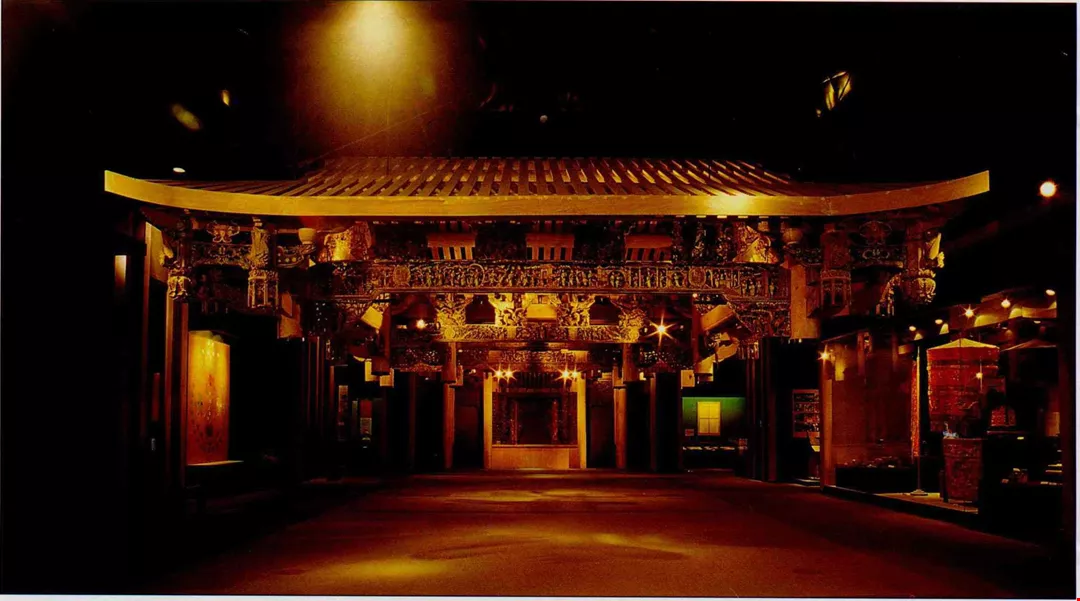
Wanfukung Temple has been reassembled and set up as a hanging display in Taichung's National Museum of Natural Science. The inappropriate way the temple was demolished made the reassembly a difficult job, and completing it was the most important challenge in Chen Yi-tsung's life. (photos by Chen Yi-tsung)
Spellbound by temples
Apart from the objects our host is just "showing off," there is something else which testifies to the effort which Chen Yi-tsung has devoted in recent years to breathing new life into traditional designs. The nearly 10,000 slide photographs which he keeps in a dampproof metal cabinet are the expression of a 14-year love affair with traditional architecture.
Fourteen years ago, at the age of 17, Chen Yi-tsung had just graduated from an architecture course at a technical senior high school. As luck would have it, he found a job at Han-kwang architects' office--the first architectural practice within the ROC to carry out restoration of ancient monuments and to incorporate the spirit of traditional architecture in modern buildings.
Contrary to what one might think, his technical college education had given him no knowledge whatsoever of traditional architecture. "When my colleagues talked about swallowtail ridges, toukung [a system of blocks and curved brackets used to support beams] and tiaot'ung [decorative lanternshaped carvings suspended below the eaves], it was all Greek to me," says Chen Yi-tsung. So he set to work, not only seeking out what few materials were available at the time, but also using his spare time to look closely at any temple he caught sight of, and take photographs of traditional houses wherever he went. Every day he also carefully drafted scale drawings of traditional buildings with a fineliner. Pen stroke by pen stroke, he soon acquired a detailed knowledge both of traditional buildings' wooden structural framework and of their decorative detail. And the ornamental details found in traditional architecture aroused a love in him which has lasted to this day.
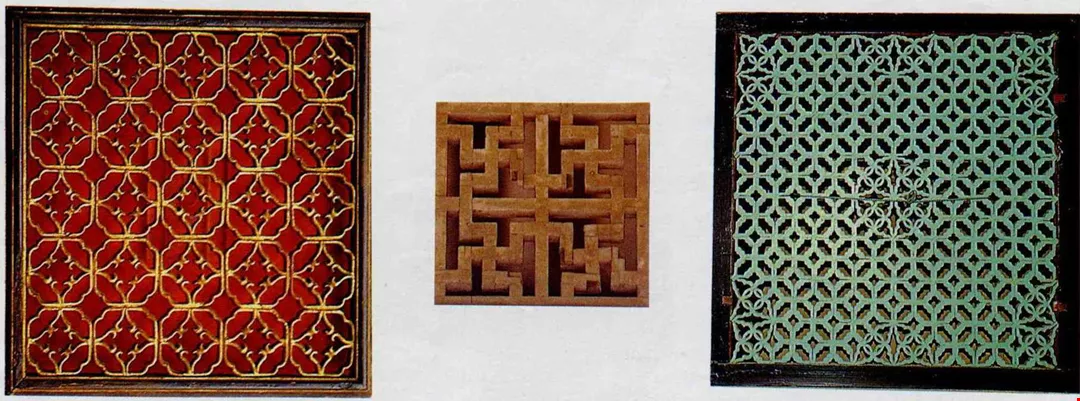
Auspicious motifs used in traditional buildings' window lattices: a persimmon pattern, a swastika pattern and a coin-and-bottle-gourd pattern. (photos by Chen Yi-tsung)
The magic is in the detail
Chen has travelled all over Taiwan and southern Fujian looking at traditional buildings, but his favorite is Chaihsing Villa in Tantsu Rural Township, Taichung County. Its carved wood, chiachishao (decorative lead-glaze ceramics) and carved brick-clay tiles are all superb. Bringing out pictures of Chaihsing Villa, he describes at length the subtleties of every detail. For instance, running along a side wall is a perch for birds to rest on, which not only embodies our ancestors' love of all living things, but also puts a "belt" across the large expanse of wall, adding to the sense of stability which the house imparts. And in the corners where the perch ends, the builders did not simply leave it at that, but finished them off in tiles carved with dragons and juyi shapes inside bottle gourd patterns, to repel evil and attract good luck.
"Its the effort that goes into those finishing touches which is the most captivating thing about traditional architecture," says Chen Yi-tsung. He explains that whenever the craftsmen came to a corner or a joint in the structure, they would use all their skill to disguise it with a decorative feature. Furthermore, every house built had to stand comparison with those around it, so not one window or motif was exactly the same as another.
In his eight years with Han-kwang, Chen was involved in the construction of such Chinese-style modern buildings as the Kenting Youth Activity Center, which imitates the style of southern Fujian, the Institute of Ethnology building at Academia Sinica in Taipei, and the Lienyuan activity center. He also took part in the restoration of Yuanching Temple in Changhua, Lungshan Temple in Lukang, and the Confucian temple in Tainan. Leaving behind his drawing board in the office and going to supervise work on site, he would even sleep in the temples at night. This gave him a rare depth of practical experience in addition to the knowledge he had gleaned from studying traditional architecture.
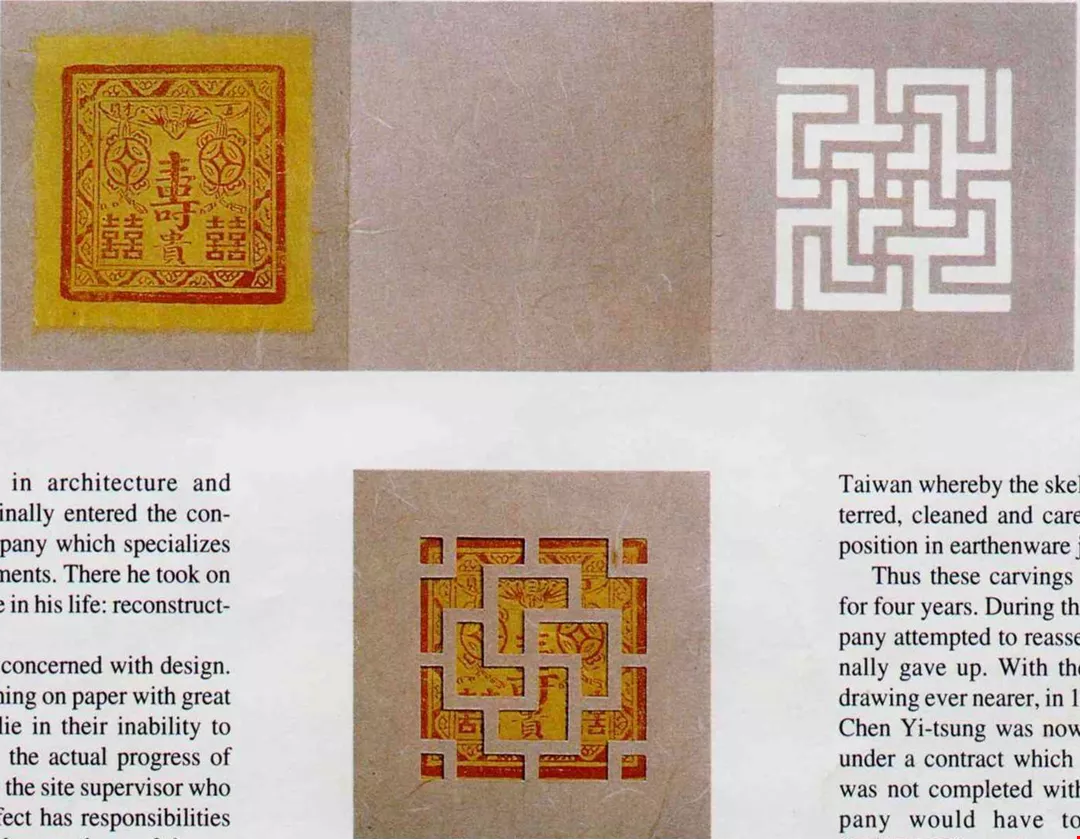
A greetings card design composed from a folk print and a swastika pattern from a window lattice.
His greatest challenge
After leaving the architectural firm, Chen Yi-tsung took part in the restoration of Penghu's Tienhoukung Temple, a Grade 1 national monument, by National Taiwan University architecture department's Graduate Institute of Building and Planning. Despite having only a senior high school education, he became an assistant research fellow at the school.
"Although Chen Yi-tsung only has a technical high school education, his rich practical experience in the preservation of ancient monuments is something which is sorely lacking in the academic world," says the Institute's Professor Chu-Joe Hsia. But because of academic institutions' insistence on formal qualifications, Chen Yi-tsung could only be employed by the Institute on a special short-term contract. Professor Hsia feels that this is a real loss for monument conservation.
Going from the world of design to the world of scholarship, Chen Yi-tsung began to interpret traditional architecture in more ways and with even greater rigor. With a mastery born of experience, he spent several months systematically recording and individually referencing over 3500 features of Tienhoukung Temple’s structure, from large items such as beams and doors to small ones such as plaques and the corbels supporting them. "If the temple were dismantled tomorrow, I'm perfectly sure I could reassemble it," he says with confidence. And this work was of great assistance to him in the next major task he was to undertake.
After having worked in architecture and academia, Chen Yi-tsung finally entered the construction industry, in a company which specializes in renovating ancient monuments. There he took on the most important challenge in his life: reconstructing Wanfukung Temple.
Most architects are only concerned with design. They can orchestrate everything on paper with great skill, but their limitations lie in their inability to foresee problems arising in the actual progress of the work. On the other hand, the site supervisor who has to put the plans into effect has responsibilities and experience which complement those of the architect. The traditional old master builders may have possessed both skills, but most of them have already passed away. In an age of fine division of labor, specialists in all areas of the construction industry, however proficient, are only experts in their own fields. "The great thing about Yi-tsung is that he not only knows all about design, but is capable of overseeing work too, and he has also examined, dismantled and renovated many traditional buildings," says Shih Chen-yang, who often discusses such issues with Chen Yi-tsung. Shih Chen-yang, the youngest-ever winner of the arts and crafts category prize in the Ministry of Education's "Hsinchuan" awards for the transmission of traditional folk arts, specializes in wood carvings for traditional buildings. Shih also says that although Chen Yi-tsung is still young, he started early and worked hard, and after looking at traditional buildings all over Taiwan, spent two months on his own recording traditional dwellings in southern Fujian; thus his experience is not inferior to that of the old master builders.
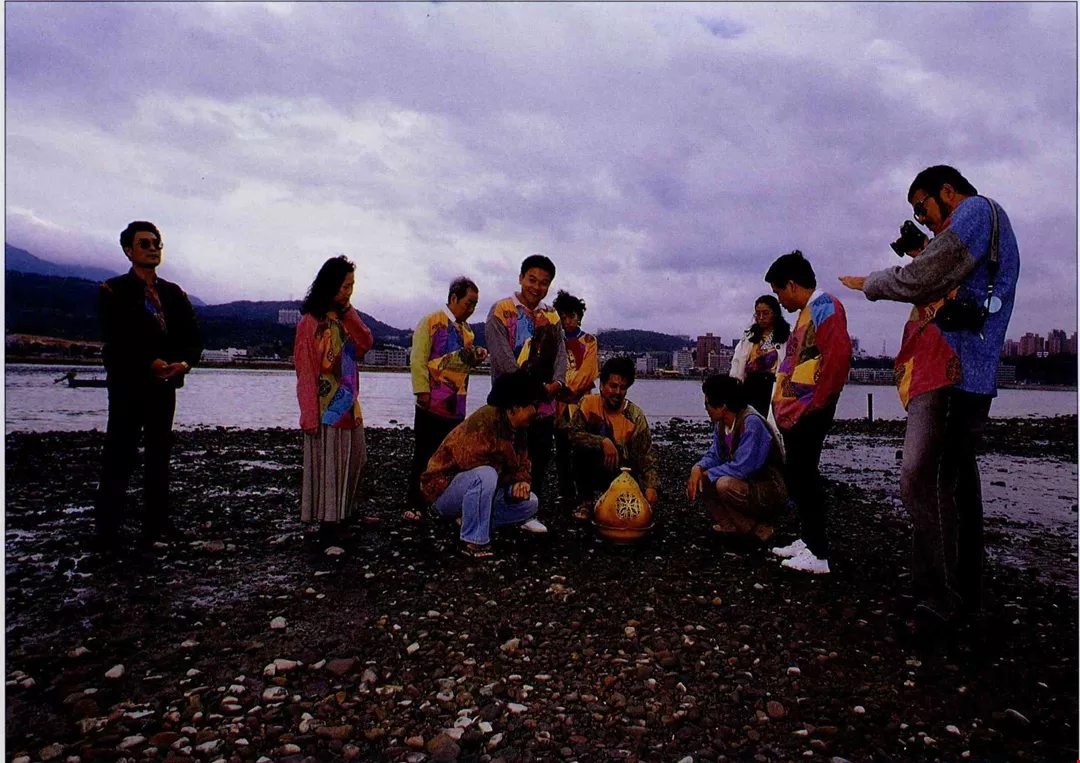
In answer to Chen Yi-tsung's call, professionals from a wide variety of fields have come together to design and make objects which bring traditional motifs into daily life.
A case without clues
Wanfukung Temple, which is now on display in the "Spiritual Life of the Chinese" section of the National Museum of Natural Science in Taichung, originally stood in Kaohsiung County's Chiehting Rural Township. According to inscriptions on plaques from the temple, it was first built over a century ago in the reign of the Ching dynasty emperor Kuang-hsu (ruled 1874-1908), but the last major rebuilding was in 1962.
In 1988 the temple's management committee decided to tear down the existing structure and build a larger temple. The demolition workers used mechanical excavators to reduce this temple, with its fine carvings, to rubble. Without regard to how they were fitted together, they cut the best carvings out with electric saws and sold them to an antique dealer. Six months later these carvings were bought up as a job lot by the Museum of Natural Science, with the intention of reassembling them for display in its hall devoted to Chinese people's world view and their religious beliefs and practices.
This is when the problems began. Firstly, when the temple was demolished, the parts were sold off cheap as scrap material, and the demolition was done extremely roughly. The exquisitely carved spirit niche was cut in half, and large wooden structural elements without carvings, such as beams and columns, were thrown away altogether. There was certainly no attempt to record or reference the components. Apart from this jumbled mass of carved wood itself, the only source of clues was a video tape filmed by an antique dealer. There was no chance at all of fulfilling the two great principles of renovating ancient monuments: referencing all the parts, and the same people being responsible for both dismantling and reassembly. "It was like a murder case without a body," describes Shih Chen-yang. Wang Chiu-piao, a carpenter who took part in reassembling Wanfukung Temple, says with a laugh that the "spine" was all gone, leaving only a few small "bones." "It was harder than arranging ancestral bones [a custom in Fujian, Guangdong and Taiwan whereby the skeletons of the dead are disinterred, cleaned and carefully arranged in a seated position in earthenware jars]."
Thus these carvings languished at the museum for four years. During this time a construction company attempted to reassemble parts of them, but finally gave up. With the Museum's opening date drawing ever nearer, in 1992 the company for which Chen Yi-tsung was now working took on the job, under a contract which stipulated that if the work was not completed within four months, the company would have to pay an indemnity of NT$150,000 per day.
Not just a jigsaw puzzle
In the end Wanfukung Temple was reassembled from some 2000 pieces, of which 60% were newly made. The first step in the process was to calculate the dimensions of the missing parts on the basis of the surviving fragments. Then full-size mock-ups were made from plywood and reassembly attempted. Only when this trial assembly was successfully completed did the craftsmen carve the replacement pieces from good timber and carry out the final reassembly.
Chen Yi-tsung felt that the most difficult part was judging the length, breadth and thickness of the nearly 1000 newly made pieces. Any errors in calculating these dimensions would not only mean that they would not fit together with the original parts, but would also create a difference in the roof inclinations of the front halls and the main hall so that they would not join correctly either. And any mistakes in the trial assembly not only meant that the elements had to be manhandled apart and back together again using only simple trolleys (there was no room inside the hall to set up a crane), but also jeopardized the deadline for finishing the job, in which every minute counted. "Every night I would dream I saw those lumps of carved wood flying about in the air looking for their right places," says Chen Yi-tsung, describing the pressure he was under.
During the assembly process there was one phoenix-shaped toukung support which the craftsmen looked at for a long time but could still not figure out where it belonged. According to traditional architectural custom, such supports are always oriented front-to-back through the building, but exceptionally this one was oriented across the width of building. "If Yi-tsung hadn't known so much more than everybody else, we would never have figured it out," says Wang Chiu-piao. Relying on his wealth of knowledge of traditional architecture, and by examining the mortises and tenons by which the components were fitted together, the dust deposits on them and the shade to which they had been blackened by incense smoke, Chen Yi-tsung completed the reassembly of Wanfukung Temple from old and new parts on time within four months.
But Chen Yi-tsung says with some regret that there are two imperfections in the reconstruction of Wanfukung Temple. Firstly, there is an almost 10-centimeter mismatch in height between the innermost main hall, where people prayed, and the hall in front of it which housed an incense burner dedicated to the ruler of heaven. And secondly, because there was not time to season the wood for a long period, with the changes in humidity caused by the museum's air conditioning being turned on by day and off at night, the beams and columns are already starting to split. "If only we'd had a bit more time," says Chen Yi-tsung sadly.
A way of collecting without destroying
In over a decade of involvement with traditional architecture, Chen Yi-tsung has never lost his love of the detail and carved motifs of traditional buildings, but he has not amassed a houseful of antiques. "I don't collect things, I collect images," says Chen Yi-tsung. The reason is that collecting the items themselves indirectly leads to their destruction, by encouraging antique dealers to get hold of them by fair means or foul. In the past, when people went into traditional homes to take photographs, the owners would welcome them with open arms. But today most are none too willing to let strangers visit, for once word gets out, they may soon find themselves the victims of burglars who not only steal small pieces of the structure, but carry away whole doors or even their ancestors' spirit tablets. Owners have little choice but to surround the finer decorations with iron bars and gratings, or to refuse visitors altogether. This is the reason why in the three notebooks illustrated with sketches of traditional architectural motifs which Chen Yi-tsung has compiled and published, he does not indicate the source of every design.
In his collection of images, window lattices form the largest group, numbering over a thousand. In traditional architecture, window lattices serve to divide space and soften light, but what is most captivating about them is the variety and content of the motifs they incorporate. The traditional designs which decorate homes use homophony, symbolism and allusion to auspicious words. Common examples are bottle gourds, coins, swastikas and crisscross patterns, which can all be combined, broken down or reshaped. Through repetition, the basic motifs can be assembled into different, larger images. Just the swastika, which symbolizes eternal good fortune, can be combined in different ways to produce some 60 different patterns!
As well as variations on single patterns, different motifs can be combined together too. For instance, in a "four segments and bottle gourd" window lattice, the four segments of a persimmon together form a juyi scepter pattern, and on top of this is added a shape which turns the whole into a bottle gourd. The composite image can be read: "Four persimmons, juyi, bottle gourd, both complete," which by assonance means, "Everything as you would desire, happiness and wealth in equal abundance."
These richly decorated window lattices are all assembled with mortises and tenons. On the one hand this saves material, and on the other hand if the whole lattice were carved from a single piece of wood it would warp more easily. The mortised strips of wood are also much more flexible and much stronger.
In more than ten years of involvement with traditional architecture, Chen Yi-tsung has realized the rich creativity of folk art, and the sense of beauty and prayer which it brings to every aspect of daily life. This has prompted him to bring together good friends from various fields, and open up his chests and cabinets full of information and photographs, in the hope of turning these images from something which could only be looked at and studied, into things that can be used in people's everyday lives.
Coming from life, returning to life
Since October last year, Chen Yi-tsung has been rushing around like a delivery boy, taking materials to the studios of each member of the group, and collecting their products. Although these members' ages average only 35 years, most have 10 to 20 years' experience in their respective fields. Huang Sheng-chung, a sculptor from Yuanli in Miaoli County, has been carving wood for 22 years, and Yang Cheng-yung, a potter from Pali in Taipei County, has been working in ceramics for 15. Their aim is not to produce pieces that will be venerated as great works of art, but merely to act as a catalyst to spur on others with similar ideas--especially companies capable of mass production--for only this will achieve their goal of bringing traditional designs into everyday life.
For after all, traditional images were originally inseparable from daily life, whether they appear on the roofs of houses, in windows, on the cups, bowls, tables and chairs we use or even on the food we eat or the clothes we wear: a button knotted in a criss-cross pattern symbolizes a long life, wealth and rank, while the curve of a garment's shoulder is the perfect place to embroider a bottle gourd or applique a butterfly (symbolizing good luck).
"If we take those old artefacts home, they may not be usable or convenient, but our hopes in life are no different from those of people in days gone by," says group member Yang Cheng-yung. And what makes folk art so accessible is its origins in everyday life.
The late painter Hsi Te-chin, who was also a student of traditional architecture, once said: "It was China's traditional architecture which gave me a clear insight into the soul of the Chinese." What easier way could there be of appreciating our own culture than by communing with our ancestors' souls when putting on a piece of clothing or drinking a cup of tea?
[Picture Caption]
p.90
In his home, his clothes and the things he uses, Chen Yi-tsung's life is full of designs drawn from traditional architecture.
p.92
Fingered citron--sounds like "happiness and longevity"
Bottle gourd--sounds like "happiness and wealth"
Pomegranate--many sons and grandsons, prosperous descendants
Peach--longevity
Happiness and wealth in equal measure
Prosperous descendants
(courtesy of Chen Yi-tsung)
p.94
Wanfukung Temple has been reassembled and set up as a hanging display in Taichung's National Museum of Natural Science. The inappropriate way the temple was demolished made the reassembly a difficult job, and completing it was the most important challenge in Chen Yi-tsung's life. (photos by Chen Yi-tsung)
p.94
Auspicious motifs used in traditional buildings' window lattices: a persimmon pattern, a swastika pattern and a coin-and-bottle-gourd pattern. (photos by Chen Yi-tsung)
p.95
A greetings card design composed from a folk print and a swastika pattern from a window lattice.
p.96
In answer to Chen Yi-tsung's call, professionals from a wide variety of fields have come together to design and make objects which bring traditional motifs into daily life.


