DNA Fingerprinting Takes the Mystery Out of Family Lineage
Chang Chiung-fang / photos Yang Wen-ching / tr. by Minn Song
April 2006


In recent years, DNA fingerprinting has been used to solve mysteries that in the past would have gone unsolved--such as the identity of victims in disasters like plane crashes or the 911 terrorist attacks, or the identity of persons involved in various crimes. DNA fingerprinting has also been used to determine the validity of claims of blood relationships in inheritance disputes or in cases where someone born out of wedlock is seeking recognition as the biological offspring of his or her parents.
DNA, the secret code of life, records the origins, evolution, and transformations of life. Though our understanding of DNA remains quite limited, and the use of gene therapy in medicine has not yet come to fruition, DNA has been used in determining a person's identity--in particular to establish definitive answers to how two or more persons are related, eliminating much ambiguity and doubt.
But what in fact does DNA fingerprinting rely on for its results? What questions does this technology resolve? What dilemmas does it give rise to? The answers to these questions are worth seeking.
Last year, an extramarital affair of Koo Chen-fu, the late elder statesman of Taiwanese party politics and former chairman of the Straits Exchange Foundation, came to light. A mother and daughter surnamed Teng demanded recognition as immediate family, giving rise to a much-publicized controversy. With the two sides in the dispute refusing to yield their positions, DNA fingerprinting naturally became the key to determining whose claims were correct.
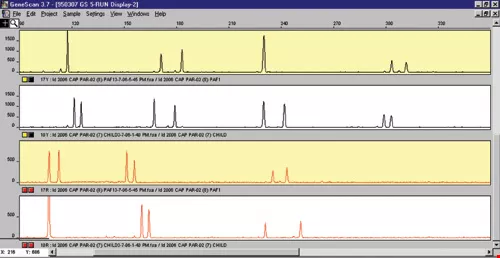
Using a technique called capillary electrophoresis, 13 to 15 loci are examined. Statistical analysis is performed to calculate the degree of familial relationship. If there are three or more loci where two DNA samples do not match, a familial relationship is excluded. The illustrations show comparisons of seven loci.
No faking it
It is indeed difficult to fake a DNA test, and a recent actual case reminds us that in human affairs it is never wise to believe that a passing ship leaves no wake. DNA can leave a record that is impossible to eradicate.
Newspapers reported the travails of a woman in her sixties who was not willing to recognize the illegitimate child of her deceased second son. In the court case to determine the child's parentage, she provided a DNA specimen from her first son to match against the child's, in an attempt to disprove a familial relationship. Convinced she was in right, the child's mother refused to accept the test result. Forensics experts from the Bureau of Investigation repeated the analysis using a cancer biopsy taken from the second son before his death. The new results showed that the child's father was indeed the woman's second son--and that her two sons had been fathered by different men, revealing an extramarital affair that the woman had had more than 30 years before.

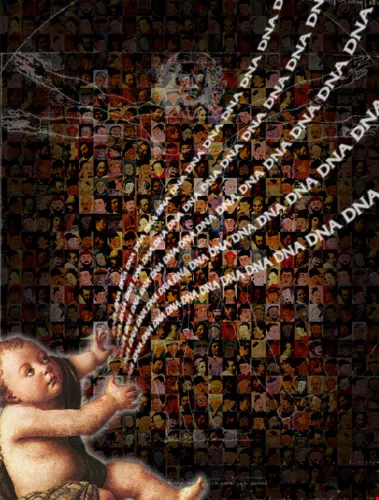
The depiction of a kirin delivering an infant, symbolizing good fortune, demonstrates the importance that Chinese traditionally place on sustaining a family lineage.
Blood thicker than water?
From ancient times, men have been bedeviled by doubts about whether they are truly the biological father of their own children. People who look very different from their siblings may develop their own doubts after constantly hearing friends and family remark about it. In fact, even a woman, if she has cheated on her spouse, may not be sure who the true father of her child is. Even after the mother has passed nine months of pregnancy and the agony of giving birth, there is no absolute assurance that after the infant was born it was not switched for another. Rumors that some prince was actually a peasant's child, or that Emperor Qianlong was of Han rather than Manchu descent, are grist to the mill of authors engrossed by royal intrigue.
The Song-dynasty forensics classic Witness to a Prosecution recorded a method for unraveling such mysteries: dripping the blood of children onto the skeletal remains for their parents, and using the ability of the blood to penetrate the bones as proof of a filial relationship.
Martial arts novels allude to another method for determining parentage--dripping the blood of two people into a bowl of water. If the blood blended together, this was taken to mean that the two had a familial relationship.
These tests using blood appear now to lack a scientific basis.
Consider the method of dripping blood into water. Taipei Veterans General Hospital (VGH) blood bank medical test technologist Liu Hsueh-mei points out that O-type blood contains both A and B type antigens, while B type blood contains both O and A type antigens. Dripping different types of blood into water will cause them to coalesce accordingly. But other than this, it is difficult to glean any further conclusions about the two people.
In fact, as early as 1935, doctors had begun using blood type to determine familial relationships. However, too many people have the same rheusus blood group for this method to be effective. For example, in Taiwan the most common blood type is O, possessed by 42% of the population--meaning more than one out of every three people--making it a poor tool for making the necessary distinctions. In addition, the discovery of the para-Bombay phenotype and other special blood types has created another blind spot for this method. In sum, using rhesus blood group to determine familial relationships can give erroneous results, and people have even been wrongly condemned on this account.
Tzeng Cheng-hwai, chief of the Section of Transfusion Medicine at Taipei VGH, points out that using blood type to determine parent/child relationships can only eliminate 60% of false claims (meaning that of every 100 "false" fathers, only 60 can be excluded).
In 1976, the human leukocyte antigens (HLA) test was introduced. Mutation rates in this polymorphous protein are quite high, allowing its accuracy to reach roughly 90%. However, for determining paternity, which demands certainty, HLA tests still leave something to be desired.
In the 1990s, DNA fingerprinting was adopted for use in paternity testing, resulting in the ability to correctly identify more than 99.99% of "false" fathers, making it virtually foolproof. Tzeng illustrates its accuracy by pointing out that if the fathers of everyone in Taiwan were not who they were supposed to be, the accuracy of DNA fingerprinting would mean only one person would not be ruled out.
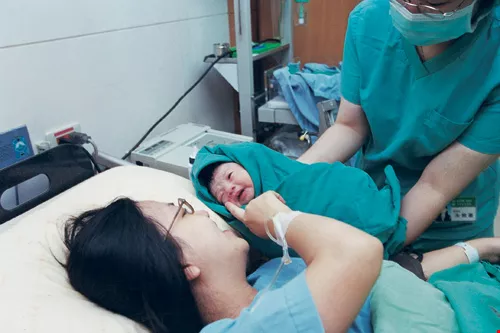
Having endured nine months of pregnancy and the agony of giving birth, a mother has a greater sense of certainty that the infant is hers than does a father, who is largely an outsider for everything that happens between conception and birth.
New technology for old purposes
It was not until 1999 that a law was passed to govern the collection of DNA specimens, with the law taking effect in 2000. However, before the law was passed, numerous medical facilities had already begun performing paternity tests due to the heavy demand.
Because a paternity test is not a medical procedure, it is not covered by the laws governing medical practice. However, to ensure the quality of testing and protect the rights of those tested, the Department of Health drafted a set of certification standards. Healthcare institutions and laboratories that meet these standards are not only eligible for subsidies from the DOH, but their test results have legal force.
Sixteen healthcare institutions have already been certified. These paternity testing outfits must not only possess equipment, personnel, and testing procedures that meet DOH standards, but they are restricted to obtaining DNA samples only from the requesting parties directly and in circumstances where their identities can be verified. An ethical code also applies, stipulating that the final results can only be reported to the persons tested, as it is strictly forbidden to reveal the result to a third party.
National Taiwan University Hospital, the first institution to offer genetic fingerprinting services, began accepting anonymous samples for testing seven years ago. At the time, anything that might provide a suitable DNA specimen--from toothbrushes and hair to toilet paper stained with bodily fluids--were submitted for DNA testing. There was even one man, suspecting that his wife was cheating on him, who brought in an entire bed quilt, demanding that all possible DNA specimens be collected from it. Su Yi-ning, a doctor in the Department of Genetic Medicine at NTUH, adds that at the time, the hospital simply provided test results to the anonymous test recipients, and not a formal report, so that these results carried no legal force.
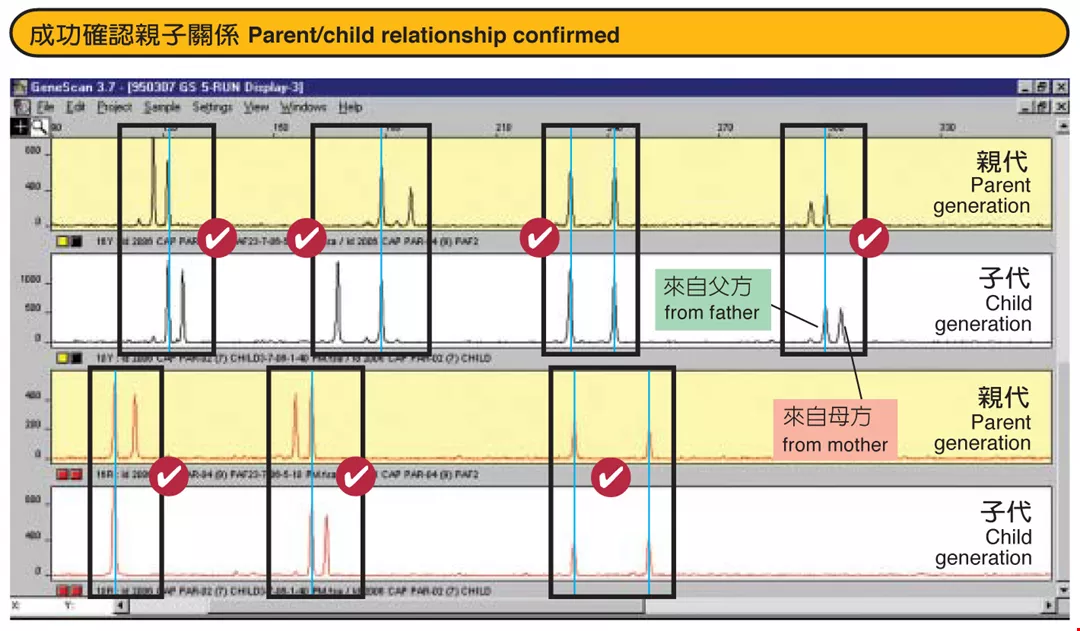
Using a technique called capillary electrophoresis, 13 to 15 loci are examined. Statistical analysis is performed to calculate the degree of familial relationship. If there are three or more loci where two DNA samples do not match, a familial relationship is excluded. The illustrations show comparisons of seven loci.
How much do we know?
How many men are being cuckolded? How many paternity tests are carried out each year in Taiwan? Exact figures that might answer these questions definitively are lacking, so that the only clue lies in the number of paternity tests carried out at a few medical institutions.
Su relates that NTUH handles an average of more than 400 paternity tests each year, the most of any institution in Taiwan. Taipei's VHG processes over 200 such tests a year. Tzeng Cheng-hwai points out that the volume of tests performed there peaked in 1999 and 2000, with 400 to 500 each year. In recent years, as the number of certified medical institutions has increased, the number of tests handled by individual institutions has declined.
However, it would be misleading to consider only the tests performed by these 16 certified medical institutions, as many unregulated laboratories can be found through the Internet. Because these laboratories accept test specimens submitted anonymously, to accommodate those wishing to conceal their identity, the volume of testing handled outside of official sanction must surely be even higher.
In fact, paternity testing is not used solely to assuage people's uncertainties. In some circumstances, such testing must be used to either demonstrate or promote one's legal rights.
Based on analysis of the cases sent to the Bureau of Investigation by the courts, the scenarios where paternity testing is required include: someone conceived out of wedlock making inheritance claims; grandparents wishing to claim guardianship of a child from the unwed mother when the father died before the child was born; mainland Chinese families seeking relatives in Taiwan; and applications for immigration.
There is also a special situation arising out of legal considerations--after a couple divorces, if the woman marries again and gives birth to a child before 302 days have elapsed, paternity testing must be carried out to verify the identity of the child's father. Otherwise, according to the law, the infant will be considered the child of the divorced man.
A woman surnamed Lai who found herself in just such circumstances explains that it was "extremely embarrassing." When the men went to the hospital to give samples for on-the-spot testing as agreed, the unease was acute for both the woman's former husband, who had to once again face the old anguish of his wife's cheating on him, and her current husband, who unexpectedly discovered he had a new burden to shoulder.
One in ten?
According to the figures of NTUH physician Su Yi-ning, 80% of the paternity tests performed at NTUH are requested to prove that children born outside Taiwan have the right to Taiwanese citizenship, 10% are required because the above 302-day waiting period was not observed, 5% are used to determine inheritance rights, and the remaining 5% are needed to confirm or deny a parent/child relationship.
Although concerns about being cuckolded are not the main factor behind paternity tests as sexual mores become more liberal, the occurrence of extramarital affairs and childbirth outside of marriage are on the rise. One can imagine that the demand for determinations of the genetic relationship between a parent and child will correspondingly increase.
The technique of DNA paternity testing has solved the complex problem of how people are related to each other. But might accurate testing reveal something unexpected?
The Gene Phile Bioscience Laboratory, headed by renowned ob/gyn specialist Ko Tsang-ming, has performed prenatal screening and genetic testing for many years, compiling statistics on genetic testing results.
Of the 699 man/child pairs tested for paternity by the lab, 74 (10.6%) proved not be genetically related. Of the 459 woman/child pairs tested, there were seven (1.5%) in which there was no genetic relationship. Such results may perhaps put some suspicious men somewhat more at ease. But the fact of a mother/child relationship could not be clearer, so why would a test be needed? In fact, many such "maternity" tests are done in cases where a child is born out of wedlock, or when there is no birth certificate, but the child must have proven parentage in order to be included in a household registration. As for the 1.5% of cases where maternity is excluded, most result from a male relative being claimed as a child in order to carry on the family line, or the child being given to someone else to raise. In such circumstances, if the child's ancestry is to be certified, a blood relationship to the guardian parents must be ruled out.
The results of tests requested in cases of extramarital affairs show that nearly 30% (28% to be exact) of presumptive fathers are not in fact the biological father. This result ought to alarm philandering men. And when results of paternity tests for children of marriages between Taiwanese businessmen and their mainland Chinese wives are scrutinized, 8.2% turn out not to be the biological offspring of these businessmen. In light of corresponding findings in Taiwan, this frequency still counts as "normal".
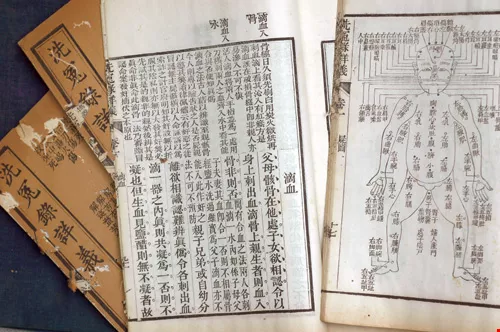
The Song-dynasty forensics classic Witness to a Prosecution describes the method of blood dripping that ancient Chinese used to identify relatives. Such a method does not meet modern scientific standards of rigor.
Paranoid about paternity?
In the five years she has been a medical technologist, VGH's Chen Pei-shan has seen through her paternity testing work the various paths that a human life can take.
"Most people who submit samples are wasting their money," says Chen. Quite a few married couples bring in a child for DNA testing after an argument, not only spending their money pointlessly, but also causing great harm to their marriage, and even to the relationship with their child.
When most people bring in a child to draw blood for a DNA test, they conceal the true purpose by saying that it is for a physical examination. However, there are those who recklessly call the child a "mutt," behavior that stuns Chen Pei-shan. "Whatever the test result, the harm done to the child by saying such things is irreparable," laments Chen. What right do people have to take their own grievances and burden their children with them, she asks.
However, some test results certainly will leave people at a loss, or even unable to face facts.
"I dealt with one mother who gave birth to twins. However, the test showed that one was her husband's and one was not." Chen says that although it wasn't as egregious as the case abroad in which one twin was negroid and one was pale-skinned, the meaning was the same. The siblings who should be the closest of all were instead the result of competition between two "romantic rivals," and this circumstance is a blow to the children as well.
In another case, a father suspected that his son was actually his younger brother. Ultimately, the paternity test result showed that he was right--the child was actually conceived by his wife and his father. Even for a medical technologist, such a result is difficult to report. This type of event, once proved, has no satisfactory resolution, and may give rise to other dilemmas.
Although it could be said that DNA testing can do almost anything if specimens from both the parent and the child are available, there have been cases where even DNA testing could not shed any light on the matter. One famous case involved identical male twins in Hsinchu who "shared" a girlfriend. The girlfriend became pregnant, but wasn't clear who the father was. Because identical twins share the exact same DNA, DNA testing was of no help.
Predictable answers
In the experience of NTUH doctor Su Yi-ning, unexpected results for paternity tests make up less than 5% of the total. In other words, most people who request a test already know the answer, but simply are using the test as final confirmation.
Modern technology has discovered the "truth" that humanity has so arduously sought for so long. However, is knowledge of the truth for the better? Are people equipped to confront and resolve the problems that come with the truth? Must the relationship between husband and wife, between parent and child, really depend on DNA testing to be sustained?
Medical technologist Chen describes a "false" father who did this: when he knew that his child was not his biological offspring, after checking that no "third party" would know about it, gently sighed and threw the report in the trash before leaving.
Looking abroad, one finds that many people adopt other people's children, even those from another country, of another race, with different skin color, or even children with physical or mental disabilities. Their love is completely oblivious to whatever secrets the child's DNA might hold.
Perhaps love and forgiveness are the true secret to dispelling lingering doubts about the relationship between a parent and child.

Using a technique called capillary electrophoresis, 13 to 15 loci are examined. Statistical analysis is performed to calculate the degree of familial relationship. If there are three or more loci where two DNA samples do not match, a familial relationship is excluded. The illustrations show comparisons of seven loci.
The DNA fingerprinting process
• Obtain a specimen of blood, saliva, or hair from the person to be tested.
• Extract the DNA.
• Use a primed polymerase chain reaction (PCR) to amplify the DNA "signal."
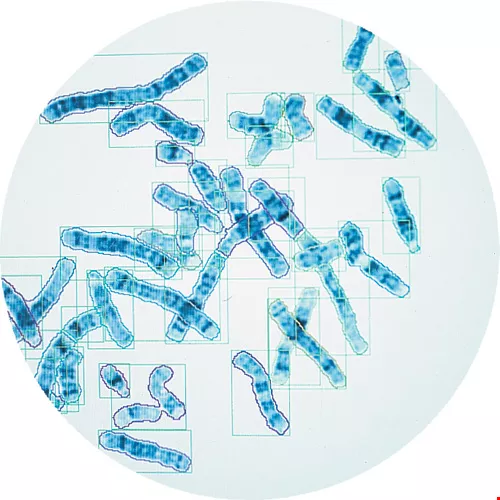
Besides the system using 13 to 15 DNA loci, in certain situations the precision of familial relationship testing can be enhanced by specifically comparing the X chromosome, Y chromosome and mitochondrial DNA.
X chromosome: The sex chromosome. A female has two--one each from her father and mother. Therefore, all the daughters of a single man must possess a matching X chromosome.
Y chromosome: Can be used to determine whether two people belong to the same paternal lineage. A male will share the same Y chromosome with his paternal grandfather, a paternal uncle, or a paternal male cousin.
Mitochondria: A genetic marker passed along a maternal line. All the biological offspring of a single woman will share the same mitochondrial type.
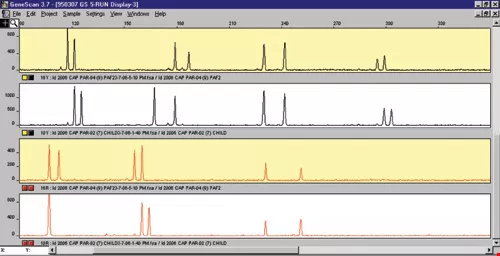
Using a technique called capillary electrophoresis, 13 to 15 loci are examined. Statistical analysis is performed to calculate the degree of familial relationship. If there are three or more loci where two DNA samples do not match, a familial relationship is excluded. The illustrations show comparisons of seven loci.

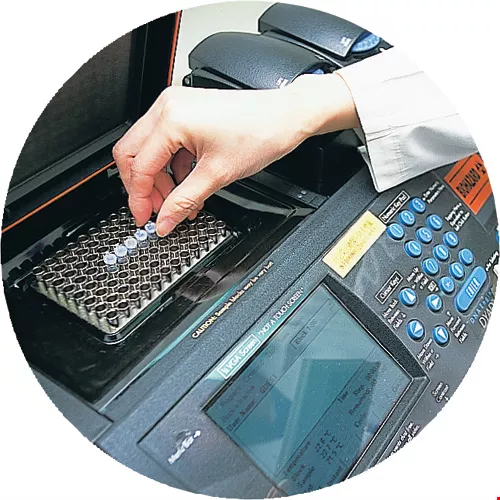
Using a technique called capillary electrophoresis, 13 to 15 loci are examined. Statistical analysis is performed to calculate the degree of familial relationship. If there are three or more loci where two DNA samples do not match, a familial relationship is excluded. The illustrations show comparisons of seven loci.
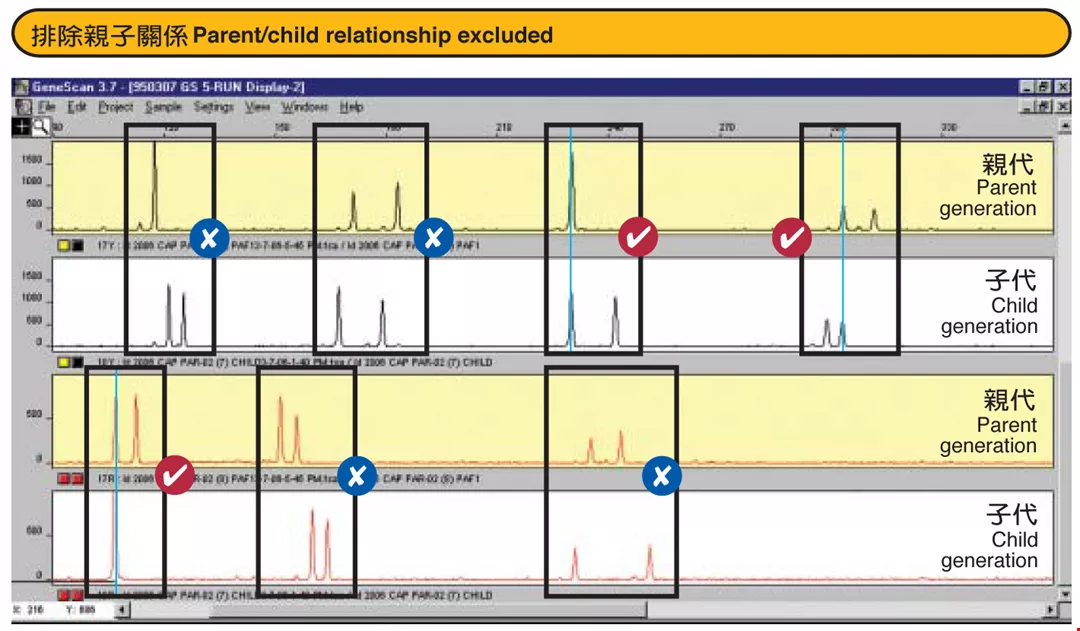
Using a technique called capillary electrophoresis, 13 to 15 loci are examined. Statistical analysis is performed to calculate the degree of familial relationship. If there are three or more loci where two DNA samples do not match, a familial relationship is excluded. The illustrations show comparisons of seven loci.
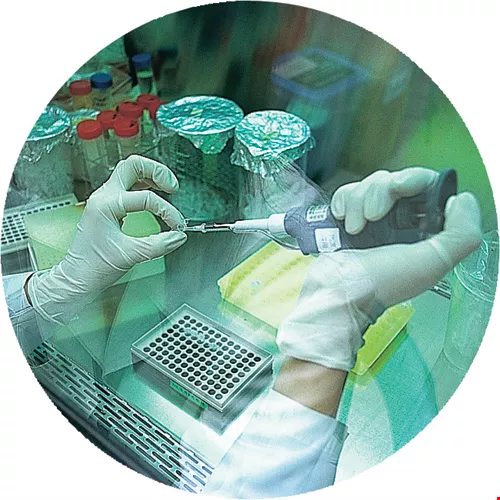
Using a technique called capillary electrophoresis, 13 to 15 loci are examined. Statistical analysis is performed to calculate the degree of familial relationship. If there are three or more loci where two DNA samples do not match, a familial relationship is excluded. The illustrations show comparisons of seven loci.


