On the Cutting Edge of Fashion-the Japanophiles
Marlene Chen / photos Hsueh Chi-kuang / tr. by David Mayer
July 1999


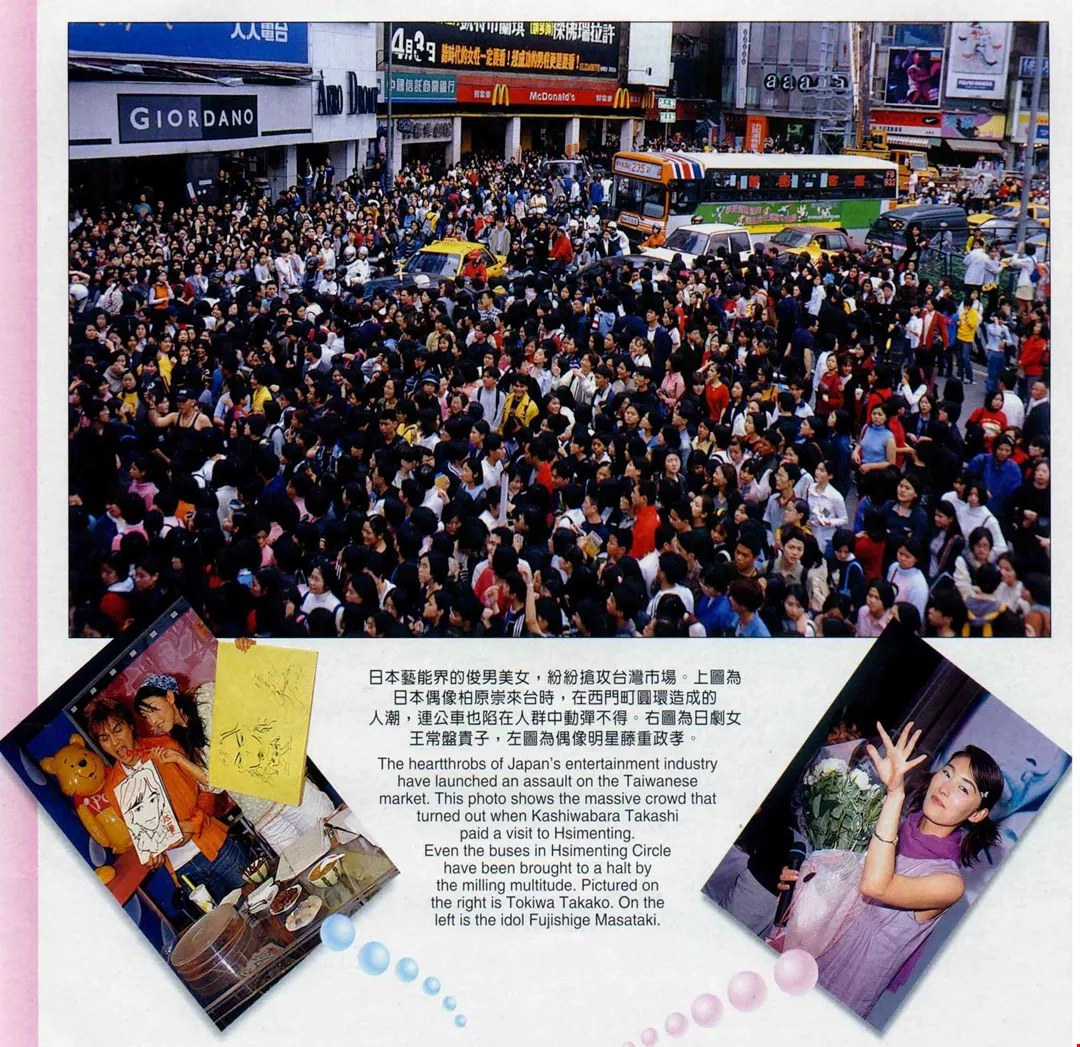
The heartthrobs of Japan's entertainment industry have launched an assault on the Taiwanese market. This photo shows the massive crowd that turned out when Kashiwabara Takashi paid a visit to Hsimenting. Even the buses in Hsimenting Circle have been brought to a halt by the milling multitude. Pictured on the right is Tokiwa Takako. On the left is the idol Fujishige Masataki.
Hsimenting Circle is a busy traffic hub on Taipei's west side. It is normally a raging river of cars and trucks, but on this fine day in May the motorized river has transformed into a roiling sea of humanity. The anxiously awaited Japanese pop idol Kashiwabara Takashi is about to appear before the excited, jostling crowd.
Japanese pop idols have a large following in Taiwan, and they frequently make visits here to keep in touch with their fans. Not all stars are even real people-we mustn't forget "Hello Kitty," the little white kitten whose image appears on an endless of range of pastel-hued promotional goods. More and more people are being pulled into the orbit of Japanese pop culture.
Taiyang no Chuchuang is a trendy clothing store in Hsimenting. Jam-packed with the latest Japanese fashions, the store's two narrow aisles fill up every Saturday afternoon with eager young faces.
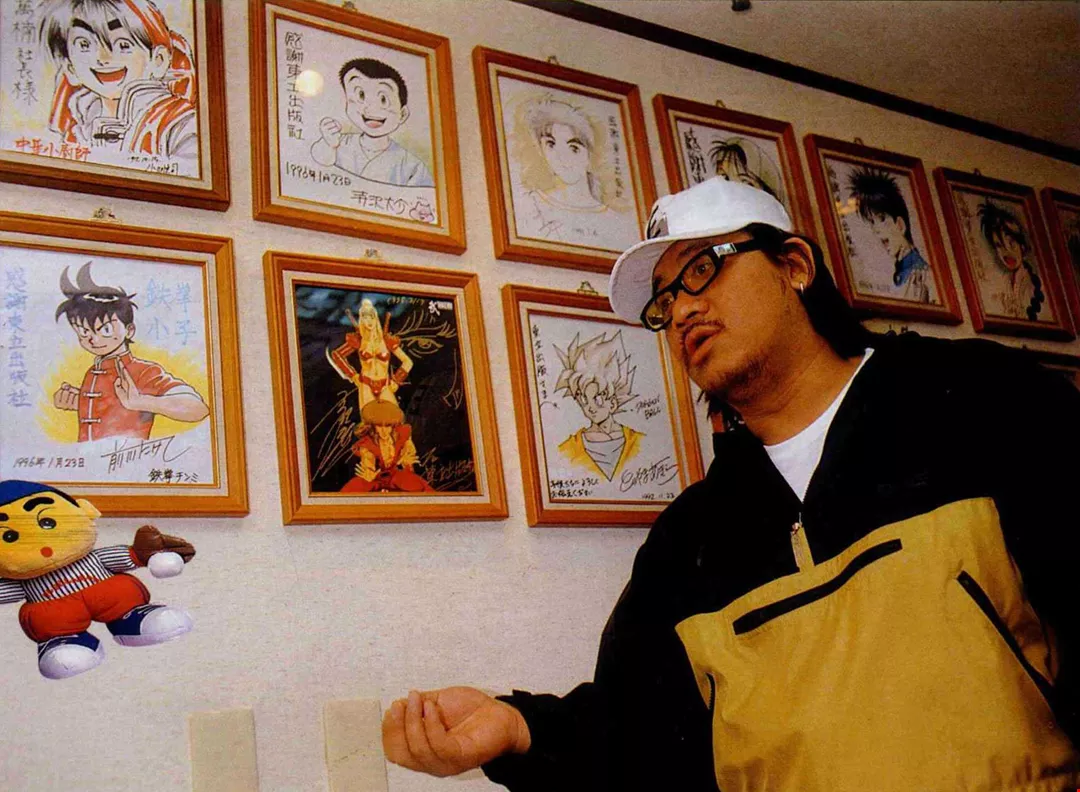
Tsai Chia-chun, of Tong Li Publishing Co., notes that kids in Taiwan grow up entertained by all sorts of Japanese cartoon characters, including Doraemon and Crayon Shin-chan.
A sales clerk named Amy directs the customers' attention to a necklace just in from Japan: "This is Amuro Namie's latest accessory." She pulls out current issues of four or five Japanese fashion magazines with a teen focus, then points to several hot-selling items right there in her store: "We're always more up-to-date than the customer. Every magazine we read and every product that comes in is the absolute latest." Is it Taipei or Harajuku?
As Amy chats with the customers, three familiar faces stroll by. They're a really biang bunch (biang is slang for "cool"). Chun has two syringe tubes tied in her hair, and is wearing a fluffy little pastel-blue skirt and wooden clogs. Wei-wei is wearing a red denim hat over a blond wig. Chih, in the meantime, has gotten Chun to apply eyebrow pencil and eye shadow to his (yes, his!) handsome if still slightly childish face.
Today is the last day of spring break, and Hsimenting is awash in golden sunshine. These three walking fashion statements are just a few of the many junior high students taking advantage of their freedom to roam the streets of Hsimenting. Chun and her friends attract lots of attention. Someone exclaims, "Hey, cool!"
Wei-wei had bought 90 syringe tubes at a pharmacy, and used two of them to make Chun's hair ornament. Laughs Wei-wei, "The man at the pharmacy thought I was a needle addict."
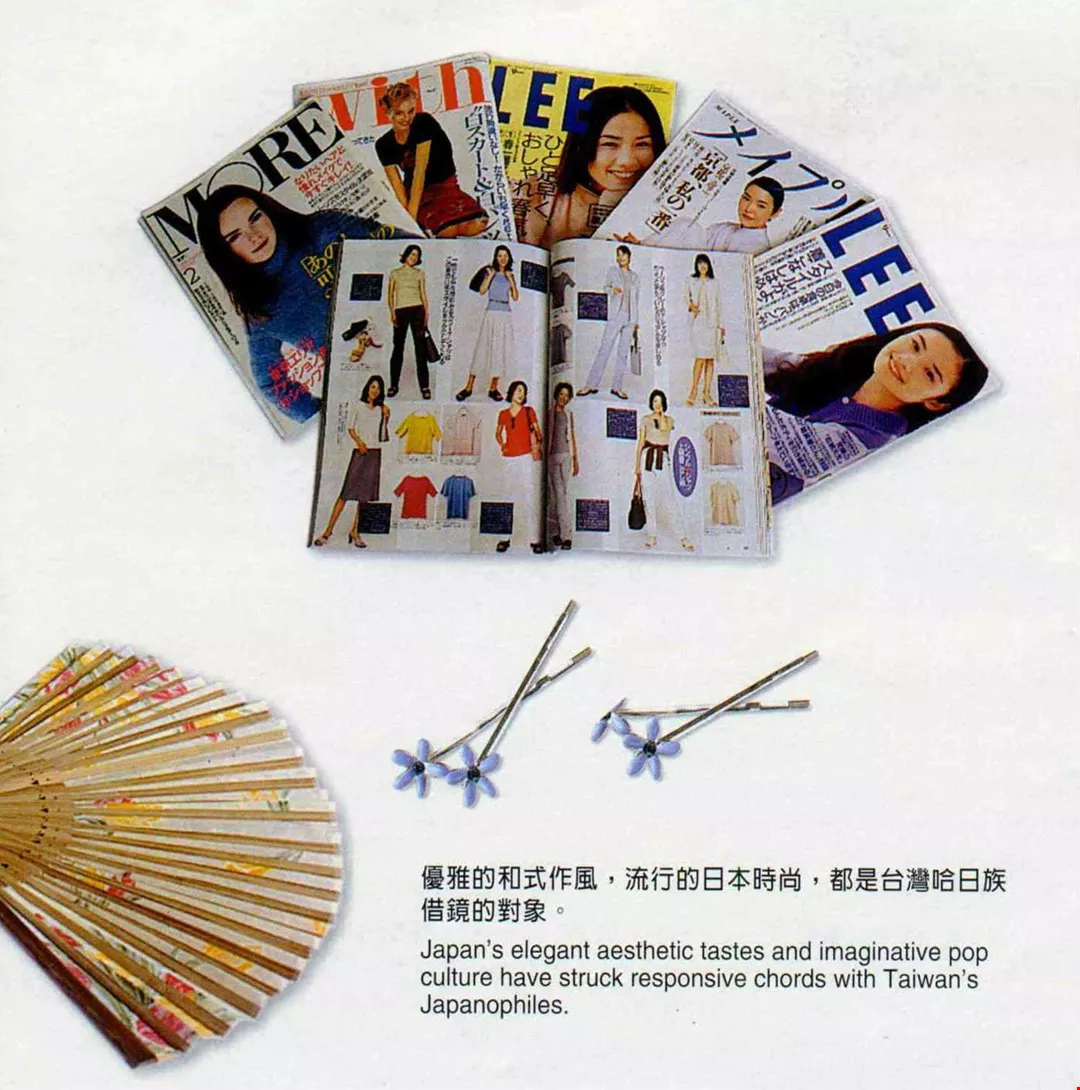
Japan's elegant aesthetic tastes and imaginative pop culture have struck responsive chords with Taiwan's Japanophiles.
As he talks, the blond-wigged Wei-wei pores eagerly over a fashion magazine that his older sister has just brought back from Japan. Chun flips through the pages of everybody's organizers. They're full of photos of friends and the popular sticker photos that you get from vending machines for about NT$100 per sheet. These sticker photo machines originated in Japan, where they are known as purikura. Direct from Japan
You run across a lot of these cool types in Hsimenting. In fashion, they march in virtual lock step with their counterparts in Tokyo, and if it weren't for the familiar Mandarin and Taiwanese coming from their mouths, the visitor to Hsimenting might think he was in Harajuku, Tokyo's epicenter of youth fashion.
You don't have to go to Hsimenting to see the impact of Japanese pop culture in Taiwan. TV commercials peddle an endless stream of products with Japanese names, such as onigiri rice snacks, ramen noodles, cosmetics, and toys. Japanese language and culture is a dominant theme in today's TV commercials.
There has always been a market for Japanese products, of course, but they are especially popular right now. The boom began with Japanese comics in 1995. Leading the way was the Crayon Shin-chan series. A story about a five-year-old boy with a precocious eye for the opposite sex and an uncanny knack for infuriating his mother, the series has sold 600,000 copies so far. Many Japanese comic book artists have come to Taiwan for signing sessions, including Usui Yoshito, author of Crayon Shin-chan.
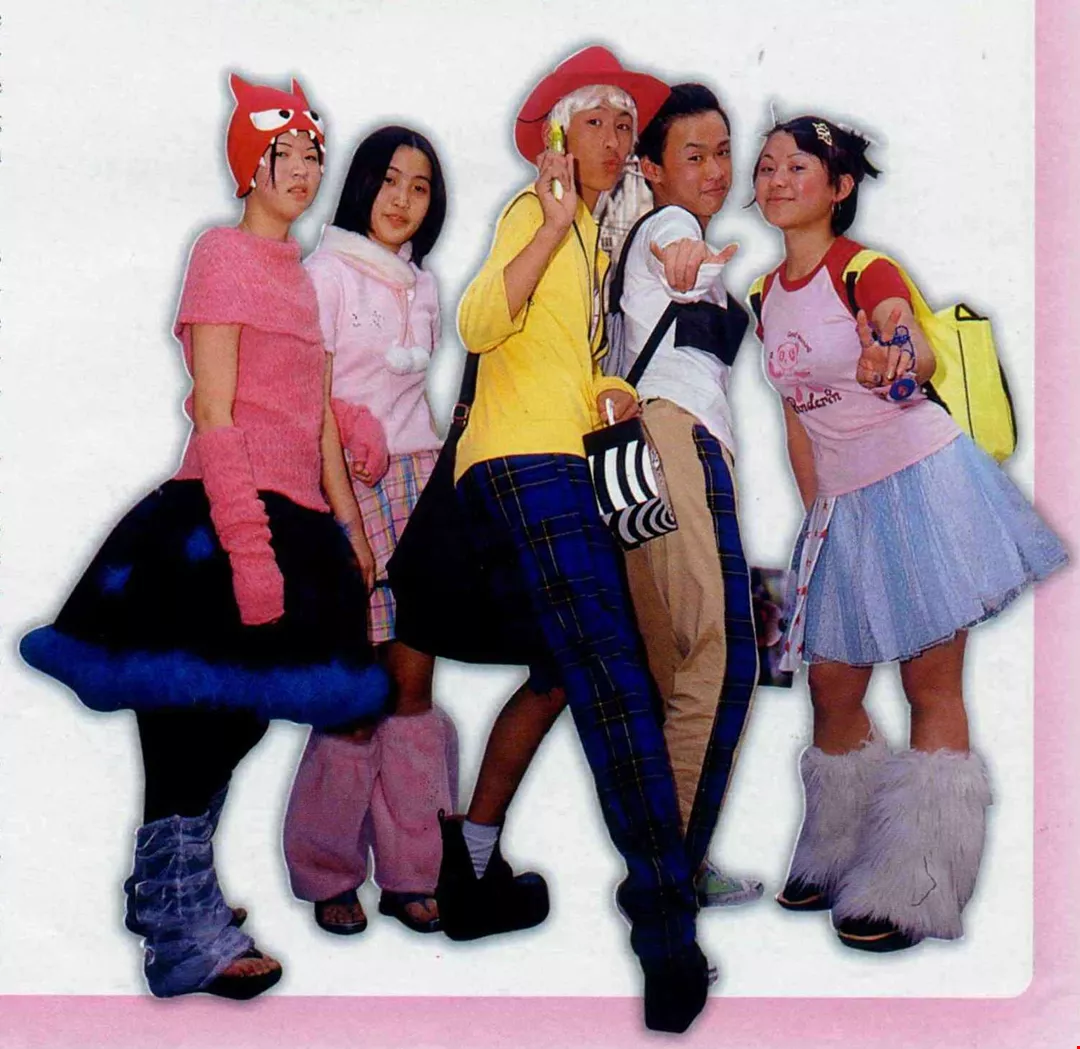
Aren't we kawaii? Let's go get some purikura pictures made!" Hsimenting is a paradise for Japanophiles. In Hsimenting you will run across lots of young people who appear to have sprung from the pages of a Japanese fashion magazine for teens.
Even though the Taiwanese economy has not been very strong lately, many Japanese entertainers have launched assaults on the Taiwanese market. Komuro Takuya, for example, is the producer of a popular Japanese TV show in which regular man-on-the-street types prepare songs, skits, stupid stunts, and other acts to perform on TV before a national audience. Recently he has established a studio in Taiwan to produce the same show for Taiwanese TV. The female duo Puffy has come to Taiwan, and they even performed songs in Mandarin. Nishikawa Takanori, who represents a recent trend among some male Japanese singers to dress in an eye-catching, androgynous style, is a very recent arrival to stardom in Japan who has also been promoting himself in Taiwan. Lifting the ban on Japanese culture
Since Crayon Shin-chan kicked off the boom four years ago, the subsequent wave of Japanophilia has generated scores of hot-selling Japanese products in Taiwan. Tsai Chia-chun, project manager at Tong Li Publishing Co. (the Taiwanese publisher of Crayon Shin-chan), attributes much of this trend to a media frenzy. The trend has also been fueled by two especially significant changes to the legal environment in late 1993-passage of the cable TV law, and the repeal of long-standing restrictions upon the import of Japanese TV programs and music.
Magic Stone Music Co. is a long-time distributor of Japanese music in Taiwan. Uno Lin, Magic Stone's director of planning and public relations, mentions one particular song that stands out as a landmark in the invasion of Japanese music-the Chage & Aska theme song for a Japanese TV drama entitled 101st Marriage Proposal.
NHK, JET, Videoland Japanese Channel, and Kuo Hsing Satellite TV bring Japanese TV dramas, variety shows, and travel and leisure shows to Taiwan as quickly as possible in an effort to keep Japanophiles here happy. Among the most popular of all programs are the "idol dramas," i.e. mini-series starring Japan's hottest heartthrobs.
Tokyo Love Story, starring Suzuki Honami, for example, has aired no less than five times, while Prank Kiss, starring Kashiwabara Takashi and Sato Aoko has aired eight times!
From the storyline to the dialogue and clothing of the actors, these mini-series, known in Japan as "trend dramas," closely reflect the nitty-gritty details of everyday life in the 1990s. Great Teacher Onizuka, which revolves around the life of a wild and crazy teacher, renders a realistic portrait of high school life. Got No Money! tells the story of an impecunious young man at an insurance company struggling to make his way upward in society. In the opinion of Tsai Chia-chun, these Japanese shows have much more to do with everyday life and are much more likely to strike a responsive chord than Taiwan's locally produced mini-series or its many dramas set in the imperial past.
In addition to the intriguing storylines, viewers are captivated by a galaxy of Japanese idols, including the likes of Suzuki Honami, Eguchi Yosuke, and Sakai Noriko. One show after another, loyal fans stay glued to the tube, and they even write letters to the editors of major publications to discuss the love lives of these actors and actresses. Tugging at the purse strings
Signs of the impact of Japanese pop culture abound in Taiwan, and thanks to active marketing by Japanese companies and the abundance of attractive Japanese products, Japanophilia in Taiwan has escalated to new heights.
The thing that hooks people on Japanese products is the fact that they're so kawaii (Japanese for "cute"). What could be cuter than Hello Kitty? She's everywhere-peeking out from tiny little stickers, plastered all over vacuum cleaners, rice cookers, and air purifiers. You can even find her on automotive products and mobile telephone jackets. The earliest Hello Kitty products all came in a red color theme, but now there is pink for girls and pastel-blue for boys. Kitty herself is getting a bit more dressed up these days too, with her hair bows adorned now by cherries, strawberries, and flowers.
In developing new products, Japanese companies pay attention to every little detail and every last variation. The effect upon a shopper is powerful-you've got to have that thing! Even the packaging is so pretty that you hate to tear it apart.
Exquisitely crafted products and creative marketing strategies have resulted in countless success stories. Tsai Chia-chun notes that Shueisha Publishing Co. (one of Japan's three top publishing houses) has pulled in faithful readers by hitting on different responsive chords with three different comics. Dragon Ball stresses friendship, Yu Yu Hakusho emphasizes hard work, and Slam Dunk hammers on the theme of triumph. These comics have all been developed into TV cartoons and video games, generating still further business opportunities.
One of Shueisha's main competitors, Kodansha, has found a formula for success with such stories as Kid Detective Kinta Hajime and Shota the Sushi Master, each of which revolves around the exploits of a heroic main character. Both have been developed into animated TV shows that rival the popularity of Japan's "idol dramas."
These popular products compete fiercely on the Japanese market, but once it comes time to export, the competitors close ranks and cooperate with each other. According to Tsai Chia-chun, over ten of Japan's comic book publishers hold regularly scheduled colloquiums at which they discuss exporting strategies. Says cultural commentator Nan-fang Shuo, "That's why Westerners talk about Japan Inc." Japanophilia or preference for Asia?
The selling power of products from Japan Inc. can be felt around the globe. Even in the West, Hello Kitty has taken one country after another by storm. With some types of products, however, Japanese exports have done best primarily in Asia. Examples include clothing, TV programs, music, and other popular consumer items. In both South Korea and Taiwan, Japanese comics command 80% of the market, and even though South Korea restricts the import of Japanese movies and music, young consumers still get their hands on them via the black market and the Internet. In Hong Kong and Singapore, Hello Kitty and Japanese "idol dramas" are extremely popular with Japanophiles.
"That has to do with the fact that we're all Asian," comments Nan-fang Shuo. American pop music queen Janet Jackson, for example, is not hugely popular in Taiwan, but Amuro Namie, who could be described as her Japanese-style counterpart, has made a big splash here.
"Western pop culture is very different from ours," says Huang Tzu-chiao, a TV variety show host who has been very much involved with the Japanese entertainment industry for the past two years. Huang, who produces TV and radio programs that report on the Japanese pop music charts and provide the audience with a wide range of other information on the latest pop culture trends in Japan, mentions humor as one area where East and West are different. Western comedians are not as popular in Taiwan as Japan's Shimura Ken, whose routines sometimes remind a Westerner of Benny Hill, and at other times bring to mind the antics of Mr. Bean.
China Times reporter Chen Wen-fen often peruses the shops of Hsimenting. She asks, "Where else besides Japan do they make clothes and accessories that are basically made-to-order for the Taiwanese physique?" That is why, in Huang Tzu-chiao's opinion, many people who are described as Japanophiles "actually just have a preference for things Asian."
Japan, furthermore, is the most advanced nation in Asia. Says Makoto Liang, manager of the Japan department at a record company called Avex Taiwan, "An individual's preference for a particular culture or country is very deeply influenced by natural affinities that exist between cultures as a whole." The fondness of Taiwanese people for Japan does not extend to other Asian nations. Japan's status as a major power has much to do with this phenomenon, but perhaps the fact that Taiwan is a former Japanese colony is another underlying factor. A Japanophile since before birth?
Wu Chuan-ning is a longtime Japanophile. In her student days, she kept a photo of Nakayama Miho inside the front cover of her history textbook and a photo of Kudo Shizuka inside the back cover. Now she is a planner in the programming department at Sanlih Entertainment TV. As a fan, she was strictly on the receiving end of information about Japan, but now her job puts her on the sending end as well. She feels that her affinity for Japanese culture probably has to do with the fact that she grew up listening to her grandfather sing Japanese songs.
Japan laid the foundation for the modernization of Taiwan. As such, says Wu Chan-liang, associate professor of history at National Taiwan University, "A lot of Taiwanese-born people of the older generation have a great deal of respect for Japan, and this cultural link makes it easier for younger generations to identify with Japan."
After Japan's colonial rule over Taiwan came to an end, however, a new government swept in and took strong action to suppress Japanese culture in Taiwan. In the view of Makoto Liang, a mixture of Chinese patriotism and a colonial mentality has left the older generation of Taiwanese with a love-hate relationship toward Japan. In addition, attitudes toward Japan can vary significantly depending on age and whether one was born in Taiwan or the mainland.
Travel writer Ha Jih Hsin-tzu is an interesting case. Her pen name means "Kyoko the Japan-lover." Still short of age 30, her enthusiasm as a teenager for Japanese culture in general, and for pop singer Matsuda Seiko in particular, prompted classmates to label her as "a little self-made Jap." Far from taking offense, however, she wore the label with pride. "I must have been a Japanese person in a previous existence," says Kyoko. "If not that, then I must have at least been a Japanese pig."
Japanophiles thus carry their enthusiasm to considerable lengths at times, and those with an antipathy for Japan find this exasperating. Evidence of this tug-of-war within the Taiwanese psyche can be seen in society. Says Makoto Liang, "The long-standing restrictions upon Japanese culture in Taiwan turned out to be counterproductive. Look at the frenzy that ensued after they were lifted." Birth of the Japanophiles
Once restrictions on media activities were lifted, "Japanophilia" swept through Taiwanese society like a virus. If you have a preference for Japanese products, closely follow the doings of Japanese entertainers, or dress up in all the latest, coolest fashions, consider yourself a Japanophile. According to Makoto Liang, "The term ha ri zu (Japanophile) has come to be associated with the idea of mindless infatuation." (The ha in ha ri zu is a Taiwanese word that means to be infatuated with someone or something.) For many, to describe a person as ha ri zu is to accuse that person of being airheaded, impulsive, and shallow. Nevertheless, the various media devote considerable column space and air time to items of interest to Japanophiles, and this media attention continually draws more and more Japanophiles into the ranks.
Uno Lin points out that Japanese stars who achieve success in Taiwan are mostly idols who do well in large part due to their good looks. He notes that there are not many Taiwanese fans who actually understand the lyrics of Japanese songs. There used to be a Taiwanese magazine devoted exclusively to reporting on Japanese culture, business, and society. It was called Japan Digest, but it went out of publication not long before Taiwan got caught up in the current wave of Japanophilia. When Japan Digest closed down, Taiwan lost its only in-depth coverage of Japan.
Huang Chih-nan, publisher of Japan Digest, states that there is much more worth paying attention to in Japanese society than just its exports and traditional cultural pursuits like the tea ceremony and flower arrangement. The Japanese author Murakami Haruki, for example, has recently enjoyed widespread popularity in Taiwan, and many Taiwanese writers have taken to imitating his style. Tsai Kang-yung and some other writers have even published a book entitled 100% Murakami Haruki. Admirers of Japanese highbrow culture, however, enjoy nothing close to the notoriety of those with a fondness for Japan's pop culture.
Huang Chih-nan looks on with concern as Japanese pop culture (or perhaps it should be called Japanese consumer culture) makes inroads into Taiwan, Says Huang, "As we assimilate elements of other cultures, we must do so with a critical eye." Taiwan first
Kuo Yu-fu, a specialist in Taiwanese history who proclaims himself a Japanophile until his dying day, has some stern advice for fellow Japanophiles of his generation, who have never actually been subjects of the Japanese emperor.
In studying Japanese literature and the history of relations between Japan and Taiwan, Kuo has found that earlier generations of Japanese historians seem to have deliberately remained silent about the Japanese government's opium policy in Taiwan, nor do they make any mention of an incident in which the Japanese police massacred Taiwanese citizens in Tokyo. Kuo emphasizes that although he loves Japanese literature and relies heavily on Japanese sources in his academic research, he still puts Taiwan first.
He notes that the mass media have the power to influence thought patterns and shape lifestyles. The Japanese government requires that all TV programs be dubbed into Japanese for this very reason. He asks whether we should not also impose appropriate restrictions on Japanese products.
Tsai Chia-chun does not view the issue from quite the same perspective, however. He points out that while the younger generation is agog about Japan, the tendency of those just a bit older to spike their conversation with English all the time is indicative of a similar infatuation with the West. As the world shrinks into a single global village, national boundaries are becoming blurred. Travel and telecommunications are highly developed nowadays, and the ROC government has eliminated its former prohibitions against cable TV and Japanese programming. Many nations are now wrestling with the difficult question of how to preserve one's own traditional culture without cutting oneself off from the global village and falling out of step with the international community. Rebellious youth
Some scholars urge that before turning one's attention abroad, it is a good idea to take a close look at one's own culture.
Says Makoto Liang, "For the past several centuries, the island of Taiwan has been ruled by a succession of outside powers. The Taiwanese people are quick to assimilate cultural influences from abroad, but we have long ignored our own culture." In his opinion, the infatuation of Taiwanese youth with Japanese pop culture may be due primarily to the fact that we have not fully developed our own culture.
Huang Chih-nan feels strongly that the government has not done enough to build up Taiwanese culture, and that the island's youth do not identify with their own culture.
Chen Wen-fen views the fondness of Taiwanese youth for Japan from yet another perspective. According to Ms. Chen, this youth sub-culture has local roots, and reflects directly upon the state of Taiwanese society. She asks, "What do you see on TV? What do you read about in the newspapers? Every day it's murder, robbery, and mumbo-jumbo from the politicians. Where do you turn if you're looking for something uplifting?"
At a deeper level, the Japanese stars and fads that Japanophiles follow so closely actually reflect the rebellious impulses of the Japanese youth sub-culture, and express a rejection of rigid social systems and old politicians. The good guy in the film Sanctuary looks a lot like Richard Gere, while the movie's villain, with his pudgy physique and bushy eyebrows, looks more like a crafty old politician. An honest-looking image is basically associated with rebellion against the system. Better for the experience
The younger generation has its Japanophiles, and so do the older generations. In the final analysis, what they have in common is a disgust for their own society and a search for something new and different.
Lin Chi-po works at a magazine and often travels to Japan to "recharge his batteries." Lin comments, "Sure, we're nuts about Japan, but there are lots of Japanese people who feel the same way about Taiwan. A lot of my Japanese friends come to Taiwan every year. They say the Taiwanese people are friendly, outgoing, and not inclined to let themselves be bound by rules. This is just what the highly rule-conscious Japanese lack."
Many commentators have noted a fawning attitude in Japan toward the West. After the powerful cannon of Western warships forced Japan to abandon its isolationist policies in the mid-19th century, the big-nosed Westerners who entered Japan reminded the Japanese of their own tengu (a long-beaked avatar, half-man and half-bird, both feared as an abductor of humans and valued as a protector against evil). During the ensuing Meiji Restoration, Japan aped the West with a vengeance. Ever since then, says Wu Chuan-ning, Japan's visual arts have adopted a French baroque style. Makoto Liang also notes that Japan's strong adulation of the West is reflected in marked preferences for French cuisine and German tableware.
Nan-fang Shuo, on the other hand, argues that Japan's highly refined style of decorative art dates back over a millennium to the Heian period, and that even though it can sometimes be quite elaborate, there is nevertheless a pleasing elegance about it that is unsurpassed anywhere in the world. According to Nan-fang Shuo, "Japanese culture is highly unique. Even when they assimilate cultural influences from abroad, they end up transforming everything they borrow into something unmistakably Japanese."
When you really think about it, perhaps there's nothing wrong with people feeling fascinated with Japan, Europe, America, or wherever. When these crazes die down, we often find that they have enriched our own culture and left us with something that people from abroad can get excited about when they visit Taiwan. Without a doubt, the global village is turning into a very interesting place.


@List.jpg?w=522&h=410&mode=crop&format=webp&quality=80)
