From the Streets to the Villages--The Indigenous Peoples' Movement Turns 20
Tsai Wen-ting / photos Jimmy Lin / tr. by Scott Williams
March 2006


"He's like a plant, always growing," chants the popular Taiwanese Aboriginal writer Yaronglong Sakinu in an ad calling for the government to allow Taiwanese Aborigines to use their Aboriginal names on their national IDs. "He runs like a beast, howling your name--Sakinu." He looks so confident and full of vitality that the viewer can't help but admire him.
Over the last decade or so, Taiwan's indigenous peoples have become something of a Taiwanese obsession. Ads for village tours and Aboriginal foods cover full pages of Taiwan's newspapers and pop up again and again on the TV. Countless books line the halls of academia, analyzing these indigenous peoples from the perspective of every area of study. The premier regularly makes statements calling for multicultural talks, while the government implements initiative after initiative promoting development in Aboriginal villages. Internationally, indigenous accessories and handicrafts have become elements of Taiwanese design, totems that demonstrate Taiwan's cultural uniqueness.
But the arrival of Han Chinese, who 400 years ago began to cross the dark waters of the Taiwan Strait to till Taiwan's soil, marked the beginning of the humiliation of Taiwan's indigenous peoples. Over the years, the non-native groups that have dominated Taiwan have referred to them as "strange savages," "familiar savages," "mountain tribes" and "mountain compatriots." When the Alliance of Taiwan Aborigines was formed in 1984, it gave voice to the pain they felt at their treatment and asked mainstream society to address key Aboriginal issues, including their terrible living conditions and their dwindling numbers. With this, Taiwan's indigenous peoples' movement was underway.
Prior to the 2000 presidential election, then-candidate Chen Shui-bian called for a "new partnership" that would advance the indigenous peoples' movement, put relations on something approaching a state-to-state level, and move Taiwan's indigenous peoples towards political autonomy.
Over the last 20 years, Taiwan's indigenous peoples' movement has made many demands--for the restitution of Aboriginal names, for the establishment of institutions controlled by Aborigines, for the return of Aboriginal lands, and for Aboriginal self-determination--but what has it achieved? How much respect and how many rights have been regained? How much assistance have all the laws passed to protect Taiwan's Aborigines actually provided? And as society responds to the Aborigines' demands, how are the movement's energies to be redirected?
Our names have been silenced on the ID rolls,
Selfless worldviews shaken on job-site scaffoldings,
We pace the shipbreaking yards, the mines, the fishing boats,
Our sacred myths now pedestrian plots for TV dramas,
Our traditional morals trampled in the brothels....
What do we have left? Frustrated footsteps through the lowlands?
What do we have left? Hesitant aspirations on clifftops?
This 1983 poem by blind Paiwan poet Monaneng expresses the pain indigenous peoples from Taiwan and abroad have experienced as a result of their difficult circumstances: they've been pushed off their lands and left without opportunities; their languages are dying; their cultural identities are fragmenting; their labor is being marginalized.... They are a people in their twilight, their society being overtaken by the night.
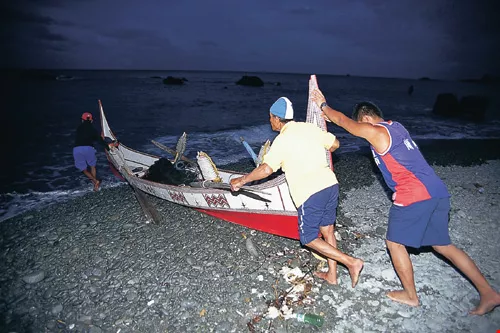
The villages are at the heart of Aboriginal culture and ritual. The photo shows the Tao people of Orchid Island setting out in the middle of the night to catch flying fish.
Calling out together
In the mid-1980s, the first hints of a democratic Taiwan began to emerge. As the lifting of martial law approached in 1987, social movements burgeoned and people took to the streets. At this same moment in history, Taiwan's long-ignored, disadvantaged indigenous peoples came down from the mountains to shout their anger.
"Taiwan's indigenous peoples' movement wasn't formed in a vacuum," says Sun Ta-chuan, a former leader of the movement who now heads the Dong Hwa University Institute of Development for Indigenous Peoples. "It was linked to Taiwanese society and culture as a whole, part and parcel of Taiwan's movement towards democracy and nativization. As a result, the indigenous people's movement received the support of many Han Chinese and gained enough momentum to continue developing."
Though the indigenous peoples' movement was quite small (it involved only about 300,000 people) relative to the other movements of the day--the nativization movement of Taiwan's majority Minnan-speakers, the farmers' movement, the workers' movement, or even the four-million-strong Hakka movement--it was very successful. The strength of its demands and the suffering out of which they grew attracted mainstream society's attention and its sympathy.
Taiwan's indigenous peoples have been largely powerless to resist the market capitalism that has driven the island's economy since the 1970s. While the government was proclaiming Taiwan's "economic miracle," Taiwan's Aborigines were rapidly losing their land and falling further behind the island's Han Chinese majority.
The period during which the indigenous peoples' movement was taking shape was not a happy one for Taiwan's Aborigines: In 1984, the Fisheries Bureau reported that 1,973 fisherman had died at sea during the previous eight years, the majority of whom were Aborigines. According to rescue groups, of the nearly 100,000 Aboriginal women then between the ages of 13 and 34, approximately 30,000 were working in the sex trade. In 1987, more than 80% of the lifeless bodies retrieved after the Haishan Mine disaster in Taipei County were Aborigines.
"Our compatriots float on the sea, are buried in mines, are trampled in dark streets...." In 1983, National Taiwan University students Icyang Parod and Iban Nokan began publishing an underground magazine called Gaoshan Qing. With pen instead of hunting gun, they indicted Taiwan's Han Chinese majority for 400 years of economic invasion, cultural assimilation, and social discrimination.
Whether struggling to be heard in the cities or returning to their home villages to put down roots, the brave youths who led the Indigenous Peoples' Movement 20 years ago are still fighting for what they believe in. Pictured is Walis Nogang.
The birth of the movement
Icyang Parod, now deputy minister of the Council of Indigenous Peoples, was one of the movement's most important leaders. An Amis born in Hualien, Icyang didn't learn that his legal name was Liu Wen-hsiung until he entered elementary school. Even in what was an Aboriginal elementary school, students were not permitted speak their mother tongue. Unable to find his classroom or explain his predicament, "Liu Wen-hsiung" simply sat down on the school's athletic field and cried for help. Getting get a handle on Han society was very difficult for Aboriginal students cut off from their mother culture and mother tongue within the educational system.
It was only after Icyang entered NTU and began talking to other Aboriginal students that he realized the injustice and unfairness to which Taiwan's indigenous peoples were subject.
On 29 December 1984, Icyang gathered the Aboriginal Youth Association that he led, the Tang-wai Writers' Association, and members of the Taiwan Presbyterian Church in the large conference room on the ninth floor of Mackay Memorial Hospital and formed the Alliance of Taiwan Aborigines (ATA).
On hearing about the formation of the group, Hsieh Shih-chung, who currently chairs NTU's Department of Anthropology, took a leave of absence from his PhD program in the US and returned to Taiwan to study it. Hsieh, who last year was recognized by the Executive Yuan for his work on the restoration of Aboriginal names, believes that the formation of the ATA was a seminal event for indigenous peoples more used to keeping a low profile. Like a stone thrown into a still lake, it made waves and awakened the Aborigines' long-dormant inner strength.
In its earliest days, the ATA addressed the unfair circumstances faced by each of Taiwan's indigenous peoples. When Icyang took over leadership of the association in 1986, he changed its direction, taking members into the streets for what was to be the movement's explosive "golden decade." He also revamped the indigenous peoples' movement, elevating it from an aid-seeking movement to a protest movement fighting for ethnic autonomy.
Under Icyang, their first proposal was that Taiwan's indigenous peoples be called by their proper names. For more than 400 years, groups from outside of Taiwan had bestowed their own names upon the island's Aborigines. At the ATA's urging, Taiwan's nine distinct officially recognized indigenous peoples (this number has since increased to 12) began referring to themselves collectively as "Aborigines" to distinguish themselves from Taiwan's Han Chinese majority.
With the passage of amendments to the ROC constitution in 1994, which established a national consensus on using "Aborigines" to address Taiwan's indigenous peoples rather than the more pejorative terms that had been used before, the 20-some passionate young people who had begun discussing Aboriginal issues in 1984 tasted for the first time the sweet fruit of victory.
In 1991, some 500 university students and members of the ATA took to the streets with the support of church groups and under Icyang's leadership to call for the establishment of an Aboriginal affairs commission at central government level. However, a number of the protesters, including Icyang and his deputy Mayaw Kumod were jailed for a year for violating the assembly and parade law. In the courtroom, Icyang spoke only in his mother tongue and requested an interpreter. This angered the judge, who cited him for contempt of court and increased his sentence. "In those days," says Icyang, "Aboriginal rights were the only thing I thought about." Now a key figure in the setting of Aboriginal policy, he smiles when he reflects back on his courage and single-mindedness.
The restitution of Aboriginal lands was next on the agenda. On 10 December 1993, Icyang took his tribe north, departing the Hualien-Taitung area early in the morning bound for Taipei. Unfortunately, their train broke down halfway to the capital, and they missed the protest march. But when the nearly 2,000 elderly tribespeople ultimately made it to the Chiang Kai-shek Memorial on foot, their raised voices brought the indigenous peoples' movement to a climax.
"Taiwan's indigenous peoples' movement got a late start relative to similar movements overseas," says Icyang. "But it moved very fast. When our demands didn't conflict with the interests of mainstream society, we almost always received a very satisfying response."
The formation of the Council of Aboriginal Affairs (now the Council of Indigenous Peoples) in 1996 provided the 30 Aboriginal townships in the mountains and the 25 in the lowlands with a direct channel for communication with the central government, and began the construction of new administrative and legal structures for Taiwan's indigenous peoples. Over the next several years, the government passed new laws covering Aboriginal education, ID cards, surnames and worker protections.
"Noteworthy political and legislative strides were made in Aboriginal affairs," says Sun Ta-chuan, a Puyuma. But the movement encountered so little resistance that it lost focus and essentially ran out of steam.
Meanwhile, the tribes were confronting another problem: while young people had been active in the street protests, few remained in the villages. Generally speaking, people of working age have left the villages in search of jobs, leaving behind only children and the elderly. This has resulted in something of a disconnect between the movement and the villages, where employment is the most pressing concern. Hsieh refers to the many movement people who, when they returned to their villages to run for political office, have suffered defeat as "elites who are far removed from the masses."
Whether struggling to be heard in the cities or returning to their home villages to put down roots, the brave youths who led the Indigenous Peoples' Movement 20 years ago are still fighting for what they believe in. Pictured is Icyang Parod.
Cultural renaissance
"Once a movement loses its focus, it takes on new shapes," says Hsieh. "The ethnic political movement is only one aspect of the indigenous peoples' movement." From the mid-1990s, many of Taiwan's social movements began to lose some of their vigor. But, while the labor movement and the women's movement quieted, the indigenous peoples' movement soldiered on. Once political progress had been made, the movement turned its attention to introducing Aboriginal scholarship, arts, and literature into the mainstream.
The awakening of an ethnic consciousness among Taiwan's Aborigines and their determined quest for their roots led to a cultural renaissance. Long a subject of Han Chinese scholarship, Aborigines, both scholars and interested amateurs, began to apply the techniques of anthropology to the study of their own tribes, thereby reclaiming the right to interpret their culture themselves.
Sun Ta-chuan's Aboriginal literature movement got its start by directing angry indictments at the establishment. Later, it began an effort to put together a comprehensive collection of Aboriginal myths, which revealed Aboriginal culture's uniqueness and subjectivity. Aboriginal literature adds a new aesthetic to Taiwanese literature. More importantly, says Sun, "We finally can read Aboriginal writers, sample our subjective identities, recount the experience of our own tribes, and release 100 years of pent-up creativity."
The leaders of the indigenous peoples' movement have split into two camps on the issue of the hollowing out of Aboriginal villages. Some have chosen to remain in the cities where they seek to make their issues heard and enter government service in an effort to reform the system from the inside. More have chosen to return to their villages to engage in grassroots efforts to revive them. As the fight has moved from the streets to the villages, the pan-Aboriginalism that characterized the early movement has given way to a tribalism centered on the villages.
The first stage in the village revival was largely led by cultural elites whose cultural interventions gave rise to a new sense of vitality. When Walis Nogang, an Atayal writer who founded the magazine Hunter Culture in 1990, returned to Shuangchi Village in Taichung County, he founded the Mihu Reconstruction Society to provide assistance to Aborigines rebuilding after the Chichi Earthquake. When the Tao writer and anti-nuclear activist Syaman Rapongan returned to Orchid Island, he learned afresh how to be Tao man, becoming adept at catching flying fish and living a maritime life. The Paiwan artist Sakuliu revived the production of earthenware pots and hunting knives, and campaigned for the establishment of a village schoolroom. Made famous by the recently released film The Sage Hunter, Sakuliu has expanded his activism--he is now rebuilding the youth activity center in Taitung's Hsinhsianglan Village, working on an alliance of like-minded youth centers, and leading groups of Aboriginal youth abroad to participate in international events.
"The return of movement members to their villages to foster their development has been crucial to their revival," says Iohani Isqaqavut, a former chairman of the Council of Indigenous Peoples. He says that these movement members from the cultural arena are not concerned with practical political or economic gains, but instead stress the communitarian Aboriginal spirit and strive to achieve consensus among tribespeople.
Once there is consensus and identification, the second stage is to open up the villages, to welcome outsiders in to visit and sample Aboriginal culture. During this year's Lunar New Year's holidays, the "Open your door on Jade Mountain" promotion for tourism in the Bunun village of Wanghsiang in Nantou County for the first time brought in a seemingly endless stream of visitors.
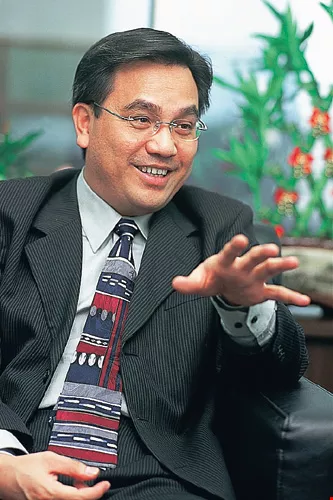
"In the past," says Iohani, "the villagers didn't believe that there was any hope for the future of their tribes. The dazzling white snowscapes of Mt. Jade and the Central Mountain Range are beautiful, but people get tired of them when they see them every day. They even complain that it is the mountains that cut us off from the rest of the world." Having returned to his tribe after leaving the Council of Indigenous Peoples, Iohani has finally been able to do what he has been dreaming about for the last dozen years--foster the development of his tribe.
Based on his survey data, Hsieh Shih-chung estimates that several hundred Aboriginal village workshops have opened since the mid 1990s. Though the village revival movement has had failures as well as successes, the energy and creativity with which it has been conducted has both surprised and won over mainstream society.
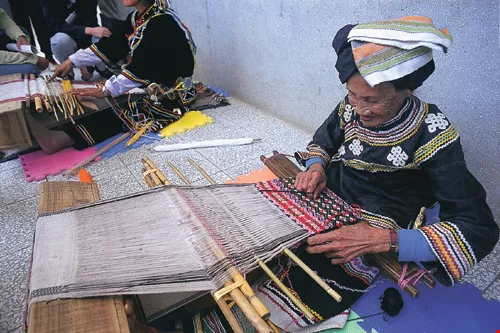
The wisdom and skills of the elderly are among the precious cultural assets of Taiwan's indigenous peoples. The photo shows an elderly Paiwan weaving cloth.
Revolution in progress
The indigenous peoples' movement has achieved many things over its 20-year history, but the restoration of Taiwanese Aborigines' self-confidence surely belongs at the top of the list.
"When my generation of young people left the villages," says Icyang, "we rarely returned. When we did, we pretended we didn't understand our mother tongue, or refused to use it to speak to our elders. In contrast, young Aborigines today delight in proclaiming their tribal affiliation and have even reverted to using their Aboriginal names. They have a much healthier attitude."
Aborigines are also shrinking the gap between themselves and Taiwan's Han Chinese majority. In the past, fewer than 2% of Aborigines pursued higher education, but this figure has risen to 8% over the last decade. In addition, the Indigenous Peoples' Employment Rights Protection Act states that one-third of all non-professional jobs at schools and other public institutions in Aboriginal townships must be reserved for Aborigines, and that school administrators must give preference to hiring Aborigines. As a result, the unemployment rate among Taiwan's indigenous peoples fell from 14% in 1998 to 5.76% in 2004.
But, Hsieh admits, "Taiwan's indigenous peoples' movement is demanding the autonomy of a democratic state, while at the same time hoping to be cared for by an authoritarian one." In other words, they want the government to play a paternal role, but don't want to be subject to paternalist control. This attitude has made it difficult for the movement to position itself as one based on ethnic pride rather than one based on social disadvantage.
Sun also feels that when many Aborigines lobby for benefits at the grassroots level, there's a sense that they are coming hat in hand for ready-made social benefits. "This only increases Aborigines' dependency," says Sun. "More resources just lead to a greater lack of creativity."
When you look closely at the indigenous peoples' movement, you see that it has blind spots and is confronting some knotty problems, one of which is the conflict between Han and Aboriginal interests over land.
In 1968, the government set aside some 260,000 hectares for Taiwan's indigenous peoples. About two-thirds of this amount was alpine forest, while another third was farmland and pasture. Only 50-60,000 hectares were on level ground, and of this portion, the 20,000 hectares with the potential for economic development were long ago acquired by Han Chinese business interests.
Naturally, these reservations are quite small relative to the self-governing reservations of the indigenous peoples of Australia, Canada and the United States. The mountains that march down the length of Taiwan keep the bulk of the population in the crowded and overdeveloped plains. Given the limitations of the terrain, the question of how to create a living space for Taiwan's indigenous peoples presents an enormous challenge. To what extent can Taiwan's 23 million people accommodate its 460,000 Aborigines?
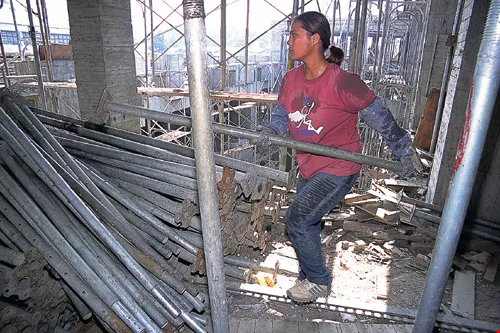
Their names have been removed from the national rolls, and their selfless worldview shaken on jobsites. Confronted by political and economic systems different from their own, Taiwanese Aborigines entering the mainstream prior to the mid 1990s almost always found themselves on the bottom rungs of urban society.
The road to autonomy
To honor President Chen Shui-bian's electoral promises and demonstrate goodwill, in 2003 the Executive Yuan approved draft legislation on autonomous regions for Taiwan's indigenous peoples. The draft stated that the Aborigines could use referenda to establish autonomous zones, then themselves hold elections for a chief executive and a legislature that would have a status equivalent to that of Taiwan's county and independent municipality governments. The legislation would also provide the zones with funding from the central government to finance their administration and foster their development.
Internationally, Aboriginal self-government has become a widespread trend, and more than 50 nations have already established autonomous regions.
According to Walis Pelin, minister of the Council of Indigenous Peoples, Aboriginal self-government should begin with "village councils." To build a foundation for future self-government, the CIP is currently promoting model village councils at 50 locations. Shanmei Village in the Mt. Ali area is a case in point. Its council persuaded villagers to sign an agreement to protect local streams in order to preserve the fish of the Tanayi Valley. Such local management of land and water resources provides a solid foundation for self-government.
After gaining recognition as an independent tribe, the Truku people, who have been among the most ardent Aboriginal activists for self-government, ran 29 separate publicity campaigns, one in each Truku village, to familiarize the entire tribe with the concept. The Truku completed a draft "Truku Self-Government Act" in 2005 and are expected to sign a self-government agreement with the President in 2006.
"If we don't change our social structure," says Lee Chih-shoon, "more subsidies and compensation from afar will merely slow the extinction of our people." Lee, whose Truku name is Tera Yadau, is the head of Truku Self-Government Promotion Commission.
But Sun Ta-chuan says that the outlook is not as rosy as it seems. Sun, whose warning that the Taiwan's Aborigines were facing extinction resonated strongly, says that the nature of the threat they face has changed. In the past, the danger was from external pressures. Now it is internal, originating in the fantasy that the good life is going to come to everyone immediately. "This makes for a much more frightening kind of decline," says Sun.
For example, the government currently offers a number of "benefits" to Aborigines, but many are illusory--the majority of Aborigines can't distinguish between them and don't keep up with them. When the draft act on Aboriginal self-government was passed, the tribes celebrated. But Sun notes that the draft only raises township administrations to the status of county administrations; it doesn't truly provide for Aboriginal autonomy. Moreover, Aborigines have long relied on money from the central government to get by, which is very much at odds with the notion of autonomy. Though President Chen has put forward the idea of a "nation within a nation," it clearly is going to be quite a long time before Taiwanese society as a whole accepts the idea of Aboriginal self-government and the legislature passes the relevant legislation.
If we put aside all the confusion at the movement level and instead recognize that Aborigines and Han live in the same world, one that seeks cultural diversity, then we need both cultures.
A Han Chinese university professor once went to a small fishing village in Hualien County for a meal and ordered a variety of seafood--fresh fish, prawns, shellfish and seaweed--from a stand. Half an hour later, the owner brought it all to him in one big pot. "How could you cook it like this," the professor exclaimed a little angrily. To which the boss, an Amis, responded, "They were all together in the ocean. Why would you separate them?" The culture and life-journeys of Taiwan's Aborigines are wildly different from those of the island's Han Chinese. As such, they are an excellent symbol of Taiwan's diversity.
A-mei's music, Aboriginal literature, pretty casual bags sewn from Aboriginal fabrics that look as good as international brands.... "Aboriginal culture is very visible and widely appreciated in Taiwanese society," says Sun. "There's no chance of it being again ignored or wiped out."
With 20 years of history now under its belt, we expect the Aboriginal peoples' movement to inspire more and more self-confident Aborigines to take action, whether on the streets or in the villages. When they do, all of Taiwan will welcome them with open arms and applaud their achievements. Moving forward, Taiwan's indigenous peoples' movement will challenge the island's Aborigines and Han alike, as well as you and me.
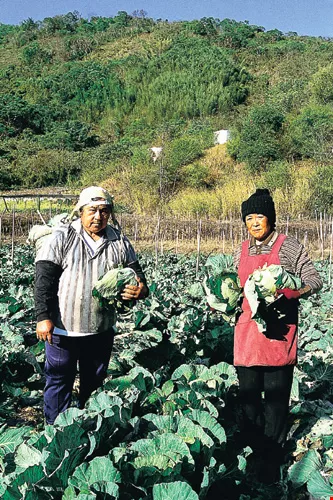
These days, few besides the elderly and the very young live in Taiwan's Aboriginal villages, making the question of how to provide opportunities in the villages for people of working age a pressing one.
Major Milestones in the Aboriginal Movement
1983 The Aboriginal underground publication Gaoshan Qing begins publication.
1984 The Association for Aboriginal Rights Promotion is estab-lished.
1986 The "Ten Golden Years" of ethnic struggle begin.
1989 Start of the movement to "Give Back Our Names."
The Aboriginal newspaper the Aboriginal Post begins publi-cation.
1990 The Association for Aboriginal Rights Promotion insists on use of the name "Aboriginal."
The magazine Hunter Culture begins publication.
1993 Large-scale demonstration to "Give Back Our Land."
Ministry of Interior revises "Standards for Determining Mountain Compatriot Status." Women married to Han Chinese are able to recover their Aboriginal status.
1994 Demonstrations to "include the rights to names, to land and to autonomy in the constitution."
The National Assembly amends the constitution and changes the words "mountain compatriots" to "Aboriginals."
The Name Act is amended and Aboriginals can restore their traditional names.
1996 The Executive Yuan establishes the Council of Indigenous Peoples.
1998 The Aboriginal Education Act is passed. Qualified Aboriginals are to be given preference for positions as prin-cipals, department heads and teachers in Aboriginal town-ship schools.
2001 The definition of Aboriginal status is broadened. One Abori-ginal parent is sufficient to establish Aboriginal status. The Indigenous Peoples' Employment Rights Protection Act is passed.
2003 The Executive Yuan approves the Draft Bill for Aboriginal Autonomy.
2005 The Aboriginal Basic Act is passed. The government is to liberally budget for assistance in the development of Ab-original autonomy.
(compiled by Tsai Wen-ting/tr. by Anthony W. Sariti)
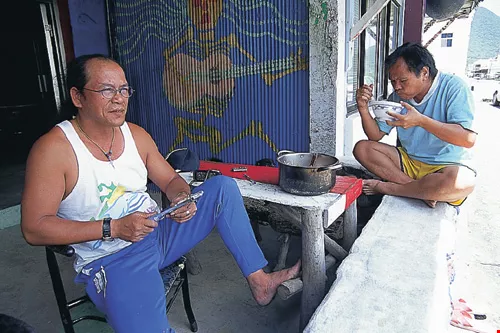
Whether struggling to be heard in the cities or returning to their home villages to put down roots, the brave youths who led the Indigenous Peoples' Movement 20 years ago are still fighting for what they believe in. Pictured is Syaman Rapongan.
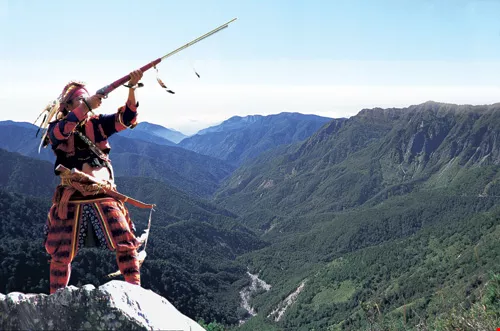
After more than 400 years of mistreatment, Taiwan's Aborigines finally voiced their anger and demanded the return of their right to self-determination.
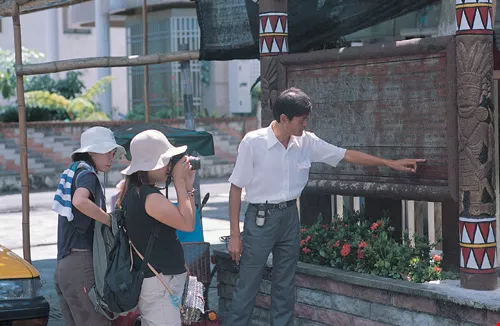
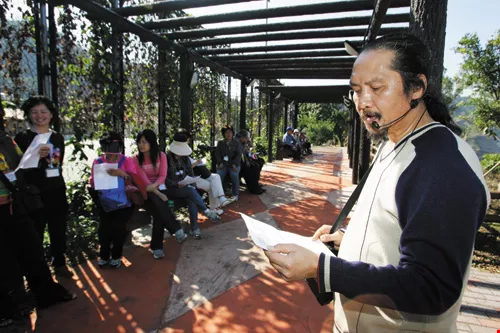
One result of the street protests and village revival efforts is that indigenous people in their villages now how have the confidence to describe the wonders of their culture to outsiders.
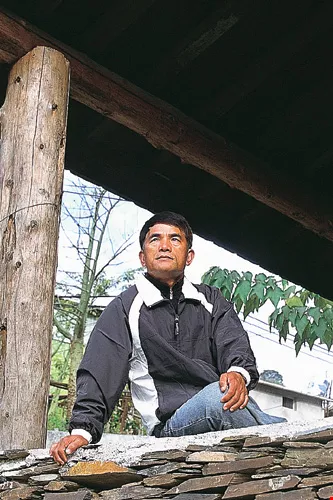
Whether struggling to be heard in the cities or returning to their home villages to put down roots, the brave youths who led the Indigenous Peoples' Movement 20 years ago are still fighting for what they believe in. Pictured is Iohani Isqaqavut.
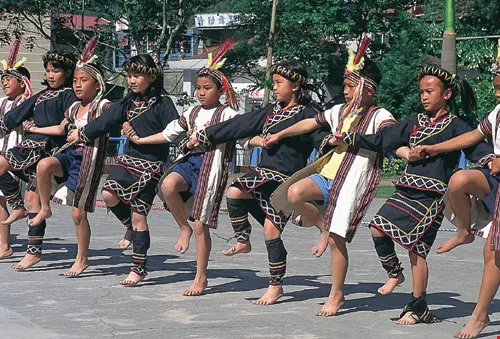
The decorative arts and dance of Taiwan's indigenous peoples, quite different from those of its Han majority, enrich the island's culture and are providing the raw materials for the cultural and artistic renaissance taking place in Aboriginal village workshops.
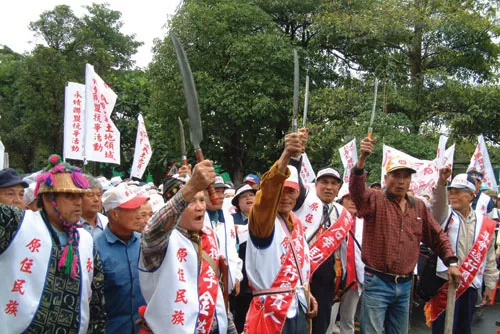
When the Alliance of Taiwan Aborigines was formed at the end of 1984, Taiwan's long silent indigenous peoples began to take to the streets. In 1986, the movement entered what was to be a decade-long golden age.
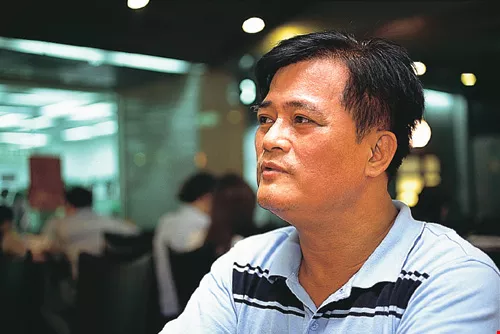
Whether struggling to be heard in the cities or returning to their home villages to put down roots, the brave youths who led the Indigenous Peoples' Movement 20 years ago are still fighting for what they believe in. Pictured is Sun Ta-chuan.


