

With the Chinese New Year--the Year of the Dog--almost upon us, people's minds and conversation are turning to dogs. Of all the domesticated animals, the dog's association with mankind has been the longest, and has given rise to countless legends and stories. But first let's talk about the dog's position in the Chinese zodiac.
The twelve animals or year signs of the Chinese zodiac as they are known today are the Rat, the Ox, the Tiger, the Rabbit, the Dragon, the Snake, the Horse, the Sheep, the Monkey, the Cock, the Dog and the Pig, each associated respectively with one of the 12 Earthly Branches, tzu, ch'ou, yin, mao, ch'en, ssu, wu, wei, shen, you, hsu and hai.
The dog is assigned to the 11th stem hsu, and is also associated with Earth among the traditional Five Elements (Wood, Fire, Metal, Water and Earth). This connection between hsu, Earth and the dog is recorded in ancient books as early as Lun Heng by Wang Chung (27 - c. 97) of the Eastern Han dynasty.
In fact, in still earlier times the dog did not count among the twelve zodiac animals. An almanac written on bamboo strips from the Ch'in dynasty (221-206 BC), discovered at Shuihudi in Yunmeng County, Hubei Province, shows a slightly different set of animals, which includes the deer but not the dog. Later, for some unknown reason, the deer was "squeezed out" and the dog pulled in to replace it.
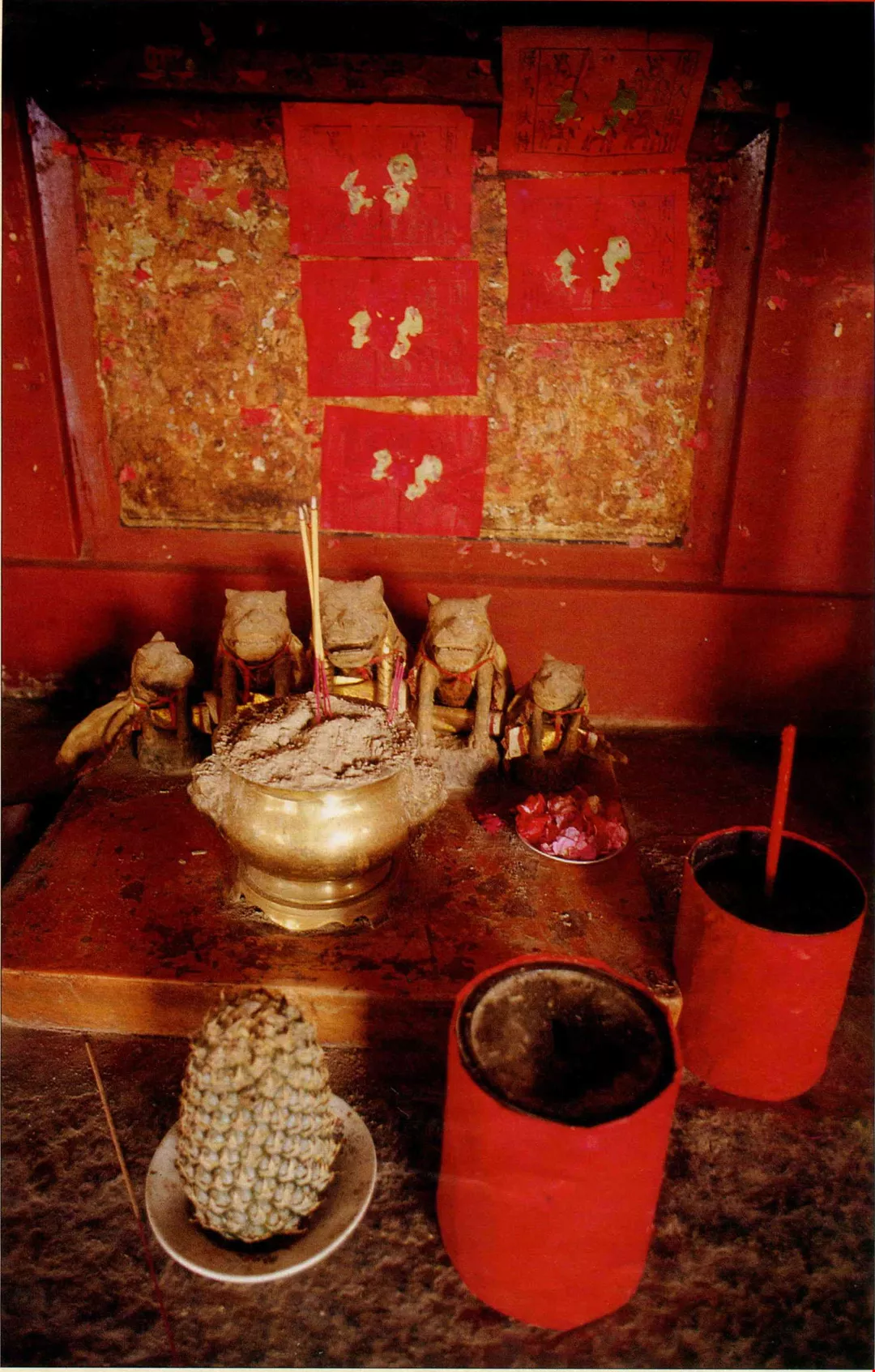
These five dogs large and small are revered in a Chinese temple in Malacca, Malaysia.
Totem worship
Some people believe that the origin of the 12 zodiac animals was the worship of totems, of which the dog was one. As far back as the time of the prehistoric matriarchal society, the primitive people living in the Yellow River valley had begun to keep dogs. Dogs were the first domestic animals to be reared by humans, and were not only intimately involved in people's daily lives on a practical level, but were also an indispensable part of life on the spiritual plane.
For instance, archaeological research shows that the custom of ritual burying of dogs existed as early as the Shang dynasty (c. 17-11C BC); divination records inscribed on shells and bones also contain much evidence.
The Chou Li (Ritual of Chou) describes an official rank of "dog man" whose job was to select dogs for ritual purposes and lead them to the ceremony. The Han dynasty (206 BC - 220 AD) had an official charged with rearing the emperor's hunting dogs, and in the Tang dynasty (618-907) there was even a special imperial kennels which raised hunting dogs for the emperor.
Long ago, primitive men had dances imitating animals. The "dance of the hundred beasts" was not a performance using real animals as in a circus, but a religious ritual dance similar to the annual nuowu dances to drive out evil.
The section on rites and ceremonies in the Hou Han Shu (History of the Latter Han Dynasty) tells how each year in the 12th lunar month, dances would be held to exorcise disease-bringing spirits from all around. The main characters in the dance were Fang-hsiang and 12 magical beasts, who had the power to drive out demons. The 12 beasts probably corresponded to the 12 months in the year and also to 12 points of the compass, and expressed the prayer that each month would pass safely and that the disease demons would be driven out from all quarters.
Dogs were also often looked upon as tribal ancestors. For instance, the Hou Han Shu records: "Ti-ku (one of the legendary five emperors reputed to have ruled in China from c. 26-23C BC) had a dog named Pan-hu. At that time, the army of the Ch'uen-jung (a tribe in northwest central China in ancient times) was strong. Whosoever would bring back the head of General Wu of the Ch'uen-jung would be rewarded with the hand of his youngest daughter. Pan-hu brought back Wu's head. The princess followed Pan-hu to the southern mountains and bore 12 sons and daughters, who married among themselves and multiplied." In other words, a dog named Pan-hu married the emperor Ti-ku's daughter, and fathered six sons and six daughters to become the founder of a clan. This story is also the origin of the Japanese legend Satomi Hakken Den (The Eight Dogs of Satomi, recently dramatized as a film).
To this day, some minority peoples in China such as the Miao, She, Yao, Li, Tung, Chuang and Wa still have the dog as their tribal totems, and in some places still make sacrifices to Pan-hu and abstain from eating dog meat.
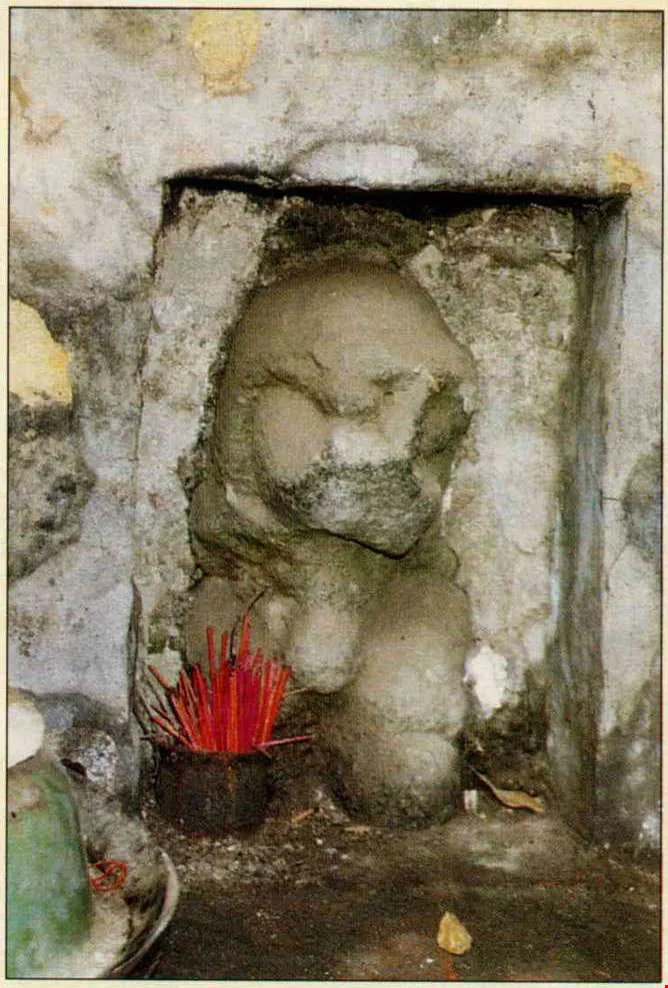
A shrine to Kou She Yeh in a temple to the God of the Earth in Quanzhou, mainland China. (photo by Chuang Po-he)
The dog's power over evil
Humans' reverence of the dog naturally brought with it the idea that the dog could ward off evil. The phrase "to have one's head spattered with dog's blood" nowadays means to be cursed roundly, but in fact dog's blood was once credited with the same mysterious powers as chicken's blood.
For instance, in his notes to Erh Ya (China's oldest dictionary, probably dating from the early Han dynasty), the Chin dynasty savant Kuo Pu (276-324) wrote: "It is a custom today to dismember a dog in the middle of a wide road, which is said to stop the wind"; which is to say that by killing a dog on an exposed highway, one could temper the force of the wind. And the Shang Shu (Book of History, one of the Five Classics) says that in a certain place there were nine wells. In time of drought, if dogs were killed and thrown into these wells, heavy rain was sure to fall. This reveals that killing dogs was seen as a way of making rain.
Feng Su Tung (Penetrating Popular Ways), by Liu Hsiang (c. 77-6 BC) of the Han dynasty recounts that the first Ch'in emperor would kill a dog and smear its blood at the four gates to ward off evil spells. This was behind the later custom of killing a white dog in the first lunar month and smearing its blood on the doors of one's house.
To this day, there are customs involving the veneration of dogs in many parts of Taiwan. Most honor the memory of canine acts of faithfulness. The faithful dog revered in the temple to the "18 princes" is one example.
It is told how once during the Ch'ing dynasty (1644-1911) a large sailing ship was struck by a typhoon, and was lost with all hands. The wreck drifted onto Taiwan's north coast between Tanshui and Shihmen. 17 sun-bleached corpses littered the shore, with only a faithful dog watching over them day and night, whining plaintively and refusing to take food or water. Moved by this piteous scene, the villagers took the bodies and buried them at the foot of a hill. But to their surprise the faithful dog jumped into the open grave and could not be persuaded to come out. Touched, the villagers finally fulfilled the dog's wish to be buried with its masters, and called the dog and the sailors the "18 princes." Legend has it that later the souls of the 18 princes would often appear to protect the villagers from danger when they were out fishing, and so the villagers built them a temple, where incense is still burned in their honor today.
Of all the dog spirits, perhaps the most interesting is "Kou She Yeh," who is revered in Quanzhou, a town on the coast of mainland China's Fujian Province.
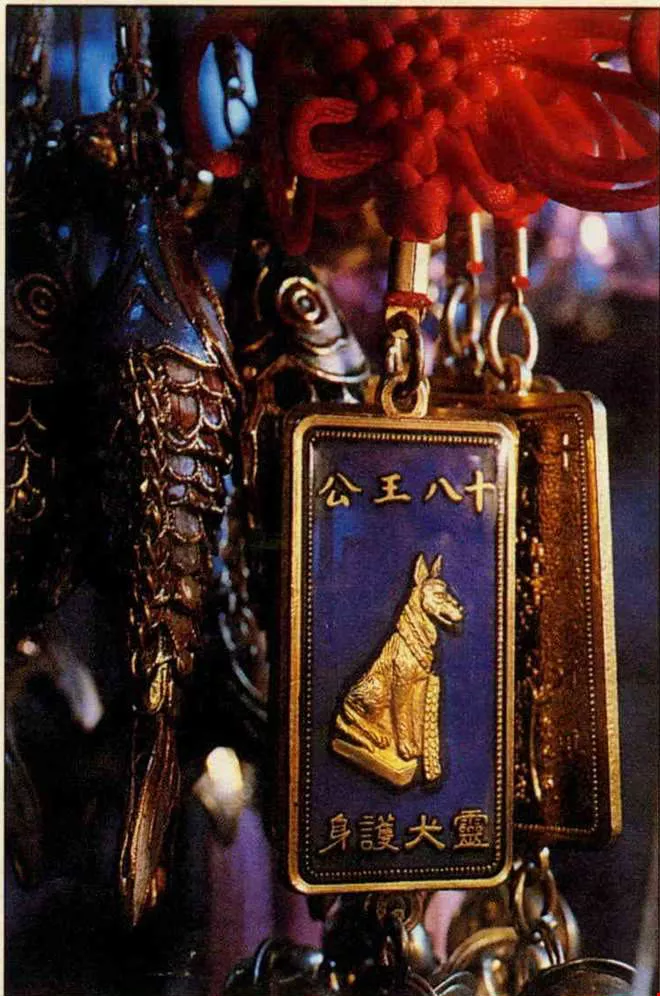
Worshippers flock to the Temple of the 18 Princes from far and wide. These dog amulet keyrings are especially popular with motorists. (photo by Chen Ping-hsun)
Kou She Yeh
Kou She Yeh is either found below temples to the God of the Earth or is revered separately, and his veneration is widespread among the people of Quanzhou. Kou means dog and Yeh is a respectful form of address for elders. She is an old word formerly used in southern Fujian and in Taiwan to address local people of wealth and status. To use this term of respect for a dog, elevating it to the level of a person of status, shows that he is no ordinary hound.
Kou She Yeh is the protector of small children, and keeps them safe from harm. In particular, when children are afflicted with itchy sores the grown-ups ask Kou She Yeh to bless an oblong strip of yellow paper which they rub on the afflicted part, and this is said to cure the sores completely.
Preposterous as this claim seem, it reflects the reverence in which dogs are held by ordinary people.
The ancients' choice of the 12 animals of the Chinese zodiac and the order in which they are arranged no doubt had its own logic, and since that time people have tried to fit many facts into the same theoretical framework to suit their various needs.
For instance, dogs have always been afraid of tigers, and this has been tied to the fact that the dog in the zodiac is linked to the element Earth, while the tiger is associated with Wood. According to the theory of mutual generation and domination between the Five Elements, Wood dominates Earth, and so the dog is dominated by the tiger (as are the ox and the sheep, which are also associated with the element Earth).
In terms of Yin and Yang, the Earthly Branches tzu, yin, ch'en, wu, shen and hsu are associated with Yang (the positive or masculine force), while ch'ou, mao, ssu, wei, you and hai are associated with the negative or feminine Yin. The division into Yin and Yang can also be seen in the numbers of toes on the feet of the 12 zodiac animals. Those with an even number of toes are Yin, while those with an odd number are Yang. The dog has five claws on each paw, and is therefore a "Yang" animal. In the Eight Trigrams, Yang is represented by an unbroken line, which with the broken line for Yin becomes the basis of divination.
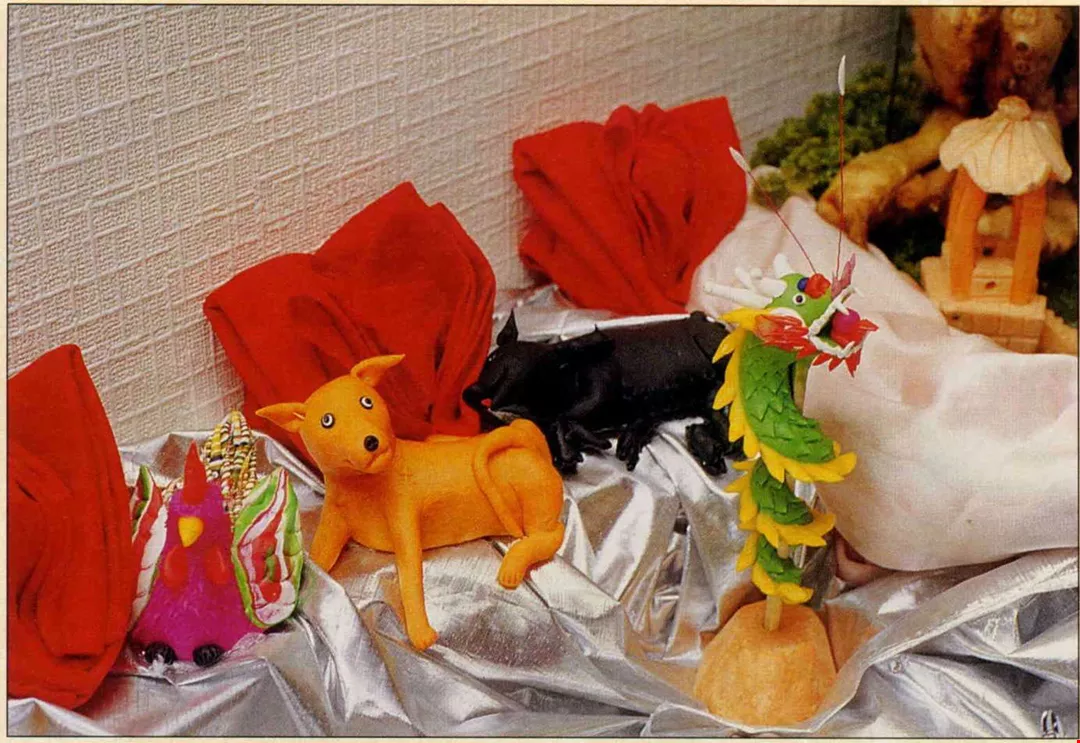
Dough figures such as these often depict the 12 Chinese zodiac animals, including the dog. (photo by Vincent Chang)
Zodiac animal taboos
Everyone has their own zodiac animal, and many people are either strongly attracted to or strongly repelled by their own birth sign animal.
The Sung dynasty emperor Hui Tsung (ruled 1100-1125) was born in the Year of the Dog. One year, at the suggestion of a fawning minister out to ingratiate himself, the emperor issued an edict banning the slaughter of dogs. But there were some dissenters who said: "The emperor Shen Tsung (ruled 1067-1085) was born in the Year of the Rat, but when he was on the throne nobody said people couldn't keep cats!"
For the same reason, the Ming dynasty emperor Cheng-teh (ruled 1505-1521) once forbade the keeping of pigs, for he was born in the Year of the Pig and was also surnamed Chu, which in Chinese is homophonous with the word for pig. And the Ch'ing dynasty Empress Dowager Tsu-his (1835-1908) once banned opera performers from singing the line "when the sheep goes into the tiger's mouth it won't come out again" from the opera Lu Tang Chun--naturally because she was born in the Year of the Sheep.
Chinese has many idiomatic phrases involving dogs. Many also refer to chickens, and although this is doubtless because the chicken and the dog are the most typical and representative of the domestic fowl and animals, it also reflects the fact that the chicken and dog are adjacent in the sequence of the 12 zodiac animals.
For instance, "when a man gains enlightenment, even his chickens and dogs ascend to heaven" (when a person gains power, everyone connected with him benefits); "even chickens and dogs are not left in peace" (general turmoil); "she who is married to a chicken must follow the chicken, she who is married to a dog must follow the dog" (a woman has no choice but to share her husband's fate); "chickens flying and dogs jumping" (panic and disorder); "hearing each other's chickens and dogs" (living close side by side); or "able to crow like a cock and snatch like a dog" (only having paltry little skills) are all colorful and amusing expressions.
In Taiwan, it is a popular custom at the Winter Solstice and at festivals to shape "mother hens and puppy dogs" from balls of rice flour dough. As well as being a pet name for small animals, this name also expresses how the dog follows the chicken in the 12 zodiac animals.
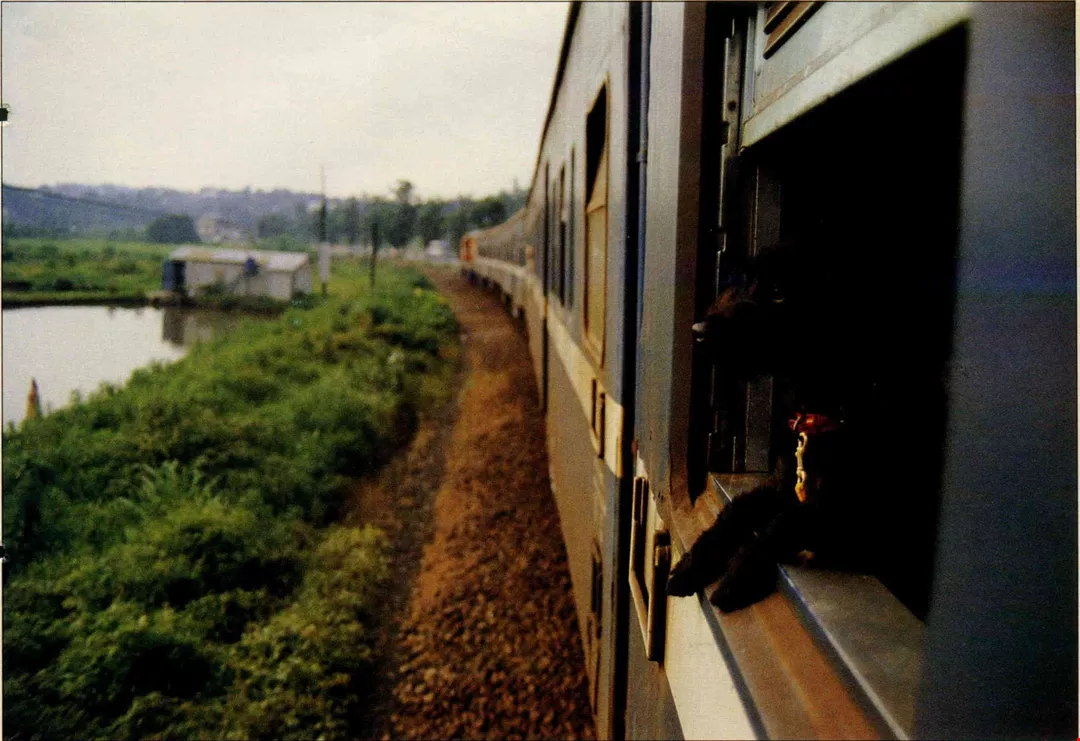
In seemingly pensive mood, a dog gazes into the distance from the window of the Tanshui train, which no longer runs.
Dog bites rat
The common idiom "a dog biting a rat" refers to someone meddling in other people's affairs.
But history shows that for a dog to bite a rat was once something perfectly respectable. Both written and archaeological records show that in early times, the Chinese were in the habit of keeping dogs as mousers. From Lu Shih Ch'un Ch'iu (The Spring and Autumn Annals of Mr. Lu, collected by Lu Pei-wei (d. 235 BC) of the Warring States period), Tai Ping Yu Lan (written at the command of the Sung emperor from 977 AD onwards) and You Ming Lu (by Lin Yu-ching(403-444) of the Southern Sung dynasty), we can see that it was nothing unusual for people in ancient times to buy or rear dogs to combat rodents. This is backed up by archaeological finds such as a stone carving from the Han dynasty showing a dog biting a rat, which was unearthed at Chengdu in mainland China's Sichuan Province.
Zoologists too observe that humans began to keep dogs before they began to keep cats, and may well have also used dogs as mousers earlier than cats. But as cats are better than dogs at climbing beams and squeezing through holes, they seem more suited than dogs to hunting mice in the confined spaces of a house. Thus responsibility for catching mice gradually shifted from dogs to cats, while the dogs were left with the task of keeping watch.
Thus for humans to accuse a dog which by instinct or in memory of its old task catches a mouse, of meddling in other's affairs, is really more a sign of meddlesome humans' forgetfulness!
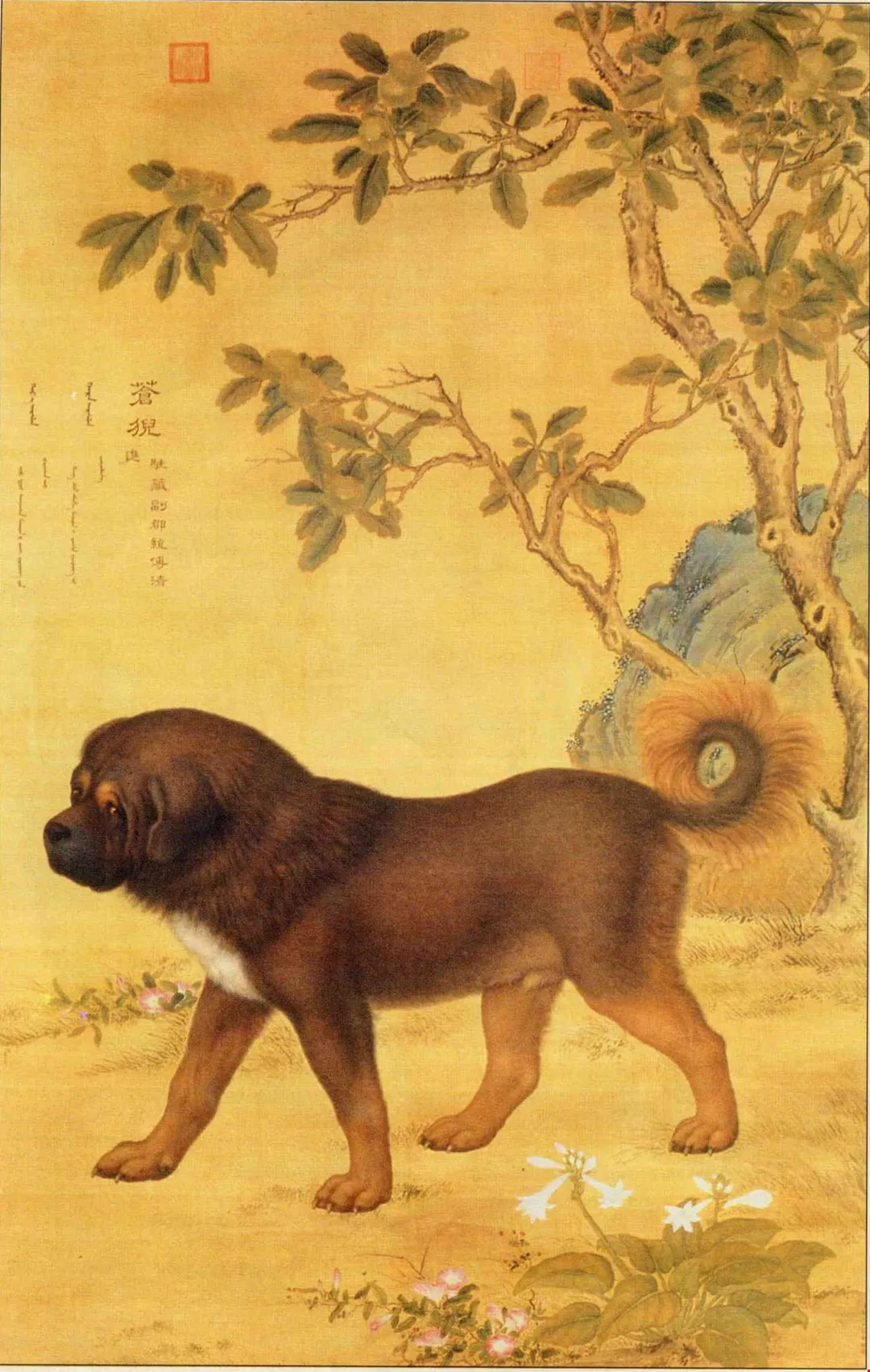
Black Lion, a pedigree dog named personally by the Ching emperor Chien-lung, as depicted by the ltalian missionary painter Giuseppe Castiglione (1698-1768). (courte sy of the National Palace Museum)
Dogs fear tigers
Among the 12 zodiac animals, the tiger is another which is often mentioned together with the dog. Of course, the dog is no match for the tiger's fearsome strength, except in a few cases such as in the expression "a tiger away from the mountain is at the mercy of dogs," or the chuoch'uen or luch'uen, a strange beast which could fly and which ate tigers and leopards, mentioned in Chou Shu (History of the Northern Chou Dynasty) and in San Ts'ai T'u Hui (Assembled Pictures of the Three Realms, compiled in 1607 by Wang chi of the Ming dynasty).
It is said that if a tiger eats a dog, it will be as if drunk. Mao T'ing K'e Hua, compiled by Huang Hsiu-fu of the Northern Sung dynasty (960-1127), recounts the following legend: "Any tiger which eats a dog is sure to be drunk, for a dog is as wine to a tiger."
Of course, next to a tiger a dog doesn't look half so impressive, and in the expression "trying to draw a tiger and ending up with the likeness of a dog" (wildly overestimating one's own abilities) the dog becomes an object of ridicule.
Actually this is partly because since people feared vicious dogs, it was only natural for them to compare them jestingly with the even more ferocious tiger, as in this joke about an "illiterate dog":
In olden times legend had it that the written character for tiger, or the character for the tiger's associated Earthly Branch yin, had the power to subdue a dog. There was once a dog which liked to bite people, and everyone was afraid of it and did not dare to pass it. Then a monk said: "If you write the character for 'tiger' on the palm of your hand, and show it to the dog, it will not dare to bite you." Later, someone really tried this out. When he saw the dog, he wrote 'tiger' on the palm of his hand and walked towards the animal, stretching out his hand in front of its face. But to his surprise, without a sound the dog suddenly sank its teeth into his hand. When the man told the monk what had happened, the monk said: "Why, that dog must be illiterate!"
This joke is widely known in Japan, and is said to have originated in China.
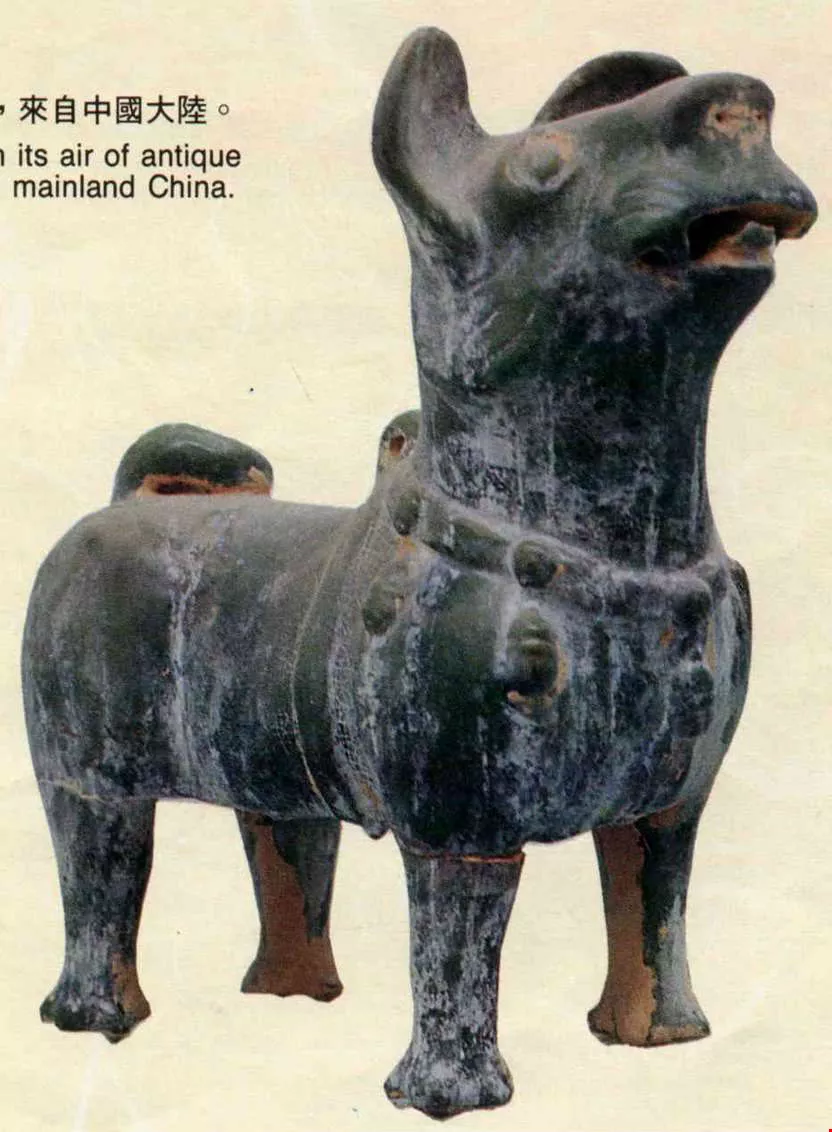
This ceramic dog with its air of antique simplicity comes from mainland China.
Why dogs hate cats
Although a tiger may be "at the mercy of dogs when away from the mountain," generally speaking the tiger is many times more formidable than the dog. But the tiger's cousin the cat is no match for the dog. It is as if the creator had deliberately set out to tease, and after creating the tiger to overawe the dog, also created the cat for the dog to bully. Thus it seems quite natural for the cat to fear the dog just as the dog fears the tiger, and this has become the stuff of many folk stories.
In the Baltic country Estonia, the following tale is told about the enmity between cats and dogs:
In days gone by all the animals were the best of friends, but then a dog ate a rabbit in the woods, and all the animals went up before God to complain of the dog's crime. But when God interrogated the dog, the dog asked in return how he could live if he could not eat meat. So God had no choice but to allow him to eat other animals which had fallen to the ground, and at the dog's request issued him with a license to show his authorization. The most trusted of all the dogs was the sheepdog, so the license was given to the sheepdog for safe keeping. But when autumn came, which is the busiest time for sheepdogs, he found that he could not carry the license with him and had nowhere dry to keep it, so he had no choice but to leave it with his friend the cat. The cat readily agreed, and she put the license up on top of her stove. Later, a dog saw a young colt which had fallen down in the forest, and rushed forward to kill it and eat it. The other animals again denounced the dog, who was found guilty. But the dog did not submit to this verdict, saying that the license allowed him to eat any animal which had fallen down, and said nothing about whether it had to be dead or alive. To prove the case, the sheepdog hurried to ask the cat to return the license which had been left in her care.
But the license had already been torn to shreds by mice. The cat was so angry that ever since, she has done her best to punish any mouse she has seen, while the dog hates the cat to this day for her untrustworthiness. As for the sheepdog, having lost the license he no longer dared to face the rest of his kind, and ran away to hide. Even today, whenever a dog meets another dog it will go right up close to it, and they say that this is to ask whether the license has been found again.
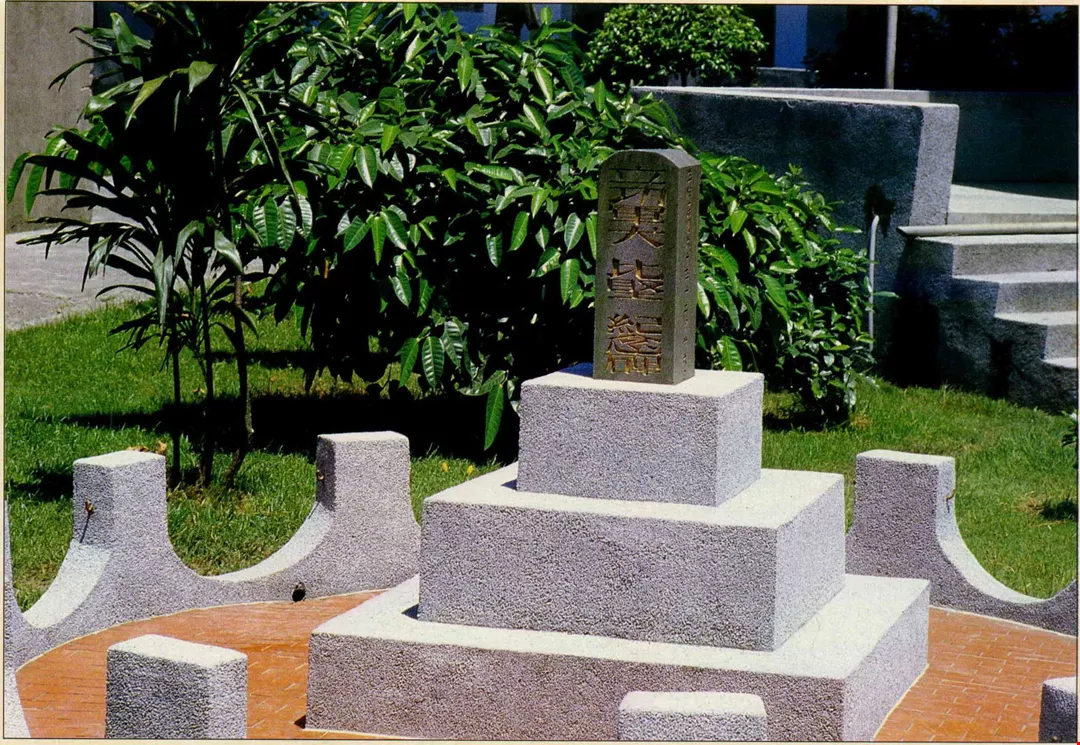
Dogs' loyalty and intelligence have allowed them to shoulder heavy responsibilities as working animals. Their role in the military is a prime example. The army has often raised memorials to service dogs which have died in action. (Sinorama file photo)
Many folk tales
In Romania, another legend is told:
In the beginning, when the dog and the cat were working for Adam, they were both very conscientious and got on very well together. To keep things running smoothly they agreed that the dog would take care of matters outside the house, while the cat would see to things inside. They signed an agreement, which the cat hid between the rafters of the ceiling.
Later the house was constantly bothered by sprites and demons, and because the dog was in charge of everything outside the house, he was soon rushed off his feet. The dog grew more and more angry, thinking that he was doing all the hard work for the whole household, protecting the house from thieves in all weathers, but all he got to eat was a few scraps or bones or sometimes even nothing at all, while the cat was always able to eat her fill and sleep in safety and comfort next to the stove. This unfair treatment finally caused the dog to fly into a rage. But the cat, because of their previous agreement, insisted that things should stay just as they were. "OK," said the dog, "bring out that agreement and let's see it!"
Naturally the cat climbed straight up to the ceiling to fetch out the agreement, but because the paper had been stained with grease, it had long ago been eaten by the mouse, who had been attracted by the scent. In her anger, the cat caught and killed the mouse. Because the cat could not produce their agreement, the dog continually tried to catch her to pay her back. And so to this day, whenever a dog sees a cat, he is sure to ask her what became of their lost agreement, and whenever a cat sees a mouse she will ask it the same question.
Be that as it may, last month Taiwan's Liberty Times newspaper reported the strange case of a mother dog suckling a kitten. A bitch living on the grounds of Chungcheng Elementary School in Hualien City had given birth to a litter of puppies, but unhappily several had died. By chance, the grief-stricken animal came upon a new-born kitten which someone had abandoned, and transferring her motherly love to the kitten, carried it home to feed with her pups.
In fact this is not the first report of this kind, and so we can see that although dogs and cats are not usually on friendly terms, this is not always the case.
Let's finish with two stories about vicious dogs:
According to a story in Han Fei Tzu, there was once an inn in the state of Sung which sold wine of the finest flavor at a very reasonable price, and never gave short measure. The inn-keeper was friendly and courteous, and the eye-catching flag above the inn could be seen clearly from afar. But strange to say, despite the inn's many advantages, fewer and fewer guests graced its doors, and the wine would often turn to vinegar before it could be sold. Searching for the explanation, the inn-keeper finally discovered that everyone was afraid of the ferocious dog which he kept at the inn, and naturally no one dared to come and drink there. Thus the saying goes: "A fierce dog will leave wine sour and unsold."
The natives of New Britain Island in the south Pacific say that dogs once walked upright and could move at great speed, so that many people were eaten by them. After discussing what to do, the surviving people roasted breadfruit to scalding heat, and spread the seeds in the dogs' path. When the dogs stepped on the seeds they yelped with pain and fell to the ground, so that their hands were burned too. Since that day they have never been able to stand upright again, and the hard breadfruit seeds still stick to their paws.
[Picture Caption]
p.28
This rubbing showing a dog biting a rat is taken from a atone carving excavated from a Han dynasty cliffside burial site in Sichuan. (courtesy of Chuang Po-he)
p.28
1994 is the Year of the Dog, so of course the dog is the star of this year's New Year postage stamps. (courtesy of the Post Office)
p.29
A dog enjoys the cool shade of some clothes hung out to dry.
p.30
These five dogs large and small are revered in a Chinese temple in Malacca, Malaysia.
p.31
A shrine to Kou She Yeh in a temple to the God of the Earth in Quanzhou, mainland China. (photo by Chuang Po-he)
p.31
Worshippers flock to the Temple of the 18 Princes from far and wide. These dog amulet keyrings are especially popular with motorists. (photo by Chen Ping-hsun)
p.32
Dough figures such as these often depict the 12 Chinese zodiac animals, including the dog. (photo by Vincent Chang)
p.33
In seemingly pensive mood, a dog gazes into the distance from the window of the Tanshui train, which no longer runs.
p.34
Black Lion, a pedigree dog named personally by the Ching emperor Chien-lung, as depicted by the ltalian missionary painter Giuseppe Castiglione (1698-1768). (courtesy of the National Palace Museum)
p.35
This ceramic dog with its air of antique simplicity comes from mainland China.
p.36
Dogs' loyalty and intelligence have allowed them to shoulder heavy responsibilities as working animals. Their role in the military is a prime example. The army has often raised memorials to service dogs which have died in action. (Sinorama file photo)
p.37
These fu or talismans were used in Taiwanese folk culture to improve thefortune of sickly children. (courtesy of Chuang Po-he)
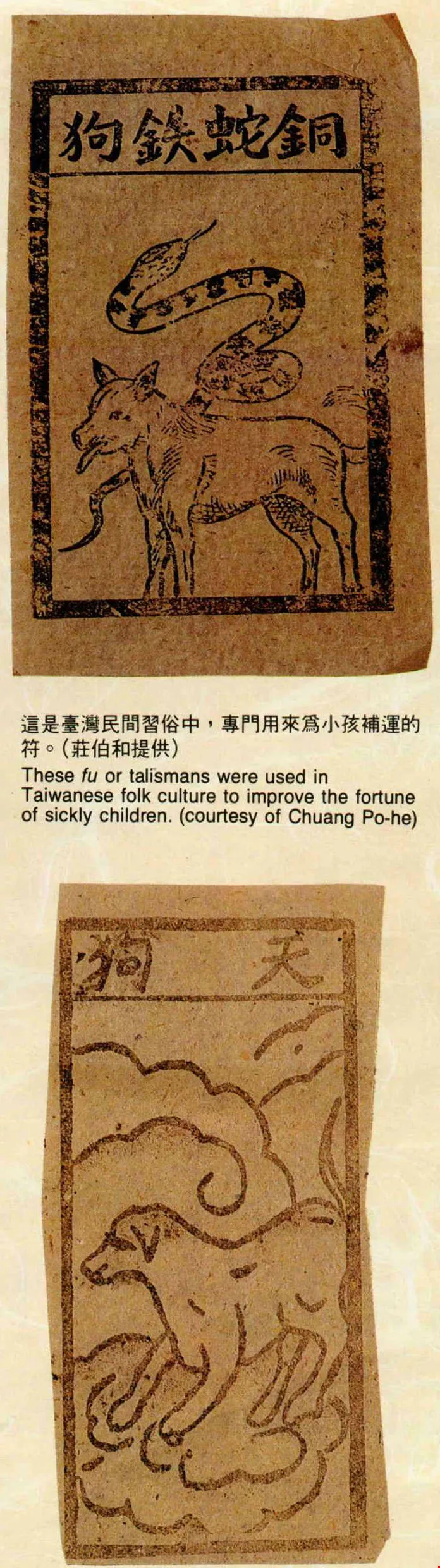
These fu or talismans were used in Taiwanese folk culture to improve thefortune of sickly children. (courtesy of Chuang Po-he)


@List.jpg?w=522&h=410&mode=crop&format=webp&quality=80)


@List.jpg?w=522&h=410&mode=crop&format=webp&quality=80)
