Poor Boy Makes Good: Vice Premier Lai In-jaw
Eric Lin and Anna Wang / photos Pu Hua-chih / tr. by Phil Newell
June 2001


"High moral character; a light heart." The wood engraving on Lai In-jaw 's wall reveals a heart that is at peace and not filled with ambition.
Life doesn't always go in a straight line, but it always goes forward. Born in Ilan and educated at an agricultural school, Vice Premier Lai In-jaw had a desire to learn that no hardship could hinder. He eventually earned his doctorate in law, and attained his dream of becoming a Supreme Court justice. From the law he has also branched out to hold a financial portfolio, serving in important posts under past Kuomintang administrations, in the provincial government under James Soong, and now under the Democratic Progressive Party administration. Respected by the politically savvy of all stripes, he is today seen as an important navigator for Taiwan's economy.
What kind of person is Lai? How has he gotten to where he is today? How does he see Taiwan in this time of transformation? How will he help the premier in dealing with current hard times?
On May 20, on the first anniversary of the coming to power of the Democratic Progressive Party administration, some were celebrating the stability of the transition of power, while others were making more critical assessments. Meanwhile, Vice Premier Lai In-jaw, representing the government at a finance conference where business people pleaded with government and opposition parties to put political squabbling aside and focus on the economy, was quoting President Chen Shui-bian to the effect that successful economic recovery depends on the participation of government, business, and ordinary citizens. More concretely, he spoke of the government's determination to come up with better policies for labor-management relations, mergers and acquisitions, high-tech industry, biotechnology education and training, and reform of the financial system.
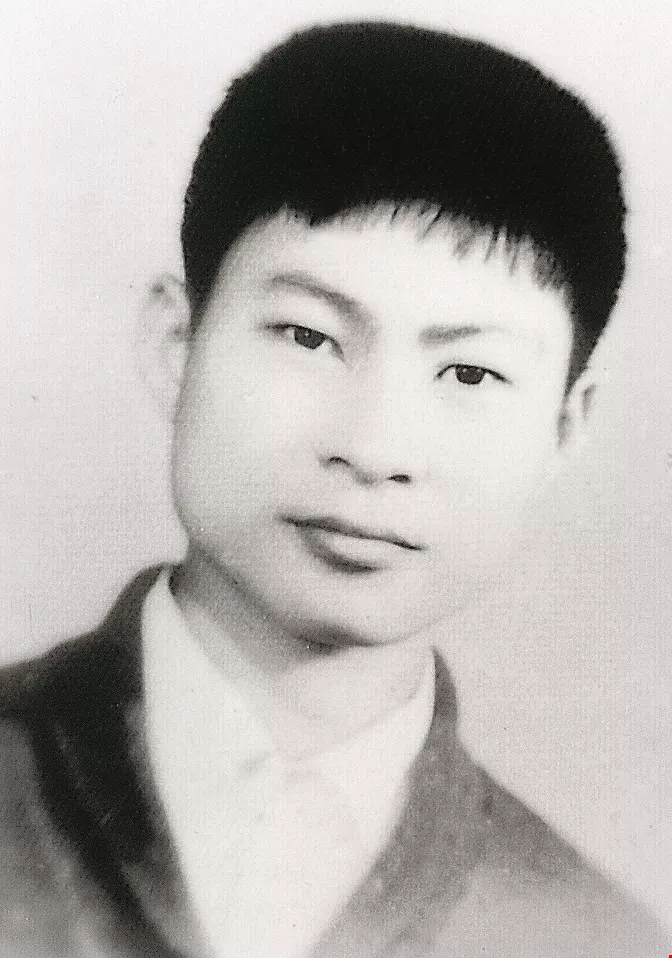
A photo of Lai in his agricultural school; he looks straightforward and unassuming, like a typical country kid. (courtesy of Lai In-jaw)
Transcending boundaries
Lai In-jaw is unusual in the domestic political scene, for he is respected by all parties. He has great experience in law and finance, and has served as president of the Graduate Institute of Law at Chunghsing University; as head of the Department of Customs Administration, standing vice-minister, and political vice-minister in the Ministry of Finance; head of the Taiwan Provincial Department of Finance and provincial vice-governor; and as a justice of the Supreme Court. He is one of the few people to hold important positions under different parties and factions.
He has been described by the media as "capable and above the fray." He has not only avoided being dragged into political struggles, he has literally risen above them to put his specialized knowledge to work for the government in ever more important roles. Lai's stock was never higher than during the controversy over the freezing of the provincial government, when he stayed aloof from both the mainstream and non-mainstream factions of the Kuomintang. Eventually, he was able to escape from the controversy completely after being appointed a Supreme Court justice by President Lee Teng-hui.
He keeps out of political infighting, but doesn't turn down opportunities to show what he is made of. After the resignation of the Tang Fei cabinet last October, in hopes of doing something for the economy, he accepted a role as one of the economic helmsmen for the new administration.
Taiwan has not been democratic for long, and the political atmosphere is thick with ideology. There is often pressure to "choose sides." But through it all Lai has carried himself with the dignity of a scholar. Where does he get it from?
Lai laughs and quotes from the Taoist classic of Lao Zi: "Yet here are three treasures that I cherish and commend to you. The first is compassion, by which one finds courage. The second is restraint, by which one finds strength. And the third is unimpor-tance, by which one finds influence." He not only calls forth such quotations with easy familiarity, but takes them to heart. He is a great admirer of ancient wisdom, and writings 2500 years old seem to him just as relevant today as ever. They are an inexhaustible supply of inspiration for him. In fact, Lai's own writings and letters are peppered with ancient poems and maxims. He has said many a time that he would have loved being a professor of Chinese literature and language, and his love for this realm goes back to his youth.
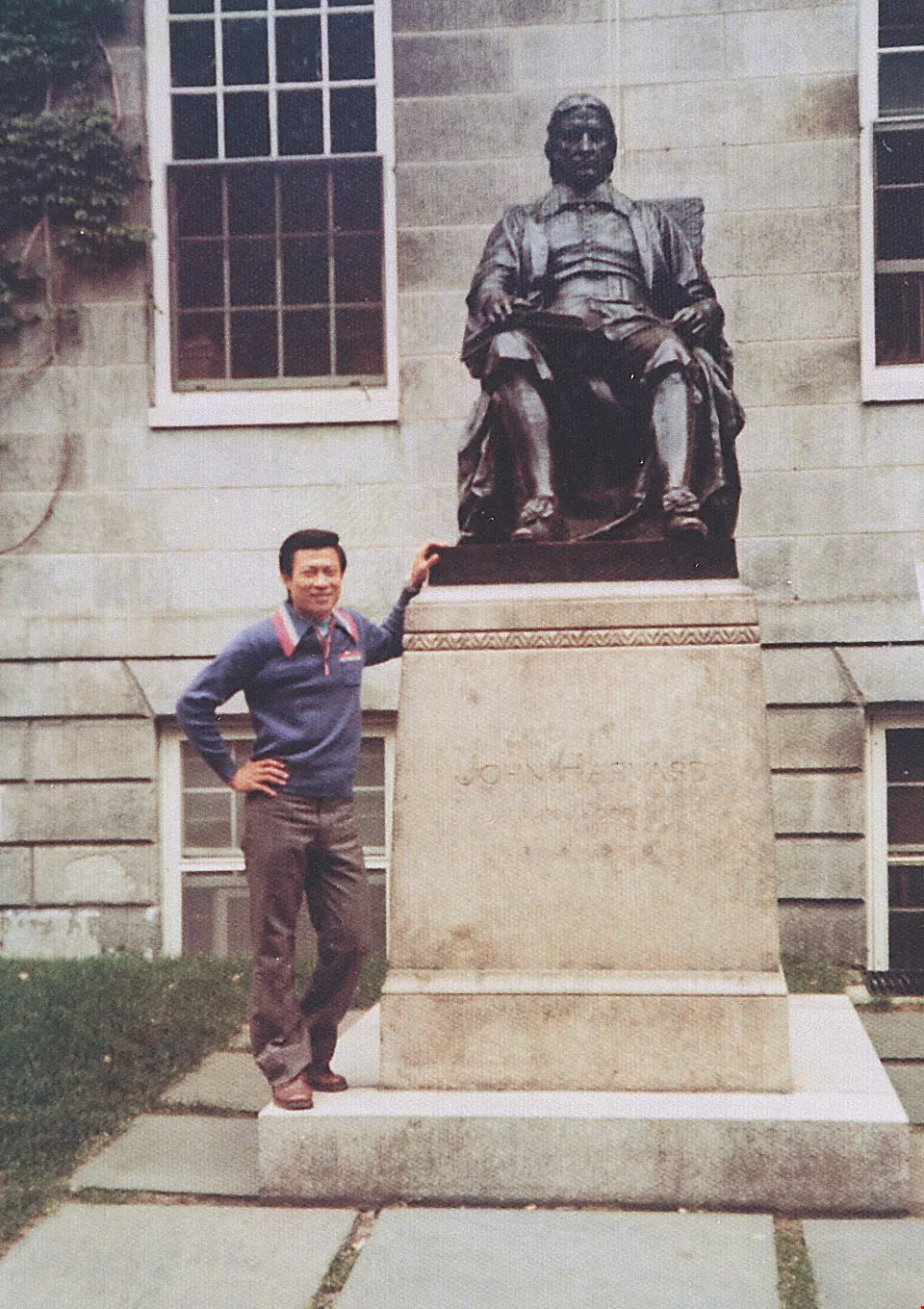
In the 13 years after his military service, Lai completed his BA, two MAs, and a PhD. The photo shows Lai at Harvard, which he attended after winning a government scholarship. (courtesy of Lai In-jaw)
Wild swan prints in the snow
Lai, who was born a year after Taiwan came under the control of the ROC, still recalls that in the rural Ilan of his youth, learning was in short supply, and the most treasured gift a child could receive was a book. He has since then always treasured books. The first one he ever received, a gift from his father when Lai was in third grade, was Three Hundred Tang Dynasty Poems.
That book cost NT$10, which was a lot of money in those days. He more than made the purchase worthwhile, however, by reading it cover to cover many times, until he could quote from it effortlessly.
Tang poetry was an eye-opener, giving him a thirst for more. Even today, outside of his own specialties, he still reads a lot of ancient writings. He reveals that he buys such books by the set, which saves him time choosing books and also ensures that he doesn't just stick to what he knows and likes already.
There is a poem by the Song Dynasty literary giant Su Dongpo which comments on the uncertainty of life, drawing on a lovely metaphor: "A magnificent bird has left its tracks in the snow; who knows where it came from or where it has flown to?" Directed to a former friend with whom Su spent days in a monastery while they were taking imperial exams together, the poem continues: "The old monk is dead, and a new facade rises in the old place. Do you still remember those days gone by?" Lai often quotes this work as a reflection on the impermanence of life.
"We are all like wild swans leaving our marks in the snow, it's just that our inner worlds are very different," says Lai. Some people despair in the face of difficulties, but others just wipe away their tears and move on.
Lai's grades in primary school were exceptional, but he missed the train on the day he was to take the middle school entrance exam. One of his elementary school teachers, recognizing his talent, convinced Lai's father to allow the boy to enter a five-year agricultural school.
Originally Lai figured he had no hope of getting much formal education, and often compared himself to the self-educated scholar Wang Yun-wu. So when he was in school he read widely, even covering "existentialism," which was in vogue for a time.
Though Lai read a lot of famous books as a youthful intellectual, he had a particular reaction to existentialism. At that time, he recalls, most people thought existentialism was decadent and degenerate. But in reading Camus' work The Myth of Sisyphus, he was inspired with the idea that, as a human being, one exists and has a nature or condition, and from that one must struggle. Whether this is what Camus meant or not, what matters to Lai is that this idea is similar to that of the ancients that great men are not made by circumstance, but by their own efforts, and the fire of desire to learn burned even brighter.
After graduating from agricultural school, Lai began his compulsory military service. When he served as platoon education director at Chengkungling, he borrowed from his platoon all the middle school texts he had never had a chance to read, and bored through them systematically using every free moment. He would even stuff a book in his uniform when going out for calisthenics. Though his company commander initially ridiculed him and discouraged him, the commander was eventually moved by Lai's dedication and self-motivation. Thus began a pursuit of knowledge which carried him for the next 13 years through university and to the attainment of his Ph.D.
Lai recalls that when he was preparing for the college entrance exam, he got up every day at 4:00 a.m. and went to a road in the camp to study by the feeble light of the streetlamps. He only went back to the barracks after reveille at 6:00. When his unit went into the field, he would take a textbook along, and read whenever he got the chance. On hot days, his books became soaked in sweat.
His habit of studying at every free moment not only enabled him to test into his first preference-the Department of Law at Chunghsing University-it allowed him to consistently be first in his class despite working while in school.
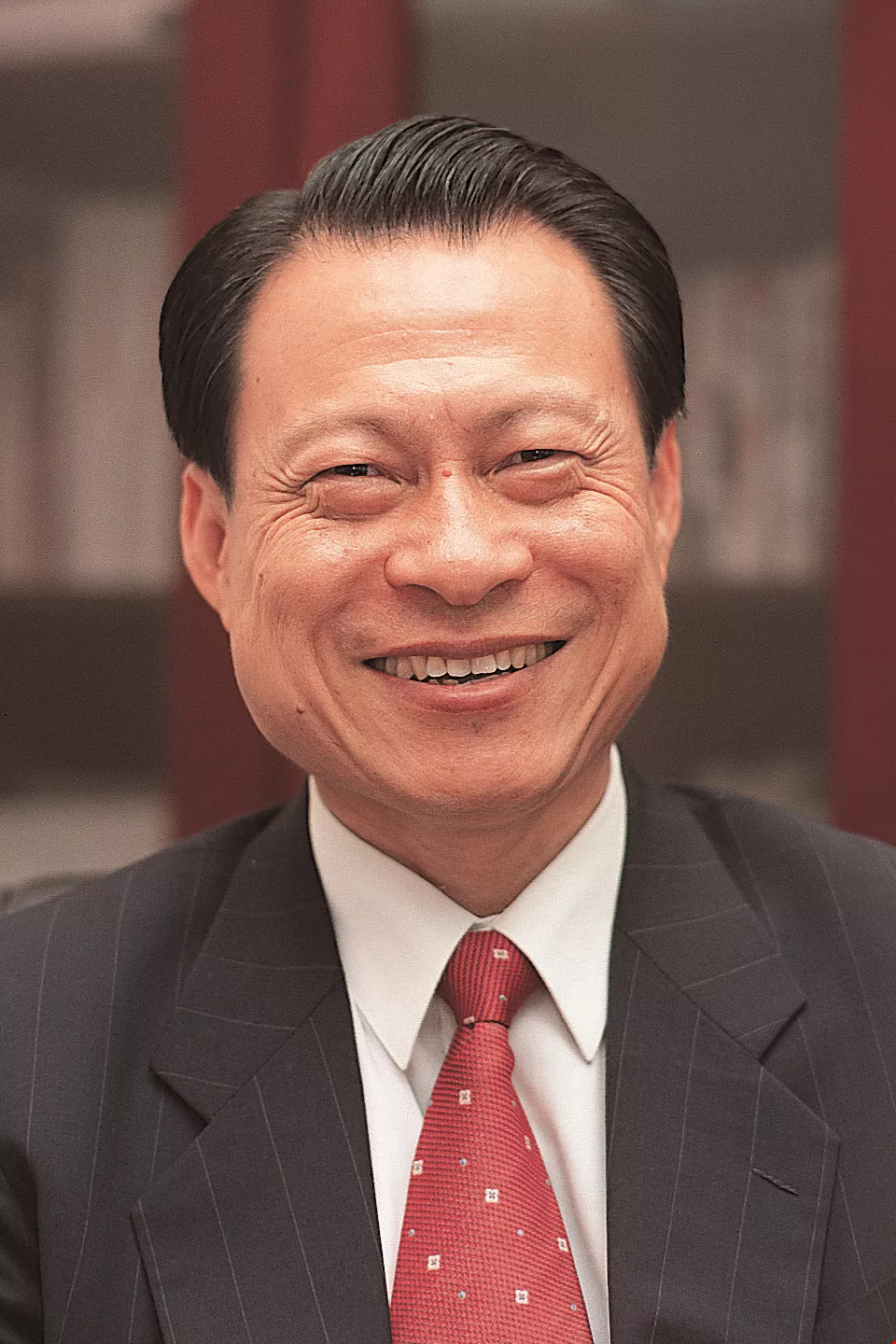
An expert in law and finance, Lai is also a lover of the Chinese classics, especially the poetry of Su Dongpo. Below is a quote from Lao Zi that Lai wrote out for us.
Errata
During his five years in university, Lai worked during the day for the National Youth Commission and the Taipei City Government, while attending classes at night. He had little time to study, a problem which he resolved by reading all the books he would need for a semester during the preceding summer or winter vacation. As a result, during the school year, while other students struggled, it was all review for him.
Not only that, but Lai also made the law part of his daily life. When going to the movies, he might wonder: What rights and responsibilities are implied by the sale and purchase of this ticket? If the film should break, under what statute could one ask for compensation? When reading the newspapers, he would think about how he would have decided a case if he were the judge.
With so much learning and understanding of many areas incorporated into his very existence, Lai passed the exam to become a court clerk while still in his third year at school, then passed the bar exam in his fourth year. In his fifth year he surpassed himself, passing the exam to become a judge, the exam to enter the Graduate Institute of Law at National Taiwan University, and the special exam on tax law, thereby entering the civil service at a senior level.
Thereafter, he worked at the National Tax Bureau (NTB) and attended the graduate school in law at NTU at the same time, never altering his concentration on learning and study. He remembers one incident particularly well.
During his time in the NTB, the bureau director was the financial whiz Lu Reng-kong. At that time Lu released a book entitled A New Commentary on the US Federal Constitution, and gave copies to some of the advanced students in the bureau. Lai spent a week poring over the work, and even went to the US information center to get more materials, discovering in the process that some of Lu's data was out of date. Lai then wrote up an "errata" and a critique of the book, and sent these to Lu. Though Lu never responded, he must have been impressed. When Lu became minister of finance in 1984, he asked Lai to become head of the Department of Customs Administration.
Many people think that Lai was such a success at taking exams because he must have some kind of "photographic memory." Lai admits that his memory was indeed quite good when he was young. But he says that the important thing when studying is to understand what you are reading, and grasp the core logic. When you understand the crux of what is being said, not only is it easy to remember what you've read, it becomes much more useful in life and is not readily forgotten. On the other hand, if you just cram your head with material, no matter how good your memory is you will forget it all after a while. It will not become real learning that truly belongs to you.
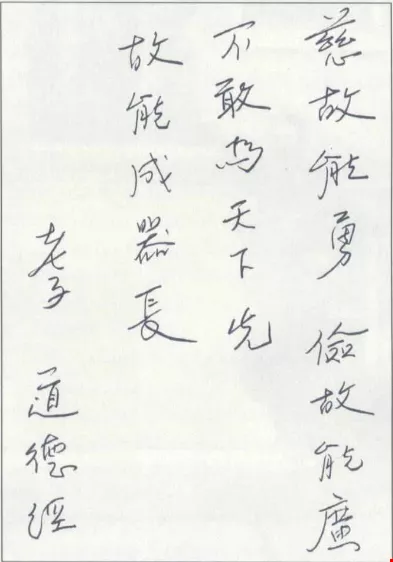
An expert in law and finance, Lai is also a lover of the Chinese classics, especially the poetry of Su Dongpo. Below is a quote from Lao Zi that Lai wrote out for us.
Applied learning
Lai's attitude to study has always been realistic. When taking the exam for government-funded doctoral studies abroad, he eschewed the popular choice of traditional law and chose international trade law instead. This opened the door to the world of economics and finance, and he became an important influence on policy at key turning points of Taiwan's economic development and internationalization.
When serving as head of the Department of Customs Administration in the Ministry of Finance, he promoted many reformist ideas like wide-scale reduction of tariffs, a unified classification system for international products, and automation of customs, thereby laying a solid foundation for Taiwan's accession to the WTO.
As political vice-minister of finance, he participated in various reforms of the securities and financial systems, such as revising the regulations governing securities trading and promoting diversification of financial products. He also played a key role in trade and tariff negotiations with the US and Europe, and led a team from Taiwan participating in technical committee work at the OECD, where he was a force behind the signing of numerous agreements between the ROC and European countries.
While head of the provincial Department of Finance in the provincial government, he actively promoted the privatization of province-run financial institutions.
Last year during the transition of power to a new administration, Lai's financial expertise and ability to coordinate across issue areas did not go unnoticed. After taking the post of vice premier, he immediately proposed a number of policies of fundamental importance, including putting the financial system in order, helping traditional industries, upgrading infrastructure, promoting job creation, and inviting public participation. These outline the hopes of the new government for economic and financial development.
Be prepared
With regard to current economic difficulties, Lai argues that you can only understand the situation by putting Taiwan in the global context. He takes for example the "flying geese theory" of economics, where one economy is in the lead, and the others follow, with the more advanced economy handing off industries to the ones just behind.
The US has been the leader in economic growth for the past half-century. By the 1950s or 60s, it was already becoming difficult for labor-intensive industry to survive in the US, so things like textiles and shoes moved to places like Taiwan and Hong Kong. Taiwan's economy really began to take off in the 1980s, and traditional industries had to leave, with the information industry taking up the baton. In the 90s, integrated circuits boomed, and now, as the president and premier have stated, the stars of the future will be biotechnology and "smokestack-less industry." Their success will depend on the combined efforts of government, academia, and business, in a search for market niches that exploit Taiwan's highly skilled workforce and R&D environment.
Lai says everything in his life has been the result of chance, or fate if you will. This is surely too modest, but it is also true that he has had much good fortune in his political career, and made many friends, so when President Chen Shui-bian began to consider asking him to be vice-premier, his Ilan connections went to bat for him.
Speaking of his personal future, Lai smiles and says that, looking back over the last 50 years, he has never done any "career planning," nor does he believe that life can be mapped out in advance. He only knows that you must be dedicated, sincere, and realistic, whether at school or at work, and learn as much as you can. Then, "when opportunity knocks," you'll be ready.
A son of the soil can become president, and an agricultural school graduate who loves learning can become a vice-premier and steer a country's economy. In Taiwan, where the belief that "you can achieve anything if you work hard enough at it" runs deep, a story like that of Lai In-jaw not only really happened, it had to happen.


@List.jpg?w=522&h=410&mode=crop&format=webp&quality=80)
