Crane Operators--High Priests of the Modern Skyline
Jenny Hu / photos Diago Chiu/by Jonathan Barnard
May 1994


Suspended tens of stories high, neither in heaven nor on earth, they rely on just a thin framework for support. If the wind picks up, their whole workroom shakes, setting them to lonely jiggling in mid air.
When search lights shine on the 50-story Great Fifty Tower, this Kaohsiung landmark, which opened in February of last year, can be seen all the way from the expressway.
When the 51-story Shin Kong Life Tower in front of the Taipei train station opened as the tallest building in all of Taiwan early this year, heads turned skyward, and crowds showed up to take in a view of the city.
The Shin Kong Life Tower and the Great Fifty Tower are the highest of Taiwan's high rises, flag bearers for northern and southern Taiwan. But in the coming years, they will lose their positions to a succession of newer and higher buildings.
This recent wave of new skyscrapers has changed the face of the building industry. Steel frame construction has replaced the use of reinforced concrete, and as these steel skeletons grow ever higher, a giant crane can always be found top and center, lifting things up and setting them down. No matter how tall a building rises, the crane always looms above it.
"The tower crane is the heart of a skyscraper's construction site," remarks Su Ping-huang, the manager of Lee Yuh Engineering, which built the steel skeleton for the Shin Kong Life Tower.
Most people in the construction business call buildings that are over 30 stories skyscrapers. Traditional reinforced concrete has no way to support structures of such enormous size. In order to strengthen such buildings' ability to withstand earthquakes and to maintain the construction schedule, builders have begun using steel frames. Cranes of sufficient power are essential for lifting girders weighing ten or twenty tons, and so tower cranes are more and more popular. Riding this wave of new skyscrapers, licensed crane operators have become highly sought-after talents.
The tower crane's central position allows it to stretch its arm out to any corner of the work site. With the mission of lugging pieces of the metal skeleton, form panels and other construction materials, a crane must rise a step ahead of the building, always maintaining its position on top. When the Shin Kong Life Tower was raised to its peak of 51 stories (250 meters tall), the operator of the tower crane stood in mid air nearly 260 meters high, overseeing the allocation of building materials from on high. Crane operator Huang Chin-hsing's nickname of "Cloud Walker" truly catches the spirit of the job.
Other than tower cranes, Taiwan's most famous big cranes are the two giant gantry cranes of the China Shipbuilding Corp. In 1975 cranes were introduced from Japan in Taiwan's shipyards, where they stand at dockside 34-stories tall, assembling the large pieces during the final stages of building a ship.
Cranes--from a simple pulley, to mobile surface cranes, on up to tower and gantry cranes--all serve in assembly processes of various sizes. The bigger the crane, the more nimbly it can move heavy loads. In modern times, a crane's strong arm in the sky is essential for building a high rise, major bridge or big boat.
When outsiders see the height of a crane at work, they often worry for the crane operator. Are such fears well founded?
"This is truly a dangerous profession," says Chang Sheng-chi, who oversees the cranes at China Shipbuilding. But the danger to which he refers is "damaging the structure of the work place." "We're under no particular danger ourselves," crane operator Huang Chin-hsing points out. "The biggest danger is that we might damage the structure or hit someone else."
Even though the operator's cab of the crane is suspended in the air half way to the sky, it is ultimately one part of the crane. It is very stable, and crane operators are protected by a steel framework around them. Their situation is much less dangerous than those working under all sorts of metal construction materials below.
But accidents do happen. And "moving" is one of the actions that puts the crane itself most at risk. Because a tower crane is supported on all four sides by a metal framework, as the crane rises with the growth of the building, it relies on motors in its four feet to jack it skyward. "If human oversight or problems with the oil pressure or jacks cause the four legs to rise at uneven speeds, it could put the crane in great danger." Huang Chin-hsing recalls that many workers died at a site in Taichung when differences in motor speeds caused a crane to topple. When a gantry crane of China Shipbuilding is moving, its two feet slide along tracks, and every 50 meters the crane operators have to check to see if the crane is moving straight.
But for licensed crane operators accidents while moving are rare. The process of lifting and lowering is what really requires their full attention. Steel materials can weigh anywhere from several tons to several dozens of tons. Hitting nearby structures or people with them would be no laughing matter.
"There's a lot of pressure operating a crane," says Huang Chin-hsing, who has eight years' experience working tower cranes. An operator spends all day in a small control cabin, paying close attention to the progress of the work below and communicating only via intercom. Sometimes it's hard not to get a little down. Setting down lifted objects in precise locations is a crane operator's chief responsibility, requiring great concentration over long periods of time. The work may tax the mind and not the body, but crane operators get just as tired as construction workers who use their muscles.
Huang says the hardest part is taking large and heavy objects such as elevators and stairs and setting them down through the interlocking girders of a steel skeleton. With workers on the beams, "you often worry that you're going to hit someone." Once, when rushed, he lifted three steel girders at one go and delivered them to workers on three different floors. "You've got to have all your wits about you."
The floor of the operator's cab is transparent, and a single look down could bring those scared of heights close to fainting. But the crane operators have got to pay strict attention to the process of lifting below them. "My vision is improving," laughs Huang Hsi-ying, a crane operator with four years experience who worked on the Shin Kong Life Tower.
Although the working pressures are great, there is time to relax during breaks between the busyness of lifting. Some people bring radios or newspapers with them. "When I have nothing to do," Huang says, "I just look at the scenery." Lin Rui-chiung, a senior gantry crane operator at China Shipbuilding, brings An Outline of Tientai Buddhism, keeping abreast of the Buddhist doctrines. There in the shipyard two operators spell each other in shifts. "Sometimes when you go to the engine room to do maintenance, you can catch the pigeons that have come to build their nests."
High crane operators work "above the masses," but ascending to their perch requires time and skill. To get the control cab of a tower crane, the operators have got to climb a foot-wide ladder welded from thin round steel pipes for about two minutes (this of course doesn't include the time it takes to get from the ground to the base of the tower crane). Those without sufficient strength and skill won't be able to make the ascent.
And if you want to get on the gantry cranes at China Shipbuilding, you've got to first take an elevator for 2 minutes and 40 seconds, and then climb a ladder wide enough for only one person. At the top of the crane, you walk along a beam six meters across and 177 meters long, and then climb down for about four stories before reaching the control room. "It takes about five minutes," Chang Sheng-chi estimates.
Climbing up and down takes much time and energy, and this presents difficulties. "The biggest problem with working up there in the air is going to the bathroom," say Lin Rui-chiung and Huang Hsi-ying in unison. What is to be done? "Each deals with it in his own way," says a smiling Huang elusively.
It's less of a problem on the gantry cranes at China Shipbuilding, where in a concealed corner at the top of the exit from the elevator, the company has "considerately" installed a make-shift urinal that connects to the surface. But tower cranes lack the extra space for installing such facilities, and so the modus operandi of their operators is as follows: In the morning they drink a glass of water at home, pissing it away before they start work. Then they drink again during their lunch break and pee before they go back to work. They won't drink with abandon until they get off.
This, however, isn't a complete solution, and so many bring plastic buckets, which have the drawback of a pervasive odor. Huang Hsi-ying has cleverly installed a "urine transporting pipe" in his operator's cab: a funnel connects to a plastic pipe that extends all the way to the bottom of the tower.It's a neat solution.
There's no such remedy for diarrhea. Crane operators with the runs just hurry down the ladder. All of the lifting work, meanwhile, is put on hold.
Lords of the sky, cranes are nonetheless subject to the whims of the weather. In a stiff wind, the operating cab will set to shaking. Lin Ruichiung admits he was scared his first time up. He got used to it after a while and now feels quite at ease up there. Engineers who only go up on rare occasions, however, go pale and cling to the walls. Gantry cranes are very heavy, but typhoons have been known to blow them along their tracks, and so when the wind blows faster than 12 meters a second, work stops. The same limit applies to tower cranes. And if the wind is twisting around girders or other lifted objects, work will stop even under the limit.
The fog of winter is an unwelcome visitor, and the summer thunder storm an even greater natural enemy. Operators' cabs have lightning rods attached, but work stops so that lifted materials won't attract lightning. Pigeon droppings are another potential trouble maker for China Shipbuilding's crane operators. They can block the flow of electricity.
As the skyscrapers ascend to 40 or 50 stories, crane operators sometimes find themselves above the clouds. Ground crews will then have to direct their movements under cloud level via intercom.
Half of what a crane operator sees is the vastness of the sky and half the jumbled mess of humanity. "Being here for long periods of time gives you a broader perspective," Lin Rui-chiung observes.
Operating cranes is technically skilled work, for which experience is most important and great strength unnecessary. Why is it that you see no women crane operators? "All along I've felt that women could do this work," says operator Su Ping-huang. In Germany there are women tower crane operators, but they are yet to be seen in Taiwan. "We haven't made any gender restrictions, but up to the present no women have come to apply. Perhaps it's a matter of the customs here." Be that as it may, most women have a fear of heights and would find the lack of bathroom facilities inconvenient. Furthermore, "construction workers are a motley bunch, and inevitably some of them would poke fun at woman colleagues to relieve their boredom," says Su Ping-huang. "Other than grandmas, few women would be able to put up with it."
An orderly lifestyle is important for a good crane operator. To keep a strong stomach and stay alert, boozing and gorging are no-nos, and getting ample sleep is a basic living requirement. "When you get home, you're very tired," says Huang Chin-hsing. "You could say that there's not much time for leisure activities." And though Huang Hsi-ying will sometimes stay out bowling with friends until quite late, these nights are exceptions to the rule.Most of the time he respects the dictum, "Work during the day, and rest at night."
Many crane operators believe that temperaments improve with long stints as crane operators. "We've got to listen to instructions from down below," Huang Hsi-ying says. "If you're temperamental and subjective, you won't be able to stand the job for long." Lin Rui-chiung has done it for 18 years, during which time he feels his temper has mellowed and his ability to work with others has improved. Tall cranes lift huge objects. "There must be a feeling of great accomplishment," says Fang Chuehtao, a ground crew foreman for China Shipbuilding who has only been allowed up in a gantry crane once in his more than ten years with the company. "If I had the chance," he says, chin up and eyes on the cranes, "I'd like to go and give it a try."
Ten-thousand-ton ships and skyscrapers are built one step at a time. "I went into this field because the feeling of accomplishment is really great and because I'm doing something constructive for society," says Huang Hsi-ying. His motives may not reflect those of all crane operators, but when a job is done, few won't feel proud inside.
[Picture Caption]
p.116
Window washers at work on a skyscraper in Shenzhen on the mainland. It's not work for the faint of heart. The growing number of skyscrapers has given rise to related service industries.
p.117
The 51-story Shin Kong Life Tower is a Taipei landmark. It took three years for its crane to work from ground level to roof top.
p.118
China Shipbuilding's gantry cranes stand 97 meters tall at dockside. How tiny the operator's cab--suspended in mid air--looks from afar.
p.119
The view from the operator's chair of one of China Shipbuilding's gantry cranes. From here the heavy construction materials below look like toys. When engineers have occasion to come up, they can't keep themselves from trembling.
P.120
Lifting is the basis for construction. Placing materials precisely where they are needed tests the experience and patience of a crane operator.
p.122
The crane is always at the highest--and safest--spot on a construction site. Those working below a crane, on the other hand, must always take precautions not to be hit by what it's lifting.
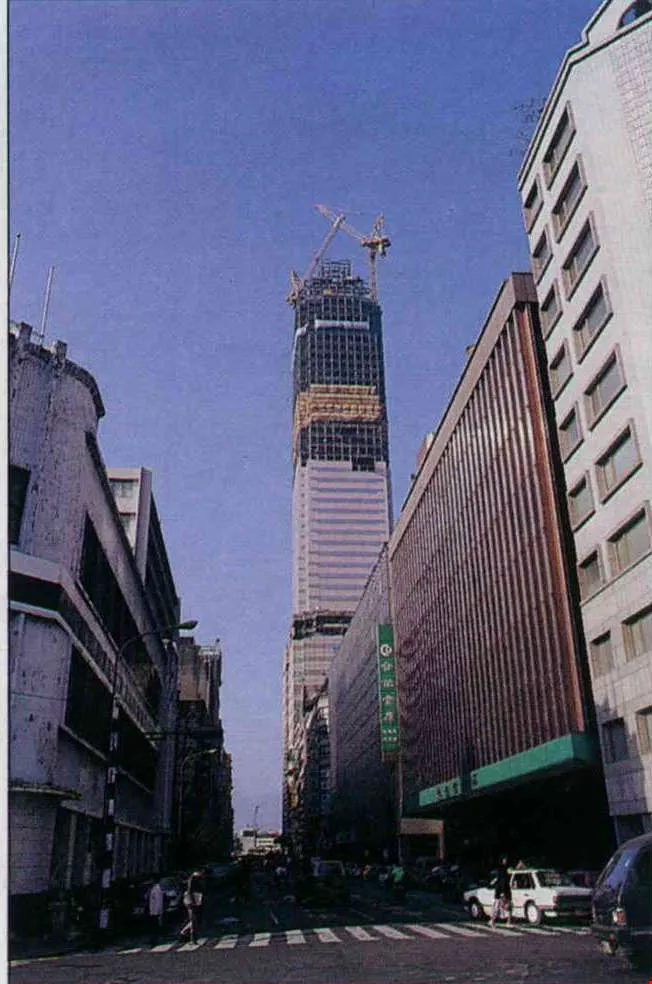
The 51-story Shin Kong Life Tower is a Taipei landmark. It took three years for its crane to work from ground level to roof top.
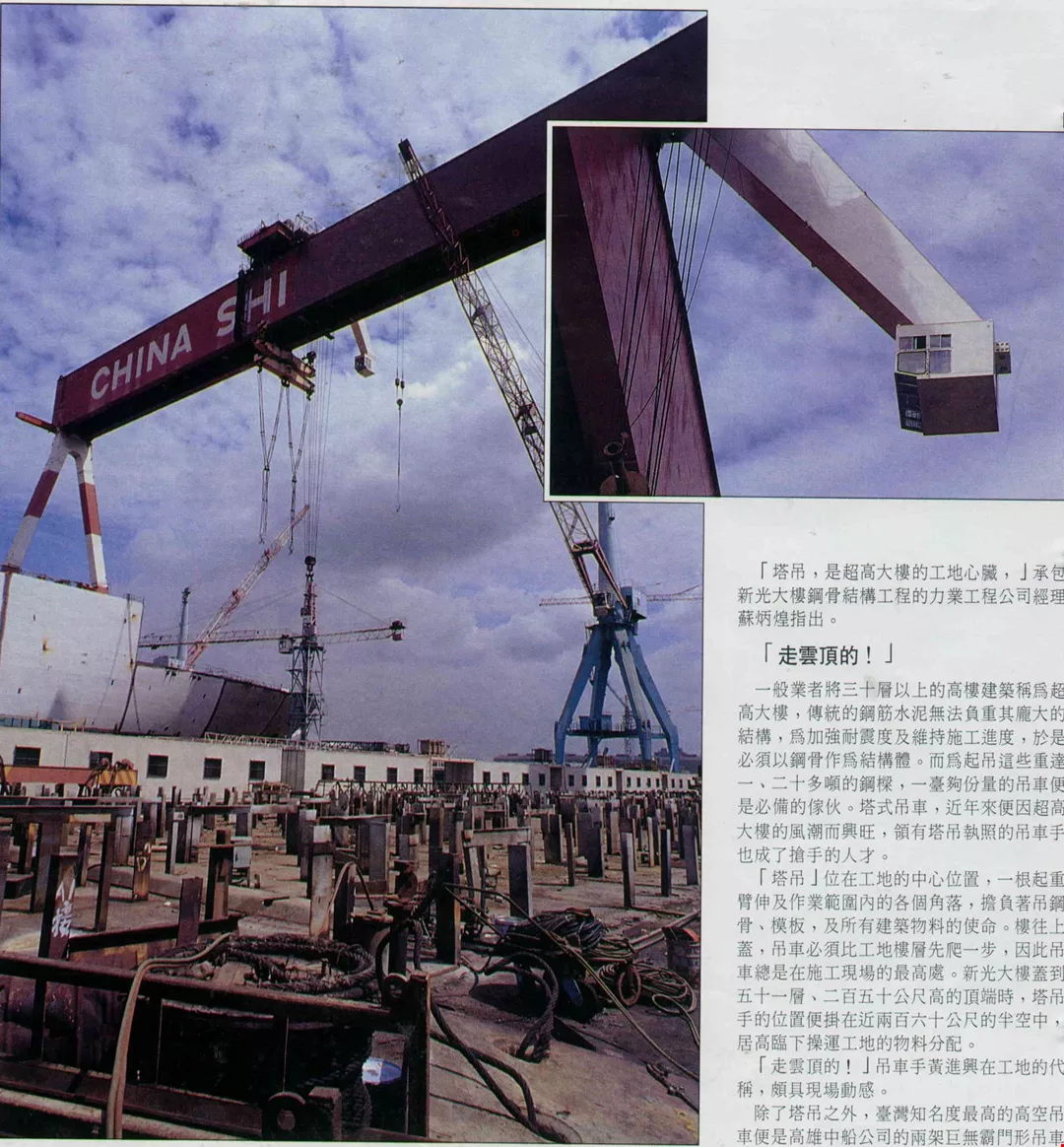
China Shipbuilding's gantry cranes stand 97 meters tall at dockside. How tiny the operator's cab--suspended in mid air--looks from afar.
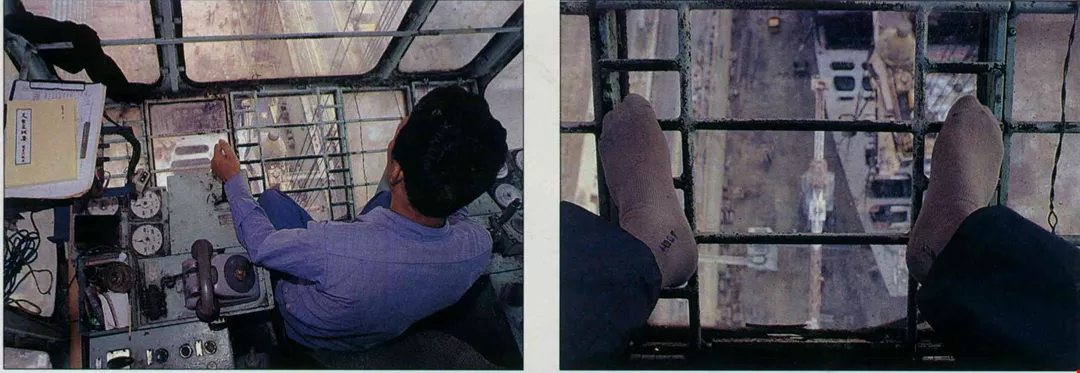
The view from the operator's chair of one of China Shipbuilding's gantry cranes. From here the heavy construction materials below look like toys. When engineers have occasion to come up, they can't keep themselves from trembling.
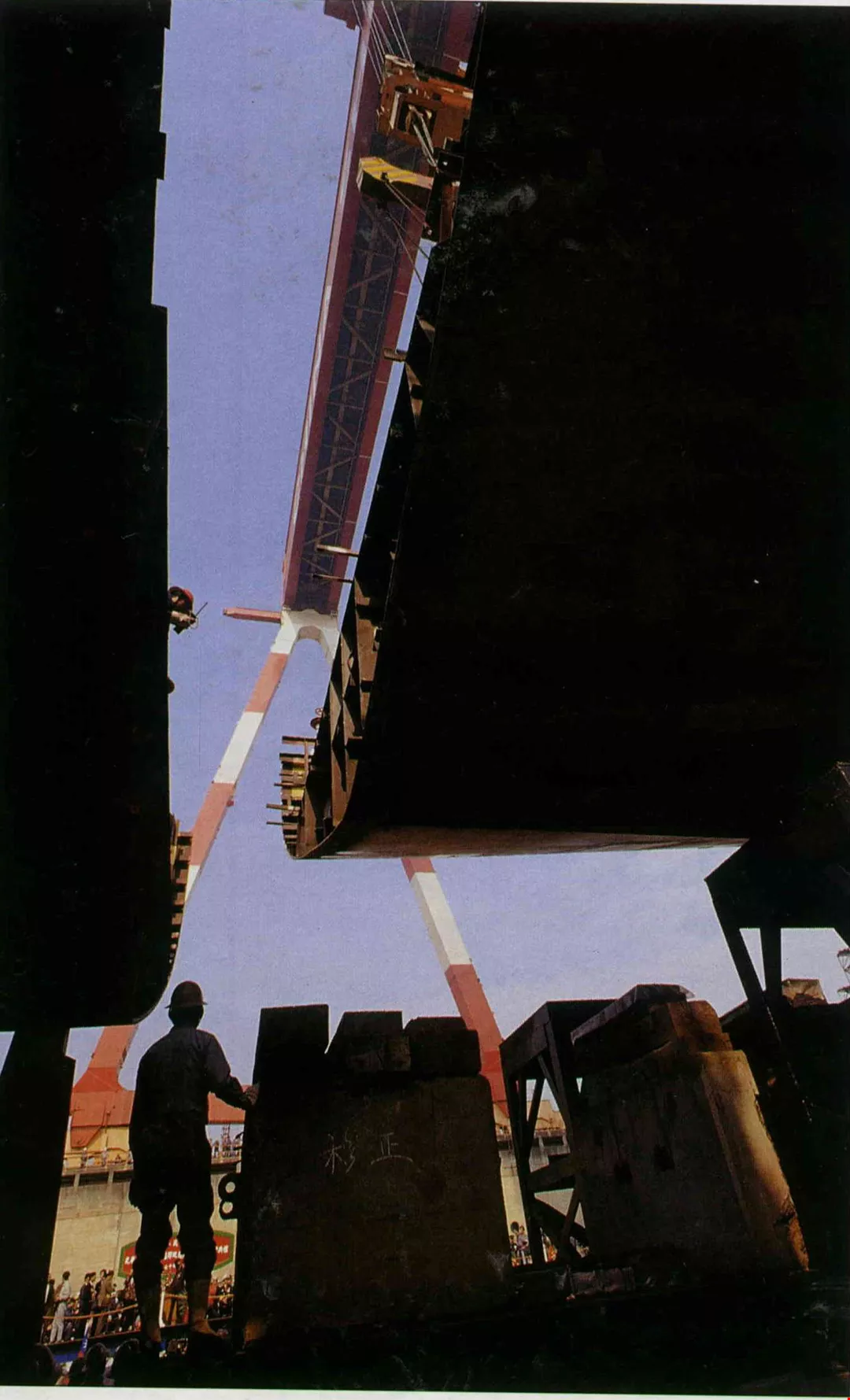
Lifting is the basis for construction. Placing materials precisely where they are needed tests the experience and patience of a crane operator.
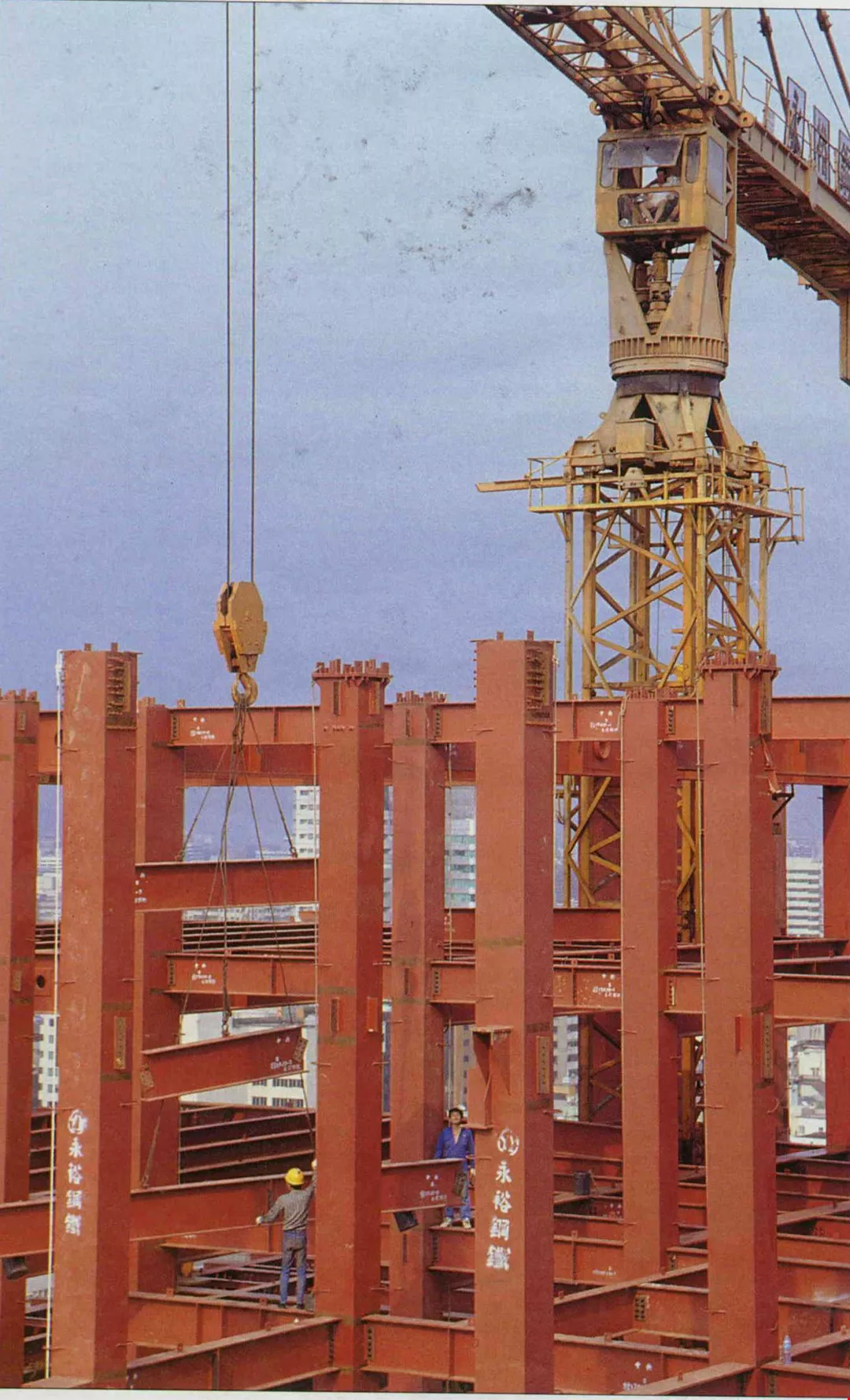
The crane is always at the highest--and safest--spot on a construction site. Those working below a crane, on the other hand, must always take precautions not to be hit by what it's lifting.


