Learning from Mom and Dad with Homeschooling
Chang Chiung-fang / photos Hsueh Chi-kuang / tr. by Jonathan Barnard
December 2002


The command "put on your book bag and go to school!" used to be part and parcel of one stage of life, those years when all children would leave their homes to be educated at school. Yet today going to school is no longer a certainty. With Taiwanese society stressing diversity and freedom more and more, it is now legal for children to be educated at home. The age of homeschooling is upon us!
On a lane off Wenchou Street in Taipei, Lu Chi-hua is leading a group of children reciting a passage from Zhuangzi: "Somewhere far to the north there is a fish called Kun. . . ." A perusal of the blackboard indicates that the Analects of Confucius, Tang dynasty poetry and English Biblical passages are also being covered today.
Out in the countryside, in Toufen, Miaoli County, an occasional patient drops in for an appointment at dentist Chen Hsieh-chi's clinic. But the sound that predominates isn't the buzz of the dental drill but the ringing voice of Chen's eight-and-half-year-old daughter Yu-hsuan reciting the classics. "My income has been halved," says Chen Hsieh-chi. "I'm focusing on my daughter."
It's neither winter nor summer vacation, but these children, unlike most their age, never need to pick up their book bags and march off to school. Rather, they are receiving what the government calls "non-school-based experimental education"-or what is commonly known as homeschooling.
According to the Chinese Christians' Home Education Association, there are about 200 children receiving "non-school-based experimental education" in Taiwan. They can study at home both because their parents are nonconformists and because the laws have changed.
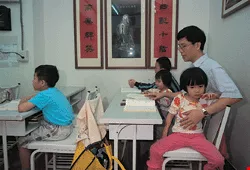
The best time to study the Chinese classics is when one is young. Kao Wei-chien, a Chinese teacher at the high school affiliated with National Taiwan Normal University, and his wife are homeschooling their child with the Chinese classics so as not to miss the best time for the child's verbal development.
No more forced school attendance
Compulsory education in Taiwan began in 1943 during the era of Japanese rule. Then, after retrocession, the ROC government ensured that every citizen would receive an education by passing the "School-Age Children Compulsory Education Act" in 1947. In 1982 it issued the "Compulsory Education Regulations."
As Taiwan has modernized, there have been growing calls for diversity in education, and educational policy has gradually grown more liberal. The fourth clause of the "Citizens Education Act" of 1999 states: "In order to protect the right of a student to an education, students are permitted to receive non-school-based experimental education during the ages of compulsory education." The eighth clause of the Basic Education Law, which was passed in June of the same year, puts it even more clearly: "During the period of compulsory education, parents are responsible for guiding and assisting their children. Moreover, parents have the legal right to select educational method and content on behalf of their children and to decide whether they enroll in a school." With homeschooling thus legalized, the number of homeschooled kids in Taiwan began steadily to grow. Taipei, which had 88 applications to homeschool this past year, now leads all localities.
In fact, before the "Basic Education Law" was passed, Taipei City had already passed its own "Homeschooling Law." In 1994 then-mayor (and current ROC president) Chen Shui-bian was holding a series of "dates with the people." During one of these, a group delivered the following petition: "We are mothers who have chosen to be full-time homemakers so that we can raise and teach our own children. Our children are about to enter primary school, but currently the social climate, including the environment in the schools, is horrendous. This has seriously affected the educational environment for school-age children. For instance, elementary schools are full of Gameboys, petty trade, violence, extortion, gangs, conspicuous materialism, and pornographic comic books. In such an environment, it would be extremely difficult to exercise self-control and not be adversely influenced. . . ." After holding several expert panel discussions, the Taipei Education Department began to allow homeschooling in the 1997 school year.
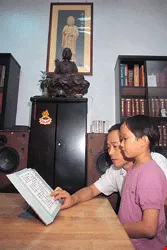
Dentist Chen Hsieh-chi teaches his own daughter one step at a time. He has great confidence in homeschooling.
My child's not going to school!
Homeschooling has been an option in the US, Britain, New Zealand, Australia and other nations for many years now. During the 18th and 19th centuries, Western countries had introduced compulsory education in order to strengthen their nations, but school education had its shortcomings.
Cheng Yu-chin, an associate professor at the Graduate School of Elementary Education at Taipei Municipal Teachers College, notes that in the 1960s schools in the West began to put too much emphasis on educational efficiency. The resulting policies killed students' initiative, curiosity and creativity, and greatly reduced their interest in their studies. The policies also sapped the students' self-respect and retarded the development of their character. As a result, many parents refused to let their children attend school.
Lin Tien-yu, a professor of elementary education at Taipei Municipal Teachers College, points out that early homeschoolers in the United States were largely motivated by religion. Parents held that the public schools were not providing satisfactory religious and spiritual education. Then, in response to violence in the schools, as well as academic pressures on students and falling educational standards, more and more parents decided to teach students at home. After much struggle, homeschooling became legal in every state. Today it is an educational option well known to all.
Yang Chiao-ling, an associate professor of education at National Kaohsiung Normal University, describes homeschooling in the United States as a revolutionary movement that has been growing by leaps and bounds. By 1993 it was legal in every state. The number of homeschooled kids, moreover, jumped from 30,000 in 1990 to 150,000 in 1999, when they comprised about 2% of the student population.
In Taiwan compulsory education was extended to nine years in 1968, and attending school became regarded as a right and a duty. Why would parents want to forsake that right and duty now and elect to educate their children privately at home?
"The philosopher Arnold Toynbee once said, 'Only the teachings of Confucius, Mencius and Mahayana Buddhism will be able to solve the problems of the 21st century,'" wrote dentist Chen Hsieh-chi in the application he submitted to homeschool his child with an academic program centered on the Chinese classics. "In the scientific age, by teaching ethics to youth, you cultivate proper morality, which is of paramount importance. . . . The correctness and applicability of Chinese educational theory, as well as the superiority and broadmindedness of classical Chinese teaching materials, give them breadth and depth. . . ."

Homeschooling also stresses learning from life. Through daily living, one can put into practice the spirit of book learning. (photo by Tsai Chih-pen)
Save education in the schools!
Chen had previously unsuccessfully petitioned the minister of education and legislators to have the study of Chinese classics included in the elementary school curriculum.
"Out of office, one should attend to one's own virtue in solitude," says Chen, quoting Mencius. "Since I couldn't change the school system, all I could do was to teach my child at home by myself. At first we were groping in the dark, but now that I know the advantages of homeschooling, I wouldn't do it any other way!"
"I choose homeschooling to fulfill an educational dream," says Kao Wei-chien, a Chinese teacher at the high school affiliated with National Taiwan Normal University who is homeschooling his fourth-grader. Kao hopes that his child will study happily in a self-directed manner to become a cultured person of outstanding character, someone who is both patriotic and globally minded and who understands the importance of self-respect, kindness and giving something back to society.
"Children are like trees," says Tseng Yi-ting, who homeschools her children. "They need their parents' help. It's hard work to teach them to obey from when they are small and to expand their realms of understanding every day. Sometimes it can truly be tough going. But in order to give them a solid foundation, I have chosen homeschooling." Although these parents have different motivations for choosing to homeschool, they all have high hopes for their children.
But what about what the children want? "Going to school is boring!" says Chen Yu-hsuan, whom the authorities first required to spend half a day in school every week. When asked whether school or homeschooling is better, Kao Tsun-cheng, who began homeschooling in fourth grade, always responds: "They're both good!"
But from the perspective of homeschooling parents, is there nothing to be said for education at school?
Kao Wei-chien quotes Yeh Sheng-tao, an educational expert half a century ago who described education in the schools as "using the intellect to destroy morality and physical robustness, and using tests to destroy the intellect." Kao says that as society has grown increasingly chaotic and uncultivated, the new methods of school-based education have become more and more divorced from giving children a proper upbringing.
Huang Hsia-cheng, the secretary-general of the Chinese Christian Home Education Association, laments the lack of ethics courses in schools. He believes that the years of compulsory education are the "age of enlightenment" and the key period for character development. Knowledge and conceptual frameworks, as well as active and supportive teaching, are extremely important for children's mental and physical health.
Apart from being worried about the lack of ethics in schools, some parents also criticize the methods and content of education in the schools. "Modern education doesn't teach children the right things at the right times," avers Kao Wei-chien. Children who are taught under this system "may seem to have conquered the world when they are young, but they end up losers for a lifetime."
Huang Hsia-cheng advocates a well-rounded education. Yet education in the schools, with its large classes, uniform pace, and rigid grading system, is an inefficient way to impart knowledge, let alone provide a well-rounded education. He believes that homeschooling is the best way to educate the whole person. "Only by providing instruction from real life can you achieve a method that is closest to reality, and only then do you reestablish the connection between education and life."

A Chinese Christians' Home Education Association study group goes on field trips during their weekly meeting. Today, they are at the Museum of Drinking Water, where they are learning about water resources.
Following the classics
It's worth noting that many homeschooling parents focus the curriculum on the Chinese classics.
In 1911, the first year of the Republic of China, public elementary schools and junior and senior high schools abandoned the practice of reciting the classics. Ever since, study of the classics has been limited to university Chinese departments. Most people have little opportunity or desire to read them. And today many regard returning to a classics-based educational system as being very odd indeed. What's the point of having children recite classical Chinese?
"The result of not reading the classics is that people lack Confucius and Laozi's 'vision' of the true nature of life and the world, and they can't identify with the universality of the 'Tao,'" says Wang Pang-hsiung, a professor in the Chinese department and graduate philosophy program at National Central University.
Wang Tsai-kuei, a professor of language education at National Taichung Teacher's College who spares no effort promoting study of classics, established the "Huashan Center for the Promotion of Reading the Classics" and has been encouraging homeschoolers to study the classics ever since the passage of the Basic Education Law. Wang believes that language is the basis for all knowledge, and that other facets of the intellect-from math and spatial abilities to interpersonal skills and self-awareness-are all stimulated by mastery of language. The period before 13 years of age, moreover, is the key period for developing language skills. It's a narrow window that closes fast.
It is out of fear that their children will miss that chance that some parents become determined to homeschool their children. Take, for instance, Kao Wei-chien and his wife Lu Chi-hua. Not wanting their children to "waste their time" in school, they applied to homeschool their fourth-grade son. "Why do parents struggle in their lives?" rhetorically asks Kao, a teacher at the high school affiliated with National Taiwan Normal University. "Is it not in the hope that their children will have bright futures?" By letting their son read the classics now, they hope that it will make junior high school and senior high school much easier.
To spread the word about the advantages of reading the classics, and also to find study mates for her son, Lu Chi-hua organized a classics reciting class that meets on Wenchou Road. The class is centered on teaching the classics, and an arts and traditional school-based curriculum are secondary. Works in its classics curriculum include: The Analects of Confucius, Mencius, The Great Learning, The Doctrine of the Mean, Laozi, Zhuangzi, The Book of Odes, The Book of Rites, and Three Hundred Tang Poems, as well as the Bible, Shakespeare, Plato's Dialogues and other Western classics.

In an age of diversity, learning is not confined to the campus. Despite busy schedules, parents should not overlook the importance of being good role models for their kids.
It's also an attitude about life
Christians comprise a large share of the people that choose to homeschool. Among the 60 families that belong to the Chinese Christians' Home Education Association, "non-school based experimental education" isn't just an educational method. It's an attitude about life.
They believe that raising and educating their children is a mission that God has given them, and that it isn't something that they should just leave up to the government or the schools. Hence, they encourage parents, within the bounds of the law, to completely take over responsibility for educating their children. Huang Hsia-cheng argues that the "educational production lines" of schools can't meet the life growth needs of individuals. Children of the 21st century need specifically tailored educational programs.
In 2000 the Chinese Christians' Home Education Association, which grew out of a Christian fellowship, was formally established. Fan Shou-kang, the managing director of the association, and his wife Ma Cho-chun, explain that homeschooling doesn't just mean keeping a child at home to read and study, but rather it involves "the whole family living according to Jesus' example." They regard homeschooling as a revolutionary movement that they hope will have a very positive impact on society.
"For four or five years, our entire family hasn't bought a new piece of clothing," says Huang Hsia-cheng. Because families that homeschool are limited to one salary, every dollar has to be well spent.
With respect to educational philosophy, the association's buzzwords are "teaching by example" and "learning families." "The parents are the families' first students," Huang explains, "and the children are like their younger schoolmates." The association recommends homeschoolers, wherever they are, to establish small "study groups" that provide teaching materials and hold regularly scheduled meetings. It recommends that parents design an integrated curriculum, taking an interdisciplinary approach that looks at subject matter from different angles.
Teaching your own children?
"Homeschooling does have various advantages, such as combining living with learning, fostering family togetherness, and allowing the curriculum to closely match the talents and needs of the student," says Wu Hui-chin, the principal of West Gate Elementary School. But the relative merits of mainstream education and homeschooling are still the source of many an argument.
"Education in the schools is functionally very positive," remarks one elementary school teacher. "I can't accept the notion that children will suffer harm and abuse once they step into a classroom."
Homeschoolers, meanwhile, take issue with outsiders' criticisms that the sheltered environment of homeschooling might leave children deficient in skills of social adaptability.
"Of course children should be protected when they are most impressionable," says Kao Wei-chien. In his view, if you wait until children have developed sufficient powers of resistance before letting them out in the world, then they will have a positive impact on society, rather than be led astray by it.
"So-called 'group education' is really a pretty vague concept," says Huang Hsia-cheng. Moreover, she argues that the age-exclusive groupings in schools are in fact very unnatural and that in a high-density living environment such as Taiwan's people need to learn to deal with a variety of people. "It's the kids in the schools who will have problems adjusting to society."
Then there's the question of whether "non-professional" parents have what it takes to educate their children. This is one of the main sources of doubt for homeschooling skeptics.
"It's not that you have to provide something, but rather that you take the children on a journey and face the challenges together," says Lu Chi-hua, who holds that anyone can homeschool their kids with the right attitude. "The truth is that parents need only to spur their motivation to learn."
Others question parental motives, believing that they must have some sort of stubborn and fanatical religious or intellectual bias.
Chen Hsieh-ching, who is teaching his daughter to read the Buddhist Sutras as well as the Chinese classics has encountered lots of opposition along the way from family, friends and the schools. All had grave doubts. "It's weird enough that the kid is studying Buddhism," Chen relates, "let alone that he's not going to school." When facing the doubts of the outside world, Chen's inner determination did not so much as flicker. He firmly believes that the path he has chosen for his child is the right one.
Yet he admits that it is hard to wear the double hat of parent and teacher: "In eras past, people used to trade children to teach, for fear that teaching one's own children was detrimental to the parent-child relationship." Chen says that playing the double role is only temporary. Eventually he will find an enlightened teacher for his daughter.
According to statistics compiled by Fang Hui-chin, mothers most often take on the principal responsibility for teaching homeschooled children. Most of them have formal class for four or five hours a day. Naturally, assuming two vastly different roles as mother and teacher leaves these women feeling overstretched at times.
From his experience observing familes that homeschool, Huang Hsia-cheng says there are several potential problems: the parents may get extremely tired; they may overlook the need for a balanced education that develops a well-rounded person; they may lack self-discipline and procrastinate; and they may have difficulty finding the middle ground between flexibility and discipline and between isolation and having too many educational commitments outside the home.
Because homeschooling is so out of the ordinary, many people hold prejudices and misconceptions about it. Fang Hui-chin, a government caseworker who keeps track of homeschoolers' educational progress, originally harbored many doubts about homeschooling. But with his first-hand and in-depth experience, he has developed a deep respect for homeschoolers. "It has been my fate to meet these people, and now I understand that they are much different from other teachers and much different from other parents. I've found their commitment very moving," Fang says.
Laughing in their dreams
Although homeschooling has gradually been meeting with greater acceptance, "non-school-based experimental education" is still coming up short in several areas.
Since the "Basic Education Law" was announced, some 15 counties and cities have announced their own regulations governing "non-school-based experimental education." In these places, as long as the parent is willing to draw up an educational plan and make an application to the schools in accordance with the law, the family will be allowed to homeschool after a review. But Huang Hsia-cheng points out that many counties and cities have not announced their regulations. Without the administrative structure in place, schools, which may never have even heard of the concept, may believe that homeschooling is impossible to arrange.
Tang Hsueh-e, who is in charge of "non-school-based experimental education" for the Taipei Bureau of Education, says that the system isn't fully developed and doesn't provide sufficient direction, support and oversight. She says that parents can work hard toward completing a certain educational objective but that there need to be more professionals involved.
Fang Hui-chin also points out that the current law doesn't provide a basic mechanism for educational assessment that would allow homeschooled children to reenter the schools.
But homeschooling parents aren't expecting educational "guidance," and few are worried about how their children will go about reenrolling in school.
Chen Hsieh-chi frankly states that it is likely that his daughter will never go to school, but that doesn't bother him. "Rather than being under someone else's control, isn't it better to go home and worry about it for yourself?" He believes that as along as he cultivates his daughter's basic abilities, she will attain great learning on her own.
"I smile whenever I think about it!" says Chen about his decision to educate his daughter himself. "My child's future ambitions and field of vision will definitely surpass my own," he says. With a blue chip stock in the family, why would he choose to sell it short? "I'm willing to be used as a stepping stone, to be sacrificed for the next generation."


