It Could Happen to You!
Lin Hsin-ching / photos Lan Chun-hsiao / tr. by Geof Aberhart
September 2008


Within the field of criminology is a subject called "quantitative criminology." It says that under certain political, social, economic, and regulatory conditions, certain kinds of crime are more likely to appear. That is to say, in a stable, growing society, certain kinds of criminal behavior will at a certain point likely become impossible to eradicate. There will always be victims, and the crimes themselves may appear different, but they will always be there. This is known as the "law of criminal saturation."
Applying this theory to the fraud cases that have caused no end of headaches for Taiwanese law enforcement in recent years, it certainly seems there is something to it.
Each year, over 40,000 cases of fraud are reported in Taiwan. It seems as though almost everyone has had a run-in with telephone-based fraudsters. Even with fraud so rampant-thanks in part to the unique cross-strait political situation, low penalties for conviction, and society experiencing greater liberalization in telecommunications and finance-there still seems to be a lack of awareness of the importance of personal information protection. While some temporary measures can stifle certain kinds of fraud, the fraudsters quickly adapt and create more convincing, more detailed, and more imaginative methods. Stopping it completely requires in-depth consideration and substantial overhauling of the system.
"Excuse me, are you Ms Lin? My name is Y, from the Yungho Police Station. We recently cracked a fraud gang and found that they were using accounts at the Yungho branches of Bank of Taiwan and Taiwan Cooperative Bank which had been opened under your name...." On July 16, Ms Lin, an employee of a major public hospital, was startled to received the above phone call from someone claiming to be a police officer. "My God," she thought, "how did I get dragged into this? They're using my name for their fraudulent accounts? My personal information might have been stolen!"
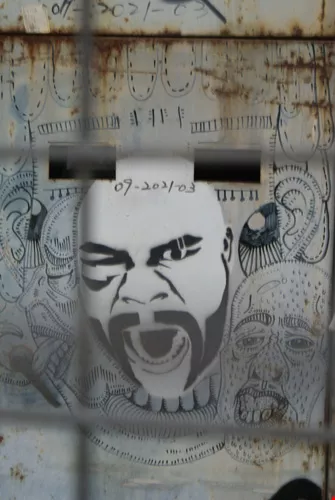
The keys to fraudsters' tricks are people's greed; their susceptibility to fear and panic in emergencies; and their willingness to trust authorities, friends, and family.
A professional script
While Ms Lin was still reeling, the officer comforted her and told her not to panic: all she had to do was provide some information to help with the case, and be more careful next time.
Half an hour later, Ms Lin received a call from a Mr. Cheng, a clerk for the X District Prosecutors' Office. He told Ms Lin that they needed her help with a case, and that they needed a statement from her. He also told her that the call was being recorded, and that she should not hang up mid-call.
"Before the recording official began, he played a voice saying 'The time now is (time), on the (day) of (month), (year),' and during the recording he seemed very authoritative and genuine."
During the call, Cheng asked Ms Lin for details of her bank accounts, including her balance, and asked her if she could take the afternoon off work and take her bank book to the bank.
"He wanted me to go and get my bank book updated, and said that then they would inspect the bank's security footage and verify that the accounts were actually mine and not just some fraudster's," says Ms Lin.
After convincing Ms Lin with a long, complicated process, Cheng finally got to the real point. He asked Ms Lin to withdraw a total of NT$280,000 in cash from five accounts and deposit the money into an account managed by "Yeh Cheng-ming" of the district prosecutors' office. He then explained that after a few hours, once the money was confirmed as being from a legitimate source, it would be returned to Ms Lin and she would be cleared of any suspicion of being part of the fraud gang.
"Even though I still had doubts throughout the whole process, since I couldn't hang up I couldn't go and check with anyone else, and they were very convincing. It was like I'd been brainwashed, just following their instructions blindly," says Ms Lin regretfully.
Despite this, Ms Lin was still lucky. Not long after depositing the money, she had a feeling something wasn't right and called her husband about what had happened. They contacted the police, getting the fraudsters' account frozen and getting Ms Lin's money back. But she is in the minority. Many other victims have been duped into losing their life savings, and even if they report what happened to the police, often the police cannot find what happened to the money. This leaves victims forced to borrow money just to get by, praying that the police are able to crack the case quickly.

A haven for fraudsters
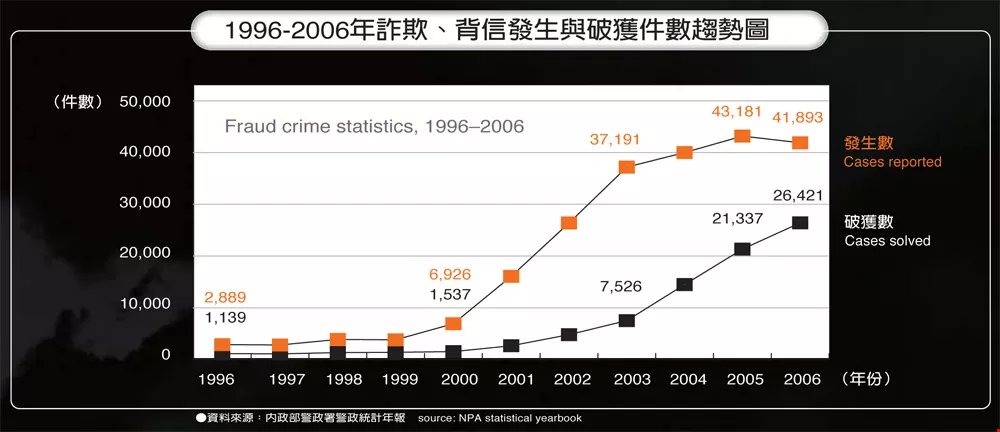
According to National Police Administration statistics, cases of fraud in Taiwan have risen from 2,889 in 1996 (accounting for 0.65% of all criminal cases) to 41,893 cases in 2006 (8.17% of all cases). That's a 1450% increase in 11 years. Since 2004, there have been over 40,000 cases of fraud a year involving annual totals of up to NT$60 billion. Even more disheartening is that generally only 50-60% of cases are solved, meaning that many victims are left with no recourse after having their money stolen, no matter how loud they may cry for justice.
So how did Taiwan become a hotbed of fraud? The tale begins eight years ago....
As Chang Chin-lan, an officer with the Criminal Investigation Bureau's Crime Prevention Section and spokesperson for the 165 Anti-Fraud Hotline, says, with the boom in mobile phone and Internet usage since 2001, Taiwan has achieved a cellphone penetration rate that is amongst the highest in the world. People can text message, buy prepaid cards, send email, or make phone calls online with increasing convenience. This convenience, however, also provides potential fraudsters with a high degree of anonymity.
Meanwhile, to make things more convenient for their clients, financial institutions have started offering online banking, ATM deposits, ATM transfers, and all kinds of credit card options, including cash advances, loyalty programs, and online services. Many customers, though, may have signed their contracts, but remain unfamiliar with how to correctly use these myriad services, making them the perfect patsies for fraudsters.
Fraud gangs are spread across China, Taiwan, Hong Kong, and Macao and exploit loopholes created by the cross-strait political situation, targeting Taiwanese by dialing in remotely from China. The most telling evidence of this is that every year during long holidays in China such as Chinese New Year and Labor Day, the number of fraudulent phone calls encountered in Taiwan drops dramatically.
"Faced with the fact these criminals are operating out of China, once the authorities here have traced the phone calls, essentially all they can do is look out toward China and sigh," says Chang Chin-lan.

Rapidly evolving methods
Aside from this, the other thing that makes fraud gangs such an unparalleled hassle is their remarkable ability to adapt and evolve their methods.
Tsai Tien-mu, an associate professor at Central Police University's Department of Crime Prevention and Corrections and a former researcher into the methods used in telephone-based fraud, notes that when fraud gangs started out in 2001 and 2002, they relied largely on sending documents, making phone calls, and sending text messages to their victims, the content of which was generally telling them they'd won a prize, got a tax rebate, or needed to repay a debt urgently. Victims would, out of either greed or surprise, call the sender of the text message back and soon be charmed by the fraudsters into making a transfer at an ATM or simply be conned into spending forever on the phone and racking up a huge phone bill.
The most popular method in 2003 and 2004 was stealing credit card information and getting the victim to go to an ATM and change their PIN number. This may have been thanks to the increasing use of credit cards online, providing the criminals with an opportunity too good to miss. In 2005, they went back to the old method of telling people they were overdue to pay a debt, with the most favored ruse being to pose as someone in customer service at Chunghwa Telecom, Taiwan's main telephone service provider.
Since 2006, online fraud and posing as someone from the authorities have become the most used tactics. Methods such as those Ms Lin encountered, with fake cops and real fraud, are amongst the most widespread applications of the latter.
Online fraud generally takes the form of opening fake stores under fake names, taking buyers' money and not shipping any goods. Another approach is informing the victim that there has been an error in their online banking or credit card settings, and that since they supposedly clicked on something that would be an ongoing payment, they need to go to an ATM and "change their settings."
Another common method is fraudulent online "dating," where the criminals use a young woman to get the victim chatting online, and after the two are familiar with one another, bringing up discussion of sex and loans to con people out of money. Even worse, the criminals will use the victim's fear of their online dalliances being revealed to blackmail the victim out of even more money.
Many of the victims of this last form of fraud are engineers who, although well educated, have little experience with the opposite sex and small social circles. Even former Olympic Taekwondo gold medalist Chu Mu-yen has fallen victim to fraud, having been scammed out of NT$1 million in a moment of carelessness.
From shotgun to sniper rifle
In recent years the techniques used by fraud groups have become increasingly refined, using the victim's personal information to tailor their approach and creating scripts that get the job done in one hit without giving the victim a chance to catch their breath.
"As their methods have gone from a more scattershot approach to a tightly focused one, fraudsters have become increasingly successful," says Chang.
As an example, Chang points to the older tactic of faking kidnappings. Fraudsters would call and let distraught parents hear a cry, but sometimes they would call, for example, single and childless women, resulting in their attempts being greeted with no more than mocking laughter.
Now that the public is more vigilant, the fraudsters have turned to coming up with ways of getting more personal information about their victims, then telling them on the phone how old their child is, what school they go to, how they get to and from school, and why they have the child. The whole script seems to leave almost no room for doubt, and with the parents flustered and unable to call their child, they're more ready to fall for it and do whatever they have to to "save" their child.
One of the most common methods today, abusing online dating, is especially refined. As Chang explains, since people are marrying later these days, many people will go online to look for love, and fraudsters are happy to exploit these lonely love-seekers. They start with online chat, seemingly with no subject out of bounds, and once an emotional foundation has been laid, they cajole the victim into "investing" their money somewhere. This method can take a relatively long time, but it can result in successful hauls of over NT$5 million a go.
Chang tells of one particular case where the female victim had known the perpetrator for over six months. During that time, he never mentioned money, and whether it was in chats or on dates, everything seemed like a normal relationship. But when it came time to strike, he was ruthless-after convincing her he could help her make NT$10 million on an investment, he sweet-talked her into putting up NT$5 million as a deposit, after which her hard-earned money vanished into thin air.

Option 1: Harsher penalties
With fraud rates showing no signs of dropping and fraudsters being as agile as ever in their methods, what can be done to stem the tide?
Research done by Tsai Tien-mu of the Department of Crime Prevention at National Central Police University shows that fraud in Taiwan shows five particular attractive qualities-low cost, low risk, low penalties, high anonymity, and high profits. This is what has drawn the swarms of fraudsters willing to try their luck.
According to Article 339 of Taiwan's Penal Code, common fraud is punishable with up to five years imprisonment, and/or a fine of up to NT$1000. Under Article 340, professional fraud is punishable with only a maximum seven-year sentence, and/or a fine of up to NT$5000.
Tsai points out that fraud gangs tend to have a very detailed division of labor, with the various members of the group not especially familiar with one another. This means that when the police track down the gang, generally all they can get is the people at the front line, and the aforementioned unfamiliarity makes it hard for them to get to the brains behind the scenes.
"With profits high, the chances of getting caught low, and the sentences if caught fairly short, the perpetrators can feel like luck is on their side," says Tsai. "So the authorities need to look into raising penalties for fraud. Only then will the law be any kind of deterrent."

Option 2: Stricter checks
With fraudsters abusing weaknesses in telecommunication, finance, and the Internet, to prevent fraud we need to work with those industries.
On the telecommunications front, Chang Chin-lan points to the changes in prepaid mobile phones. Formerly prepaid cards and phones were easily and anonymously available, making them the tool of choice for fraudsters, but since May 2004 the telecommunications industry has required anyone buying prepaid cards to produce their ID card and National Health Insurance card. This double-ID policy has led to a dramatic reduction in the use of such cards by fraudsters.
"Now they've turned largely to the Internet or international phone calls, either masking or spoofing the caller ID," says Chang. "In the future, we hope that the National Communications Commission can encourage industry cooperation to see if there is any way we can, for example, append an audio reminder in front of suspicious overseas calls as a way of warning the public."
Concerning financial institutions, Dean of Security Management at Ming Chuan University Chang Ping-wu discusses the commonly used "ATM transfer" fraud method. He notes that while banks across Taiwan have set up warnings on all their ATMs reminding people to be careful when making transfers, research indicates that many victims of fraud are too panicked or anxious and do not notice those warnings, generally only realizing they've been scammed some five minutes later.
"And so we believe that the ATM transfer system needs to be refined, with such additions as only completing a transfer after a 30-minute to one-hour delay, rather than instantly transferring the funds, so that if people realize they've been scammed they still have time to call the bank and halt the transfer," suggests Chang.
With regard to the Internet and cable companies, already many fraud gangs have been able to purchase or steal customer details, making these companies a vital source of information.
As the Data Protection Law currently only covers civil service organizations, private investigators, hospitals, schools, telecommunications firms, financial institutions, stock trading, insurance, and mass media, the rise of online-only businesses that are beyond the scope of the law has created another crack in fraud prevention efforts.
The new personal data protection act has yet to pass through the Legislative Yuan, and the Ministry of Justice is currently looking into expanding the scope of the current law to include these businesses. If this should go into effect, then if personal data leaks occur that lead to losses for customers, those customers will be able to seek up to NT$20 million in damages from the business.

Option 3: Check and check again
With most fraudsters preying on people's greed, trusting nature, or fear and anxiety, experts have recommended that no matter how convincing the phone call, how sincere the caller may sound, or how supposedly urgent the situation, you should always keep your cool. Find a reason to hang up; check, double check, and triple check; and never just blindly follow any instructions given over the phone.
If you can't contact the organizations or family member mentioned in the call, you can dial the 165 Anti-Fraud Hotline and verify the source of the phone call or find any inaccuracies in the phone call (for example, the district prosecutors' office never records phone calls as statements, and Chunghwa Telecom never calls about overdue fees). This way, you can avoid falling into their trap.
Another thorny issue for law enforcement is conducting cross-strait investigations. Chang Chin-lan explains that with Taiwan's fraudsters having moved to mainland China, they are becoming an increasingly serious public security problem there. At present Taiwan's National Police Administration is involved in discussions with the mainland's Public Security Bureau, in the hopes of getting past the political situation and inking a public security agreement. This would enable both sides to work together to fully pursue these fraud gangs and strike a blow against the criminals.
According to quantitative criminology, when a given crime is widespread enough in a stable society, it becomes impossible to eradicate, simply changing its outward presentation. As such, any efforts to reduce incidences of fraud in Taiwan will require cooperation on the political, economic, legal, and media levels. People should not be fooled into thinking "I'm too smart to fall for that!" and taking no precautions against fraud. And if you do fall into that trap, you could be next.



@List.jpg?w=522&h=410&mode=crop&format=webp&quality=80)


@List.jpg?w=522&h=410&mode=crop&format=webp&quality=80)
