Reproducing an Ancient Art:Cheng Yung-gwo's Prehistoric Pottery
Elaine Chen / photos Liu Teh-chang / tr. by Phil Newell
February 2001


In a lively and well-attended ceremony on an unusually warm and sunny winter's day, the Yingko Ceramics Museum in Taipei County is formally opened to the public.
Especially noteworthy is Room 203, "Echoes Across Space-Time," where there is an exhibit that seems quite out of the ordinary: rough sandy earth, an upright measuring stick. . . it is more like the site of an archeological dig. The layers of prehistoric pottery represent different cultures that existed at various times in the past.
It is almost impossible to tell that these rudimentary yet beautiful works of pottery are not the real thing. They are in fact reproductions by the potter Cheng Yung-gwo. It is especially fitting that they should be Cheng's work, because this unusual artist was formerly a student of archeology.
Let's go back to the eve of the opening. The museum-located very near the Yingko interchange of the Second Northern Freeway-is hopping with people scurrying and working inside and out. In the main hall on the first floor stand more than a dozen giant porcelain vases, representing the pottery industry of Yingko. When you climb to the second floor, in Room 201 a worker is stirring cement with all his might in preparation for putting up a decorative wall of cement interspersed with ceramic pieces. And in Room 203, a group of people are busy putting the finished reproductions on display, documenting the process on video as they go along.
Suddenly there is a crash, followed by a gasp, and Lu Hsiu-chin, director of the Research and Collections Department, rushes in to see what has happened. A camera lens has fallen off and struck a Yuanshan Culture jar.
"Teacher Cheng, is there anything wrong?" asks Lu nervously.
Cheng Yung-gwo turns the piece in his hands, examining it carefully for damage. Then he raises his head and smiles: "It's a good thing I increased the kiln temperature to make these things more durable, because I was worried about the knocks they would take being moved around for the exhibition."
Echoes from the past
Cheng Yung-gwo, who is addressed by the respectful title "Teacher Cheng" by all the museum staff high and low, is one of the Young Turks on the Taiwan ceramics scene. He first gained fame with an award-winnnig entry in the annual Golden Ceramics Award competition. But the most important reason why the Yingko Ceramics Museum gave him sole and total control over the recreation of the 36 pieces of prehistoric pottery in the exhibit is this: He is the only leading ceramicist in all of Taiwan who also graduated from university with a degree in archeology.
A great deal of effort has been devoted to opening new museums in Taiwan in recent years. Besides institutions devoted to the natural sciences, the main focus has been on local Taiwanese history and aboriginal culture. Examples include the National Museum of Prehistory, Taipei County's Yingko Ceramics Museum and Shihsanhang Museum, and the privately founded Sheng Ye Museum of Formosan Aborigines.
For museums, the most important thing is of course to acquire items to display. But most archeological artifacts are only shards, and the few items that have been found intact are jealously guarded by the institutions that dug them up; they are rarely lent out. Thus the Yingko Ceramics Museum's only option was to find someone to make copies of the originals.
This was vital because, during the planning stage for the museum, it was decided to establish a very special room to be called "Echoes Across Space-Time."
"We felt that Taiwan ceramics should cover more than just what Han Chinese people have done in the 400 years since large-scale migration began from the mainland, but should also include aboriginal and prehistoric pottery. But it is quite a challenge to effectively create such a comprehensive display, especially since authentic pieces are so hard to come by." Lu Hsiu-chin reveals that most of the genuine items are held by the Department of Archeology and Anthropology at National Taiwan University (NTU) or by the Institute of History and Philology at the Academia Sinica.
Hung up on red tape
The museum sent a written request to NTU asking to borrow samples from which copies could be made, but that idea quickly hit the shoals. NTU's archeology departmental affairs committee decided that the museum should have first submitted a cooperation proposal prior to asking for any loans.
Lu Hsiu-chin says with exasperation: "This was not an unreasonable request. But by that point we had no time to lose, and it would have been problematic to file a retroactive proposal."
After asking around, the museum found an old gent-a specialist in making fiberglass reproductions of old artifacts-who had done similar work for the National Museum of Prehistory. But when Lu examined the finished products, though the shapes were super, the reproductions didn't capture the texture of the original visually, much less when picked up in the hand. At this point, Lu had little choice but to turn for help to Liu I-chang, a research fellow at the Institute of History and Philology.
Liu I-chang is renowned in the archeological community in Taiwan for his field research. He has done the initial field work on dozens of important sites, including Shihsanhang, Tachuwei, and Peiyeh. His ambition is to uncover the relationship between Taiwan's indigenous peoples and its prehistoric cultures. He is also the one who was asked to select the 36 prehistoric pottery samples to be displayed at the Yingko Ceramics Museum.
In love with archeology
Lu asked Liu for advice about people qualified to do reproductions of ancient pottery. She hit the jackpot, because Liu happened to have a good friend named Cheng Yung-gwo, a ceramic artist, who had also studied in the Department of Archeology and Anthropology at NTU.
"Cheng was three years behind me in school, and we worked together on digs for many years. When he was in college, he worked on the Peinan and Chihshanyen sites," says Liu. Peinan society had highly developed pottery arts, and Chihshanyen is a multi-layered site with artifacts from several cultures, and the pottery is even more refined. In fact, Cheng's inspiration for ceramics originally came from archeology.
Liu continues: "Though later Cheng left archeology to do ceramic art, he did not forget his affection for prehistoric pottery, and his early work was influenced by ancient painted pottery." Liu notes that in recent years there has been growing demand for archeological artifacts for displays, precisely fitting with Cheng's familiarity with ceramic art and his understanding of archeological work. As Lu Hsiu-chin says, with the satisfaction that comes of knowing one has got just what one wants, "He is the ideal person to do reproductions of prehistoric pottery."
A ceramicist who reads academic papers
In fact, this is the fourth time that Cheng has done reproductions of prehistoric pottery. He previously worked on special exhibitions of Chihshanyen and Yuanshan culture and also for the Taiwan Provincial Museum. But never before had he been given a task as challenging as making reproductions representing all the major sites of prehistoric pottery in Taiwan.
In the process of making his recreations, Cheng was unable to get around the rigid system of controls to secure any original samples. "What is so incredible about Cheng Yung-gwo is that he only looked at the samples and took back some photographs to work with," says Liu I-chang.
Take for example the human-faced jar from the Shisanhang culture. The visage depicted on the piece is of complex design, with sharp angles and corners. For the work to be faithful to the original each angle had to be precise. Cheng tackled this problem by assembling a number of paper models before getting to work.
But he also had to try to duplicate the red color of the piece, a color characteristic of Shisanhang pottery. For this reason Cheng made a special trip to the Linkou Plateau to collect red clay. But he found this material impossible to get into the right shape, so he had to add a certain proportion of general-purpose potter's clay. After several tries, he settled on a combination of three parts Tachia clay to one part Linkou clay, with a 35% ratio of gravel, and a layer of 100% Linkou red clay added to the outside. Finally, he polished the surface with agate, creating a glossy effect and increasing the richness of the color.
Like a detective on a case
Even Liu I-chang couldn't say enough about Cheng's human-faced jar. Pointing to the photo on the cover of the brochure for the Shisanhang site museum, he testifies: "I was the person who dug up the original, so I should know-the color in the photograph is not right, while Cheng is much closer to the real thing."
For Cheng, the hardest thing was the facial expression. "The face is not smiling, but it is not crying either, rather it looks a bit depressed." He says that this is a very impractical piece, so its original purpose was probably decorative or ritualistic. In an effort to capture the ambivalent facial expression, he imagined the jar as a bust-length portrait of a woman. She would be an elegantly dressed noblewoman, with brushed hair, and jewelry made from shells, with perhaps an agate necklace. . . .
"During his days as a student," says Liu of Cheng, "he did hands-on work at archeological sites, digging up shards, observing, and in his mind recreating the process by which they may have been made. He has always had a naturally deep attachment to archeology." Liu says that this is probably the reason why Cheng, when doing reproductions of prehistoric pottery, aims to capture the spirit of the originals, not just their surface appearance.
Even more important for reproducing prehistoric artifacts is good detective work. You have to be able to reconstruct the general design of the original from clues on just a few shards. Conclusions that rest on a single sample may easily be inaccurate. Cheng, using his training in archeology and the concept of "correlation," is able to link together a single sample with pieces from the same culture found nearby, allowing him to draw conclusions with confidence and to bring his creative abilities into play while remaining true to the original.
Reproducing the spirit of prehistoric pottery
Stop right there! You might wonder: If he is making reproductions, how can he bring creativity into it? Cheng's response is this: "I think that the original potters also followed their whims and improvised when they worked, and didn't rigidly make each embellishment by rote." Cheng considers the problem and then adds: "I not only want to reproduce the appearance of the originals, but also the spirit of the people who made them."
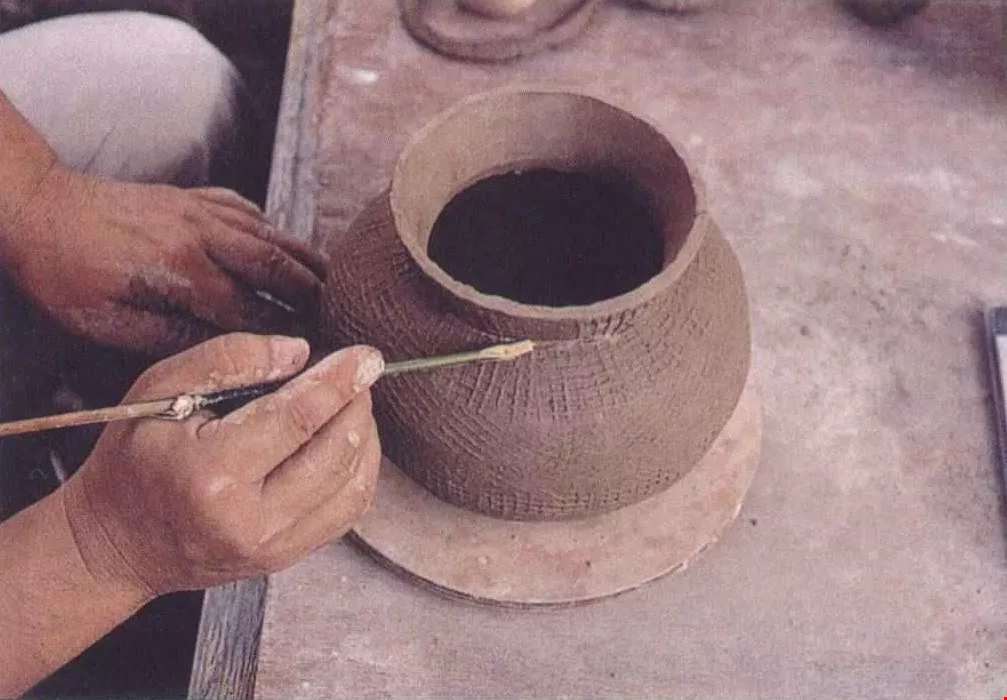
The reconstruction of an Ilan square-patterned pottery jar found by Liu I-chang in the town of Chiushe is a good illustration of Cheng's whole approach. Upon inspecting the original, Cheng discovered that the walls were very thin. If the decorative pattern had been stamped on after the clay had been formed, it would certainly have ruined the shape. So how did the original maker get the pattern on there?
Having repeatedly thought about this problem, Cheng concluded that prehistoric potters must have used an internal mold when working. Perhaps they had shards that they could just pick up from the ground around them. They could take the kneaded clay, wrap it on the outside of the shards, and tap it down lightly with a wooden stick to make the clay more compact and solid. The stick would have patterns carved into it which would then be left imprinted on the clay. But this decorative effect, thinks Cheng, was probably secondary to the functional purpose of compacting the clay.
With these ideas in mind, Cheng first ground up a handful of gravel, added it to the clay, and kneaded it vigorously. Then he took a mold that had been made from the original sample, and spread the clay-now with the texture of pizza dough-on the outside. Then he tapped it with a small stick, which he had personally prepared by paring off the bark and carving a pattern of squares into the wood. Next he cut away the bottom of the jar and carefully removed it. He repeated the process to make the top section, then connected the upper and lower parts.
Then, with his right hand he picked up the wood stick and tapped around the outside, while with his left he held a mushroom-shaped object against the inside of the jar to absorb the shock and prevent the jar from collapsing inward. A careful examination of the finished jar-with its square pattern already imprinted-showed it to look exactly like the sample in the photo.
Dialogue with academia
To reconstruct these 36 pieces of pottery, as much as he could Cheng used the same tools as were available to their original makers. In particular, he avoided using any iron implements, since none had been available back then. When making the ceramic boar, he went into the bamboo forest in front of his house and cut off bamboo branches by hand to serve as the pig's nostrils. When there were no ready-made tools available, he made his own, such as the above-mentioned "mushroom head."
"Such a 'mushroom head' was unearthed at the Peinan site," says Cheng, "and archeologists had no idea what it was for. But people like me who make pottery can identify its function with one look."
Liu I-chang states that his conversations with Cheng have given him much food for thought and allowed him to more accurately visualize the lifestyles and technology of prehistoric peoples. "We help each other a lot."
For instance, Cheng has brought his ceramicist's mind's eye to bear on the mystery of why gravel was mixed into prehistoric pottery.
In virtually all archeological reports, prehistoric pottery includes gravel, usually at a level of 25-30%. Some also includes shells or hornblende. This is definitely not because prehistoric people were unable to get clay of greater purity. On the contrary, the clay they used was often of higher quality than clay today. Thus Cheng concludes that the inclusion of gravel must have been deliberate.
Cheng explains: "These days most ceramic artists buy factory-produced clay that meets a certain set of specifications. Rarely would anybody add gravel. After all, everybody uses electric kilns, because they offer precise temperature control, so their pieces can be fired slowly, with no risk of cracking from overly rapid heating or cooling."
Prehistoric wisdom
But prehistoric peoples did not possess any of these things. They had to dig, rinse, and filter their own clay, shape the pieces, then fire them all together in a big pile of wood under the open sky. This is why they added gravel to the clay, liking mixing stones into mud, to increase its strength and so avoid having the pottery fracture as it first expanded under the heat and then contracted as it cooled.
From this we can see, affirms Cheng, that "prehistoric people understood how to use mixed materials, which was a major breakthrough in technique."
Cheng found further indirect confirmation of his judgement about the technical skills possessed by prehistoric makers of pottery from a documentary on Japan's NHK network.
In the film, a Japanese ceramic artist, an individual who is considered a "national treasure" of Japan, goes to visit a small island in Indonesia where everybody makes pottery. When he arrives there, this great master becomes more like a youthful acolyte. As the Japanese ceramicist slowly and steadily works the clay at his wheel, an elderly aboriginal woman working next to him just turns the wheel twice with her feet and shapes a finished ceramic jug.
The ability of the indigenous people on this small island to judge the quality of clay was even more impressive.
"They just toss some clay into their mouths and chew it around for a while, and they know whether it is good material or not. When we buy clay, the first thing we look at is the written specifications," says Cheng with a laugh.
Firebrand
Though Cheng was able to complete the full set of prehistoric pottery reproductions requested by the museum, and at a level of quality that received high grades from the museum and from consultant Liu I-chang, Cheng himself still feels there are things that he could have done better.
"The hardest part was getting the final color and texture of the originals to come through in the reproductions." Cheng relates that in this regard there were some factors he could manipulate, but others that were beyond his control.
"What kind of clay did prehistoric people use? At what temperature did they fire the pots? You don't get the same feeling from artifacts that have been buried in the ground for thousands of years, exposed to microbes and chemical transformations, that you can get instantly from the recreated works that I am doing today." Cheng admits that if he utilized extraneous processes, such as exposing the pieces to wood smoke for a long time, he could get the colors closer to those of the actual artifacts, but then he would be losing something else at the same time.
Thus, before getting down to work on the final version of each piece, he made numerous trials, using different proportions of iron oxide, trying different temperatures, sometimes buffing the piece to make it glossy and other times not, to get as close as possible to the correct overall effect.
And then of course there was the problem that the pottery-making process in prehistoric times was markedly different from the modern procedure.
"These days we use electric kilns. Though they are safer, they do not leave the same traces that prehistoric pottery has from being fired outdoors with uneven exposure to the heat." Cheng feels very strongly about this. In Western mythology, man escaped the fate of the other animals by stealing fire from the gods, and it was fire that allowed the rise of bronze-age civilization and pottery cultures. But now, fire has been taken offstage, and replaced by electricity. The relationship between fire and potters has been severed by modern kilns. "There is only the moment when you turn on the power-click-there is no physical sensation of kindling wood or smoke."
Back to the tribal experience
After mulling over his experiences, Cheng decided that he is going to save up money to build the finest wood-fire pottery kiln in Taiwan. This could not only restore the relationship between fire and potter, but could also induce Taiwan's ceramic artists-among whom Cheng believes there is currently too much division and distance-to cooperate with each other. "This could encourage interaction and partnership, and even in a small way create a sense of having returned to the tribal village."
Now that's a lovely thought. Beside a road in Emei Rural Township in Hsinchu, the kind of narrow, winding mountain road where you need to beep your horn continually to warn possible oncoming cars around the corner, in the home that he and his wife Shen Tung-ching built with their own hands, just next to a pond surrounded by all kinds of large trees, Cheng Yung-gwo dreams of himself sitting with a group of friends and colleagues around a fire, "alternately firing pottery and drinking wine."
p.76
In reproducing prehistoric pottery, Cheng Yung-gwo used a wooden block of his own making to compact and strengthen the clay. He aspired not only to reproduce the originals, but to rediscover the spirit of their original makers.
p.77
Cheng Yung-gwo's reproductions of prehistoric pottery are on display in the Taipei County Yingko Ceramics Museum.
p.78
The Chihshanyen site, discovered only in the 19th century, includes artifacts from multiple cultures. Many digs have been conducted there, including during Cheng's student days. (courtesy of Huang Shi-chiang)
p.79
In the spirit of a detective, Cheng Yung-gwo made his reproductions based mainly on shards. The photo shows shards unearthed from the Chihshanyen site. (courtesy of Huang Shi-chiang)
p.80
In the process of reproducing a jar with a square pattern, unearthed at Chiushe in Ilan County, Cheng not only continually reworked the clay, but also recreated the square pattern by striking the clay with a stick carved with the same design. Step by step, the jar came to life.
p.83
Cheng Yung-gwo's dream is to sit at home around a fire with a few friends, firing pots and drinking wine.


@List.jpg?w=522&h=410&mode=crop&format=webp&quality=80)


