Bridging the Generation Gap
Jenny Hu / photos Hsueh Chi-kuang / tr. by Jonathan Barnard
October 1994


Their eldest son Che-ho turned 17 this year. Ever since he entered the equivalent of tenth grade in his vocational high school-cum-junior college, parents Chung Chiang-shan and Chang Pi-yun have seen their son pulled between what he's been taught at home, on the one hand, and peer pressures and the lures of modern society on the other. Che-ho started asking if he could stay out until late at night. He dyed his hair, made repeated pleas for a pager and secretly brought his girlfriend home. Without telling his parents, he even got a part-time job to pay for a motorcycle...
There's a "new youth" in the family! How are the generations to bridge their gap? Chang Pi-yun, who has long worked providing guidance to youths, and her husband, an engineer, have a philosophy about it: They are very clear about what is out of bounds. Other parents might find their experiences edifying. Now, two years after Che-ho first entered his school, he still has his complaints. But he can't help but crack a smile when he admits, "Actually, my parents are pretty mellow!"
While Che-ho's classmates, using their pocket money, go shopping for clothes en masse, Che-ho's mother takes him shopping and picks up the tab.While classmates have taken a job to pay for a motorcycle or taken out loans with a bike shop when their parents turned them down, Che-ho has a new 125cc bike this term, a gift from his folks.
Do his parents give Che-ho anything he wants without conditions? Certainly not. He can only buy clothes during the two big sale seasons, and the motorbike was an early 18th birthday present. The next one he'll have to buy himself. They've even refused to allow him to get a pager or work part time--a far cry from the parents of some of his classmates, who provide without limit. Of the parental units he's stuck with, Che-ho says, "I'm not entirely satisfied,but I can deal."
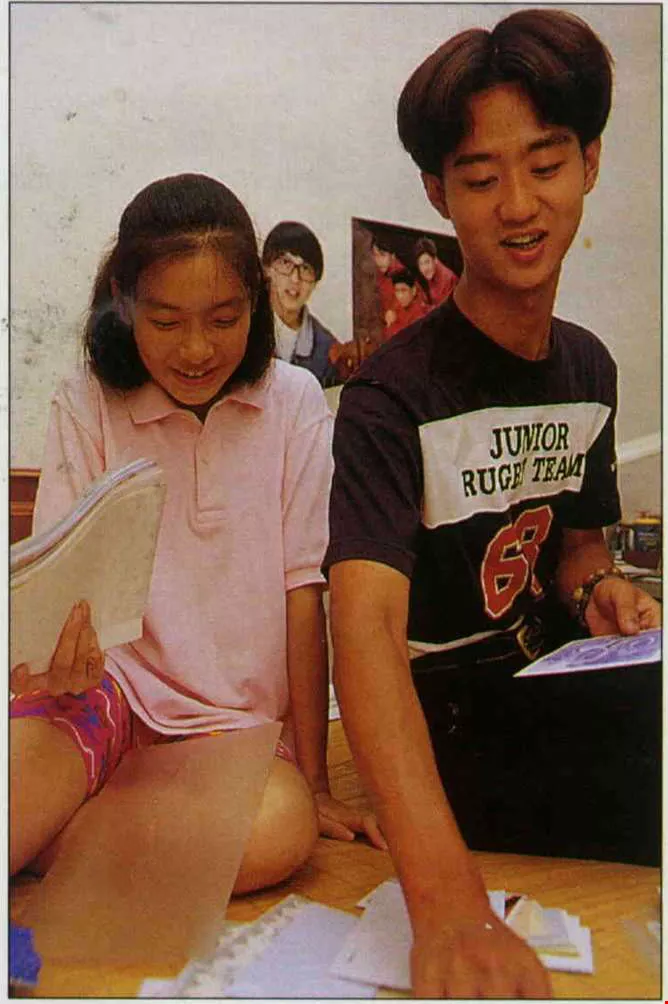
Young people today are not shy; Che-ho got into a frank conversation with his classmate's cousin the first time the two ever met.
Acceptance and guidance
Truth is, the Chungs have been close to their son ever since he was small. No matter how busy he is with work, Chung Chiang-shan plans a family trip every year. The couple's theory is that "you've got to treat the family as part of your career and manage it," and so making time to give their child and listening to what he has to say has always been among the things they consider most important. Che-ho still tells his parents about the details of his life. But since entering his vocational school, he has had more chances to make friends and has been coming in contact with so many new things that what he wants out of life is beginning to change. He's doing more things without his parents' knowledge.
The importance he places on his appearance is obvious. He goes to a stylist to get a fashionable hair cut, and he's started buying Men's Non-No, a fashion magazine. His wardrobe includes articles that bring wrinkles to his mother's brow. An enthusiastic participant in activities with the opposite sex, he's quickly found a girlfriend, even secretly bringing her home. Several times his mother has looked in his wallet or pants pocket to find that he had been given tickets for riding classmates' motorcycles without a license. After going through a short period of surprise, confusion and anger, the two parents decided to cool down and face the problem square on. "First, we had to admit that his behavior wasn't way out of line; he just likes to have fun. Youth is a time when one is anxious to probe the world and has less resistance to media messages and peer pressure. When we were young, weren't we the same way? Here was a chance for him to learn from his mistakes."
Allow your child to do the ridiculous, but he has to learn from experience. Chung Chiang-shan and Chang Pi-yun determinedly affirm this principle. What's left is just a question of implementation. In the Chung household, what's emphasized is respect and communication between the generations.
Can you give way?
Hair and clothing take their cues from the fashions of one's peers, and hence the parents don't get too involved, but Che-ho is simply not a sophisticated enough buyer. If the clothes he buys don't change shape after washing, then they're cool enough to look at but impractical to wear. He's wasted a lot of money. Chang Pi-yun's approach? She told her son, "If you want to use a limited clothes allowance, you can buy them yourselves. Or Mama can come along as you choose and she pays." After trying this several times, Che-ho discovered that his mother's taste wasn't as square as he had imagined. Plus she could help pay attention to the materials and the styles, and she seemed eager enough to pay--so he was happy for her to come along. But before adding to his clothing, she would always impose an upper limit on what he could spend each season--putting a brake on his acquisitive desires. Che-ho found he could accept the arrangement.
In an age of greater contact between the sexes, preventing him from having a girlfriend would be next to impossible. Because relationships with the opposite sex involve personal privacy, if Che-ho doesn't bring it up, Mr. and Mrs. Chung won't ask about it either. But once the mother saw the son hiding a girl in his room and reminded him, "Respect the girl's feelings. Be careful not to get in any trouble!" In recalling it, Che-ho smiles. "Mama's way is good," he says. "At least she isn't like some of my classmates' parents who get all upset about nothing and act really strange." Some of his classmates' parents secretly listen in on their children's phone calls with members of the opposite sex, and this often leads to generational war. "It's really too bad," Che-ho says.
Chung Chiang-shan and Chang Pi-yun regard Che-ho's pursuit of fashion as just a stage, and they tolerate what they can. For instance, Che-ho secretly bought a spray can for dyeing hair red and shut himself up in the bathroom, dyeing and blow drying. The parents saw what he had done, but because the color wasn't too weird, they pretended not to notice. In regard to values and behavior, however, they're not easygoing in the least.
The motorcycle incident
Two years ago, when Che-ho secretly took a job to pay for a motorcycle, it caused great friction between the generations.
All boys love the feeling of cruising fast on a motorcycle. When Che-ho was 16, he brought up his desire to buy one. His parents, like most parents,refused--based on reasons of safety and his being under age. After arguments and bitter feelings, Che-ho didn't bring it up again, but gradually he started coming home later at night. After a while, the Chungs noticed that Che-ho's face was always grimy when he came back. At this point, they knew something was amiss and confronted him. Che-ho admitted that he had indeed been working three nights a week as a cashier and had already earned enough for a second-hand motorcycle fixed up to look brand new. It was parked not far from home.
Their son's brazen deed had showed a lack of respect for his parents, but getting angry and yelling wasn't going to change the reality of what had happened. Not long after, this patched together motorbike began to have all sorts of problems. Over the course of three or four months, Che-ho spent more than NT$10,000 on repairs. At this point, Chung Chiang-shan realized that motorcycle shops were taking advantage of the teenage obsession with automotive vehicles to make a killing.
"The motorcycle shops spend a few thousand to buy second-hand motorbikes. And after sprucing them up with some spray paint, they sell them to ignorant kids. They even provide, 'only NT$10 a day interest' to seduce them into to buying a motorbike in installments. But I discovered when I went and asked that many kids eventually can't afford to make their payments. Meanwhile their national ID cards were used for a deposit. Finally they have to rely on their parents to help them straighten things out. Chung Chiang-shan holds that his son was also the victim of this incident. What's important is that it teaches him a lesson. Che-ho quickly agreed to sell the motorbike. He had struggled to pay the original NT$18,000, and the repairs went to NT$26,000--money down the drain. In the time since, he's often urged classmates not to just show up at any old motorcycle shop and buy a bike, and the incident taught him to calculate carefully when taking out a loan.
"When we were young, we also made a lot of mistakes. You have to be reminded a lot of times before you'll remember, and so you needn't be too severe with your kid. When he makes a mistake, he'll know it himself. If you forgive him, he'll remember," Chung Chiang-shan believes.
Making clear the meaning of work
Like most of today's teenagers, Che-ho wants to work, but his father's attitude is clear: "If you want to work, you'll have to start bearing the burden of all your living expenses. I won't give you any allowance." When he saw classmates going to work in a KTV or taking jobs as waiters in Western restaurants, earning tens of thousands of NT over the course of the summer, he got the itch to get a job too. But he calculated what he'd make minus his living expenses, and it wasn't worth it, so he has given up that idea.
"Most of the kids working today are doing it to earn spare cash to spend in their leisure time. From work, how many of them really come to understand that life isn't easy, that making money is difficult?" Chung Shan-ho asks, sighing. His parents have been pushing their opinions on the matter, and now Che-ho also holds that easy money in the service industry is no long-term plan: "They only want you when you're young and hip looking. For future employment, you're going to have to rely on professional ability."
Chang Pi-yun points out that the values in today's society are very mixed up. If children lack appropriate guidance, it's easy for them to get the wrong ideas. She remembers how Che-ho in junior high liked to watch Hong Kong television programs in which all of the characters were underworld figures. All day they didn't have anything to do but get in and out of the fancy foreign cars they drove. One time, her son said, "Wow! So if you're in a gang you can drive BMWs and Mercedes. I want to be like that too when I grow up." The comment shocked his parents, and Chung Chiang-shan quickly took time to explain patiently, "Joining a gang that goes and hurts other people isn't right. A Mercedes should come from your own hard work, and so what you ought to do is. . ."
Since he's been little, his parents have assigned him household chores, and they used to even stipulate that he had to mop the floor before going out to play on Saturday afternoons. Today, when teenagers are often being accused of being lazy and selfish, he has no complaints about doing housework.
Generational face-off
To narrow the distance between the two sides, using nicknames is a good place to start. Mimicking teenagers, the mother often jokingly calls her son "Slime Bucket." And because the mother's skin is good, the son calls her "Baby Face." Their joking banter is both witty and intimate. But sometimes there are indeed differences between the generations, when meaning is lost. For example, many of Che-ho's classmates carry pagers, and he also wanted one, but the answer he got was, "We've managed to get to our age without getting one. Are people of your age that wealthy? If someone calls when you're in class, are you going to get up and leave the classroom to return the call?"
Che-ho felt the suggestion was unfair: "It's so ridiculous. Of course I would wait until I had free time after class. And that way I could filter my calls. A lot of my classmates get together to use one number; you don't have to pay anything." But his parents couldn't accustom themselves to the worldly image Che-ho would project with a pager, and Che-ho had to throw in the towel.
Chung Chiang-shan originally wanted to wait until Che-ho was 18 years old and his grades improved before giving him a motorcycle, but his son protested: "What do my grades have to do with buying a motorcycle? And if you don't let me buy it, I'll still borrow bikes from my friends." His father thought about it: Didn't a lot of adults first enjoy privileges before shouldering the burdens? Che-ho's way of putting it wasn't strange. And so he told his son that this would be the only one they would ever buy him. If he got bored with it and wanted to trade it in, he would have to be responsible himself. At the same time there were three conditions: He would have to wear a helmet; he couldn't speed; and he couldn't refuse requests to use it as a family vehicle. His father also bought him a set of tools for repairing it, providing opportunities for Che-ho's friends to come over and help work on it, which would give the parents a better understanding of his social scene.
After he got the motorbike, his mother noticed that Che-ho, "was more settled and would make it home when expected." But Che-ho proudly reveals," There's nothing wrong with being a good boy at home. If my parents trust me, they'll give me more freedom." He's very clear about things, and if he knows he isn't coming back until late, he won't drive his bike. "That way when I'm being scolded, they won't be able to use that against me." And to make his mother feel at ease, when he's going to a disco he'll lie and say he's going to a KTV. His mother understands what he's going through: "He has a love-hate relationship with his family. With his parents, he's 'close but not too close.'"
Do the Chungs have a successful relationship between parents and son? Chung Shan-ho and Chang Pi-yun can't say. But they do know that at least their son isn't like many teenagers, who aren't a bit close to their parents.
[Picture Caption]
p.22
As Che-ho has gotten older, he has begun to assert his independence and claim rights; his parents are both pleased and troubled.
p.24
Young people today are not shy; Che-ho got into a frank conversation with his classmate's cousin the first time the two ever met.


@List.jpg?w=522&h=410&mode=crop&format=webp&quality=80)


