

"The dragon breeds a dragon, the phoenix a phoenix, and the rat's son can dig a hole." It is as though father and son are from the same mold. Apart from heredity, later identification is also very important. (photo by Chen Shu-ying)
Mr. Tsai's son is 18 this year, but every time the two men speak Mr. Tsai feels like he is talking with his own father. Originally, this unlikely son was actually brought up by his grandpa, resulting in a certain lack of what the Chinese call hsiao.
According to the interpretations in the classic Shuo Wen Chieh-tzu, the Chinese ideogram hsiao means "similar flesh and bones." The implication is that a son who has no hsiao is someone who is not like his male ancestors.
Why did the Chinese of former times attach such significance to their children being like themselves?
"In the past, the Chinese had children to continue the family line and build on and enhance what they already had," says Huang Lun-fen of the You Yuan Foundation. In traditional China there were family laws, regulations, teachings and ethics which could all be used by parents as tools to control their children so they would inherit the traditions, profession, affairs and learning of the family. A number of literati and Confucianists came to fix these family precepts so that they lasted down to later times.
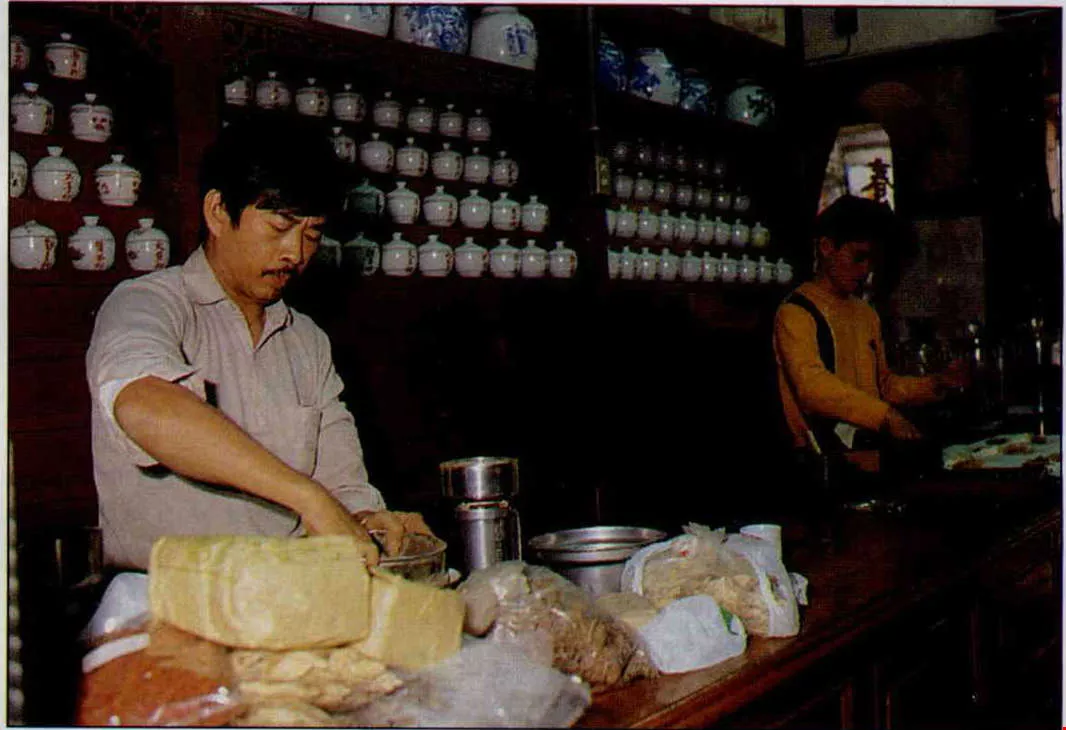
So that children would follow in the footsteps of father and continue in his trade, Chinese people in the past were always concerned that their offspring should be like themselves. But this is happening less and less . (photo by Huang Li-li)
Likeness is also filial piety:
The family trade was also something that the children should inherit. Whatever the occupation of a family, the children would be shaped to become members of that profession.
After withdrawing from the stage for 13 years, Wang Fu-jung, the daughter of Wang Chen-tzu who founded the Fuhsing Opera School, recently came back to Taiwan to play the role of Hung Niang. That she had not used those years to properly inherit her father's teaching by studying some of the old dramas passed down through the family was a matter for much regret. She hopes that after her performance of Hung Niang she will be able to pick up again on what her father had wanted, and to one day take Twice to the Palace, his tour de force, back onto the stage.
"To carry on the work and follow in the footsteps of one's father was something that was constantly raised in the ethics of filial piety," says Yeh Kuang-hui, an assistant researcher of the Institute of Ethnology of Academia Sinica. This is why China has seen so many families of famous medics, renowned scholars and Chinese apothecaries continue down through the generations. Even in operatic circles everyone pays meticulous attention to family background.
"In fact, in the past poor families did not want their children to be like themselves," says Huang Chun-chieh of Fu Jen University's sociology department, looking at it from another angle. The idea of the son being like the father was really confined to families with a certain status in society already. Yet no matter what happened later, this idea, which was first seen in the Book of Rites as a kind of reprimand, was an allusion to the child who had not done as well as he should have done.
In modern society, however, young parents have discovered that sons and daughters lacking in hsiao now come in a new edition.
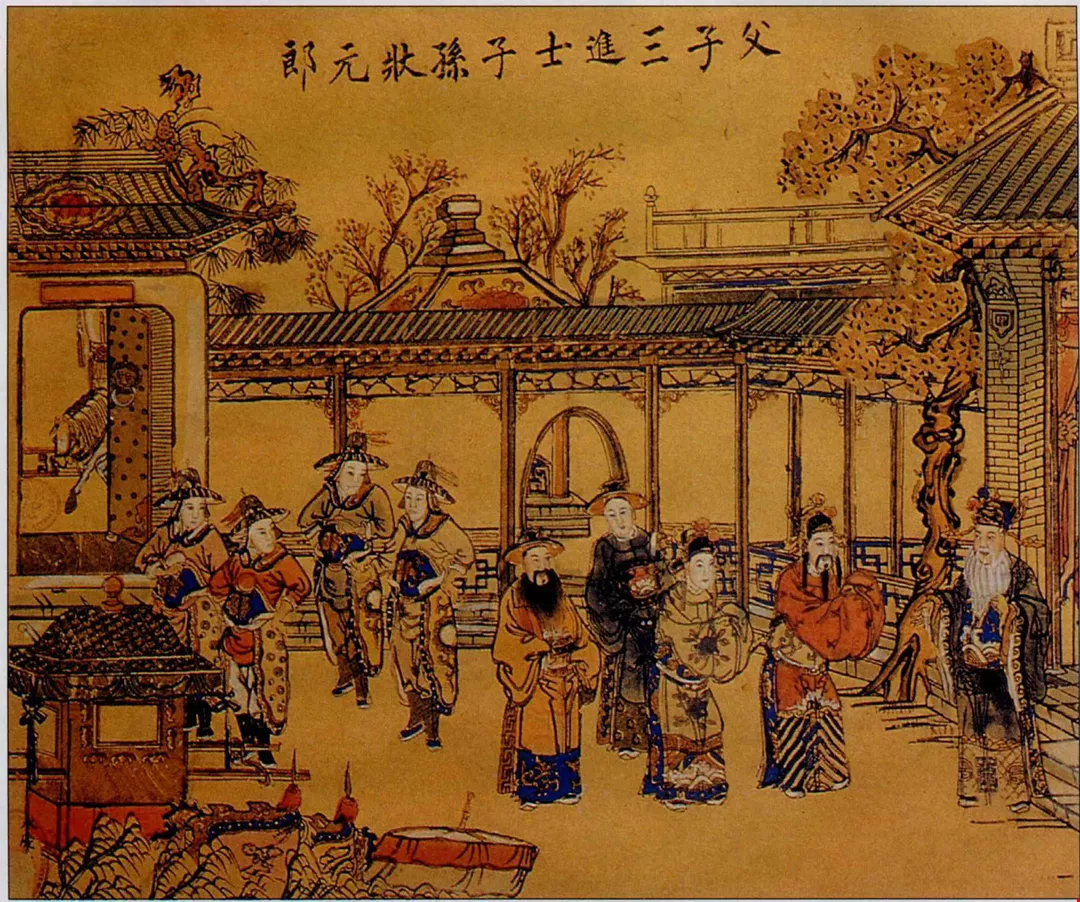
Listed among the Eight Great Artists of the Tang and Sung dynasties, the brothers Su Shih (Su Tung-po) and Su Che with their father Su Hsun are shown simultaneously graduating in the civil service exams. Such is the epitome of the Chinese family.
Growing up on grandma's milk:
Due to the demands of her work, journalist Chen Ai-chia gave her daughter to a nanny to look after for 24 hours a day, only having her home on Sundays so they could spend some time together. Before the girl got to two, everything seemed to be hunky-dory, with the child growing to be lively and loveable. It was only when the girl learnt how to speak Mandarin that Chen Ai-chia discovered she had a distinct Taiwanese accent with a very rustic flavor about it! When Chen took the child out she also discovered that, even at this tender age, whenever they came across a temple she would have to do obeisance with a kind of mumbling chant that both angered and amused the woman, who is a baptized Christian. She could not help but murmur to her husband, "How come this child is not like me?"
Such feelings are not uncommon in modern society. According to last year's figures from the Directorate-General of Budget, Accounting and Statistics, more than half the married women in the Taiwan area in the childbearing bracket between 25 and 39 years of age enter the jobs market without looking after their children at home. A survey carried out by I Ching-chun of the Institute for Social Sciences and Philosophy of Academia Sinica takes a further step forwards in discovering that 30 percent of mothers under 30 who have children under three actually put their children into the care of someone else for 24 hours a day.
"Among the cases I have come into contact with, there are many people who have sent their children away to their grandparents in the south as soon as they were born. They only brought the children back when they were old enough to go to school, with the result that they were shocked, and wondered 'how can this be our child?'" says Huang Lun-fen, who tells them, "The influence of the people who brought your child up is of course very strong. He was brought up on Grandma's milk, so of course he is like her and not like you."
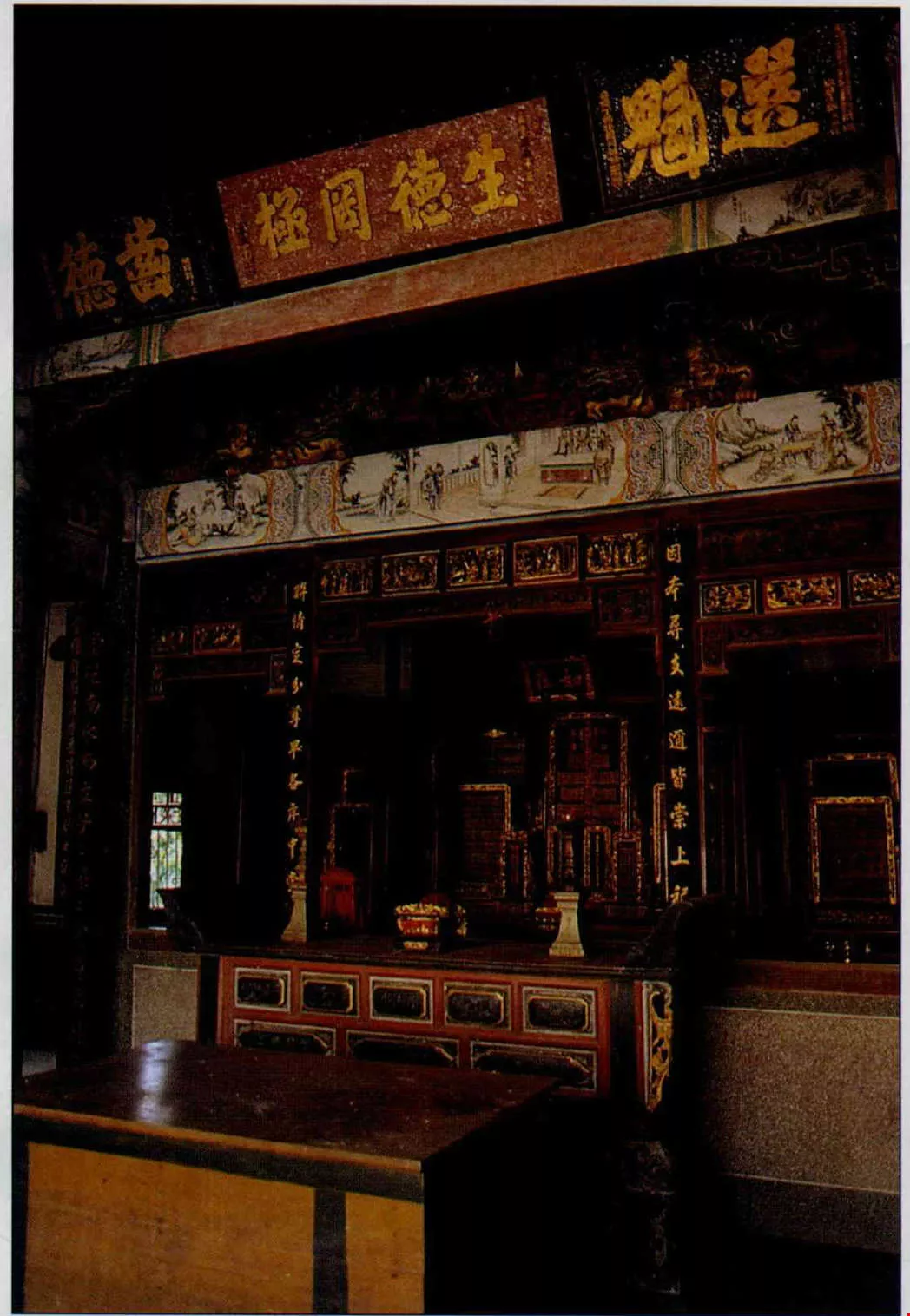
The prescripts expressed in the inscriptions in the ancestral hall give younger generations moral guidance on how to uphold the family style and traditions. (photo by Cheng Yuan-ching).
A maid teaching Philippine-style Mandarin:
A similar situation arises when some professional couples ask a foreign maid to move in to their double-high-income home.
"They live for long periods with the children, so naturally they influence a child's behaviour," says Li Mei-lan, author of The Wonderful HouseKeeper. As she herself enlisted the rich experience of a Filipina maid, her daughter now speaks fluent Mandarin with a Philippine accent.
"Before the age of six is the most important period for the development of an individual's personality. In this period of time a child's sensations are saturated by their living environment and they copy every word and movement made by adults. When a child does something that an adult approves of, receiving praise will reinforce it. A child will also identify with the people it likes," says Yeh Kuang-hui, who holds a doctorate in psychology.
Children are most easily influenced by accent and intonation, as well as by food and drink and other such life habits. Even more important is that it is hard to avoid such deep levels of the personality as character, values, and religious belief being influenced.
Chiao Tai-ling, who like her sister-in-law gave her children to her mother-in-law in Fengyuan to look after, once saw with her own eyes her five-year-old nephew take a pair of old socks and say to her grandmother: "Grandma, mend them for me." Chiao Tai-ling could not help sighing, "These days there are very few people who are so thrifty!"
Theoretically, children given over to the grandparents to bring up will best be able to inherit the family character. Yet, in fact, older people love to playfully bring up children separated from them by a generation. No matter whether it is in the degree of supervision or the types of activity, all are very different to the ways in which they brought up their own children when they themselves were young.
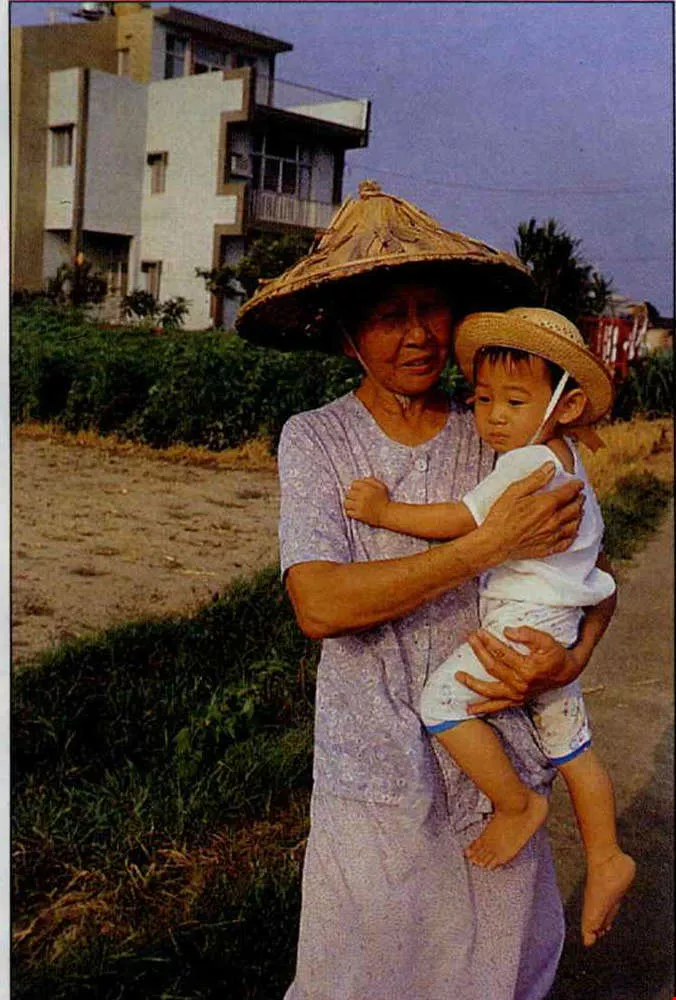
In the southern countryside there are many "Grandma's children" who belong to office workers in Taipei. (photo by Vincent Chang)
Grandma's child:
Because there is not much activity in the homes of the elderly, the children often end up in front of the television, with the result that a lot of TV kids are being raised up. "This kind of child usually has comparatively passive thought patterns," says Chen Chih-tsai, director of the Hsinyi Foundation and a consultant in the psychiatry department of the Mackay Memorial Hospital.
"Grandma's child" also has a comparatively fragile personality, with special traits such as understanding too early how to look after himself. "Firstly, the older generation use fear to teach children, saying that if you behave badly then you will be taken away by an evil person, for example. Secondly, they do not have any feeling of security and get very worried if they see children jumping about, thus tending rather to coddle them," says Huang Lun-fen.
Among the "Grandma's children" there might be a small number who really take in the teaching of their grandparents yet then end up having a "generation gap" with their own fathers.
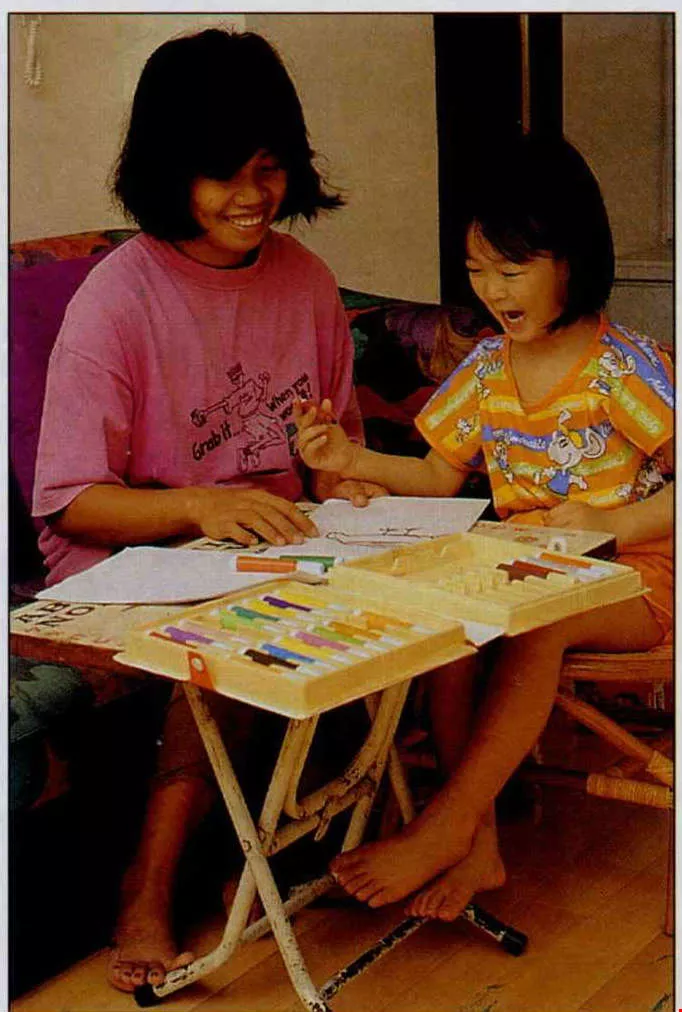
Filipino maids moving into homes and living with children from dawn till dusk results in many children ending up with a Philippine accent to their Mandarin. (photo by Huang Li-li)
Another kind of generation gap:
Freelance journalist Tsai Ching-ting has an elder brother who was sent away to his grandparents and only returned home to live with the family when he was 18.
"He is the well-behaved child in the eyes of relatives. He is very respectful to his elders and has a great sense of responsibility for the home. But his personality is too restrained and his style very traditional, criticizing people when he is concerned about them. Even my father is not like that. My sister and myself often find it hard to stomach and end up rowing with him," says Tsai Ching-ting.
Her analysis is that her brother is more traditional than her father probably because her grandfather had ten children of his own to raise and was also very busy in his work at that time. Although this meant he was very strict with his children he still could not check everything. By the time it came to bringing up his eldest grandson his load was already lighter and he went the whole hog on wielding his educational authority. On the other hand, Tsai's mother grew up in a liberal family and gave him a lot of influence.
"There was one time when I said to my mother that my elder brother is really of my grandfather's generation. My mother listened and laughed, obviously agreeing," says Tsai. Tsai's mother now hopes that her elder brother will find a vivacious wife who will be able to patch up the deficiencies in his personality. Yet she worries that there are probably not many girls today who would want to marry such a young fogey.
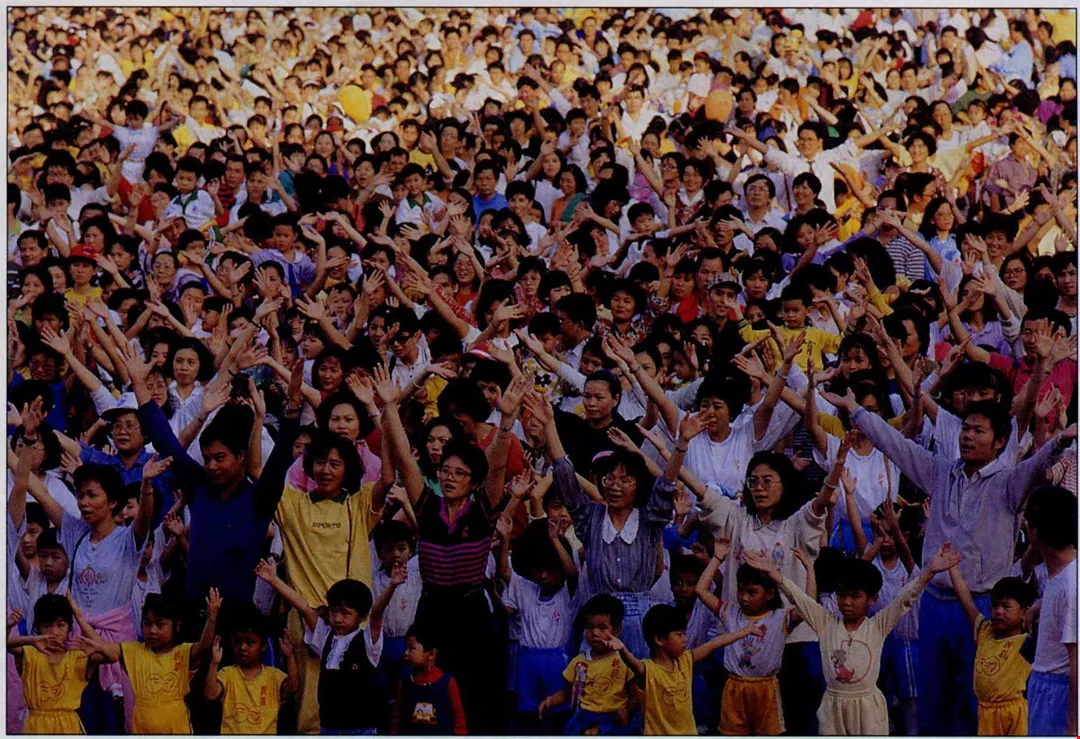
With society changing too fast, perhaps later on everybody will be an "unlikely child." (photo by Pu Hua-chih)
Old Ma's got nothing on God:
Some people just cannot accept it when they see that their child is not like them, and try to change the child. Take Chen Ai-chia, who spent a lot of energy on trying to correct her daughter's pronunciation. Huang Lun-fen also repeatedly attempted to let her son try out what she considered to be more healthy food. However, most people's reactions are not as strong as those of the ancients, who scolded the child for not being like his parents. One university professor on seeing his daughter who had just begun going to a Catholic kindergarten say grace before every meal, humorously told her: "You do not have to thank God for giving you food to eat. Just thanking your old father and mother would be enough!"
Although things have come to this, in comparison with the ancients, modern people do not care so much about whether their children are like themselves or not. "One aspect of this arises from the wind of democracy. What children want to do in future they can do; it is up to them to make the decisions. Then there is also the influence of individualism: "The achievements of the individual are more important than whatever you might be given by your family background. With the education of the younger generation being generally higher than their predecessors, these ideas are getting weaker and weaker," says Huang Chun-chieh.
There are also some people who, from another angle, look at their children and see the good points that they themselves lack. Take Huang Mei-hua, who gave her daughter to a nanny to bring up. She often feels that the girl has a straightforward personality with a big-sisterly style that is very similar to that of the nanny. "Later on she will have more affinity with people than I do," says Huang Mei-hua.
As for those "weekend parents" whose children only return to the home when they are old enough for school, there will be endless conflicts if they can find no way to accept that their children are just going to be incompatible with the parents in many ways, thinks Ko Hua-wei of the psychology department of National Chung Cheng University. The trend of working wives is an unstoppable one, but you should definitely not give your child to others for 24 hours at a time.
"As a parent you should not blame your child for being so unlike yourself, but you should know what habits he has taken on from being raised by another person. Begin by accepting him and wait until you identify with each other, then it will be easy to reshape him," she says. "To put it bluntly, when you should have been influencing the child you were not by his side. He is thus like a child you have adopted, not originally like you!"
No hsiao is commonplace:
Nevertheless, looking at it from another aspect, this generation of 30 to 40 year olds have all been brought up by their own parents. But whereas the older generation ate cucumbers in soy sauce, this generation has enjoyed the influence of the knowledge of nutrition, and the advocation of natural and healthy eating. So are they not also rather unlike their parents!
No matter what the society of the future is like, at least there is one thing that we can be certain of--to be said to be "without hsiao" will never again be a rebuke.
[Picture Caption]
p.34
"The dragon breeds a dragon, the phoenix a phoenix, and the rat's son can dig a hole." It is as though father and son are from the same mold. Apart from heredity, later identification is also very important. (photo by Chen Shu-ying)
p.35
So that children would follow in the footsteps of father and continue in his trade, Chinese people in the past were always concerned that their offspring should be like themselves. But this is happening less and less . (photo by Huang Li-li)
p.36
Listed among the Eight Great Artists of the Tang and Sung dynasties, the brothers Su Shih (Su Tung-po) and Su Che with their father Su Hsun are shown simultaneously graduating in the civil service exams. Such is the epitome of the Chinese family.
p.37
The prescripts expressed in the inscriptions in the ancestral hall give younger generations moral guidance on how to uphold the family style and traditions. (photo by Cheng Yuan-ching).
p.38
In the southern countryside there are many "Grandma's children" who belong to office workers in Taipei. (photo by Vincent Chang)
p.38
Filipino maids moving into homes and living with children from dawn till dusk results in many children ending up with a Philippine accent to their Mandarin. (photo by Huang Li-li)
p.39
With society changing too fast, perhaps later on everybody will be an "unlikely child." (photo by Pu Hua-chih)


@List.jpg?w=522&h=410&mode=crop&format=webp&quality=80)


@List.jpg?w=522&h=410&mode=crop&format=webp&quality=80)
