

On the morning of November 14, a Red Chinese Air Force pilot turned his plane toward a destination he had never seen. Twenty-seven-year-old Wang Hsueh-ch'eng began a six-hundred-kilometer journey to Taiwan and freedom.
At 9:25 a.m., Republic of China air-traffic-control radars picked up a Red Chinese airplane, near the Taiwan Strait alert zone, heading for Taiwan. The Ministry of Defense sortied two F5E fighters to intercept the approaching plane.
The two fighters came upon the MIG-17 in the sky over Matsu. The MIG pilot was wagging his wings to signal his intention of seeking freedom.
The air forces of the Republic of China and the Chinese Communists do not have compatible radio frequencies, so the pilots used hand signals to communicate with one another. The MIG pilot waved forward to show he wished to land. One of the F5Es took the lead, and brought the MIG down through the cloud layer for a better view of the ground.
The plan was to lead the MIG to a military air base near Hsinchu, along the west coast south of Taipei. But on the way south, the MIG pilot saw that his fuel gauge read empty, and he decided to land when he saw a runway at Chiang Kai-shek International Airport.
The runway was still under construction. To avoid hitting construction workers, the plane had to slither right and left for more than a kilometer after touching down. The plane's rear tires were ruined, but no one was injured. The engineers on the runway ran, or drove earth-moving equipment, to greet their visitor from the mainland. "Welcome!" "Congratulations!" They lifted up the pilot in a warm greeting. The pilot said, "I've finally made it!" The time was 10:15 a.m.
The director of C.K.S. Airport notified responsible authorities, and the Chairman of the Joint Chiefs of Staff, the Assistant Chairman, and the Commandant of the Air Force sped to the airport to welcome pilot Wang Hsueh-ch'eng. Afterwards, they escorted Wang to the Air Force Headquarters in Taipei City, and early in the evening Wang appeared in a press conference arranged by the Government Information Office. Foreign journalists from Turkey, Italy, South Africa, and Japan were in attendance, as well as many representatives of the Republic of China's various news media.
Wang indicated that since the communist policy of "four modernizations" began, the people on the mainland have had more contacts with the outside world, and are feeling that the disparity between Communist China and the outside is too extreme, and thus are developing doubts about the communist regime. "The Communist Party's philosophy is a philosophy of struggle; they struggle back and forth, and the Party thinks little about economic development and production, so the people all feel there is no hope."
According to the "Regulations Concerning Rewards for Freedom Seekers from the Red Chinese Air Force," Wang is eligible to receive 3,000 taels of gold (worth about US$1.3 million) for flying his plane to Taiwan. He is also eligible for a promotion in rank. (Wang has received both rewards, and is now a commissioned officer of the Republic of China Air Force.)
A happy scene at the press conference was Wang's meeting with an old friend from the mainland, pilot Wu Jung-ken, who defected in October 1982 by flying his MIG-19 to South Korea. Wang joked that Wu had grown taller and gained weight. Even the next day, he brought that up when asked about his future plans. "I'll watch my weight and not get fat like Wu Jung-ken."
A few days after his arrival, Wang was asked, "What are the differences between the mainland and Taiwan news media?" Wang answered, "On the mainland, the small newspapers follow the big newspapers, and the big newspapers follow direction from above; there's no journalistic competition to speak of. When people read the news in the papers, it's usually what happened several days ago; I feel the news reports here can be described as true, fast, and new. The reporters in the free fatherland are scrambling to report news; it's really hard work."
Wang is the third Red Chinese Air Force pilot to leave the mainland and attain freedom in Taiwan in thirteen months. His message to his compatriots on the mainland is "Freedom is great!"
[Picture Caption]
Left, Wang Hsueh-ch'eng (right) and Wu Jung-ken (left) were classmates on the mainland, and both succeeded in seeking freedom; in Taipei they were happily reunited. Right, Wang explained in a press conference the motives for and experiences of his defection. In the right of the picture is Dr. James C. Y. Soong, director-general of the Government Information Office and host of the press conference.
Wang appeared at a press conference and answered questions from a group of more than one hundred domestic and foreign reporters.
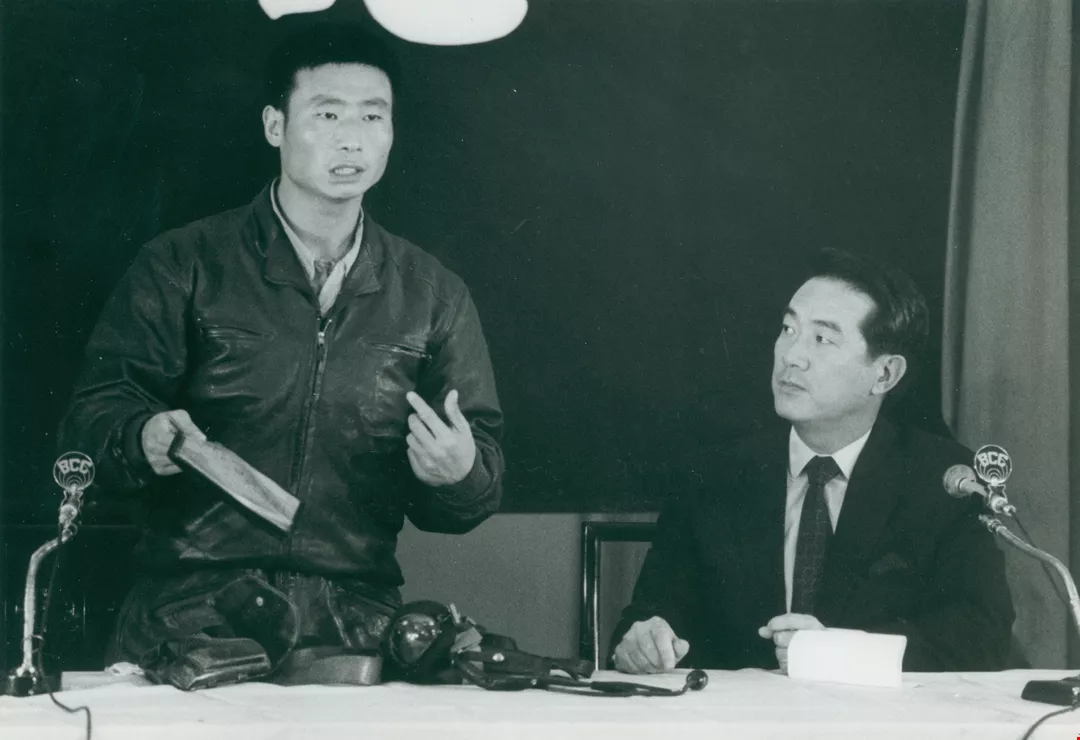
Right, Wang explained in a press conference the motives for and experiences of his defection. In the right of the picture is Dr. James C. Y. Soong, director-general of the Government Information Office and host of the press conference.
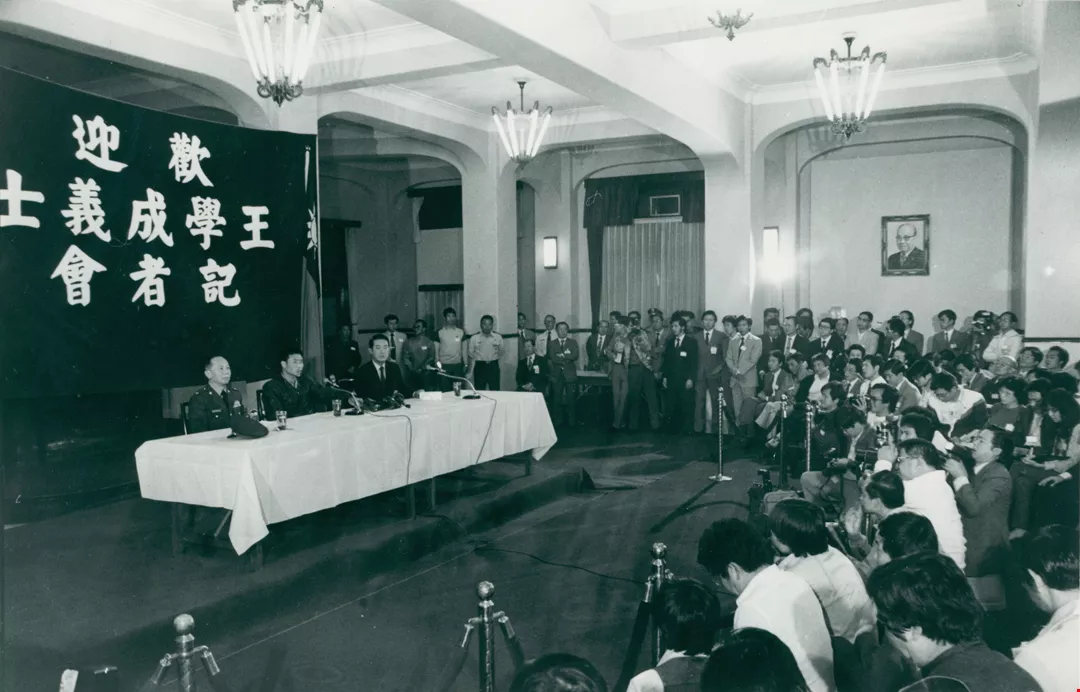
Wang appeared at a press conference and answered questions from a group of more than one hundred domestic and foreign reporters.


@List.jpg?w=522&h=410&mode=crop&format=webp&quality=80)


