
In Taiwan the image that people have of a nurse is a woman, and many are not even aware that men serve as nurses. "Often when patients can't find a nurse to help them, they call out 'miss, miss' everywhere," says Li Hsien-fa, a male nurse. "I'm a nurse right by their side, and they don't even know it."
And more than a few Patients and their families have mistaken male nurses for doctors. Chou Yueting, a nurse in the cardiac surgery department at Veterans General Hospital, says that when he tells patients he is a nurse, they have an interesting response: "After you serve for a while as a nurse, don't you become a doctor?"
Beginning in 1985, the departments of nursing at Taipei Medical College and National Taipei College of Nursing were the first to break down sexual barriers in the field by admitting men. After three or four years of study and two years of military service, these men have already started to work in hospitals.

How will male nurses make out in a women's field?
A new field:
In many countries a male nurse is nothing out of the ordinary, and in China too men have served as nurses before. As early as the war of resistance against the Japanese, military nursing schools accepted male nurses. And more than 30 years ago, men were accepted into the first class of nursing at National Taiwan University.
Lu Mei-hsiou, the chairwoman of the nursing department at Taipei Medical College, points out that the role of a nurse is to provide care, concern and support for patients, feminine work according to traditional Chinese conceptions. Yet in reality, nursing requires specialized knowledge and abilities but is gender neutral. It shouldn't be restricted to women.
According to statistics provided by the job office at National Taipei College of Nursing, of the 178 men who have graduated from the college, 57 are now working as nurses, 24 have changed professions and the remaining are continuing their studies or serving in the military.
Many fewer are in the nursing program of Taipei Medical College, where the number of male graduates still totals less than ten.

Involving what is more private, obstetrics has not as yet been able to accept male nurses. The fear is that they will only add to women's anxieties. (drawing by Tsai Chih-pen)
A minority:
Though few in number, these newcomers have been heartily welcomed and much appreciated in the profession.
The Taipei City Psychiatry Center and Veterans General lead all hospitals with seven or eight male nurses on staff. Chang Pao-chu, assistant director of nursing at Veterans, says that hospitals welcome male nurses. From a management standpoint, "They view their work as their career and don't require maternity leave." But because they are so few, "they haven't made much of an impact. "Men, being stronger, are at less of a risk when confronting unstable psychiatric patients, and they also handle pressure better," says Chen Mei-yun, the director of nursing at City Psychiatry, "They're of great use. It's just too bad there are so few of them." Of the 170 nurses at City Psychiatry, only seven are men.
Women nurses are even happier to have men working alongside them. "After working around women all the time, everyone was happy to have men join the field," says Chang Wei-chin, the head of nursing in the neurosurgery intensive care ward at Veterans. Since men are stronger, they can handle a few more of those physically tasking responsibilities.
What's more, hospitals are open places. Anyone can just walk right in. Having some men around provides greater safety. "Especially for the midnight shift," Chang says, "male nurses are really valuable."

Men get the same pay for the same work as their female colleagues, but because they are so few in number, they are often overlooked.
Going back in time:
Even if their colleagues are welcoming, beginnings are always difficult, and setbacks can only be expected.
Lin Hung-hsin was in the second class of male nurses, but he got a job in the field even before those in the class ahead of him because he was physically disqualified from military service. "Being a trail blazer," he says, "is always difficult." When he first entered Veterans, there were no uniforms and no dorm for male nurses. Making do, he wore his school uniform to work and went back to the dorm at school to sleep.
Long accustomed to women and only women as nurses, members of the public feel it's a little strange to be served by a man nurse.
Lin Hung-hsin once gave a shot to a male patient, who complained, "It hurts too much when you give me the shot; next time I want a woman nurse." Even though Lin knew that the comment just reflected the patient's psychological hang-ups, it still upset him. Afterwards, his assiduous practice in giving shots earned him the nickname, "Lin, the shotmaster."
It can't be denied that according to most people's impression, "Doctors are mostly men, and nurses are always women." Why would some men want to become nurses?
On this question, they fall into two categories: Many took the Group B (biological sciences, agriculture and medicine) joint university entrance exam, intent on becoming doctors. Because their scores didn't qualify them to study medicine, they chose instead the related field of nursing. And others were genuinely interested in nursing.
Lu Mei-hsiou admits that most of the men in the nursing program twist in the throes of inner turmoil in their first and second years. More than half of them will take the entrance exam again or transfer to such departments as public health or medical engineering. They don't settle down until their third year.

How modern--a male nanny! Chiou-liu Chin-pang may have changed professions, but he remembers how to feed and wash a baby from obstetrics training.
An anguished growing process:
ChiouLiu Chin-pang, who originally hoped to become a doctor, enrolled at National Taipei College of Nursing right before the deadline the year it began taking male students. He thought that he would enroll while preparing to retake the entrance exam. "I didn't expect to stick it out and set aside plans of retaking the entrance exam."
Lin Hsien-fa, a graduate of the nursing department at Taipei Medical College, is one of the few who was really interested in nursing. "Nursing is a new field for men," he says. "It ought to have a lot of space for developing one's potential." And so, Lin, who gives the impression of being a bit shy, chose to become a nurse.
Training in obstetrics is a big test that no male nurse is likely to forget, an experience that forces some of the male trainees to learn how to cope with rejection.
"Are you willing to have male nurses provide post-natal breast care or wash the perineum?" hospitals ask obstetrics patients.
One mother says that though she would feel a little embarrassed, she would still respect the work of a male nurse. An unmarried woman, on the other hand, says, "I'd die before I'd give my consent!"
Lin Hung-hsin once asked his teacher if she would be willing to have a male nurse when giving birth. "I wouldn't be willing either!" was the surprising response.
"Expectant mothers can accept male doctors but they can't necessarily accept male nurses," says Lin, feeling somewhat wronged. During obstetrics training, he was one of those refused.
"The guys in the class ahead of us told us we would be refused," Lin says. "Expecting rejection, we didn't take it as a slight, and it didn't bother us that much."
"While maternity patients are unwilling to have male nurses care for them, we male nurses--truth be told--aren't really so thrilled about caring for them either!" says Lin Feng-yen, echoing the sentiment of many male nurses. "At the time, I appeared cool and collected about it, but inside I was dead scared." One of his male classmates visibly trembled while helping a mother care for her breasts.
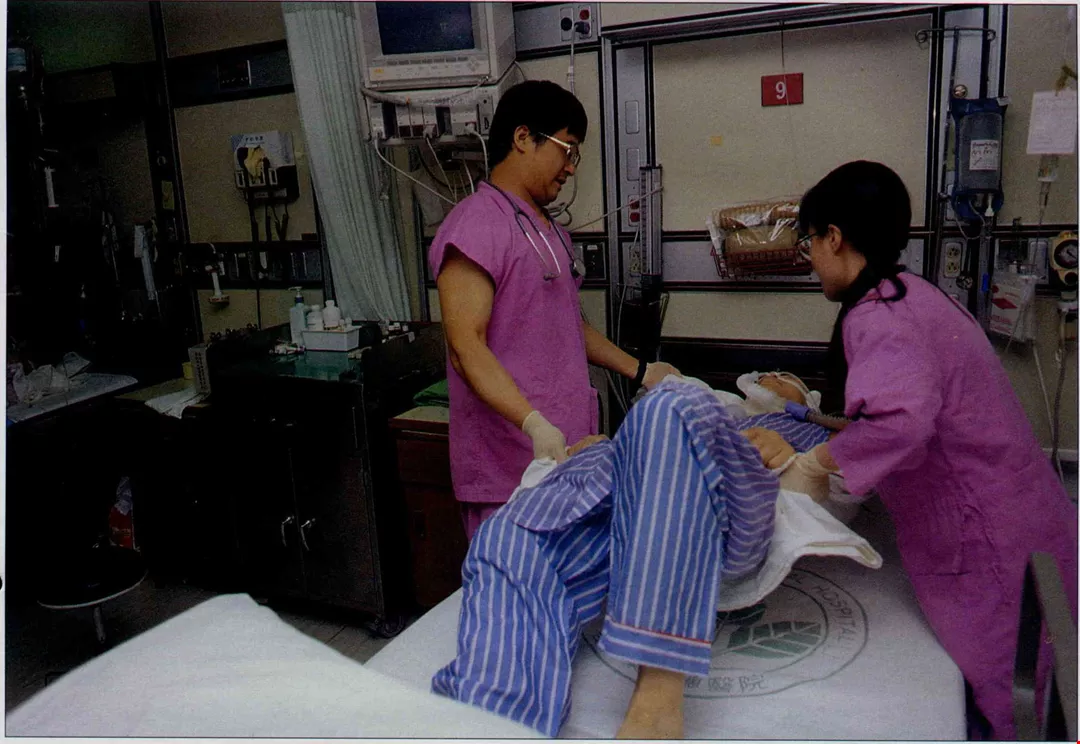
In units for the seriously ill, such as intensive care wards, there are more jobs that test one's strength. For these, men can shoulder a little more of the burden.
A good husband:
Sun Shih-chieh laughingly relates how the husbands, much to his embarrassment, would look on as he helped mothers care for their breasts at City Psychiatric. Finishing one breast, he would say, "Following my example, your husband can do the other one." Taking up another task, he would then beat a hasty departure.
Lin Feng-yen has been luckier. His teacher not only accompanied him as he completed his training but she also asked family members to leave the room so he could work free from their hovering.
Every male nurse who has undergone obstetrics training regards the experience as highly valuable.
First-time fathers can't help but be in a rush and a muddle or some indescribable state when their wives give birth, but Chiou-liu Chin-pang, thanks to his obstetrics training, was as "steady as a rock."
"The nursing college gave us an excellent education," he says. "It's of great help to ourselves and our families." How lucky is the wife with a trained nurse for a husband, who can care for her during her pregnancy and after she gives birth! Chiou-liu's wife, who has just become a mother, says she is "very satisfied" with her husband's attentive care.
"More than other men we understand the difficulties of giving birth, and every male nurse can wash a baby," says the yet-unmarried Lin Hunghsin. A male nurse does indeed make quite a catch!

Professional, knowledgeable, strong and bold, male nurses have what takes to make ideal ambulance rescue squad workers. (photo by Chan Chao-yang)
Skills wanted, strength even more:
But training is only training. Not a single male nurse has selected obstetrics upon becoming a full-fledged nurse. For starters, they don't have a lot of interest in obstetrics, and the field isn't yet really willing to accept male nurses. In obstetrics, it is feared that male doctors and male nurses would only add to the patients' anxieties.
Chang Pao-chu holds that units for serious illness, such as intensive care wards, operating rooms and mental wards, require greater strength, making the most of male nurses' special qualities. These are the places most suitable for them to work.
Whether out of necessity or discrimination, almost all of the men who are nurses now work in units dealing with serious illnesses. Operating rooms, emergency clinics, intensive care wards, and psychiatry, cardiology and osteology departments are places where you're most likely to see a male nurse.
Lin Hung-hsin chose to work in the intensive care ward of a neurology department, which is sarcastically known as the "gold room" (because nurses must clean up feces, which in Chinese are thought of as being golden in color). True, because many of the patients have lost sensation in and control over their bodies, the work takes a lot out of nurses. They've got to turn patients over, sponge them down, wipe them off, feed them and even clean up after they go to the bathroom. But the work also provides lots of challenges.
"Brain surgery patients may be confused and unclear about things," Lin Hung-hsin says. "But the state of their illness changes quickly." Nurses must carefully observe the patients, evaluating the care they are providing and planning future care for the patient. Never letting their guard down, they must also keep the doctors informed of the patients' conditions.
A symbiotic relationship:
Physical differences and diverging social expectations make men and women fundamentally different. Even if nursing is theoretically a gender-neutral occupation, male and female nurses perform differently.
Some people believe that male nurses are too rough and cannot care for their patients as considerately as female nurses. But a nurse's work doesn't end with being thoughtful. Demands placed on a nurse vary from unit to unit. "Working in an emergency room is all about saving lives," says Chang Heng, director of the emergency room at Hsin Kong Wu Ho-su Memorial Hospital, "and so speedy reactions and strength are more important there than being thoughtful."
Chen Mei-yun also points out that in psychiatric wards the nurses' capabilities--and not their kindness and patience--is of greatest importance.
Lin Hung-hsin is that unit's only male nurse. Although they downplay his gender, in the eyes of his supervisor Chang Wei-chin, his performance still differs from his female colleagues.
Chang Wei-chin believes that Lin Hung-hsin, compared to his female colleagues, is more interested in medical technology and less interested in caring for patients. Most female nurses, for example, only help doctors stick tubes into their own patients, whereas Lin, whether the patient is his or not, comes to help as soon as a doctor starts attaching them.
In accordance with Lin Hung-hsin's own experiences, he has discovered that the biggest difference between male and female nurses is that male nurses are more inclined to try to solve a problem themselves, whereas female nurses are more likely to run quickly for a doctor.
Thunderbolt Angels:
Of course, genderpolarized stereotypes shouldn't be used to judge the performance of nurses. Nevertheless, the greater physical strength of male nurses is indeed one of the main reasons hospitals are so enamored of them.
At the end of September an emergency squad of male nurses at Hsin Kong Memorial will formally hit the road. Chang Heng, the director of the emergency room at the hospital who thought up and promoted the idea of the squad, says that the 1-1-9 ambulance drivers are fire fighters and not emergency health care personnel.
Chang Heng believes that male nurses are best suited for the job. "Men are stronger than women and generally bolder," Chang points out. In scenes of disaster such as fires or car accidents, when bodies are covered with soot or blood, not everyone can keep his--or, more to the point, her -- cool. Male nurses may be just what the doctor ordered.
Chang Heng hopes that Hsin Kong's "Thunderbolt" squad will serve as a model for other hospitals. In this way, it will not only raise the quality of emergency medical services, it will also provide male nurses with another way of putting their abilities to use.
From Candles to Flashlights:
The shortage of nurses is a serious problem with no signs of improvement. Irregular hours and low pay are most frequently cited to explain why the nursing profession hasn't been able to attract and hold people.
But starting salaries for nurses are not low--close to NT$30,000 a month at most hospitals. If one has a nursing teaching certificate or has passed high level exams, it jumps to NT$35,000. That compares pretty well with most professions.
There's no difference in treatment. Male and female nurses get the same pay for the same work. But the women tend to feel that the midnight shift "saps their youth," whereas the men jump at the chance to earn a little more. (There's an extra NT$300 for the night shift and NT$500 for the late night shift.) Take Lin Hong-hsin, who regularly takes the late night shift. When you add the night bonuses to his salary, his earnings top NT$50,000 a month.
But even if male nurses are more suited to a lifestyle of night shifts and less concerned about losing their youthful appearances, they still have to consider relationships with their families. In this light, relying on night shifts to make money is not a good long-term plan.
And so practically all male nurses have a strategy for recharging their batteries. "When a candle burns out, that's the end of it, but flashlight batteries can be recharged," says Lin Hung-hsin, who uses time off to prepare for the high-level exam. Last year, he took a test for a class that would let him study for the advanced nursing exam while working at the same time. He wasn't accepted, but he's trying again this year. "In the future I hope I will be able to go abroad for further study, get a doctorate, and go into teaching," Lin says.
Another route:
Working for a few years as a nurse and then changing careers is another option, one that Chiou-liu Chin-pang took.
Based on working hours, salaries and opportunity for promotion, Chiou-liu studied for the university transfer student exam while working as a nurse. After being accepted at the night school of Taipei Medical College, he left his nursing job that he had held for a year and took up selling life insurance, a job with more flexible hours.His background in nursing has been of tremendous help. "What kind of illnesses are refused coverage or require additional payment? In what circumstances will the money be refunded? How is it refunded? I was clear about all of these questions," he says. "All I had to do was learn a bit about the insurance end of it."
With the same attitude toward nursing he had as a nurse, Chiou-liu quickly got into the thick of things. He made the switch successfully and is now a supervisor at Aetna Insurance. His doubled salary has enabled him to buy a house.
Working as a nurse for three years. Chou Yueting in August of this year changed positions to become an operator of high-tech cardiovascular machinery used during open-heart surgery. Was it because his salary was too low or because he had encountered setbacks? "It was neither," he says. "It was because I wanted to get married." Chou Yue-ting's fiancee is also a nurse, and nurses have irregular working hours. For the sake of their marriage they both wanted to make adjustments to how they worked. His fiancee has even thought about getting out of the medical field altogether.
Chou likes contact with people. The feedback from patients gratifies him. But "to take care of my family, I have had no choice but to change my original career path," he says with resignation.
Liu Ping-chi already feels worn out from the heavy load of work in the operating room, and his family is in the furniture business. "At any time I might go back into the business."
If you could do it all over:
In a time of equality between the sexes, no profession should sexually discriminate. Today, as the shortage of nurses grows, the nursing profession really needs men. But do the men who enter the profession have regrets about their choice?
"I agree that this profession needs men," says a heavy-hearted Sun Shih-chieh. "But if I could choose all over again, I wouldn't go this way." In hospitals, doctors are top bananas, and the nurses have yet to get any respect. The various injustices nurses suffer bother him.
"Eighty-five percent of the net profit in hospitals goes to the doctors, and the remaining 15 percent goes to the people who do most of the work, nurses included. This kind of distribution means that doctors are just taking other people's credit.
Nurses are no more respected in private clinics. Sun Shih-chieh's girlfriend works in a private clinic, where she makes less than NT$20,000 a month and is expected to mop the floor, wipe off tables and empty the garbage.
"I don't regret having taken this path. But I would think long and hard before choosing it again," says Lin Hung-hsin, sighing. It's tough be-ing a pioneer.
[Picture Caption]
p.30
How will male nurses make out in a women's field?
p.32
Involving what is more private, obstetrics has not as yet been able to accept male nurses. The fear is that they will only add to women's anxieties. (drawing by Tsai Chih-pen)
p.33
Men get the same pay for the same work as their female colleagues, but because they are so few in number, they are often overlooked.
p.34
How modern--a male nanny! Chiou-liu Chin-pang may have changed professions, but he remembers how to feed and wash a baby from obstetrics training.
p.35
In units for the seriously ill, such as intensive care wards, there are more jobs that test one's strength. For these, men can shoulder a little more of the burden.
p.36
Professional, knowledgeable, strong and bold, male nurses have what takes to make ideal ambulance rescue squad workers. (photo by Chan Chao-yang)
p.37
Since men have joined its ranks, the nursing profession has gained a little vigor.


@List.jpg?w=522&h=410&mode=crop&format=webp&quality=80)


@List.jpg?w=522&h=410&mode=crop&format=webp&quality=80)
