New Cross-Strait Families: Marriages of Inconvenience
Elaine Chen / photos Sinorama file photos / tr. by Peter Eberly
January 1993


"Suddenly glimpsing the color of the willows along the path/1 regret my husband went off to seek official advancement." These days, it's not only the husbands who may leave home to advance their careers. (drawing by Lee Su-ling)
Family values have been touted up a lot recently overseas.
At the same time, families in which the husband or wife lives away from home for some period of time are on the increase in Chinese communities around the world. The fall of mainland China in 1949 left many husbands and wives separated across the Taiwan Strait, creating what were called "cross-strait families." Why are there so many "new cross-strait families"? And why are so many Chinese couples, who have always placed great importance on the family, willing to live apart?
Story No. 1 : In an upscale residential area 40 minutes outside Taipei, a real estate agent takes some clients to look at a three-story Western-style house with a "for sale" sign on it. After going over it upstairs and down, the visitors can't help exclaiming how marvelously furnished it is and wondering why the owners want to sell it.
"My husband can hardly bear to part with it!" the fortyish, fashionably dressed owner explains. "But I'm going to accompany our two children to study in the U.S. and he'll be left alone in Taiwan. We don't need two houses, so we decided to sell this one and save ourselves trouble." She has short hair, cut Demi Moore style, and the decision to go overseas and sell seems to have been made in a similarly simple and straightforward fashion.
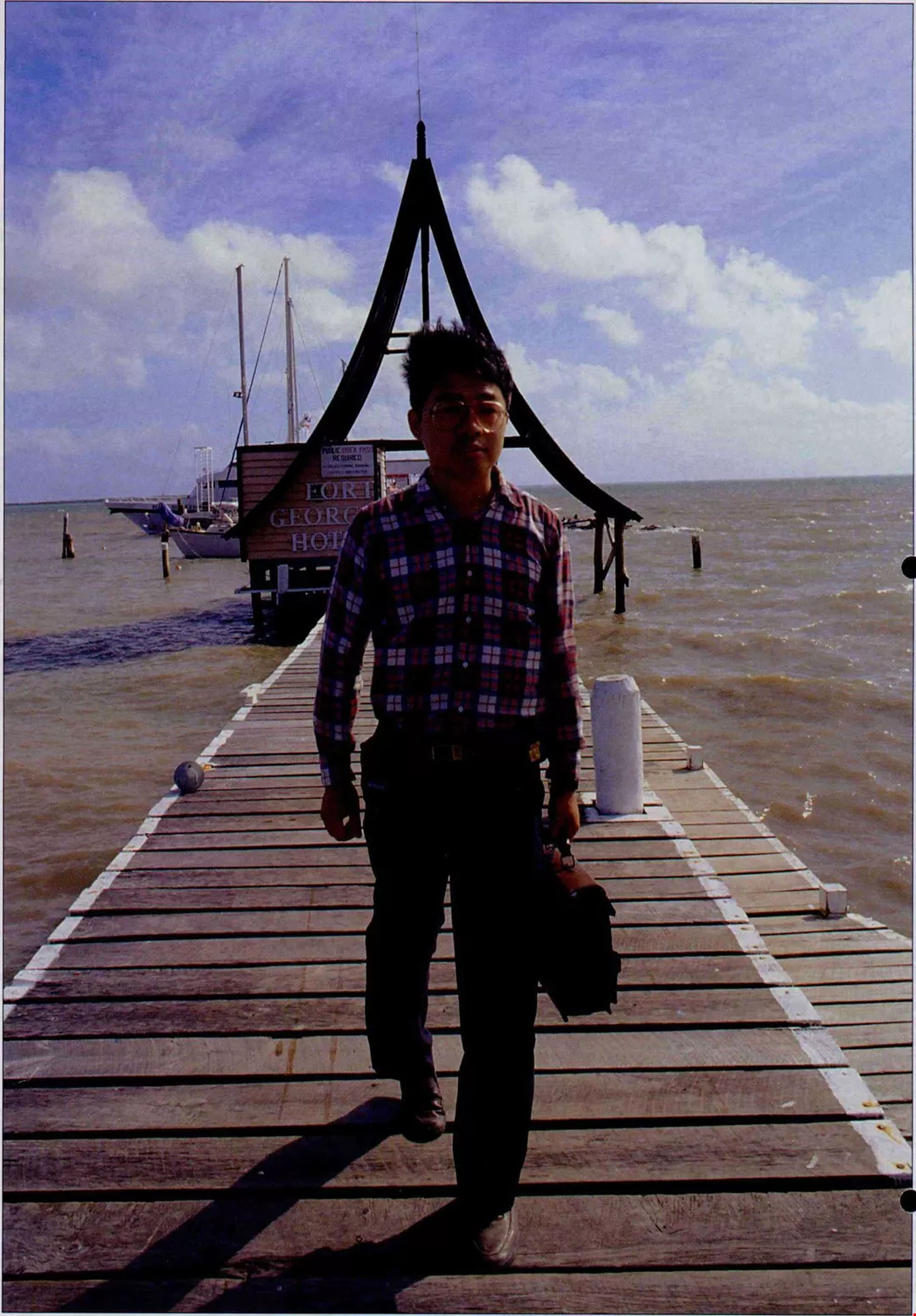
Briefcase in hand, Taiwan business people have traveled around the world, building Taiwan's economic miracle but also becoming absentees at the dinner table. (photo by Vincent Chang)
Story No. 2:
The Yangs, who both teach, are classic "upwardly mobile go-getters" in the eyes of their friends. Three years ago, when Mr. Yang went overseas to earn a master's degree, Mrs. Yang moved back in with her parents to let her husband pursue his studies without any distractions. After Mr. Yang returned to Taiwan, it was her turn to go abroad and earn a master's. Now that she's finally back, he's off to earn a Ph.D., which will take another five years. With this tag-team strategy, their academic credentials and professional standing have risen higher and higher--it's just that their growing daughter is becoming estranged from her parents.
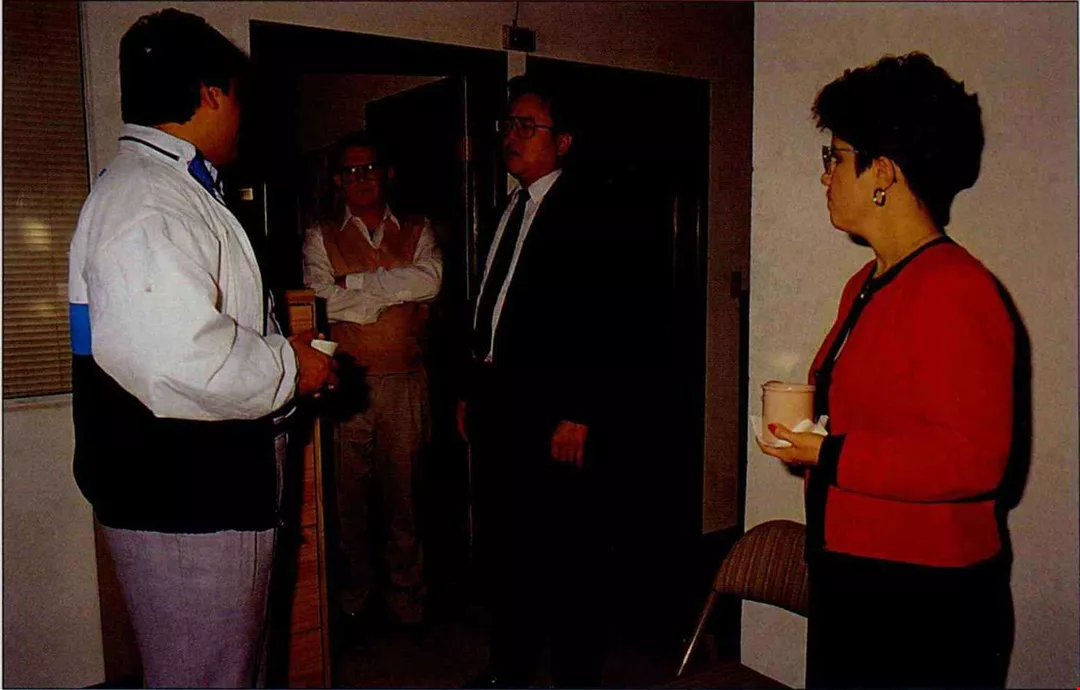
Chu Heng-yung (third from left) went all the way to Mexico to developland. His work and his business partners are his constant companions. (photo by Vincent Chang)
Story No. 3:
Chen I-ju, who works as a freelancer out of a rented office on Chung Hsiao East Rd., is faxing her work to a magazine. She has chosen independence in her marriage as well as her career, letting her husband head off for business to faraway Vietnam while she, with a baby on the way, lives by herself in Taiwan. How does she bear seeing her husband just once every three months?
"Our being in two different places is tough emotionally, but if I'd gone with him I'd have only been a housewife. Not to mention the financial pressure, I wouldn't have been able to stand the lack of self-realization." Since it was her own choice, she says, she just has to take the bitter with the sweet and support her husband the best she can.
A little overseas student alone in a foreign land. Loving mothers often accompany them abroad to look after them. (photo by Huang Li-li)
New cross-strait families:
At the same time as popular culture responds to a current hot topic overseas--family values--"new cross-strait families" have appeared in Taiwan, where husband and wife--even though they may be parents--choose to live apart.
Unlike genuine cross-strait families created 40 years ago by the fall of the mainland to Communism, new cross-strait families have mostly come about as a matter of the partners' own free will, in order to pursue a better future. And instead of the Taiwan Strait, most of the new-style families are separated by the Pacific Ocean or the South China Sea.
The first wave of new cross-strait families was caused by spouses pursuing advanced study overseas. Back when Taiwan wasn't so well off financially, most people studying abroad stayed abroad until they had earned their degrees, however long it might take. Nowadays, what with general prosperity and the increased availability of scholarships and grants from employers, quite a few wives are able and willing to accompany their husbands overseas, taking the children with them. Still, most spouses don't want to give up their careers, and the custom of leaving the family and heading off overseas on one's own is still common practice in Taiwan.
The second wave was caused by the rise of "little overseas students." With economic prosperity, many parents couldn't bear to see their children suffer from the examination pressure they had and decided to send them overseas for high school or grade school. The mother usually went along to look after them, while the father stayed in Taiwan, taking time off from work to fly over and see them.
In the past few years, as Taiwan's economy has become more internationally oriented, many business people have headed off to Europe, North America, Southeast Asia and mainland China to invest and set up factories. That has created yet a third wave of families living apart.
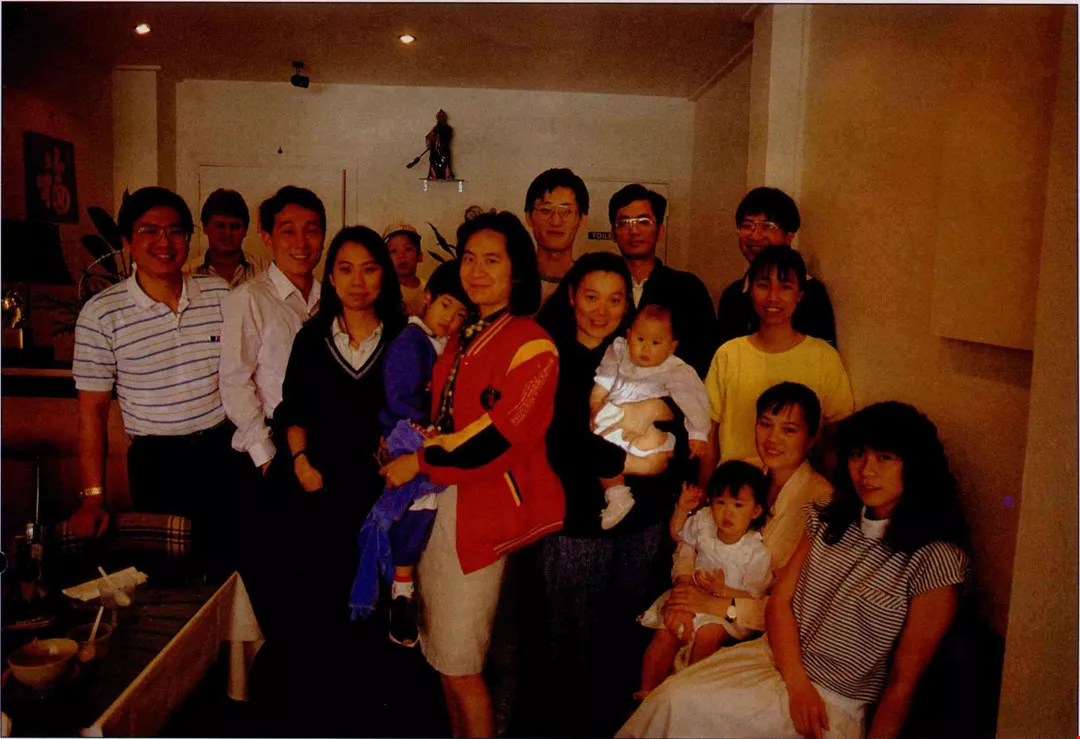
Many students abroad now take their spouse and children along with them. These are Chinese students at Leuven University in Belgium. (photo by Pu Hua-chih)
Widows' Street:
In fact, "new cross-strait families" are common among Chinese in Hongkong and mainland China as well as on Taiwan.
With 1997 looming ahead, many Hongkong residents have started to emigrate early. The result is separations similar to those of families with little overseas students: The wife and children settle down overseas first, while the husband stays behind to earn money. Because of these absentee husbands, some streets in places with many Hongkong immigrants, such as Vancouver, have even been nicknamed "widows' streets. "
In mainland China, job allocation by work units and the lack of freedom of movement once made it hard for many couples to live together. Dissident scientist Fang Lizhi and his wife Li Shuxian were separated for a long period of time while their children were raised by their grandparents, splitting the family in three. In recent years, the fad for overseas travel that has arisen with reform and liberalization has also separated many families.
Last June a play called Home Garrison Woman set a new record in Shanghai by playing to a packed house 168 times in a row. Reflecting a sensitive social topic in recent years, the play touched a raw nerve with many "home garrison women" in Shanghai whose husbands have gone overseas. The film version of the play recently won the best film and best female lead prizes at the this year's Cairo film festival.
New cross-strait marriages have created quite a few special terms in Chinese communities around the world. Such as liu-shou nu-shih ("home garrison woman") in the mainland; tso i-min chien ("serving immigrant time") in Hong Kong; and T'ai-tu ("Taiwan independence," meaning "alone in Taiwan"), t'ai-k'ung-jen ("astronaut," meaning "person whose wife is away") or nei-tsai mei ("inner beauty," meaning "the wife's in America") in Taiwan. There are even plays on words in English: Ph.D. means "pushing my husband to get a degree," and MBA stands for "married but available."
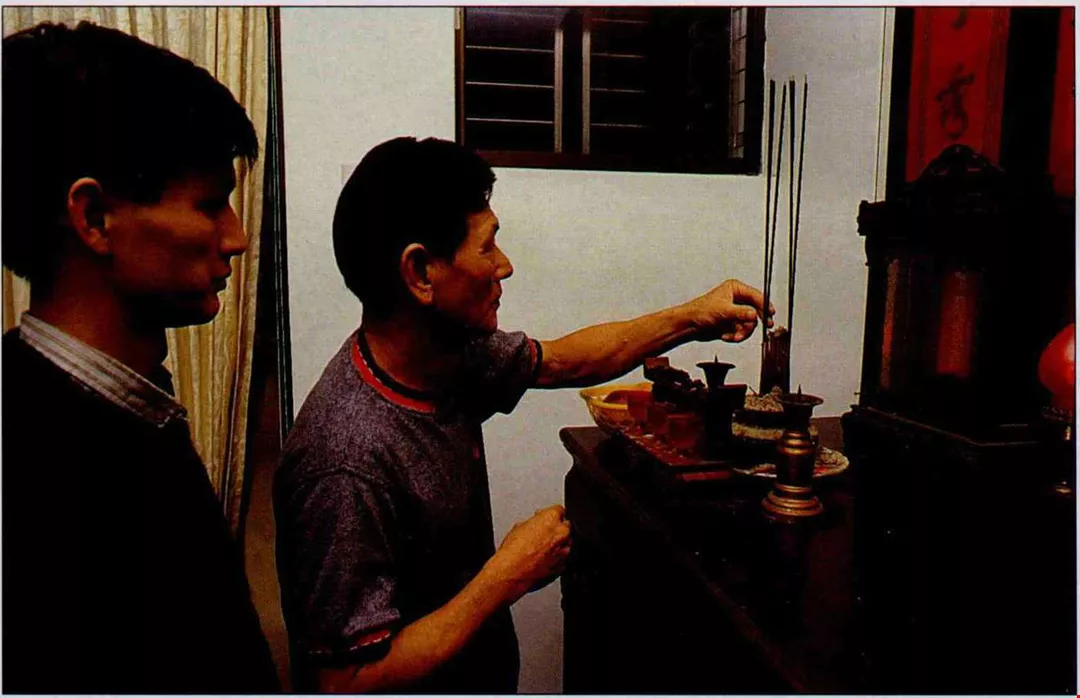
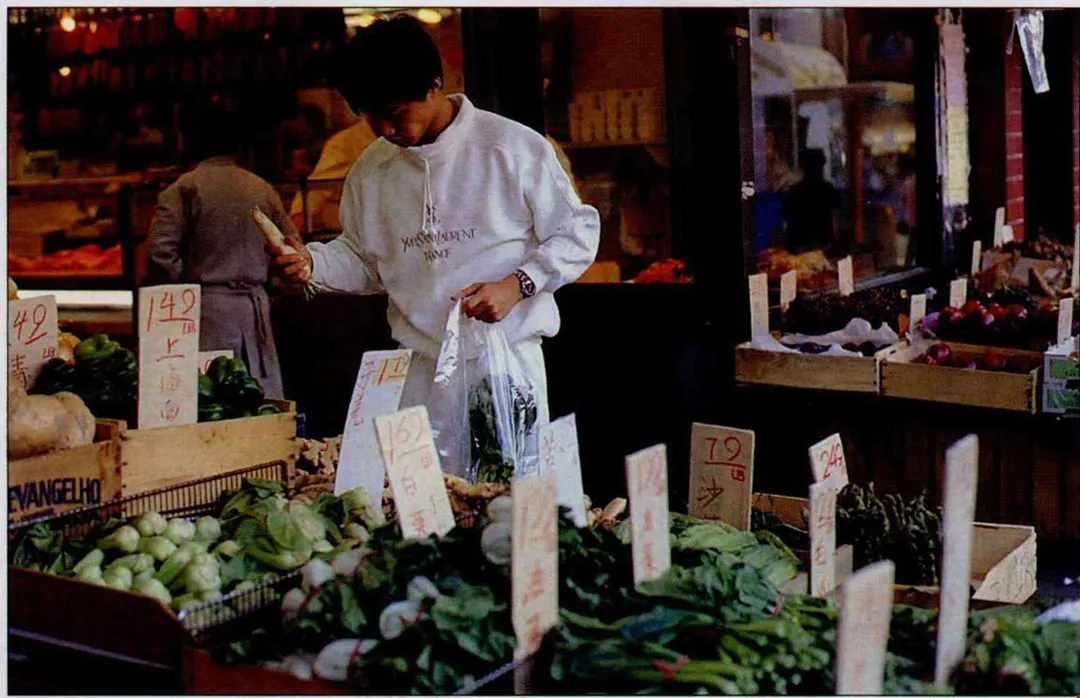
Is more attention paid to the father-son relationship in traditional Chinese families families than to that of husband and wife? (photo by Pu Hua-chih)
Dangerous MBAs:
It's precisely because some people hold the "married but available" attitude, that "new cross-strait marriages" contain unstable elements.
Chen Hsien-ming, head of the family counseling center at MacKay Memorial Hospital, indicates that the center's clientele has not been without its share of couples from all kinds of cross-strait families.
Well-heeled Taiwan businessmen are attractive targets for women in mainland Chinand Southeast Asia, and stories of men with a "spare family" have been old hat for a long time now. Chang Che-fa, president of a company that has invested in Vietnam, says he once sent 38 mid-level executives there and "a problem cropped up" with each and every one. When their wives in Taiwan found out, they came looking for him. "I had to send them all back to Taiwan." Now, he's afraid to send anyone there except married men in their fifties or sixties or unmarried youngsters.
The mainland movie Home Garrison Woman describes the family problems created by so many people going overseas since reforms began there. The female lead is a lonely wife left in Shanghai after her husband goes overseas. She happens to meet a taxi driver whose wife has also gone overseas, and the two of them have an affair. . .
The effect of "new cross-strait families" isn't limited to feelings between the spouses; they can also deliver a blow to parent-child relations.
A 40-year-old teacher who lives in Taoyuan wrote a letter to the editor of a newspaper saying that in the old days the father didn't come home for dinner and sacrificed his family happiness in order to fight for himself or his company and advance his career, which helped build Taiwan's economic miracle. Now the trend of the times is for businessmen to head off overseas to invest and build factories. The father not only misses supper -- he may not be home for months or years at a time.
The woman, who signed herself as "Someone Who's Been There," pointed out that when the father isn't around and the mother's loving care isn't enough, it's easy for teenagers to give in to temptation and end up taking a path to nowhere. "What with all the cry about rebuilding social ethics, why not rebuild sound families first?" her letter concluded.
Her worries are not groundless. According to a study by the Training and Education Commission of the Ministry of Education, behavioral problems in junior and high school, such as running away from home, skipping school, promiscuous sexual behavior and poor interpersonal relationships are all intimately related to family problems, such as parents and children not getting along or parental absence, divorce or an extramarital affair.
How could all these problems happen, it's hard not to wonder. Haven't We Chinese always prided ourselves on being people that view the family with the greatest importance?
Chinese concept of the family:
"Chinese people do place great importance on the family, but that has always meant the father-son axis and not that of husband and wife," says I Ching-chun, a researcher at the Sun Yat-sen Institute for Social Sciences and Philosophy at Academia Sinica, who has studied the sociology of the family in depth.
Cultural anthropologist Francis L.K. Hsu has made an incisive analysis of the Chinese concept of the family in his book Americans and Chinese.
Ever since ancient times, he points out, procreation and carrying on the family line have been considered the purpose of sexual relations, and the term marriage is generally synonymous with gaining a daughter-in-law. A wife was chosen by her future mother-in-law and became a new member other husband's family after marrying, although that wasn't supposed to affect the deep bond between her husband and mother-in-law. Only an unvirtuous wife who failed to get along with her mother-in-law would be so wicked as to desert her husband and children. The husband, of course, could take a concubine if his elderly parents needed someone else to look after them or if his spouse failed to bear a son to carry on the family line.
The ideal marriage of Americans, Hsu believes, involves three main factors: love, a shared life and common interests. American wives want to go wherever their husbands go, even accompanying them overseas during wartime. Chinese are not averse to the husband and wife being separated for a long time. When the husband goes away on assignment or for business, the wife stays at home and takes care of her parents-in-law and looks after children. The man is in charge of what goes on outside the home, the women of what goes on inside--so runs the old Chinese adage.
This sort of husband-wife relationship is fully testified to in works of Chinese literature throughout the ages. Starting with the Book of Songs, the complaints of lonely women pining for their absent husbands has been a major theme in poetry. The wives of ancient businessmen sighed, "A merchant values profits and slights parting" and "If I had known the tides were so faithful, I would have married a fisherman." The story of Wang Pao-chun's faithfulness to her husband, the general Hsueh Ping-kui, who was posted to the border for 18 years, is familiar to Chinese everywhere.
The man's ambitions are set on the world around him, while the wife must give up her own ambitions to take proper care of the family and bring credit to his ancestors. She can only console herself with the saying, "Affections that really last don't depend on a couple seeing each other every day."
Traditional thinking, modern behavior:
Looking at today's world in that light, we find that even though arranged marriages are a thing of the past and concubinage is prohibited by law, the Chinese concept of the family has changed very little.
Many studies have shown that the Chinese still place great importance on the family. Six years ago, Living Psychology Magazine made a survey of “the Chinese concept of happiness" and found that a happy marriage ranked first and a happy family third.
A study last June by the 21st Century Foundation on "value systems and social outlook" found that "family peace and harmony" stood out as the clear favorite among ten personal goals including goodness, truth and beauty; social justice; social equality; national security; and making money.
On an even larger scale, Academia Sinica's "Basic Survey of Social Change" came up with a similar result. One Of the questions in the survey asked respondents to give their opinion of the statement, "The family is becoming less important in modern society." Only 8.5 percent approved, while 89 percent opposed.
But placing so much importance on marriage and the family hasn't made modern Chinese more willing to cleave together as couples. On the contrary, with the change from an agricultural society to a commercial and industrial one with an international orientation, more and more couples are living apart for the sake of pursuing a better future. Some have even found that living apart actually improves their married life. Chen I-ju, whose husband is doing business in Vietnam, says the two of them often quarreled in the past but he is much better to her whenever he comes back now, probably because he "feels guilty."
Inadequate social support systems:
Maybe it's just carrying on tradition, but neither social systems nor attitudes encourage couples to live together.
To take overseas students for example, only ten years ago the government still forbade spouses from applying to visit or live with them during the first six months of their stay.
"When companies in Taiwan station people abroad, they usually just send the individuals and not their families," points out Lin Wan-i, a sociology professor at National Taiwan University. When executives in foreign corporations are stationed abroad, they receive hardship pay on top of their regular salaries and supplements for moving expenses, rent and their children's education. Taiwan businessmen, on the other hand, get double pay at the most, with no other supplements, according to Chen Chia-chun, manager of public relations at Chung Hsing Textiles. That being the case, families where the wife works and brings in income naturally find it hard to pick up en masse and leave.
"Modern-day couples have lost the support network of large families in the agricultural society of the past. Unless the husband-wife relationship is strengthened more, our families won't stand up to the blow of modernization as well as those in Europe and North America," says Yang Hsia-jung, a sociology professor at Soochow University.
The reasons aren't hard to understand. But maybe everyone thinks "it can't happen to me." "To make tomorrow better"--modern Chinese couples can still cite all kinds of high-sounding justifications to leave the family.
[Picture Caption]
p.99
"Suddenly glimpsing the color of the willows along the path/I regret my husband went off to seek official advancement." These days, it's not only the husbands who may leave home to advance their careers. (drawing by Lee Su-ling)
p.100
Briefcase in hand, Taiwan business people have traveled around the world, building Taiwan's economic miracle but also becoming absentees at the dinner table. (photo by Vincent Chang)
p.101
Chu Heng-yung (third from left) went all the way to Mexico to develop land. His work and his business partners are his constant companions. (photo by Vincent Chang)
p.102
A little overseas student alone in a foreign land. Loving mothers often accompany them abroad to look after them. (photo by Huang Li-li)
p.103
Many students abroad now take their spouse and children along with them. These are Chinese students at Leuven University in Belgium. (photo by Pu Hua-chih)
p.104
Is more attention paid to the father-son relationship in traditional Chinese families families than to that of husband and wife? (photo by Pu Hua-chih)


@List.jpg?w=522&h=410&mode=crop&format=webp&quality=80)


