The Secret Life of Boss Wives
Laura Li / photos Hsueh Chi-kuang / tr. by Brent Heinrich
December 1993


In a recent meeting of a woman's group, the topic of a lecture was, "You too really have the right to enjoy happiness." The speaker on the platform gave skillful advice; the audience was reminded of painful events in the past. They all empathized with the tales that were told. But don't make the mistake of assuming that this was a meeting of poor or disadvantaged women; they were all women dressed marvelously in fashionable attire--professional proprietresses!
Aren't these laobanniang, or "boss wives," fortunate people who arouse others' envy with their money and power? What is the true flavor of their inner lives?
"Actually, boss wives play an important role at home and in the business world; the economic miracle of Taiwan's medium- and small-scale businesses can largely be attributed to them. On the other hand, among the various groups of women, they have been greatly overlooked." So says Kao Cheng-shu, director of the department of sociology at Tunghai University, who is designing a plan to research Taiwan's boss ladies.
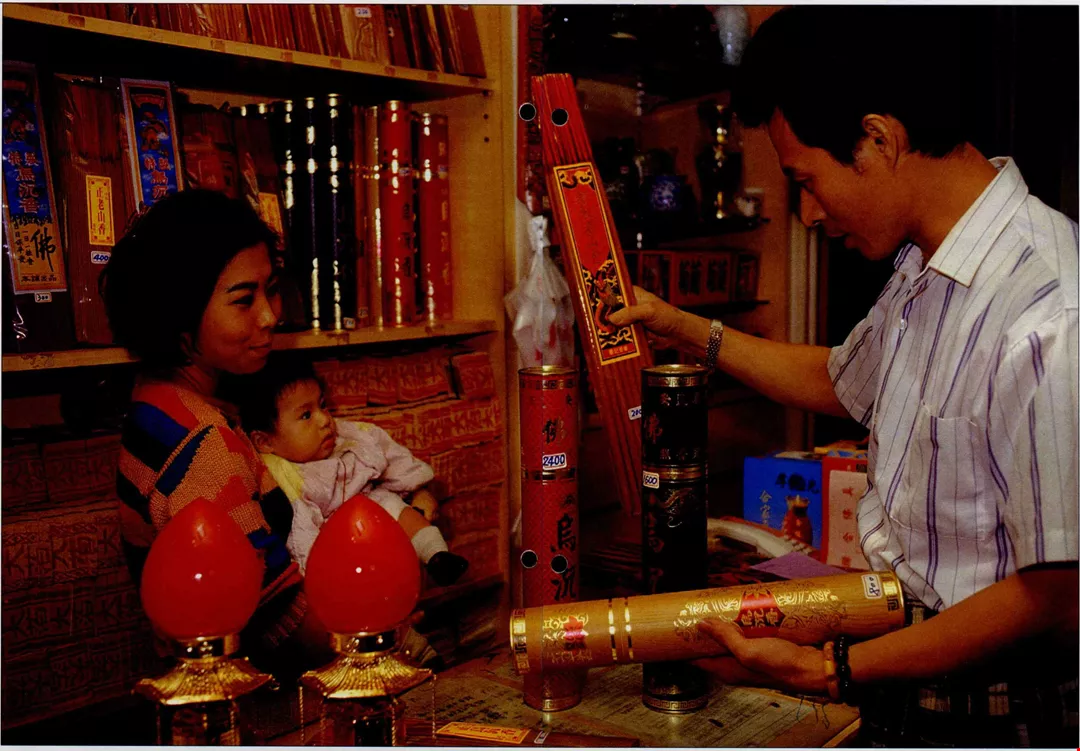
She must do her business; likewise, household affairs cannot be ignored. The boss wife, holding her child as she manages her store, takes on all challenges as a matter of course.
Keeping the peace within:
Certainly, all one has to do is pass by any book store to see that numerous books are written for women: if not aimed at daintily dressed office girls, they are oriented toward housewives. Since the recent rise of feminism, more than a few have been written for successful career women. But the boss wife is a combination of these various specializations. Little professional research has been done on the boss wife, whose role is not easily tagged or defined; few books have been written to lead her out of the maze she is in.
Discussing the proprietress is certainly not easy, because, "She is everything, yet she is nothing." Furthermore, each boss wife has a different set of struggles and problems which are bound up with her personality. Each home and each business is also different, and without examining individual cases in detail, it is hard to develop a common model.
"The problems of boss wives usually change in relation to the stage of development which her husband's business has reached, and all problems show up in different ways," points out Shen Hsiaoling, associate professor of business management at Soochow University, who is designing a series of "Executives' Wives Courses" for the Taipei YWCA Management Institute.
At first, when a business is being founded, the professional husband and wife must work hard together. During this period, the separation of work responsibilities between boss and boss wife is basically the traditional "male controls the outside, female controls the inside." Despite the fact that the proprietress has no official title and carries no name card, she actually plays the role of "keeping the peace within." She need not go out to conduct such business as purchasing raw materials, discussing business or collecting debts, but most matters inside the business, such as general management, accounting, finance, internal operations and so forth, are all under the domain of the boss wife. Those who run shops also have to meet with customers.
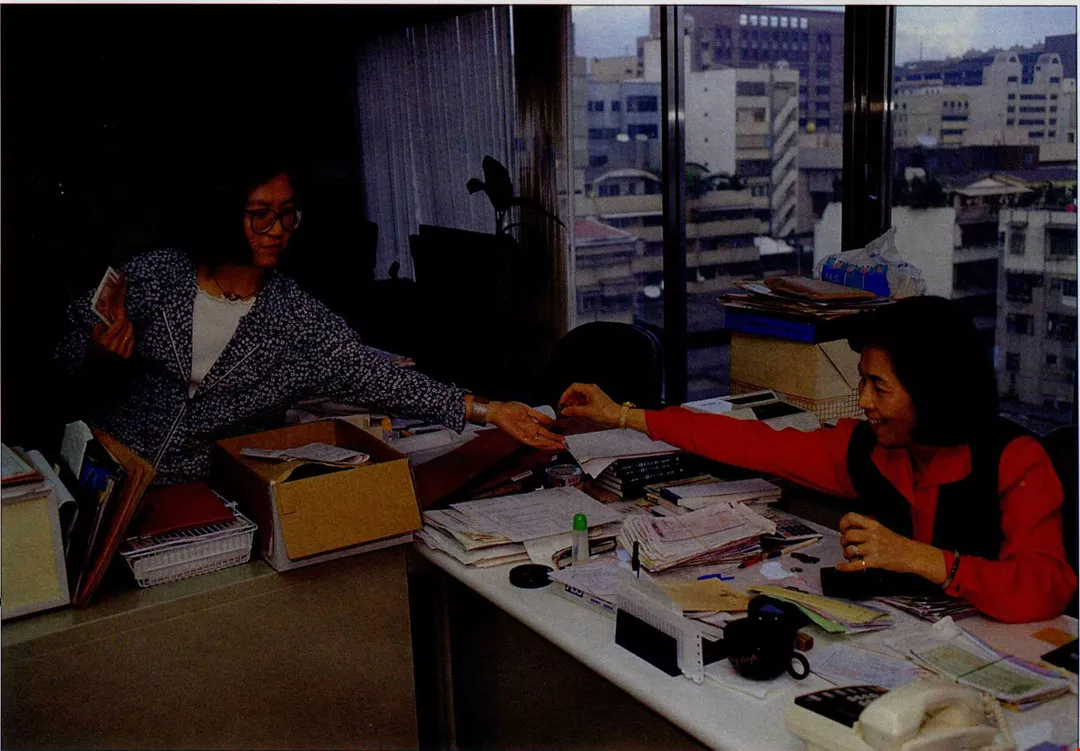
The professional boss wife, besides handling all kinds of miscellaneous details, must also boost morale and act as a bridge of communication between employees and the boss.
The unpaid worker who can never quit:
There are good reasons for the heavy responsibility of the boss wife. Assistant Researcher at the Academia Sinica Institute of Ethnology Lu Yu-hsia points out that when a man is starting up a business, besides finding a business partner there is often nowhere to turn for someone to trust except one's own wife. Moreover, a wife helps her husband as a matter of course; not only is she extremely stable, but also she is a worker who "won't get corrupt, won't get lazy and will never quit."
For example, shen Hua-mei,the delicate, sweet proprietress of Gardener Die Casting Company, says that her husband Chu Chih-cheng holds her in complete confidence. Both the company chop and bank book are under her control, and her husband often borrows money from her. "I often laugh at him, telling him that one day if I sell him out, he won't even know!"
To put it more realistically, it is very tough to start a new business. Medium- and small-scale enterprises lack resources; the way to make up for this is to keep the costs as low as possible, to collectively gather the household's wealth and industry. In addition to being an employer and an employee at the same time, the boss wife is extremely inexpensive and stable.
Lu Yu-hsia further explains, the traditional Chinese family is "inward." The family members don't place fine distinctions among themselves. They will work together to help gain family wealth. This is quite different from the custom in Western countries of sending family members out to face the exterior society in an "outward manner."
Lu Yu-hsia's investigation indicates that many wives have quite high educational backgrounds, their own professions and good jobs before and after marriage. Nevertheless, most wives "follow their man, be he idiot or thief." If their husbands have businesses, they naturally take part.
For many women, after they are married and have children, they are able to run a family enterprise while raising children at the same time. Furthermore, most factories or offices are close to home; the boss wife's work can be seen as an extension of her domestic responsibilities. This does not conflict with the traditional role of a wife. Many boss wives do not want other people to say that they are "capable"; they prefer to describe themselves as "virtuous" or "active in helping my husband."
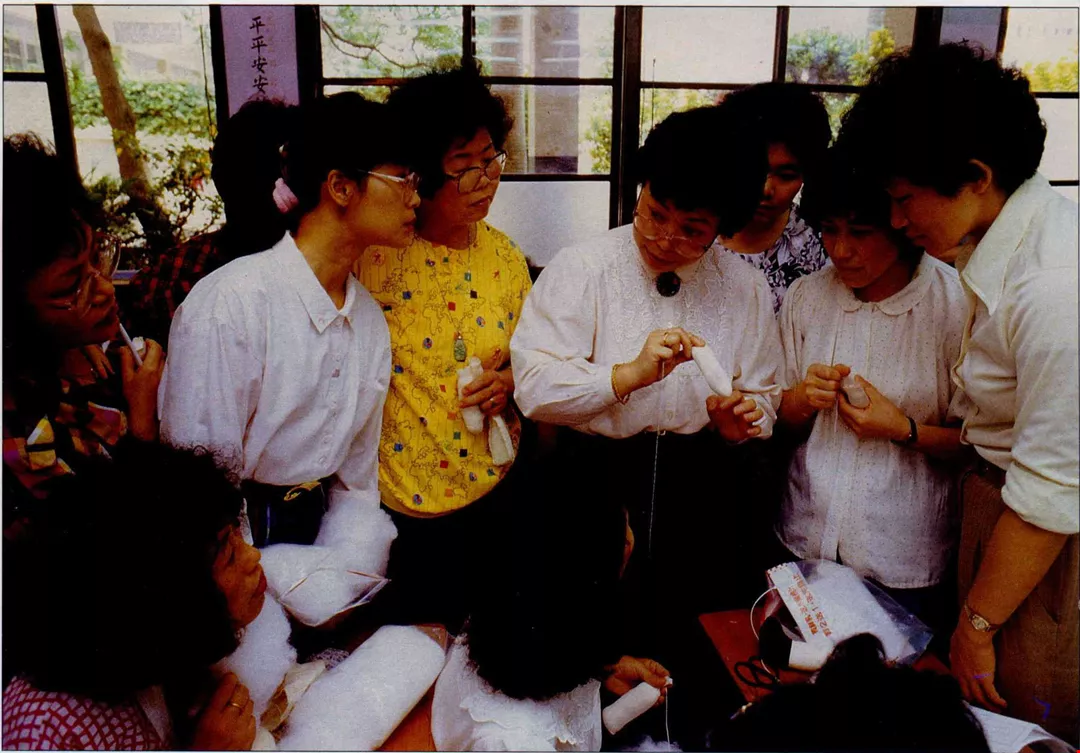
Quite a few women take part in arts and crafts classes during their free time. More often than not, boss wives choose to attend such classes as human resource management, finance or tax management. (photo by Vincent Chang)
Two full-time jobs, 24 hour standby:
On the surface, the boss wife has no set working hours. Whenever she wants, she can run off to wash her hair or buy vegetables; no one can interfere. But during the phase of creating a business, her husband's enterprise is the only thing that maintains their home. Because of this, she constantly thinks, "Business absolutely must not decline," being careful with every step she takes. Rare indeed are the times when she can completely let down her guard and stop worrying about their enterprise. Unavoidably, the boss wife does not consider herself to have any professional occupation, because she has no salary and no formal title. The boss also may hold the viewpoint, "We only need you to come help a while at the office; your main job is to manage the house." What results is that the boss wife's shoulders bear the burdens of both office and home affairs.
"A professional woman can entrust her child to someone else's care during the day and can concentrate on her work, because no husband dares to demand that his wife pick the kids up from school and go make dinner, if she is drawing a salary from someone else," one boss wife says with resignation. "But as the boss's wife, what can I do? When office affairs heat up, I still can't push aside cooking meals and taking care of the children."
In the midst of caring for both the home and the office, the majority of boss wives are not only "two career women", they are on call 24 hours a day. If their working hours were actually calculated, one would be surprised to find they are usually startlingly long, and the work pressure is frighteningly high.
As Lu Yu-hsia points out, in medium- and small-scale businesses, especially "household factories," when employees are working overtime to meet a rush order, after the wife has lulled her children to sleep at night, she still must slip downstairs to lend a hand. If she is not helping out on the production line, she helps packaging or sorting. Perhaps she distributes snacks to the workers to build morale. When she has nothing to do, at the least she will supervise, lessening the workers' opportunities to get lazy and chat. Otherwise, "What would the employees think as the wife hangs about watching?" says Shen Hua-mei, who has spent four and a half years with her husband at their Chungli factory.
Of course, the business does not belong to the wife. The biggest decisions are not hers to make. But men need dignity. Sometimes when they are worried, when they have had to play the bad guy, when they have to collect money, usually they look to their wives to keep face. Chen Ping-chi, proprietress of the Da Hsin Color Print Graphic Company, recalls moments of embarrassment when they were first starting the company, even the experience of "raising money to hand out paychecks and having to turn around and borrow money from our employees to cover expenses at home."
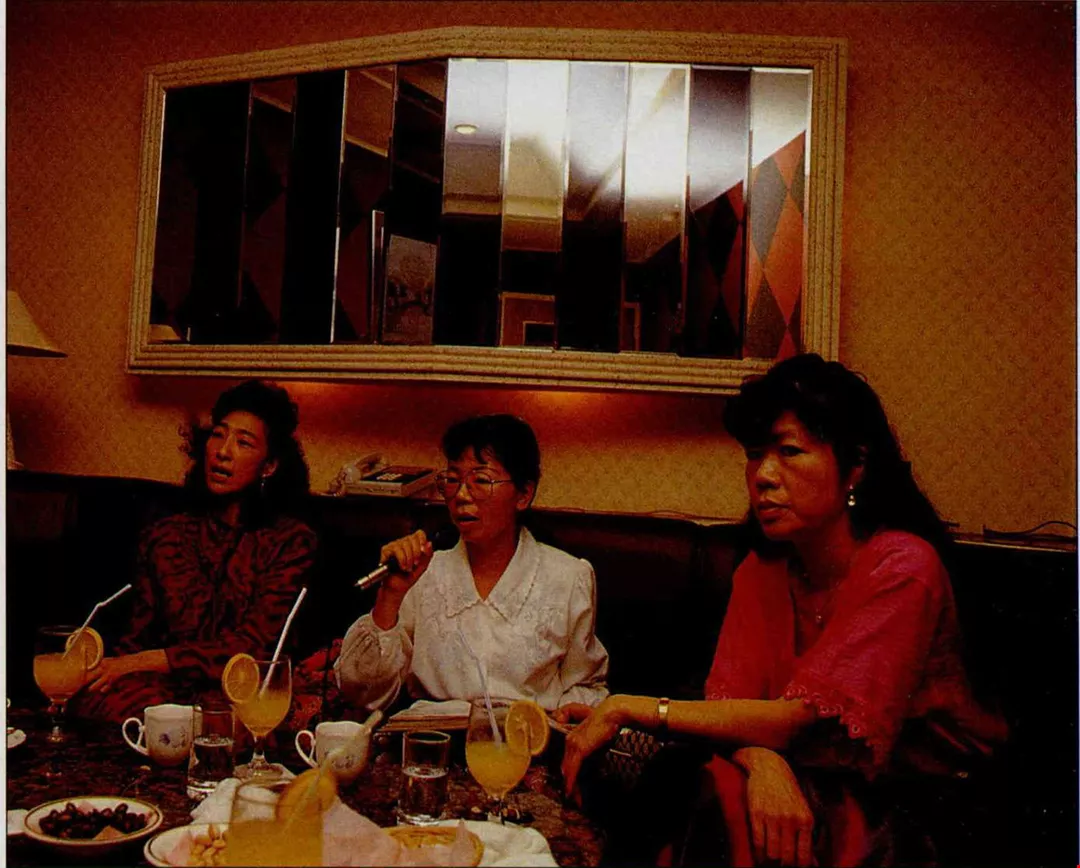
Singing karaoke is a recreation that quite a few women partake in; hard-working boss wives rarely have the time to enjoy it. (photo by Diago Chiu)
Lonely interpersonal relationships?
Besides willingly bearing the burden of office, the possibility of lonely interpersonal relationships is another obstacle that boss wives face. Shen Hsiaoling observes that most salaried women have no lack of colleagues with whom they may chat. Housewives can have a leisurely talk with their neighbors, too, when they are at rest. But the boss wife is in charge of the company, and she spends most of her time together with the employees. She is faced with the barrier of being the manager and being labeled a "capitalist"; it is not easy to build close friendships with employees.
Shen Hsiao-ling provides this analysis: Firstly, any worker who says an extra friendly word to the boss wife will be laughed at by the other workers for being a "brown noser." Secondly, most boss wives really do fear that the employees have a hidden purpose of grasping for power; when a worker makes friends with the boss wife, he not only gains special privileges, but sometimes he also may climb above her in the ranks. Under these double-sided, self-imposed restrictions, the boss wife is hard put to find a good companion to whom she can pour out her heart. It is not difficult to understand her pent-up emotions.
Because of this loneliness in interpersonal relationships, the wife can only rely on her own husband. Some people say, "Women take love to be life itself." This saying is especially appropriate for the boss wife.
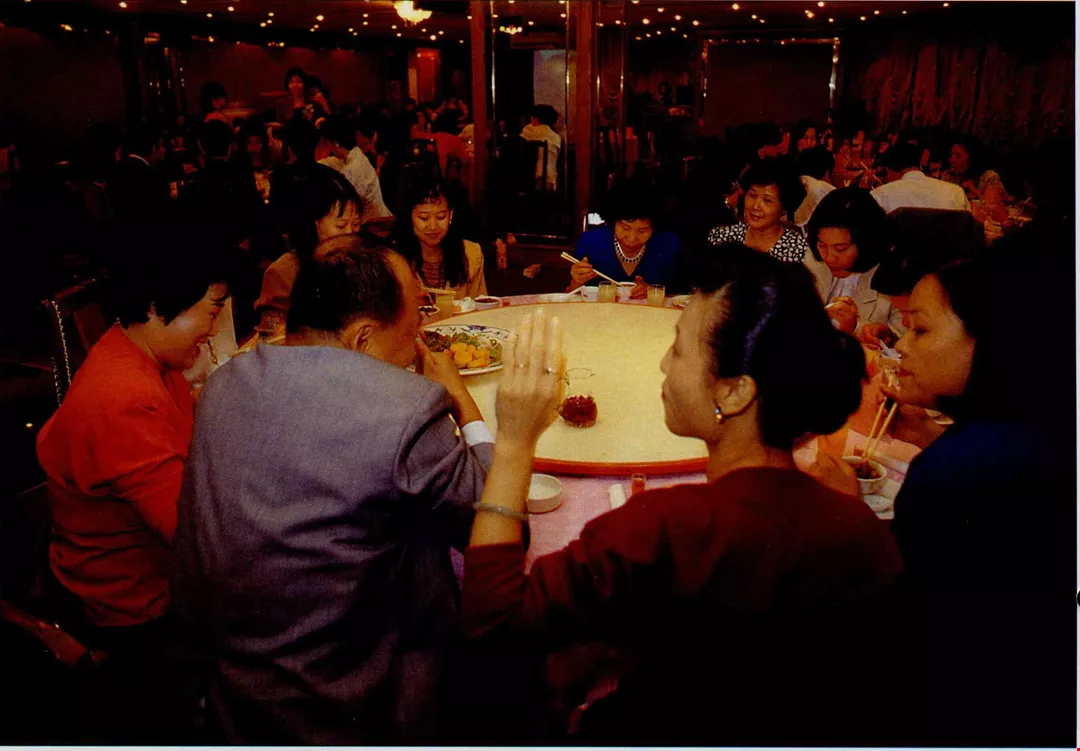
The Matsushita Electric Company's Women Distributor's Association is attempting to make use of the boss wives' outstanding talents in promoting sales, reflecting the opinions of the marketplace and other such endeavors.
Who can read the secrets of the heart?
Wu Cheng-tien, professional psychological counselor who has often given speeches to proprietresses, points out that when career women perform well, they can attain a sense of achievement by means of raises, promotions or praise from superiors and colleagues. In comparison, a boss wife has none of these; her greatest comfort is a simple word of praise or intimacy from her husband.
Unfortunately, the husband is often the most stingy in extolling his wife. The proprietress rarely receives public acclaim, and she has no way to ascertain her own status. As for turning to the most immediately visible measure of success, the amount of money one has, Wu Cheng-tien remarks, "It's kind of sad to rely on material wealth to find happiness."
Besides this, all salaried women know that they can not bring the unhappy emotions of last night's quarrel with their husband to the office. Similarly, the miseries of work can be cast aside when they return home. But for the proprietress, her husband is her superior; the home and the workplace are mixed together as one. Any given unhappiness in any facet of life could extend itself and come to the surface during a different occasion. One boss wife described her life as one of "changing faces." When she arrived at the office after having a big argument with her husband, she would quickly "change her face," forcing herself to look happy so as not to make a fool of herself in front of the employees.
Everything, however, has its good side as well as its bad. For married couples who are also business partners, the rate at which conflict occurs is much higher, but if they adjust well to this challenge, their feelings of mutual consideration and trust can become much deeper than the average husband and wife. "By going into business with my husband, seeing the way he treats others when taking care of affairs, seeing his assertive side, and seeing his fearful side too, I can really understand the man I married." So says one boss wife who describes herself as "happy every day." She feels that her tender personality complements her husband's strength.
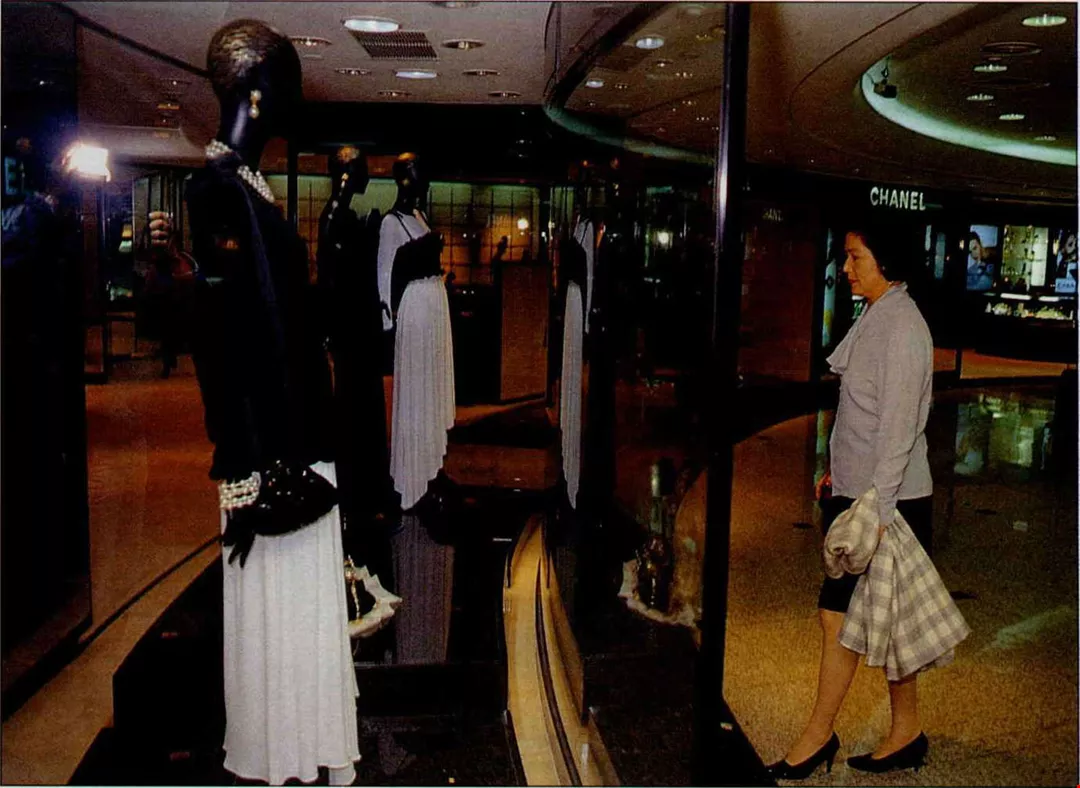
Often dressed smashingly, going in and out of boutiques, the boss wives of a medium-or large-scale businesses are a group that commands envy in terms of material possessions.
Will the marriage fail if the business falls?
Of course, when first founding a business, the boss wife must labor with both body and soul. What she looks forward to is her husband's success. Both of them wait for the business to grow, when they will have money and time to relax, when they will be able to breathe a sigh of relief. On that day all their bitter efforts will be compensated for. Too bad the marketplace has no heart: too many boss wives wait forever for that day to arrive.
The risks are naturally high in starting a business, especially in recent years when the economic trends have not been promising and many medium- and small-scale businesses have closed their doors. A certain Ms. Chang, who formerly owned a company with her husband and has now gone back to salaried employment, explains that she went through three years of the tremulous life of the proprietress, and in return she received several hundred thousand New Taiwanese dollars of debt. But her fate compares favorably with the wife of another man in the same profession as her husband. After their factory in Taiwan was closed, the husband went to mainland China, but the wife could not move, because she had to take care of the home and to clear up the entangled debts that her husband left behind. Finally, her husband found a new love in the mainland, and the wife could not even save her marriage. "When the boss wife has come to this point, the sacrifices are too great!" she moaned.
Some businesses are fortunate enough to reach a certain stage of success, moving forward and hitting the target consistently. If her business does not endeavor for an inordinately high level of success, the boss wife of such an enterprise can enjoy quite a pleasant life. She can afford to seek the space for her own happiness. But for the boss wife who is used to living sparingly whenever possible and has reached a level of fortune only after long toil, perhaps she will need to go through a phase of psychological adjustment before she can relax.
"Never mind the boss wife's beautiful, fresh outward appearance that makes her seem so intelligent and capable. Actually, her self image and sense of personal worth may very well be stunted by the view she has long fostered that she must always look after others and not care for herself," Wu Cheng-tien explains. When it comes to having the boss wife give over all her professional obligations to someone else, there usually is an ineffable feeling of loss.
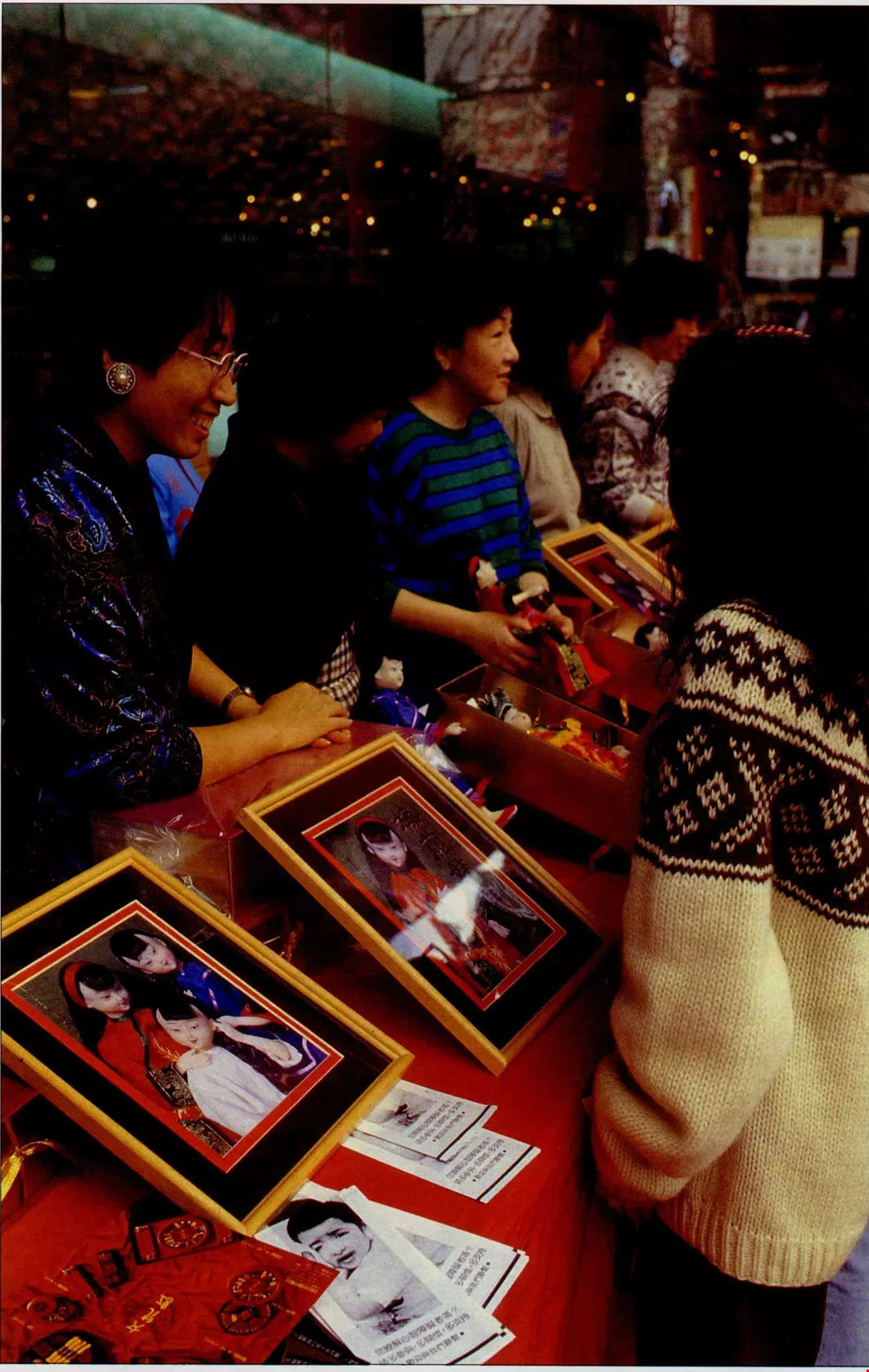
Participating in charity sales and philanthropic activities can mitigate feelings of loneliness and can also make a contribution to Society. But usually the husband must agree to it first. (photo by Diago Chiu)
Outside the office, the world is wide:
Chen Ping-chi, who currently has unloaded a heavy burden from her shoulders, is relatively fortunate. Sixteen years ago she began to participate in the Professional Wives' Association, part of the Youth Career Development Association. She heard all kinds of lectures and participated in various charitable activities. Gradually she realized that "Outside the company, there is actually a lot of space for me to pursue my own personal success." She says, "When I am growing as an individual, I don't have to constantly involve myself in all matters of the company, large and small. Neither do I need to begrudge the money it takes to bring in a few more employees to share the work load."
Concerning writing receipts, she says, "Before, I would do all the accounting myself. When I was busy, I would make mistakes, and I wouldn't know it. But now I supervise the accounts from a distance, and the mistakes are more easily detected, and I think more clearly. This yields a considerable benefit for both the company and myself." She explains, "In the beginning I was simultaneously in charge of accounting and overall operations. Now it's okay if I just act as general manager." Chen Ping-chi points out that success is only gained through sacrifice. Whether the boss wife is there surveying the whole process does have an impact upon the rate of worker productivity; however, she has learned to delegate much of the work to the employees, to give them confidence and a sense of honor.
Yu Shan Tang Food Company owner Hsiao Lina, who helps organize the Youth Career Development Association's Professional Wives' Association, feels that it is a pity that many boss wives get entangled with trivialities and find neither the time nor the spirit to seek personal growth. Even more often bosses believe that their wives should "take care of the company and the house" and don't permit their spouses to go out and participate in social functions. After the business has gradually gotten big, the wife is not so desperately needed and usually the children are grown up, as well--perhaps they were even sent away early to America for studies. This period of the "empty nest" may be particularly hard for the boss wife to adjust to.
It is often easier to suffer together than to prosper together. This phase of life is unfortunately often the period when marriage problems are most likely to appear. After many years of counselling, Wu Cheng-tien observes that after the family enterprise has blossomed, the instances of the entrepreneurs' becoming involved in illicit affairs are "incredibly numerous." Shen Hsiao-ling points out that if the husband has an extramarital affair, the boss wife's position in the company will unavoidably be affected, especially when the person with whom he has the liaison is a female employee in the company. The boss wife's humiliation is even harder for outsiders to comprehend.
When a business outgrows its mother:
The boss wife of a steadily developing medium-scale business--if she is lucky and has money, a happy marriage, leisure time and genuine power--can fully enjoy the fruits of many years of diligence. Naturally, many people find her an object of envy. But if the company is to take a further step of expansion, the boss wife's role must further undergo a degree of adjustment. Often the boss wife must give up the enterprise she herself cultivated over many years. Shen Hsiao-ling observes that after medium- and small-scale family businesses have gained a substantial position, they may wish to grow into a major enterprise. The first step is to construct a system of controls and a professional division of labor. In this kind of circumstance, the boss wife who has always been difficult to classify, who has always been in charge by virtue of her human relationships, may often face the dilemma of finding no formal position.
One business management consultant sighed. Like so many mothers who help their children to grow up only to find that they themselves have not grown, so many boss wives devote themselves to fostering the growth of their family business, while they have had no time for personal development.
The cause is perhaps not difficult to understand. When the company is in need of professional services, they may take the painful step of spending an amount of money to send an employee to be trained. But the boss wife, always on duty and entangled with little details, has few chances indeed for advanced study. After the company has grown big, personnel with university backgrounds or professional managers come in with the latest management knowledge. Thus, the boss wife who lacks a professional background appears even more backward in the eyes of the staff.
Shen Hsiao-ling has seen many a boss wife, in the midst of the process of business expansion "slowly change from the company's most valuable resource to a millstone that can not be cast aside!" Most commonly, the boss wife becomes obviously unfamiliar with recent developments in the business, yet she still tries to take charge, placing an order that should not be placed, wanting to purchase materials from companies with whom they formerly had good relations, not trusting the analyses of professional managers, and so forth.
When confronted with this kind of predicament, Shen Hsiao-ling advises the boss wife to think clearly. Just as children must leave their mother's side when they have grown, so the company has also reached maturity and no longer needs its proprietress. In other words, now that her business is becoming more systematized, the boss wife has a few options. One option is to strictly abide by the company's new institutions and perform a single task, being a professional worker who does not meddle in every affair. Otherwise, she can straightforwardly remove herself from the formal structure of the company and simply act as her husband's behind-the-scenes partner or consultant.
Staking her claim:
Shen Hsiao-ling emphasizes that the boss wife's position and role should always accommodate the changes and differences in the company's stage of development. If she does not adjust well, then she will be unhappy, and this will have a negative impact upon the entire enterprise. Despite the fact that the alternatives available to the boss wife are numerous, she must consider them calmly and clearly. "When giving in to change, she should also stake her claim to what she wants," Shen Hsiao-ling points out.
For instance, if she wishes to become the company's professional manager, she should first ask herself, should she have the special privilege of not clocking in? Is she able on her own to follow the strictures of a nine-to-five schedule and avoid early retirement? When she encounters disagreement in opinions with other managers, is she able to set aside personal vanity and solve problems smoothly without needing to "maintain the boss wife's prestige"? Especially when the company has gone public on the stock market, every little housewife who owns a few shares is technically a proprietress; the original boss wife should not hold too many privileges.
At the same time, Shen Hsiao-ling points out that the boss wife has yet another option in changing her role: to gradually move from her original position of "keeping the peace within" to working along with her husband in "challenging the forces without." In effect, she can help her husband to create good public relations and marketing, to expand human relationships. Nevertheless, whether the boss wife ought to be so utilitarian as to completely conform herself to the needs of her husband is a matter deserving some deep thought.
Huang Shu-chen (assumed name) is an example. After their company went public, her husband decided to move into the world of politics. Only half by her own will, she agreed to accompany him to all kinds of functions. In order to cater to her husband's partiality for chi-pao, a traditional gown of Chinese women, she ordered up more than 60 chi-pao in all sorts of colors, and she began to carry herself splendidly in many social occasions.
Nevertheless, in the end her husband decided that the political world did not suit his personality. He changed his mind and wished that his wife no longer be so publicly active. Huang Shu-chen could only restrain her desires to gain friendship and a sense of accomplishment in social gatherings. She made a rule for herself: "When my husband is not out of the house with social appointments, I must refuse invitations to important functions, too!"
The graciousness of the boss wife is the best testimony that "behind every great man is a great woman." Through the many buffetings of life, the boss wife has had many experiences and has acquired the wisdom to comprehend worldly matters. Chen Ping-chi recalls that when she and other boss wives gather together, no one bothers to carefully bedeck herself with jewelry, and no one compares their husbands' businesses or fortunes. "Everyone has their own life to lead; the richest person isn't necessarily the happiest. "After passing through the trial of diligently seeking to resolve all the interlocking concerns of one's personal life and domestic and business affairs, why not lead a life without regret and achieve the fullest measure!
[Picture Caption]
p.40
She must do her business; likewise, household affairs cannot be ignored. The boss wife, holding her child as she manages her store, takes on all challenges as a matter of course.
p.43
The professional boss wife, besides handling all kinds of miscellaneous details, must also boost morale and act as a bridge of communication between employees and the boss.
p.44
Quite a few women take part in arts and crafts classes during their free time. More often than not, boss wives choose to attend such classes as human resource management, finance or tax management. (photo by Vincent Chang)
p.45
Singing karaoke is a recreation that quite a few women partake in; hard-working boss wives rarely have the time to enjoy it. (photo by Diago Chiu)
p.46
The Matsushita Electric Company's Women Distributor's Association is attempting to make use of the boss wives' outstanding talents in promoting sales, reflecting the opinions of the marketplace and other such endeavors.
p.47
Often dressed smashingly, going in and out of boutiques, the boss wives of a medium-or large-scale businesses are a group that commands envy in terms of material possessions.
p.48
Participating in charity sales and philanthropic activities can mitigate feelings of loneliness and can also make a contribution to Society. But usually the husband must agree to it first. (photo by Diago Chiu)


@List.jpg?w=522&h=410&mode=crop&format=webp&quality=80)


