"Chinese Fever" in a Changing Global Economy--Taiwan and China Compete for the Chinese Language Education Market
Teng Sue-feng / photos Tsai Chih-yang / tr. by Robert Wilson
April 2004


With the entry of Taiwan and China into the World Trade Organization (WTO) and a general economic revival underway, more and more foreign students are packing up their books to go abroad and study Chinese. In fact, when it comes to teaching foreigners how to speak Chinese, Taiwan was the place to take the first steps, and many well known China hands and Sinologists have come to Taiwan to study Chinese. Continuous growth in the mainland economy, however, has brought changes to the Chinese language education market. Taiwan, once dominant, must now compete with the mainland. What are Taiwan's advantages in attracting foreign students to come to the island?
From Monday to Friday of every week, before the school bell rings, it is always very crowded at the doors to the elevator for the Po Ai Building at National Taiwan Normal University (NTNU) on Heping East Road. Dozens of young students, with blond, black, and brown hair and every type of skin color make their way into four elevators going up and down between floors. From the crowd you can hear greetings in English, French, Japanese, Korean, and other languages that are difficult to make out. NTNU is like a miniature United Nations for foreign students, with some coming to take courses in advanced Chinese and the works of the philosopher Zhuangzi, while others come to study calligraphy or the classical Chinese zither called the zheng.
By ten in the morning, Daniel Pawlak of Poland has just finished two hours of a class on Zhuangzi, carrying a blue-jacketed edition of Sanmin Publishing's Zhuangzi as he leaves the classroom. Daniel Pawlak, 29, speaks six languages, including Chinese, Russian, French, German, and Spanish. After teaching English in China for two years, he went to the Harbin Institute of Technology to study Chinese. After three years in the mainland, he was able to come to Taiwan on a scholarship awarded through a sister city program between Taipei and Warsaw. He said, "My most important reason for coming here is that I wanted to study traditional characters. Traditional characters are a part of China's tradition and have been maintained the best in Taiwan."
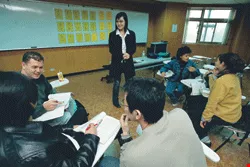
Immersion in the local environment is a way to learn a language quickly. Chinese classes in Taiwan have small classes that give students many chances to practice their speaking.
A storehouse of talent for Sinology
Founded in 1956, NTNU's Center for Chinese Language and Culture was the first to design courses to teach Chinese to foreign students. While in the early years only a few foreign students came, currently over 1,500 foreign students from over 120 countries are enrolled there; over the last 50 years, a total of over 36,000 students have studied there.
The Stanford Center at National Taiwan University (NTU), founded in 1961, is a storehouse of talent for educating Sinologists. The reason that it is called the Stanford Center, its origins and the changes it has seen over the years are in themselves a history of shifts in international politics.
Following the Second World War and the Korean War, based on its military and political needs, the United States designated Chinese, Japanese, Russian, and Arabic as priority languages, and the US Department of Education provided funding to various American universities to teach these languages. To serve its students who were interested in Chinese, in 1961 Stanford University negotiated with the ROC Ministry of Education (MOE) and NTU to establish the Stanford Center at NTU and to begin to send students to Taiwan.
In 1963, because of their common need for Chinese language personnel in the scholarly world, ten American universities organized the "Inter-University Program for Chinese Language Studies in Taipei" (IUP). Because the Chinese and English names for this organization were too long and because Stanford University continued to take responsibility for attracting students, it has always simply been called the Stanford Center. In over 30 years since then, the Stanford Center at NTU became a place of great importance worldwide for the education of Chinese language personnel, with the US Department of Education playing the most important role in funding the center.
Looking over a list of alumni from the NTU Stanford Center is like reading a "Top 100" list of renowned Sinologists and diplomats. They include B. Lynn Pascoe, former director of the American Institute in Taiwan; Alan Wachman, former director of the Johns Hopkins University-Nanjing University Center for Chinese and American Studies; and Daniel Bryant, professor of Chinese at the University of Victoria in Canada. The trademark of the Stanford Center's courses is that they are small, intensive, and finely tuned to students needs. On average the Center hosts only about 50 students per year, with only one to four students per class, making it possible for students' Chinese language ability to make great progress in a short period of time.
Because of its small class sizes, the Stanford Center is also known for its high tuition. At US$3500 (roughly NT$120,000) per three-month term, its fees are five times that of other Chinese language centers in Taiwan.
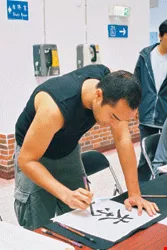
Many students take part in activities outside of their Chinese courses such as practicing calligraphy, brewing tea, and making zongzi. These activities help develop their interests in Taiwan's culture. (courtesy of NTNU.)
The "Chinese fever" keeps burning
After 30 years at the top, in the 1990s Taiwan's position in the Chinese language education market saw many changes. After the mainland began to open up and to attract foreign capital, the "Chinese fever" continued to burn, resulting in white-hot competition in the Chinese language education market.
In 1997 the IUP left Taiwan for the mainland, moving from NTU in Taipei to Beijing's Tsinghua University; the Taipei Stanford Center was absorbed into NTU and renamed the International Chinese Language Program.
For Li Yi-hao, who was hired in 1985 to teach Chinese at the University of California at Berkeley after teaching for over ten years at the NTU Stanford Center, watching the mainland attract a large number of students made her more and more worried.
According to Li, "For Westerners, the mainland is like a treasure chest, and since in recent years Taiwan has not seen itself as an inheritor of Chinese culture, it has lost some of its ability to attract foreign students." Li also says that a number of external factors have made the mainland able to attract a large number of foreign students.
According to statistics from the Ministry of Education's Bureau of International Cultural and Educational Relations, a total of 5,154 foreign students came to Taiwan in 1993. Of these, three-fifths were from Asia; over 1,200 were from the Americas, and 581 were from Europe. In 2002, the number of foreign students increased to 7,331, with virtually all of the additional students coming from Asia. There was no significant increase in students from the Americas, and an increase of only about 100 students from Europe.
While the number of foreign students coming to Taiwan has seen mild growth over the last decade, professionals in Chinese language education fear that the mainland is racing ahead, drawing 70,000 to 80,000 students per year.
Many people predict that as the mainland's economy continues to grow, more people will want to study Chinese, and the Chinese language education market will become even hotter.
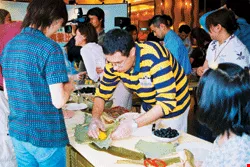
Many students take part in activities outside of their Chinese courses such as practicing calligraphy, brewing tea, and making zongzi. These activities help develop their interests in Taiwan's culture. (courtesy of NTNU.)
Following the money
According to a report from the Beijing Daily, following China's entry into the WTO many foreign students want to go to China to look for work, as is shown by Korean companies such as Samsung and Daewoo that search for personnel to work in their China trade businesses and even require "Chinese TOEFL" scores. The Chinese TOEFL is another name for the Hanyu Shuiping Kaoshi (Test of Chinese Language Ability), or HSK, which was first offered by the mainland in 1990.
As Japan and Korea take active steps to expand their trade with China, they require many workers who can speak Chinese, which has resulted in a sudden increase in the number of Asian faces, including many Chinese-Americans, coming to Taiwan to study Chinese. Their main reason for choosing Taiwan is that they feel that living and getting around in Taiwan is more convenient. They also feel that Taiwan, as a melting pot of American and Japanese culture, is friendlier to foreigners and that there are fewer chances of culture shock.
Thirty-two-year-old Fang Jui-lien, a second-generation Chinese American who grew up in New York City, also studied Chinese in Kunming, located in Yunnan Province on the mainland. She said, "People there had a very thick accents, and what we studied in class and what we heard in the street were two completely different things." Since coming to Taiwan to study Chinese, she is also able to teach English to earn money for her studies. In addition, the standard of living in Taipei is close to that in New York City, something she is very used to.
"People study where the money is," says Dai Wei-yang, director of the Center for Chinese Language and Culture at NTNU. According to Dai, currently there are 30 million people in Thailand preparing to study Chinese, and a large number of cram schools in Korea have been established to teach Chinese; the future market for Chinese, then, will not shrink-it can only expand. Taiwan's advantage lies in the fact that many exchange students from Southeast Asia who came to Taiwan in earlier years to study at various universities are now the backbone of their respective societies; more than a few of them are even heads of Chinese departments at various universities. "The seeds Taiwan planted in past years have grown into great trees," says Dai. "This will be very helpful in attracting students from Southeast Asia to come to Taiwan."
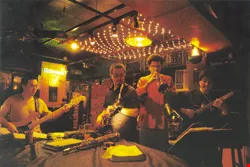
Helping foreign students adapt to and love Taiwan will be the best resource for helping the country to make international connections in the future.
"Traditional" to "simplified" is easier
Some people ask, though, with so many Chinese people using simplified characters, if Taiwan teaches traditional characters, how competitive can it really be?
"You should not be too casual about making the choice between traditional and simplified characters. Going from traditional to simplified is extremely easy, but going from simplified to traditional is relatively difficult," says Chen Ling-hsia, director of the International Chinese Language Program at NTU. According to Chen, many people believe that traditional characters are "Taiwan's greatest legacy to the world," and are proud of being able to study the "correct" characters.
People who travel often between Taiwan and China realize that traditional characters seem to be undergoing a revival in the mainland, with the usage of simplified characters becoming more and more lax. It is also becoming more common for storefront signs in major cities such as Shanghai and Beijing to be written in traditional characters.
Chimgee, a student from Ulaan Bataar, Mongolia, who came to the Chinese Language Center at NTNU in March of last year, has had a similar experience. Because of growing economic ties between Mongolia and the PRC, studying Chinese has become very important for students' futures. Since beginning Chinese as her minor while she was a history student at Ulaan Bataar University, she had only studied simplified characters. Now that she is studying traditional characters, she says she has finally learned that "every radical component of every traditional character can be broken down and analyzed. It's like learning Chinese all over again."
In his book Theory and Practice in the Teaching and Study of Chinese Characters, Huang Peirong, adjunct professor at NTNU's Graduate Institute of Teaching Chinese as a Second Language, has pointed out that one weakness of simplified characters is that during the reform of the characters, convenience in writing was the only thing taken into consideration, while the structure of Chinese characters was ignored. As a result, there are a large number of cases where the semantic and pictophonetic aspects of characters are easily confused. For example, the character ting 廳 (room, hall) has been simplified to 廳, making it easily confused with jin 斤 (a unit of measure); likewise, di 敵(enemy) has been simplified to 敵, making it easy to confuse with gu 故, a character with several meanings including "incident" and, in some cases, "friend."
In addition, some characters were simplified in order to reduce the number of characters in use, which often means that one character is used or "substituted" for one or more other characters. For example, you 遊 (to travel or tour) and you 游 (to swim) are both written with the character 游 (to swim). If however, a travel itinerary should say "touring the West Lake by night," it will not be clear whether this involves actually touring the West Lake by night or swimming in the West Lake by night. It is even worse for researchers in literature and history. For example, the character xun ?? is now used for the traditional characters 塤and 壎. In the literature of the Qing dynasty, however, there is a person named Zhang Xun 張塤 and another named Zhang Xun 張壎. If a text in simplified characters mentions either Zhang Xun, then, it would be very easy to confuse the two different people.
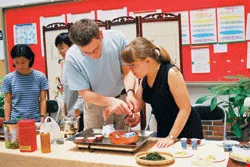
Many students take part in activities outside of their Chinese courses such as practicing calligraphy, brewing tea, and making zongzi. These activities help develop their interests in Taiwan's culture. (courtesy of NTNU.)
An atmosphere of openness
In fact, looking at the United States, where studying Chinese has become very popular, the teaching of traditional characters is not necessarily in an unfavorable position.
According to a study conducted in the year 2000 by NTNU's Chinese Language Center titled "Survey and Research on the Environment for Chinese Language Education at American Universities," in surveys returned from 91 universities (approximately 30% of American universities that offer Chinese language courses), 11% taught only traditional characters, 22% taught only simplified characters, while 67% taught both character sets. Among those schools that teach both character sets, 38% teach traditional characters first, while 6% teach simplified characters first, and 16% teach both at the same time. These results demonstrate that the demand for education in traditional characters is still quite large.
This research study concludes: "It is clear that traditional characters, representing China's traditional culture, are still in the mainstream of Chinese language education at American universities, especially for those students who want to conduct serious research in difficult aspects of traditional Chinese culture, including literature, history, and philosophy. In these cases, only when students first become well versed in orthodox Chinese characters handed down through the ages will they truly be able to enter the temple of Chinese writing."
According to Teng Shou-hsin, a professor at NTNU's Graduate Institute of Teaching Chinese as a Second Language who traveled to the mainland two years ago to observe Chinese language education on the mainland, Taiwan's strengths lie in its teachers' professionalism and its educational facilities. On the other hand, the mainland's strengths are that it has active policies and the organization in charge of Chinese language education has a high ranking position in government, which give a strong motivation to all major universities to organize Chinese language classes and to send teachers to countries that share diplomatic relations with China. The PRC State Council has established an office for Chinese language education that directly coordinates strong efforts to promote Chinese language education between various departments.
In Taiwan, in order to attract more foreign students to come to Taiwan to take classes and study Chinese, the Ministry of Education provides NT$150 million per year in scholarships so that foreign students with good grades who wish to come to Taiwan do not need to worry about tuition and living expenses. Beginning this year, the Ministry of Foreign Affairs (MOFA) will also establish NT$50 million in "Taiwan Scholarships" for students from countries sharing diplomatic relations with Taiwan and from Eastern Europe, Russia, and Mongolia. Interested students may contact MOFA's overseas offices.

Although the number of people using simplified Chinese characters is greater than those who use traditional characters, traditional characters are still the route to entering traditional Chinese culture. Due to increasing contact between people in the Greater China region, many storefronts in Shanghai use both traditional and simplified characters. (photo by Chuang Kung-ju)
Study Chinese, be more competitive
In fact, Taiwan's free and open atmosphere is even more likely to work to its advantage. The crackdown on students in the 1989 Tiananmen Incident made many students who had intended to go to the mainland think again, while several hundred foreign students already in the mainland left for Taiwan in search of a safer learning environment. At that time, in order to attract this group of students, the MOE temporarily required some universities to open or expand Chinese language classes. The Chinese language courses taught at National Chengchi University, for example, came into being in this way.
Although he traveled to Beijing ten years ago to study Chinese, Christopher Nugent, a PhD student in Harvard University's Department of East Asian Languages and Civilizations who is writing his dissertation on the transmission of Tang dynasty poetry, was unhappy about the way the Beijing government covered up the SARS epidemic, and changed his plans to return to Beijing, choosing instead to go to the International Chinese Language Program at NTU to sharpen his knowledge of classical Chinese.
Nugent says, "Language education in both Taiwan and the mainland both have their good points, but teachers and Taiwan know which methods are best suited to foreign students. During discussions they make students speak more and work hard to correct mistakes in grammar and tones." Newton believes mainland teachers' methods are more conservative, still following the model where the teacher speaks and students listen.
Although English remains the strongest language worldwide, the popularity of Chinese has certainly begun to spread, and in the future people with good Chinese and English skills will have a competitive edge. Among the many foreign students in Taiwan studying Chinese, there are probably more than a few leaders in cross-strait foreign policy or sinologists who will spread Chinese culture abroad. Thus it is definitely a worthwhile investment to encourage more foreign friends to love Taiwan and identify with Taiwan.
Web sites for information on Chinese languages courses in Taiwan
Ministry of Education Bureau of International Cultural and Educational Relations:
www.edu.tw/EDU_WEB/Web/BICER/home.htm
International Chinese Language Program, NTU:
ccms.ntu.edu.tw/~iclp/
Center for Chinese Language and Culture, NTNU:
mtc.ntnu.edu.tw
Mandarin Studies Program at National Chengchi University:
lc.nccu.edu.tw/mandarin.htm
Mandarin Learning Center at Chinese Culture University: mlc.sce.pccu.edu.tw/


@List.jpg?w=522&h=410&mode=crop&format=webp&quality=80)


@List.jpg?w=522&h=410&mode=crop&format=webp&quality=80)
