

The typical happy family as formerly portrayed in primary school textbooks in Taiwan showed the mother cleaning and sweeping while the father drank tea and read the newspaper. But didn't Mom read the paper, too?
According to surveys overseas, the news media is losing female readers and viewers in droves. What is the situation in Taiwan?
In the last ten years, under the impact of US and European feminism, some in Taiwan have begun to discuss feminist fiction and feminist film. There are even those constructing feminist perspectives on history, philosophy, the arts.... At the end of last year, the Graduate Institute of Journalism at National Taiwan University sponsored a conference on "Women and the News Media." This launched a period of discussion on a "women's perspective on the news."
"What's wrong with the way we look at news now?" wonders one male reporter. The news media aims to make an objective record of important events. Is it really necessary to try to draw a distinction between men and women?
The fact is, nevertheless, that many surveys show that women are different from men in both the things they want to know about and the way they look at events. Male and female readers (or viewers) constitute two quite different audiences.
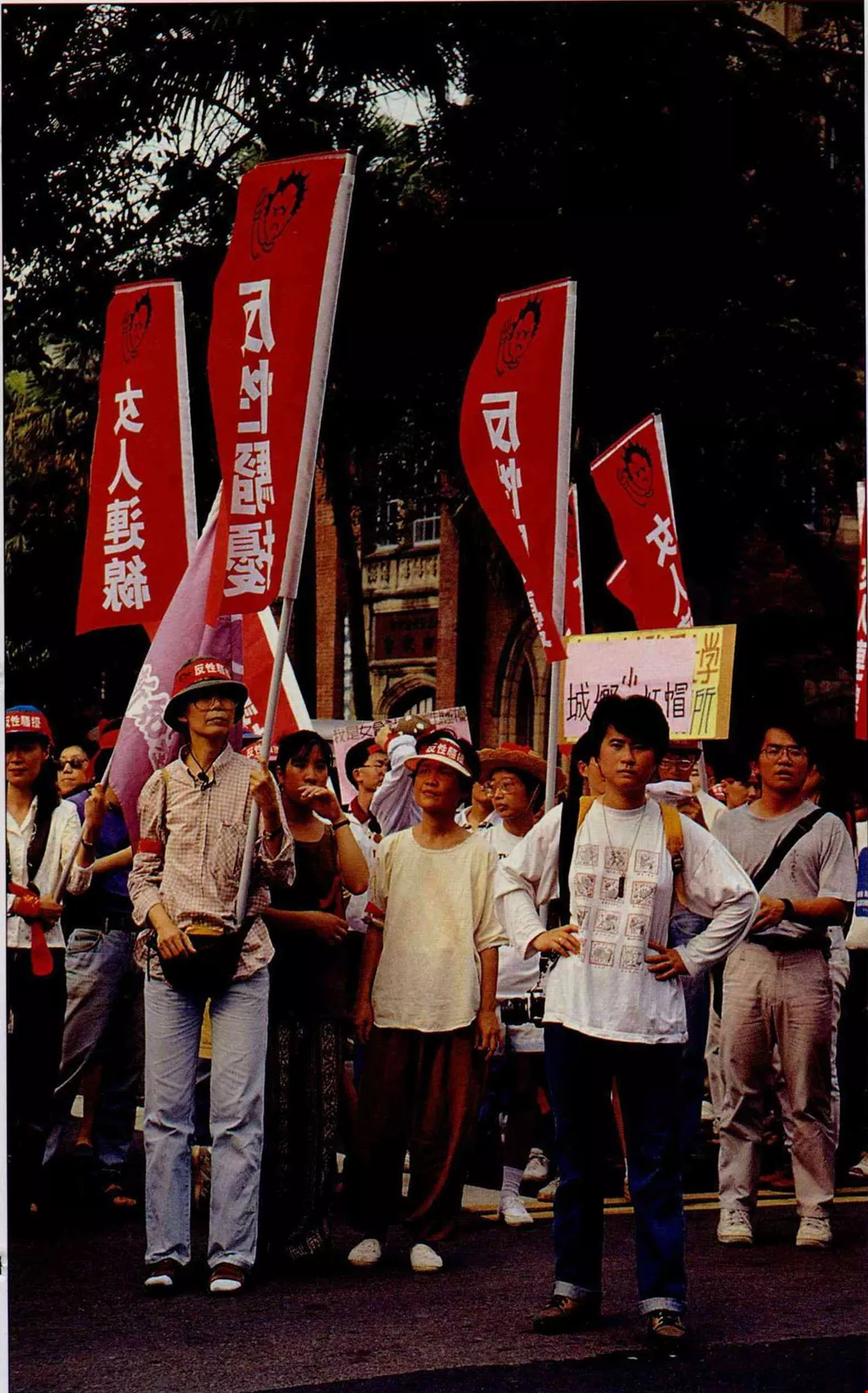
To get women's issues into the front pages, feminists have begun making their own news. The photo shows a march protesting sexual harassment. (photo by Diago Chiu)
Can the media leap over the gender gap?
Don't think so? Then just check out the "Survey of Mass Media Audience Behavior in the Taiwan Area," conducted several years ago by Professor Pan Chia-ching of the Graduate Institute of Journalism at National Chengchih University (NCCU). The variable for gender has a significant effect on the item "favorite section of the newspaper." When respondents were only allowed to choose one section, the top three items for men were community news (mainly crime, personal tragedies, and human interest), domestic political and economic affairs, and international news. Women, on the other hand, preferred community news, the literary supplement, and the pages devoted to family life and the arts and entertainment.
The number of men who chose "domestic political and economic news" as their favorite section was 2.7 times greater than the number of women; the ratio of men to women favoring international news was 3.9 to 1. However, among those who most enjoyed the pages for family life and the arts and entertainment, there were 7.2 times as many women as men. A more recent study reveals that the more education the women sampled have, the more their preferences approach those of men, but the basic tendencies remain the same.
In other words, men and women--who should be building up common ground and mutual understanding--cross mass media paths with pitiful infrequency. Except for the community news, where stimulating story lines can attract both men and women, it's a matter of you "you go your way and I'll go mine"--men to the "realm of the public" and women to the "realm of the private"--and rarely do the twain ever meet.
Flip through the pages of a newspaper. At the front are stories on the presidential elections, on Jiang Zemin's speech on Taiwan, on investment by Taiwanese businesses in mainland China and Southeast Asia, on fiscal policy, on gang wars, and on electoral corruption. In these stories men play most of the leading roles. Most of the commentators are men, as are most of the leading political figures. No wonder so many women just shake their heads and turn to the pages covering daily life, women's issues, and arts and entertainment. It seems like these are the realms where women are sovereign.
Of course, there are some men who likewise have no real interest in the "important events of the day." But when these guys get to shooting the bull with their colleagues the subject is always politics, economics, or sports. If a man has no interest in these things, or--egads--even admits to reading the "women and family" page (which most men think is only for "grannies and housewives"), he will certainly be ridiculed by his pals as a "wimp."
The media should be a bridge for communication and mutual understanding. So why is it that the media is unable to bring together men and women, each of whom account for half of the world's population?
Quite a few people wonder about this, especially those with a "feminist consciousness." They have been exploring why women seem to have no interest in the day's headlines.
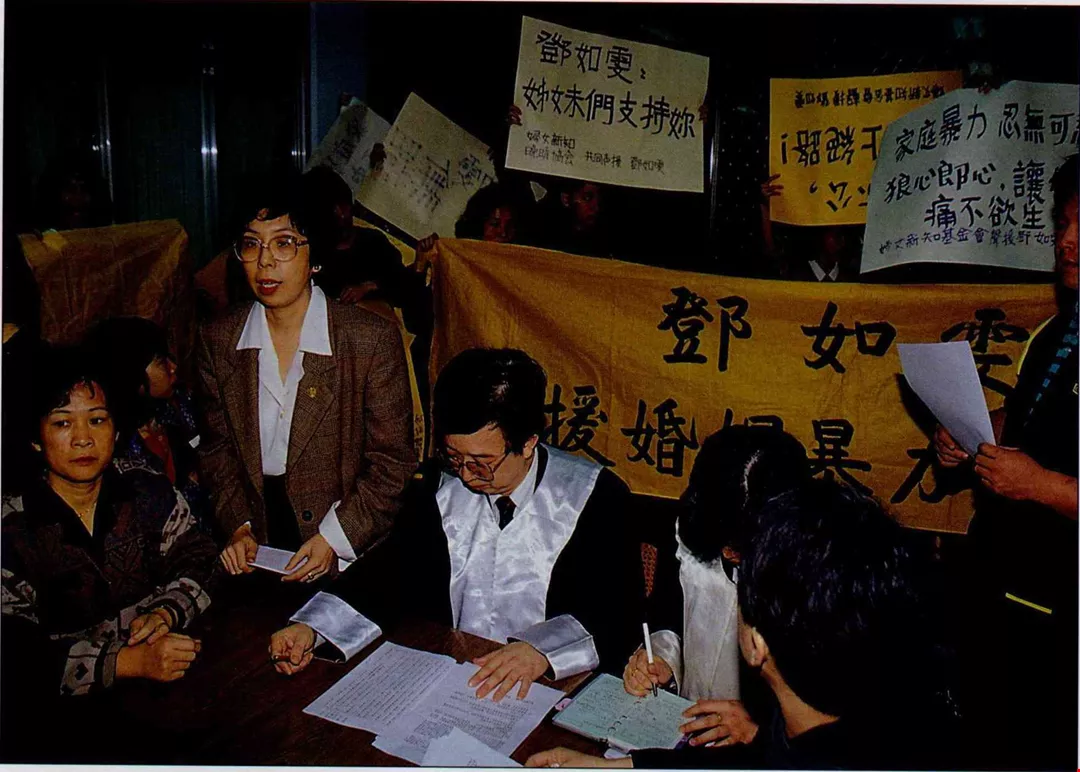
Last year there was quite a stir over the "case of Deng Ju-wen," a woman who murdered her abusive husband. The trial was widely reported in the media. (photo by Hsueh Chi-kuang)
So much "he" and so little "she"
First, "the news is a highly selective product," as NCCU professor Ong Hsiu-chi has written. Millions of events happen around the world each day. Each individual does several things, and talks about several topics, on any given day. But whose activities and whose words get into the papers to become "matters of common concern"?
The answer is in fact very straightforward: "Today's society is still male-dominated, and men emphasize competition. On the basis of this standard, only items considered 'breakthrough,' ‘conflictual,' or 'revelatory' are deemed newsworthy," explains Fan Ching, a former magazine staffer and also past secretary-general of the "New Awakening" women's foundation. She points to political struggles, where the emphasis is on who wins and who loses, and crime, with murders and revenge killings. It seems that only those who emerge victorious from intense competition--politicians, entrepreneurs, entertainers--have the chance to be the subjects of major reports.
Chu Yuan-hung, an associate professor at the Graduate Institute of Sociology at Tunghai University, points out that the media does not merely prefer to focus on those with power and influence. It also looks first to high profile "opinion leaders" to act as "spokespersons for the man in the street." And in contemporary society, where only those who symbolize "authority" are seen as public figures and opinion leaders, naturally the overwhelming majority of these are also men.
In other words, most of the main actors in the news stories deemed to be of particular importance (such as the "national news" occupying the front pages of the newspaper), as well as most of those who explain and interpret these events for us, are male. Women have been virtually unable to find a foothold.
Perhaps quantitatively expressing this disparity in the attention paid to men and women will open a few eyes.
According to a study by Li Hsiu-chu, a professor in the Graduate Institute of Mass Communications at Fujen Catholic University, in 36 news broadcasts between the end of September and the beginning of October last year, only 25 of the 745 items reported had to do with women, a miniscule 3.4 percent. Needless to say, this doesn't compare to the percentage of women in the general population! Moreover, of these 25, five were on the murder of a middle school girl, Huang Pei-fen, while there were three items each on the amending of the family provisions in the civil code, on women athletes in the Asian Games, and on Princess Di. When the duplicate stories are deducted, then the space devoted to women shrinks even further.
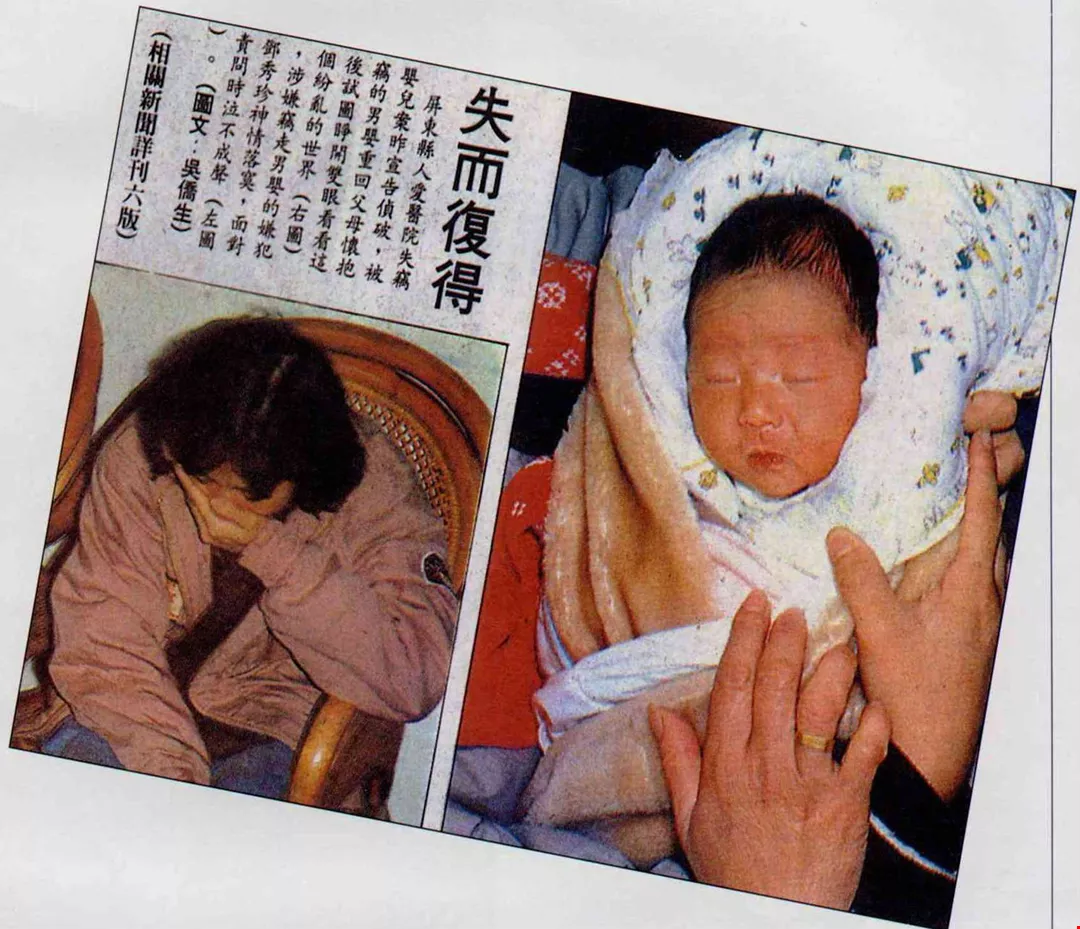
The baby-napping case which occurred right around Chinese New Year this year was big news. It is still being debated whether the fault lay with the woman who kidnapped the child or the society's male-dominated values that motivated her. (photo by Wu Chao-sheng)
Women want something different
Of course, news cannot be strictly divided along gender lines, and there are weaknesses in the method used in the above survey for calculating the number of items. Nevertheless, Fan Ching wonders: "Are the things women do really so unworthy of making the news?" The way news is currently handled (and indeed the way it has always been handled) has led to a situation in which many female readers, marginalized from the male power structure and feeling that the stories reported have little relation to their reality, get frustrated that "it's always the same old thing" whenever they open the newspaper.
In fact, as women's level of education steadily increases, more and more have made the leap out of the home, and now share social responsibilities with men. Their reality and attitudes are vastly different from those of traditional women. Like men, they are concerned about matters in the public realm, especially such areas as education, the environment, crime, social justice, and community development. However, "It's not enough that women are also attracted to these stories, because men and women also have different preferences about the way in which stories are reported," observes Fan Ching.
Fan applies the differences in the value systems of men and women that psychologists have uncovered to the news media. She notes that, compared to men, women are less likely to be concerned with winning and losing; women are more concerned with process. Women also do not like abstract and obscure theories, but prefer to see stories about the human side of things--about how people live their lives. Women are no less interested in ordinary people and disadvantaged groups than they are in the powerful and successful.
Thus, for example, in reading stories on the universal health insurance bill in the Legislative Yuan, women tended to be less interested in how the parties and factions voted, in who won or lost, or in how rough the latest scuffle was. Rather, they wanted to know: Is the matter being appropriately resolved? What will be the impact of the bill?
Or, to take another example, in following natural disaster stories, women not only want to hear what the officials have decided, or how the experts analyze the event, they are even more interested in hearing what the ordinary victims who have done all the suffering have to say. Though there are many people--including men--who share these preferences, it is still hard to overcome the traditional standard that something is only newsworthy if it is "novel" and "astounding."
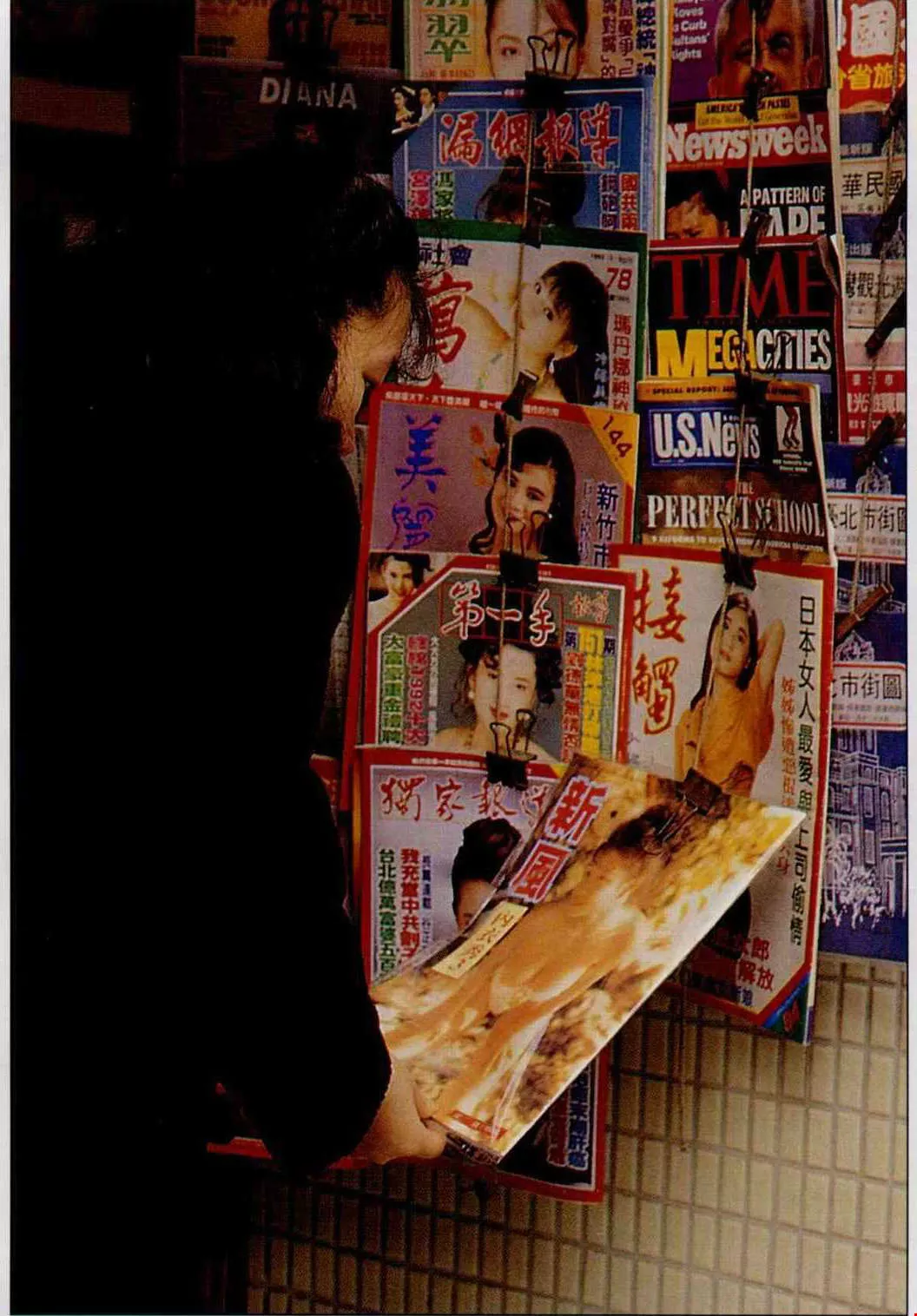
(left) There are lots of magazines with women on the cover, but most are devoted to leisure time activities, with no "women's perspective on the news" to speak of. (Sinorama file photo)
Women as victims
Or take the series of commentaries and "insider rumors" that preceded the decision on the new method for electing the president. For most women, these articles probably had less emotional impact than the contemporaneous story of the woman who, unable to face telling her husband that she had had a miscarriage, produced reports like "Baby Kidnapped, Mother Murdered."
To take the point a step further, not only do women prefer "community stories" like the one about the kidnapped child, many women readers would also like information on, say, how infertile women can best cope with the pressures that come with the inability to carry on the family line, or how they might seek the help of specialists.... Unfortunately, because such information is not of the alarming variety that is defined as news, and can't be passed off as "inside information" or as an "exclusive report," it is always relegated to the "soft news" pages covering health, daily life, or women's issues. Because it is placed on those pages, pages which males generally skip over, men--who after all should bear half the responsibility for pregnancy--are missing an excellent opportunity to understand the opposite sex through the media.
Women rarely get the opportunity to appear in those pages reserved for major news stories, and, sadly, when they do they are often portrayed in a negative light. That's precisely what happened when the photos of the baby-snatcher woman crying in the police station were splashed all over the front pages. Stereotypical "women's news" is devoted either to woman-as-victim (child prostitutes, murder victims), to scandals, or to the latest doings of a woman known only as the wife of a certain powerful man. This even applies to interviews with women legislators and cabinet ministers, in which the focus of the report is often on "how I support my husband and raise my children" or "how to juggle a family and a career." Meanwhile their policy positions are barely mentioned.
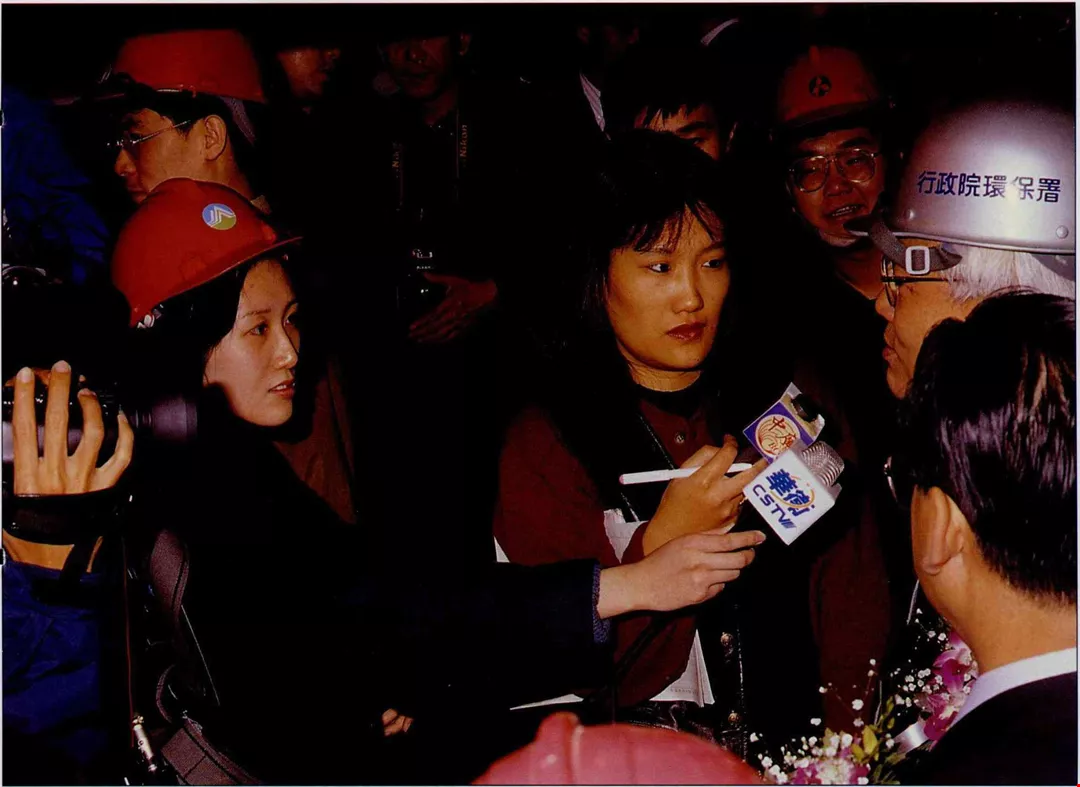
(right) Lately there has been a great increase in the number of women reporters. As they chase around the males who make up most of the subjects of the news, will they apply a "women's perspective" to the news? (photo by Vincent Chang)
Women reporters in the vanguard
Major news stories do not give much thought to women, and women correspondingly feel disinterested and at a loss. How can this standoff be broken?
Chang Chin-hwa, director of the Graduate Institute of Journalism at National Taiwan University, and also a woman, notes that traditionally men were thought to belong to the "realm of public affairs" and women to the "realm of private affairs." Thus it is less accurate to say that there is an innate difference between men and women than it is to say that women have rarely been given an opportunity to participate in the realm of public affairs. Perhaps it will only be when more women have entered the public realm, and when there are more women with the power to define and interpret issues through the media, that other women will begin to find "public" issues more relevant and interesting. Although this step is still far off, it is the most fundamental one.
Huang Chao-sung, editor-in-chief at the China Times, contends that the media does not deliberately ignore women. Instead, in a social structure which gives greater weight to men than to women, the principle of "objectively reflecting what is happening in society" means that the media naturally creates the sense that it similarly gives less attention to women.
It is no easy task to transform a social structure. Fortunately, in recent years there has been a great increase in the number of women working in journalism. These women have been, consciously or not, spreading the seeds of a women's perspective on the news through their profession. In particular, stories by women reporters about feminist activists can break down the gender disadvantage.
"Right now the ambition of women's news is to seize a corner of the pages in the newspaper devoted to major national stories," says Lin Chao-chen, a reporter at the China Times who has a strong feminist consciousness. But it won't be easy to achieve even this. Moreover, it is by no means the case that all women reporters have a feminist consciousness. "The so-called 'neutral' journalism training we received in school is in fact laced through with the male perspective, and after getting accustomed to this it is hard to escape later on," she explains.
In one sense, notes Huang, there is no need for a particular women's angle on all types of stories. The majority of topics are in fact 'neutral.' F example, many of the reporters covering national political and economic news are women. When they write their copy, they need only conform to the traditional definition of news, and their stories are treated exactly the same as the male reporters'.
But, if women want to change the angle of approach to a story, and write a truly feminist news story, they will often end up disappointed. Last year there was a string of incidents of women who murdered their abusive husbands, sexual harassment on college campuses, and rape. Many women reporters were deeply distressed by the superficial "spin" put on these stories by their newspapers, which deliberately treated the stories as "having pornographic overtones" or as cases of "the war between the sexes." They had to fight hard to get more balanced reports into the papers.
Invariably, Lin Chao-chen has had to resort to some "tricks" in order to win some front-page space for women's issues, like turning in the copy faster or writing in a more amusing way. Meanwhile, she tones down any sharp feminist rhetoric. "It gets accepted a lot easier if the packaging is done well," she explains.
Cover girls
As if it weren't enough that serious women's topics have a hard time getting into the front pages, what Lin Chao-chen has found even more disappointing is that many women are concerned about only a very narrow spectrum of issues. For example, she has on occasion written articles for the women's page about the activities of women's rights groups, but she always gets the same old nag from the page editor: "Write something a little 'softer' please!"
Chen Ai-ni, the former chief editor of Woman ABC, faced the same problems. For instance, she wanted to get rid of the traditional "cover girl" format and place "accomplished" women on the front. As a result, sales dropped and advertisers began to object.
Or, to take another case, Chen wanted to change the way traditional women's topics like "the division of housework" get discussed. She reasoned, "We shouldn't just get a closed circle of women to discuss this. We should also invite government scholars to explore fundamental issues like unreasonable pay structures, and the inadequacy of social resources devoted to women. This is the only way to treat these problems with the seriousness they deserve and to allow the two sexes to exchange ideas." In other words, she hoped to break down the wall between the private and the public realms, begin a discussion of an issue--family responsibilities--over which women have some influence, and in so doing to see what men have to say and to see whether or not the power of government might not be able to help out.
Easier said than done. Unfortunately, she also had to consider the fact that her women readers have become accustomed to a soft style of reporting that "doesn't pose brain-bending problems." She worried that readers wouldn't be able to digest a heavy dose of economic and fiscal issues added in to the discussion of family matters, and that sales would fall. In the end she decided not to take the risk of changing the format. "This should be seen as a limitation we place on ourselves," says Chen with regret.
And that is not all. Just as there is little room for women to get a foothold in the national news section of the paper, the women's page is usually confined to women writing for women readers, with "no men allowed!"
A medium of change
Jao Jen-chi is the first man ever to report for the women's page at the United Daily News. Originally the editors of the women's page, fearing that "if we always only have women writing for women, perhaps the viewpoint will be somewhat biased," decided to find a male writer to "discuss women's issues from the male point of view." Sadly things didn't work out as planned, as many women obviously found it hard to accept this "test of objectivity" in their news.
Jao offers a case in point: He once followed up on a story in which a man in Kaohsiung, despite not knowing how to swim, plunged into the water to help his girlfriend; the woman was saved, but the man drowned. Of the more than 20 men Jao interviewed, all ridiculed the man in the story as a fool, and none indicated that they felt either sympathetic or moved.
However, his (female) editors found this report unacceptable, and revised it. Even then, many women readers sent in protest letters after the article was run. "Women simply don't want to hear how men really feel," says Jao. Having been through several similarly frustrating experiences, he says with exasperation, "When it comes to sensitive topics for women, a male reporter is frankly better off sticking to the party line, because that's the only way to keep everybody happy. Is it any wonder that so many men have not the slightest interest in the 'grannies' and housewives" women's page?"
Is it thus always to be the case that men and women will stick to their own sides in the media, without any communication? Chu Yuan-hung says that the only way to move toward the ideal of truly "gender-neutral" and "humanistic" union is through two-way traffic: giving women's issues more exposure in the parts of the media devoted to major news stories, and allowing men more opportunities for their softer, more ordinary, "inner selves" to emerge.
So, if we want men and women to achieve harmony and common ground, wouldn't building up a consensus in the media and giving room to as many voices as possible be the right place to start? If we want to make this enormous step, there's a lot more work to be done.
[Picture Caption]
p.100
The era in which men sat around reading the paper while women cleaned the house is passing away. But, when will the day come when the news pages can be shared by both sexes? (photo by Diago Chiu)
p.103
To get women's issues into the front pages, feminists have begun making their own news. The photo shows a march protesting sexual harassment. (photo by Diago Chiu)
p.104
Last year there was quite a stir over the "case of Deng Ju-wen," a woman who murdered her abusive husband. The trial was widely reported in the media. (photo by Hsueh Chi-kuang)
p.105
The baby-napping case which occurred right around Chinese New Year this year was big news. It is still being debated whether the fault lay with the woman who kidnapped the child or the society's male-dominated values that motivated her. (photo by Wu Chao-sheng)
p.106
(left) There are lots of magazines with women on the cover, but most are devoted to leisure time activities, with no "women's perspective on the news" to speak of. (Sinorama file photo)
p.107
(right) Lately there has been a great increase in the number of women reporters. As they chase around the males who make up most of the subjects of the news, will they apply a "women's perspective" to the news? (photo by Vincent Chang)


@List.jpg?w=522&h=410&mode=crop&format=webp&quality=80)


