A Sensitive and Gentle Single Father-Wu Tsan-cheng
Chang Chiung-fang / photos Hsueh Chi-kuang/poems by Wu Tsan-chang / tr. by Michael FitzGerald
August 2008


"Of 1000 paper cranes or 1000 fresh roses, which would you find more touching?"
Forty-three-year-old Wu Tsan-cheng is someone who, despite being unable to afford 1000 roses, does have the will to fold 1000 paper cranes. Since being divorced he has been raising a pair of boys, 11 and eight, and living the life of "three little birds," as he puts it.
"We will endure," says Wu, a shy and sensitive man who continuously relies on lines of poetry to express both his frustrations and aspirations. Despite being soft spoken he comes across as being quite self-assured.
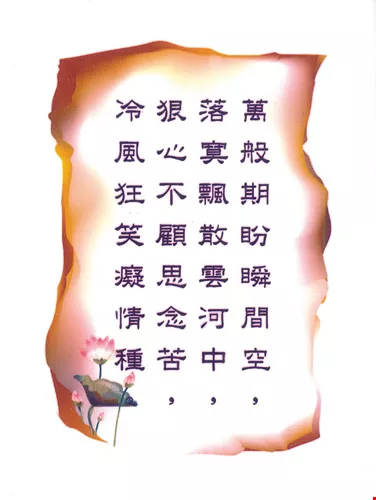
With the village behind him the boy leaves home / Not having looked ahead he chooses the wrong path / Ignorant youth, he muddles along / Doomed to move toward his tragic end
Originally a printing platemaker, Wu Tsan-cheng's jobs have included working at the Red and Blue Color Printing Company, as well as being a platemaker at the Legislative Yuan. However, after graphic editing software became popular many years back the business of handmade platemaking began to decline and his job went the way of the industry.
"I have been very unlucky," says Wu. Whether it was opening his own workshop, selling insurance, or even getting involved in various franchise operations, his ventures have all lost money. Recently he began selling various items online that he designed and printed himself, such as cups, clothing and pillows. Nevertheless, since he lacks marketing skills his products don't stand out and seem to have become just another product in the sea of online auction houses.
Speaking of his life, Wu says, "It's as if I got on the wrong escalator. I want to go up, but instead I just keep going down." He asks dejectedly, "I don't know if you can really understand the feeling of having only NT$50 or 100 in your pocket while needing to feed a family and being completely uncertain as to what the future will bring."
In order to deal with expenses Wu began using credit cards to pay off his debts. As a consequence he accrued over NT$2 million in debt owed to over ten different banks. Despite having gone through negotiations with the banks he once again reneged on his commitments. He is currently requesting assistance from the Legal Aid Foundation to apply for debt adjustment.
As the old saying goes, "The worst thing a woman can do is marry the wrong man, while the worst thing a man can do is enter the wrong profession. For Wu, entering the printing business at the wrong time left him unable to earn a livelihood and resulted in him losing his wife.
"She resented me being poor and the fact that I was unable to change my situation." Having been divorced for close to four years, Wu is still unable to shake off the identity of the "poor father."
Wu describes his marriage as consisting of five separate acts: bedazzlement, marriage, disputes, drifting along, and separation. It started with being giddy from love, then marrying and thinking of the future, followed by ridiculous disputes, the years then passing by idly and finally separation. Amidst Wu's humor is a tone of deep helplessness.
Originally both he and his wife were in the same profession, but later she became a hairdresser and her income grew. "In her eyes it's the man's responsibility to support the family and the money she earned belonged to her; she was unwilling to take on that burden," he says. "As soon as she began earning good money she brought up the idea of divorce and I said, 'Fine!'"
"I am not a heartless person. I know that love and affection are irreplaceable," says Wu. He and his wife managed to maintain a good relationship just after their divorce and he welcomed her to come back and see their children any time. There still remains a thread of hope in his heart that she might return to him for the children's sake.
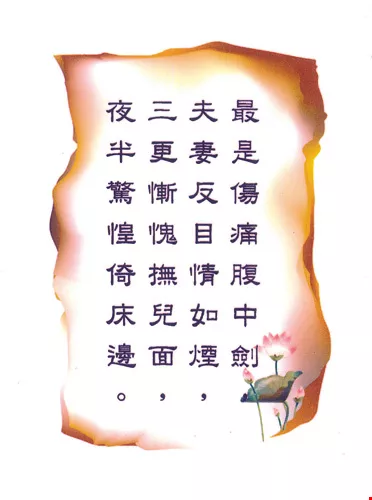
She has a new sweetheart, a new home, and a new paradise / I am a single parent, a single man, one pair of shoulders to bear the weight / What are the young children guilty of to deserve such misfortune? / Henceforth the patriarch plays both father and mother
Unexpectedly, sometime last year, Wu's wife began living with another man. Each time his child would come back from staying with his mother he would become dispirited and tell his father, "Mom was sleeping together with a man who wasn't wearing any clothes!" Wu found this difficult to accept. "I don't think a child should have to face such complicated matters," he says. The idea that he knew nothing about his wife's lover, whereas her lover might know everything about him made Wu feel anxious and he became determined to take the child away from the house they lived in, which was in his wife's name. Since that time he and his children have never had a steady place to call home.
During that time his ex-wife had gone through the courts in an attempt to resolve their dispute over her visitation rights. In response, Wu made a request that she be required to provide child support, hoping this would prevent her from seeing the children. Much to his surprise she became enraged in front of the judge, "You are so incredibly shameless. You're a grown man and you have the nerve to ask me for money!" She then laid forth three options: that the children were to come live with her, or one of the children would live with her and the other with him, or she had only to be responsible for paying the children's NT$2000 school tuition. Of course Wu found this unacceptable and would have preferred that she didn't see the children at all. Moreover his sons accept a life of poverty and hardship over living with their mother particularly because they are "afraid of being beaten to death by mother's housemate."
"I think it's better if she doesn't come to see the kids," says Wu "When she comes she leaves after only a few minutes. It's like being given a lollipop and having it taken away after only one lick; it's terribly painful. Lollipop love is meaningless, it's worse than having none at all."
"She has always insisted on doing things her way and is very obstinate, always wanting to win and refusing to accept defeat. Her attempt to take the kids is an example of this attitude. I don't understand what it is exactly she wants so badly to 'win.'"
"Living a fragmented whole is better than living a whole fragment," says Wu Tsan-cheng. Despite a dearth of material necessities, the children seem to live a free and comfortable life with their father.
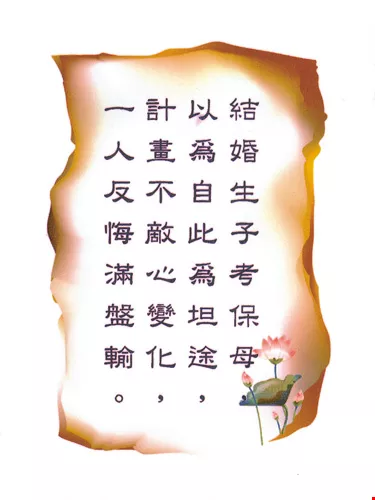
Like a wandering soul roaming the world / A lonely boat floating on the sea / If a plant can't take root in barren earth, what need is there for animosity? / I swallow my tears under the silent gloaming
In the eyes of his children Wu Tsan-cheng is a good father, despite his being poor. However a sense of exactly what kind of role a father should play or an image of what a good father looks like is somewhat unclear to Wu.
When Wu was five years old his father passed away. Having been raised single-handedly by his mother from when he was a little boy, Wu says, "I have absolutely no impression of my father, yet never have I felt that I ever lacked anything. My mother raised us in the same way that I am raising my children now. Although we were very poor, and we children had no accomplishments to speak of, none of us ever did anything horrible or ever harmed anyone."
Wu Tsan-cheng's brothers are all busy with their own affairs and his mother, now 70 years old, lives alone in Chiayi. "The fact that I have no way to take care of her means I haven't met my responsibility as a son. How could I go back to her and add to her troubles?" Under such circumstances Wu can only bear the difficult responsibility of raising his children alone and has no one to turn to for help.
"With the unemployment rate so high, and the fact that I'm in my forties with only a high-school education and two children, what kind of job am I going to be able to find?" asks Wu. Not many jobs will allow him to leave work at four in the afternoon and go back home in the middle of the day each Wednesday to be with his children. The "Job Agent" program of the Council of Labor Affairs' Bureau of Employment and Vocational Training suggested he apply for a janitorial position that was open. In the end, Wu didn't get the job and he felt the experience was like "rubbing salt into an open wound."
Some people accuse Wu of using his children as an excuse. "People shouldn't doubt me," he says, "If I could, don't you think I would?" Having to choose between work and his children, he has chosen his children. "They are all I have left; I don't have anything else in this world."
Currently Wu's primary task is to take his kids to school and pick them up. "Once they begin middle school they'll gradually stop belonging to me," he says, "I want to take advantage of this time, while I can still hug them and hold their hand, while we still rely on each other. In the future, when they look back, their memories will include a father."
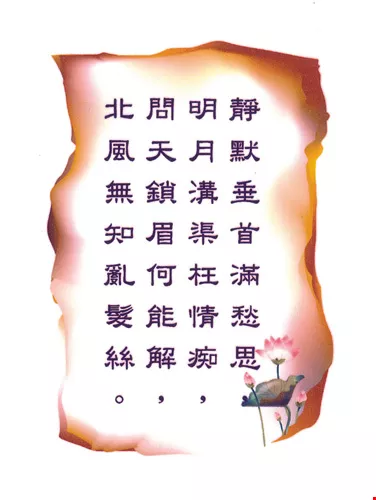
A broken wing, but not without hope / Flapping my wings I yearn to fly / Gratefully I recall those who came to my aid / Lifting me out of despair
After Wu Tsan-cheng was repeatedly late in paying his children's school fees, their teacher called to make sure everything was all right. As a result a social worker eventually intervened and helped the family. Thereafter, Wu slowly began to seek out financial assistance from social services.
Nevertheless, for Wu, whose anti-social and bookish disposition has lead him to be a man who "doesn't cry, doesn't show grief, doesn't whine, doesn't complain, lacks initiative and feels indignant," applying for any type of assistance was something he was extremely reluctant to do. However, because of his circumstances and his hopes that his children could attend after-school classes, he had no choice but to humble himself and apply for low-income status.
Wu only qualified for assistance after applying four times, all the while suffering ridicule and humiliation. Social workers investigating his case called into question his reasons for not looking for work. One told him directly, "Generally you need to be a woman raising three children before you can qualify. A man with two children won't qualify!"
"Why is a single mother pitied, but not a single father?" asks Wu. In some ways, he complains, equality of the sexes has gone too far in that most welfare assistance tends to go to women. Being seen as the stronger sex, when men actually run into trouble and need help they are denied access to it.
Wu Tsan-cheng once served as a volunteer for Lifeline Services, the Association for the Spinal Cord Injured and various schools, as well as being nominated for the Outstanding Youth of Tucheng, and Model Youth of Taipei County. He says his past commitment to volunteering is proof of his desire to help others. The fact that he has no choice but to ask for help makes him very uncomfortable. "I will not forget those who have helped me," he says,
Impatiently waiting for social services to decide on his case, Wu found a tutorial class offered by the Chinese Christian Relief Association, where he could take his children to get help with their homework. On weekends he also takes his children to free activities sponsored by WorldVision Taiwan.
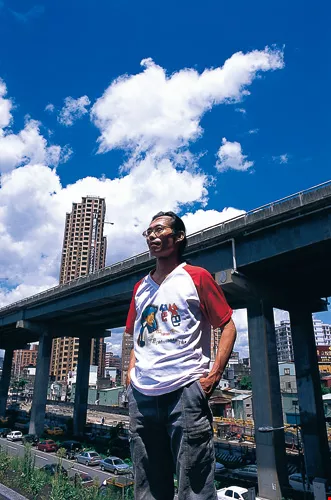
"Living a fragmented whole is better than living a whole fragment." Wu Tsan-cheng, who lives a life of adversity, believes that as long as there is wholehearted love between himself and his children, then he has no need to be concerned with a lack of material possessions.
Wish number one, three solid meals / Wish number two, a place to set down roots / Wish number three, kaleidoscope butterflies touching wings / Flying together never apart.
Meals provided as part of the tutorial class solve the problem of feeding his kids, but in order to save money, Wu eats rice porridge every day. So often does he eat porridge that it has become his "White Terror," and just looking at the white rice decoction causes his heart to tremble. He says the hardest thing to endure in winter is the intermittent aroma of sesame chicken that comes wafting over from the next-door apartment. Eventually Wu gave in to his cravings and cooked the dish himself. "It wasn't until I cooked it myself that I realized it isn't that difficult," he says. Following the Taiwanese maxim "take great delight in working and graciously accept responsibility," Wu Tsan-cheng does what he can for his children without complaint or regret. Inevitably his children respond in kind.
His younger child is more likely to seek his father's attention, often climbing all over his father like a monkey. The older son is more attentive and takes his father's difficulties to heart. Each time they must move and change schools what he regrets most is not leaving his teachers or classmates but rather the fact that, "Father has to spend money on new school uniforms!"
Last year the elder boy really wanted a PlayStation 2 for his birthday, but seeing his father's shabby undergarments the boy told his father to buy some new clothes.
After all is said and done, Wu Tsan-cheng does have some feelings of resentment. He says he is not afraid of hard work, nor is he afraid that his children won't have a promising future or that they won't respect him. What bothers him is the idea that in 20 or 30 years from now his children may reconcile with their mother, "like they do on some TV series," he says, "If it really ends up like that, then what would all my years of sacrifice mean?"
Being a single parent doesn't last forever: eventually children grow up.
"I would like to have a companion, but I wouldn't necessarily expect her to take responsibility for the children," he says. Wu has started to acknowledge his need for romantic love. However he freely admits that given his current situation, finding a partner wouldn't be easy. "People look at me and see how poor I am raising two children, and they avoid me as fast as they can."
Actually, despite being poor, Wu Tsan-cheng sees himself as being an example of an exceptional man. "I'm really quite all right in every aspect; it's only in the money-making department that I'm rather weak. Unfortunately by today's standards society judges a man on how much money he has, not what he does, like whether or not he loves his family or his children. It's similar to when I was a volunteer. Many people thought I was stupid and what I was doing was pointless."
"Even though I have reasons enough to consider 'throwing in the towel' [commiting suicide], I really can't imagine doing such a thing. I still want to take my chances with fate," he says. Despite his failures Wu is unwilling to accept defeat.
"I am not someone who gambles or chases women, I have no social life. I am a man who 'If I'm not at home I'm on my way back home.'" Wu Tsan-cheng says that early on in 1998 he passed the test to get his childminder's license and has recently passed the test for a Grade III beautician's license. He also says he still has a fighting spirit; "I am just waiting for an opportunity. If I can get an opportunity then I can turn myself around! I still hope I can stand on my own two feet, and even though I've had countless failures, as long as I can succeed in the end I can hold my head high in front of my children." Wu Tsan-cheng wants to set an example for his children-that in the end their father won through.


@List.jpg?w=522&h=410&mode=crop&format=webp&quality=80)


@List.jpg?w=522&h=410&mode=crop&format=webp&quality=80)
