A Friend Indeed--Probation Officer Chang Ho-chuan
Chang Chung-fang / photos Diago Chiu / tr. by D.J. Toman
October 1993


Thirty-one year-old Chang Ho-chuan, born and raised in Pingtung, contracted polio as a child and was left unable to walk without the aid of crutches. But he has made a career out of lifting others' spirits as a probation officer with a heart.
Chang Ho-chuan, a 1988 graduate of the National Taiwan University law department, watched as one after another of his classmates qualified to become judges and lawyers. Yet, due to his physical impairment (both his legs are disabled), he was denied the chance to take the Special Civil Service Examination. Instead, he took and passed the Qualifying Examination in 1989, and was assigned to the Pingtung District Court as a court clerk. It was there that he learned of the existence of the position of probation officer.
Chang Ho-chuan says that both probation officers and court-appointed lawyers are "good-guy" roles which afford one the chance to help others. This makes them the most welcome individuals in the court. Recognizing this, Chang leapt at the chance to take the Senior-grade Civil Service Examination in 1991, passing easily and securing the chance to become a probation officer.
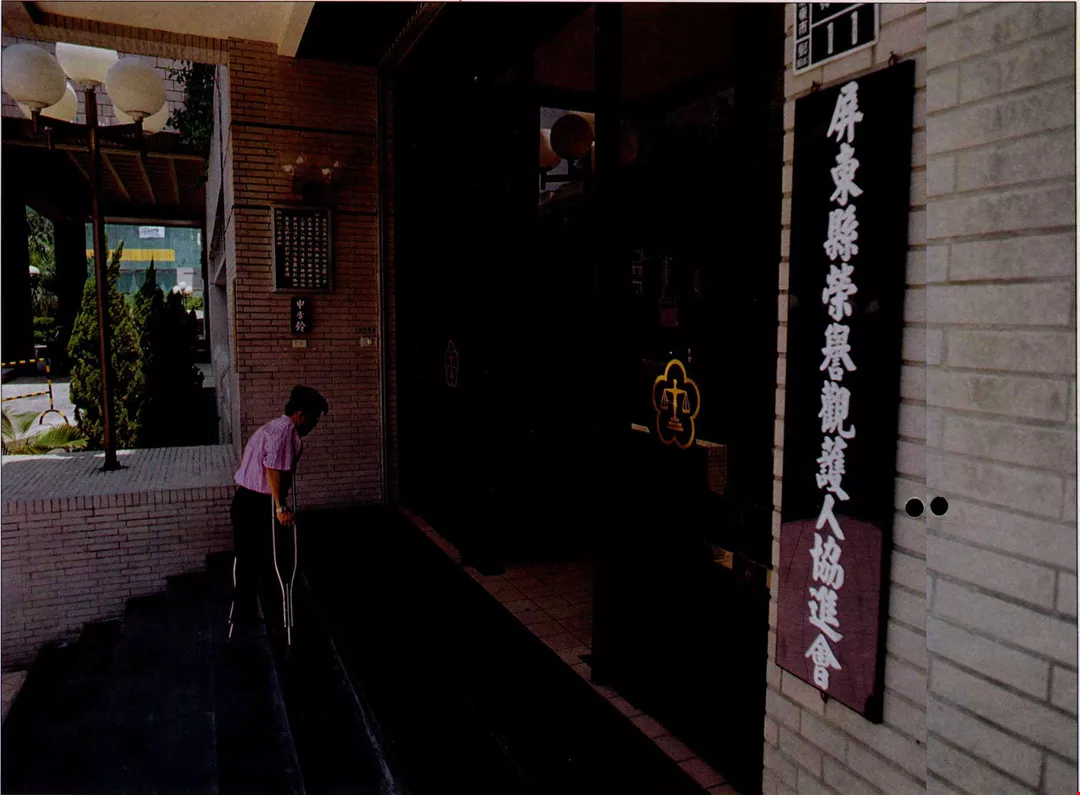
Chang Ho-chuan helps people get back on track, just as his own crutches keep him going.
Society as a prison:
The term "probation" originates from Latin, meaning a period of testing or trial.
The probationary system was first established in 19th century America. Back then it was often questioned whether or not prisons were an effective place to teach criminals. Recognizing that prisons alone were not enough to make criminals repent, a method took shape by which criminals could be corrected and acclimated to society to reduce their chances of offending again--the probationary system.
The idea that proper morality, supplemented by punishment, is the best way to teach offenders took hold in China long ago. The Book of Rituals chapter on administration during various months states that "In April, when lenient sentences, minor offenses, and light punishments are concerned, parole is the best strategy."
When it comes to the probationary system, Taiwan was a late-bloomer. Probation for minors was first instituted in 1971, followed a full nine years later by the system for adults. The Pingtung District Court, Chang Ho-chuan's place of work, saw its first probation case in 1987.
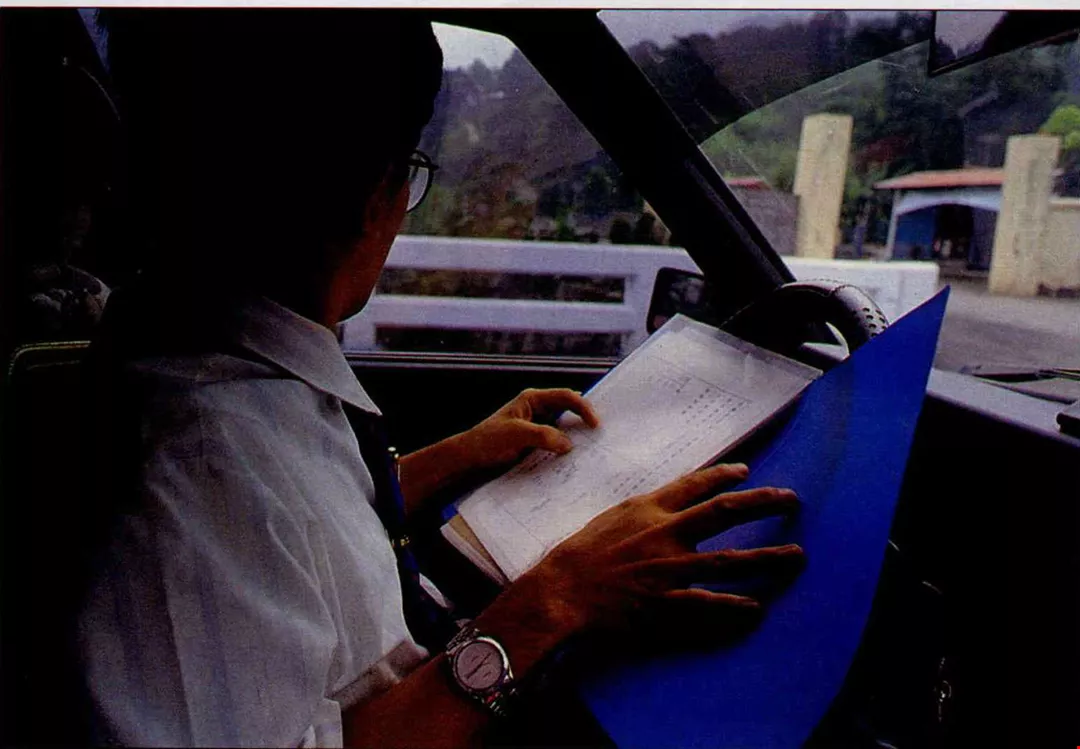
Making his rounds by car to stop in on paroled persons, Chang covers the entire county of Pingtung.
In with the tough guys:
Probation officers are people who are assigned to provide counsel to those criminals extended probation or parole. In this way it is similar to such organizations as Teacher Chang's or the Lifeline telephone counseling service, only "The biggest difference is that people seek help on their own initiative from Teacher Chang's and Lifeline, while those on probation are forced to undergo counseling," Chang explains.
Adults of all ages and descriptions, male and female, are put under Chang Ho-chuan's steward ship. Their crimes run the gamut from murder, robbery, burglary, and smuggling, to offending public morals and drug use -- you name it, Chang's seen it.
One may wonder what the risk of encountering danger might be over the course of contact with and "trusteeship" over these cases?
Chang Ho-chuan relates that those subjects assigned to probation are those who either exhibited good behavior in jail or who were convicted of minor offenses." They know full well that they are still on probation and that more time behind bars awaits them should they offend again. This knowledge is enough to keep most of them from committing crimes again once they are released, and they are even less likely to make enemies of a representative of the law such as their probation officer." Chang adds that in over a year of working as a probation officer he has never feared for his safety.
Generally, those on probation are required to report at regular intervals to their probation officer at their local court, but while some people find it bothersome, others downright reject it.
One middle aged man checking in for the first time asked Chang Ho-chuan if in the future he could be spared from reporting in. He explained, "My wife says that she'll judge by my performance whether or not to divorce me. I have to put all my effort into making money now, and if I have to report in to you I lose out on a day's pay."
One young man, recently paroled after seven years behind bars, said that he had found a job at a company and that he was afraid that the boss would find out about his record if he often took time off to report in to Chang.
Afraid of disturbing his subjects' work, Chang often sacrifices his own time after work to have subjects report to him during their off hours or on holidays.
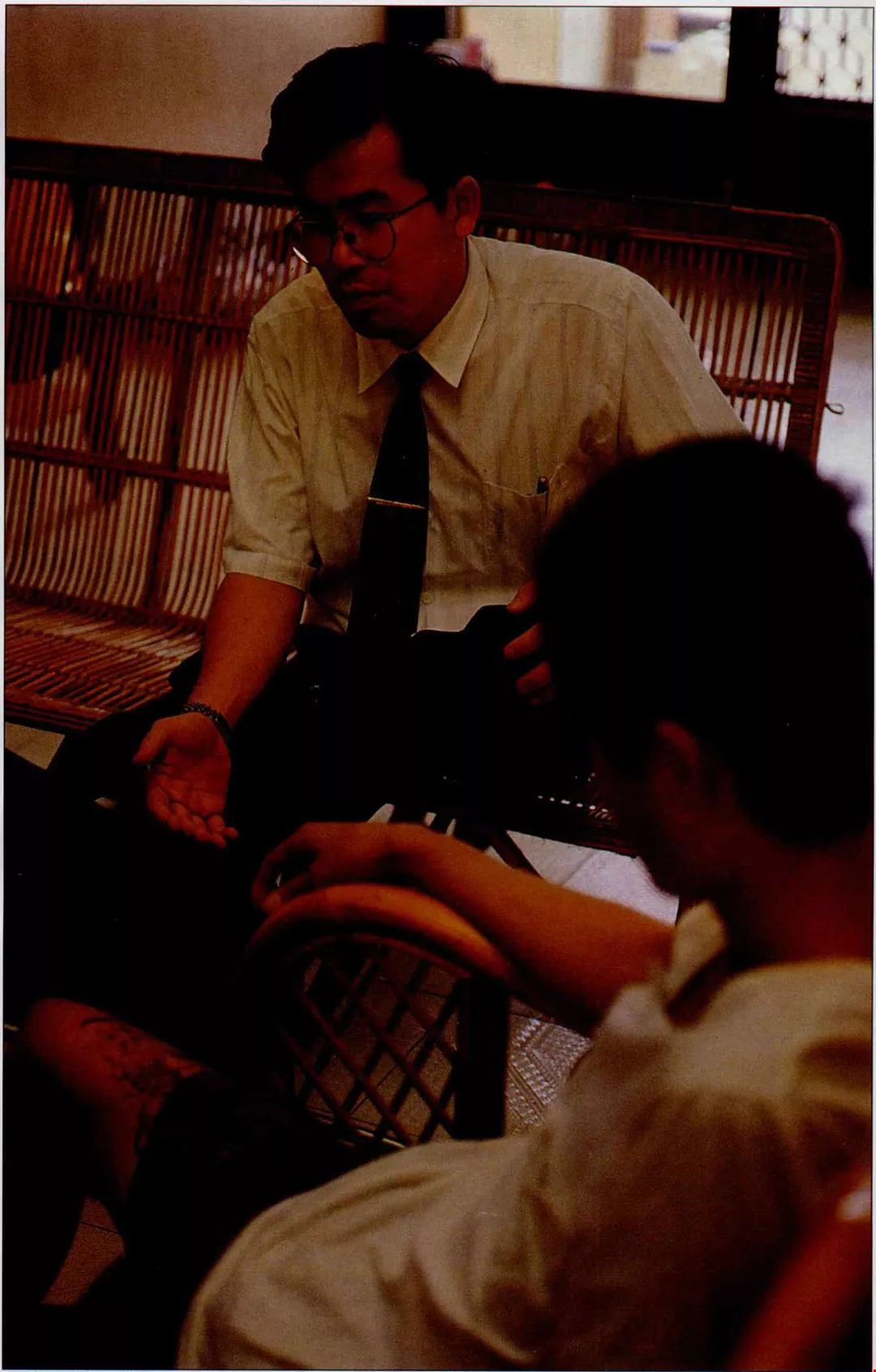
Chang Ho-chuan, who has acquired the status of "Teacher Chang," bridges distance and distrust with care and patience.
Rain is the biggest nuisance:
Requiring probation assignees to report in once a month is not enough to ensure that they will not offend again. What is necessary in addition is frequent visits to their homes. This accomplishes two objectives. First, it allows the probation officer to verify whether or not what the subject says is true, and it also affords the chance to talk and work with family members, greatly enhancing effectiveness.
A map drawn by his advisee in hand and a com pass on the dashboard, Chang Ho-chuan drives his modified, hand-controlled car all around the county checking in on people. There is barely a corner of Pingtung that he has left untouched. Chang estimates that he puts at least 1000 km on his car each month.
Despite partial immobility in his legs, Chang Ho-chuan does not find making the rounds a chore, but rather a chance to get out of the office and ease his body and mind. Still, if there is one thing that Chang fears, it is a rainy day. He says that on rainy days his task is complicated because he must find his way as he drives. And with both hands tied up by his crutches, he is unable to hold an umbrella. Chang exclaims, "Only at such times do I find the going difficult."
On the road an average of three days per week, Chang Ho-chuan gets an early start, following a planned route and making his visits to one after another of his subjects' families. Always thinking for others, Chang never stays at a subject's home through lunchtime for fear of disturbing their mid-day routine. For the same reason, he also makes it a rule not to drop in on people before two o'clock in the afternoon.
Abiding by these principles, Chang normally cuts his visits off around 11:00 a.m. and finds a place to eat lunch. Next, he takes cover at a temple or under a shady tree where he looks over his papers and catches some rest. When lunch time is past, he picks up where he left off with his visitations.
Chang normally does not provide any notification prior to his visits. "First, I don't want to disrupt the work of my subjects or their families. Second, if I let them know beforehand, some people will go out of their way to prepare things for me, and I don't want to give people extra trouble or pressure." Yet for these reasons, Chang often goes to extra lengths to visit someone, only to find the door locked tight and nobody home.
Still, even when he fails to find his subjects or their families at home, Chang manages to make the most of his presence by engaging the neighbors in conversation as a friend of the subject and asking them about the subject's recent behavior. Through casual conversation with neighbors, Chang can ask questions such as "Has Ah-ching been around the house much recently?" "What kind of work is Ah-piao doing these days?" or "Is old Tseng still hitting the bottle?"
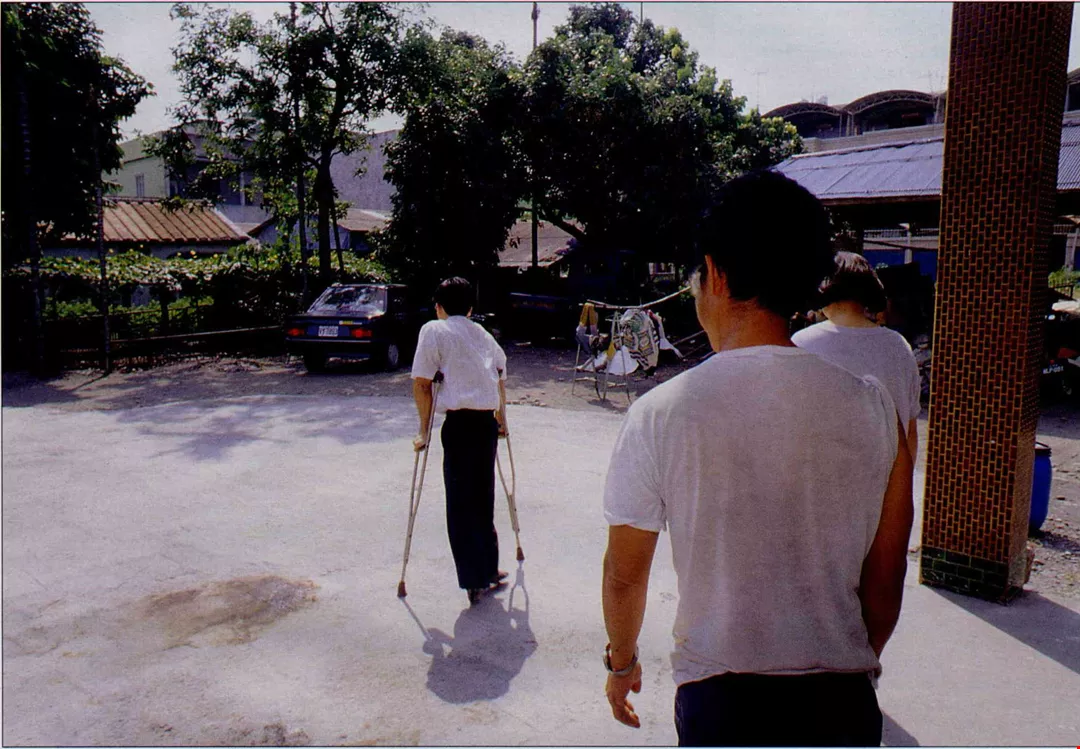
Family cooperation is the key factor behind successful probation work.
Family is the key to success:
For Chang, the focus of his visits is not the subjects themselves, but their families. He relates that the success of probationary work is measured by how well a given subject's family works together with him. Granted, each family is different. Some family members are happy to provide a detailed account of all the subject's doings, and will ask for help with certain problems. One married couple, mutes convicted of robbery, liked to trick their families but were terrified of their probation officer. For some time they liked to use work as a ruse for going off together on their own. Fortunately, the husband's mother accommodated the probation officer perfectly and always called him whenever anything was amiss. Now that they'll listen to him, Chang often converses with them in writing to give them more direction.
These days the couple work hard in construction. The husband pulls down a steady NT$60,000 per month as a mason, and promotion to "master" practitioner is reportedly not far off.
At the other extreme, some families see their probation officer as the enemy. Universally uncooperative, they like to cover for their relative on probation.
As Chang Ho-chuan recalls a particularly unpleasant experience, his voice betrays his frustration. Once, when calling on a youth on probation, Chang came up against the subject's mother, who became particularly disagreeable after learning of Chang's identity. From behind her door she demanded, "What do you want? What are you up to?" not even giving him a chance to come in and visit.
Friend or enemy?
Is the probation officer an enemy or a friend to a person on probation? As each subject has a different view, the answers are likely to vary, but as a probation officer, Chang Ho-chuan hopes to establish friendship with his subjects.
In his heart, Chang knows that at first many of his probation cases won't give him the time of day, but that he must persevere and not look for overnight success. Only after reviewing the information provided by the prison and making repeated visits to the subject's home to get a feel for his or her family background can the distance slowly be bridged.
In order to close the distance between himself and his subjects, who have all taken a wrong step or two in life, and to win their acceptance and trust, Chang Ho-chuan tries to speak their "language," even to the extent of using "four-letter words" as enthusiastically as his subjects.
Keep your distance?
While it is true that a probation officer's main tasks are having subjects report in and visiting their homes, Chang Ho-chuan believes that a really good probation officer must make everything his business. In this way, "I'm a real busy-body," he says with a laugh.
In the interest of safety, the probation officers' handbook clearly states that "Probation officers must avoid involvement in a subject's personal disputes." Chang, who is deeply skeptical of this restriction, counters" "How can you prevent them from committing more crimes if you don't understand and resolve their personal disputes?" In Chang's mind there exists no definite boundary; as long as he feels the compulsion to do something he knows he is capable of doing, he never gives up.
The most common problems facing newly paroled subjects concern marriage and work. Given his role and disposition, Chang Ho-chuan acts as a personal mediator or vocational counselor to many a probation subject.
Some subjects are released from jail only to find their wives after them to get a divorce. "I always tell them to stay together, and I ask the wife not to push the husband, but to give him another chance," Chang says. In fact, Chang can take credit for helping some couples make love blossom again.
Probation officer and guardian:
Inevitably, even where one has done everything to help, counseling sometimes fails. Chang relates that among the few repeat offenders, most are drug users.
Last August an amphetamine user sentenced to probation for five years (hereafter to be referred to as "Miss Chou") fell back into her old habits and was handed a prison sentence. Her parents having died, and her older brother (who once only saw her as a source of money) having abandoned the family, her only remaining relative was a schizophrenic younger sister. Facing a prison sentence, Miss Chou knew that in her absence there would be nobody around to look after her sister.
It goes without saying that Chang ho-chuan is deeply saddened when his probation cases become repeat offenders. And while Miss Chou's plight was not her probation officer's responsibility, Chang nevertheless offered his help in her time of need. Making his way around on his crutches, Chang went to great lengths to help Miss Chou's sister, finally obtaining a "mental treatment assistance certificate" and personally arranging for a bed at the Yuli Mental Hospital in Hualien. This way, with her sister under care at the institution, Miss Chou could serve out her prison sentence with no reservations.
"The day before the younger Chou sister was scheduled to go to Yuli, I went to their home with some wine to make sure she wouldn't run off. I ended up getting the two of them drunk," Chang recalls this escapade with a laugh. "Little did I expect that first thing the next day I would knock on their door for two hours and still be unable to wake them." Chang ended up calling the institution, apologizing, and asking them to save the bed for the younger Chou sister.
These days Chang still receives frequent letters from the older sister in prison and the younger sister at the institution.
Teacher and friend:
Examples in which Chang Ho-chuan has become good friends with his probation cases are too numerous to mention.
Ah-ying, released from prison last year, never runs out of good things to say about him. Ah-ying relates that "Teacher Chang," friendly and easy-going, is always there to answer her questions. She even goes to him for answers when her friends have legal questions.
Ah-ying's parole is up now and she no longer has to undergo probation, yet she keeps in close contact with "Teacher Chang" just the same.
"I tell him everything. He came to my wedding, and he looked after me when I was recuperating from giving birth to my daughter," Ah-ying relates. "Teacher Chang is really a good person; not only does he not hold anything against me for having been in jail, but he's willing to be my friend." To show her appreciation, Ah-ying, a banquet caterer who knows that Chang has a taste for meat, often sends surplus meat his way.
Chang says that while Ah-ying is one of the more successful cases, as just one individual he is unable to attend to everything he finds important. At present, just 69 qualified adult probation officers at district courts throughout the country are responsible for over 10,000 individual cases. "With 164 individuals on probation on my hands right now, if I tried to go all out with each one I would accomplish nothing for anybody," Chang says, sounding somewhat defeated. Under the circumstances, he adds, "I would rather spend my energy on a few individual cases worthy of extra attention."
Is crime the sole territory of society's lower rungs?
Since becoming a probation officer, Chang Ho-chuan has acquired an acute sensitivity for injustice. "I find it unfair that in our society crime is seen as a lower class thing." He says that the white collar class commits crimes, too, only its members are not caught or fail to attract attention. In Chang's view, his probation cases are not heinous criminals; it's just that they were not clever enough to avoid getting caught.
Given that adults have already become set in who they are, changing their values or ways of thinking is no easy task. "I just do my best, and if I can save a few people I've done my part," Chang asserts.
Actually, probation officers extend their help beyond individual probation cases to their entire families. At around 200 cases each year, a probation officer serves nearly 1000 people annually.
Determined to save people, Chang Ho-chuan is too wrapped up in his work to realize how busy he is. "He doesn't even have time for me on Sundays these days," Mrs. Chang (Yu Jui-chu) says with a chuckle. Still, she is quick to point out that while her husband is busier than he was when he was a court clerk, he's also much happier.
"He tells me that when he was a clerk he would get upset seeing people locked up, but now as a probation officer he gets to see people released, which cheers him up a lot."
An occupation of conscience:
Conscience plays a great part in the occupation of a probation officer. Nobody notices how much effort the probation officer expends or how effective he is. The behavior of counselees, whether they find their way onto the right path or go astray again, has no bearing on the ranking and promotion of probation officers.
Still, all Chang Ho-chuan's hard work doesn't escape the notice of Mrs. Chang, who is also disabled. "Whenever he comes home pleased with himself for succeeding in doing something good, he burns incense and shares the news with his ancestors," Yu Jui-chu says.
Perhaps in his heart Chang Ho-chuan feels this way: what other people don't know, the ancestors always do.
[Picture Caption]
p.106
Chang Ho-chuan helps people get back on track, just as his own crutches keep him going.
p.108
Making his rounds by car to stop in on paroled persons, Chang covers the entire county of Pingtung.
p.109
Chang Ho-chuan, who has acquired the status of "Teacher Chang," bridges distance and distrust with care and patience.
p.110
Family cooperation is the key factor behind successful probation work.
p.112
Greeted by his wife and the appetizing dishes she has prepared, Chang Ho -chuan's hard day melts into the clouds.


@List.jpg?w=522&h=410&mode=crop&format=webp&quality=80)


